

The Julia La Roche Show · Oct 8, 2026 · recorded earlier · 34m · 22m saved
With Ray Dalio, Founder of Bridgewater Associates
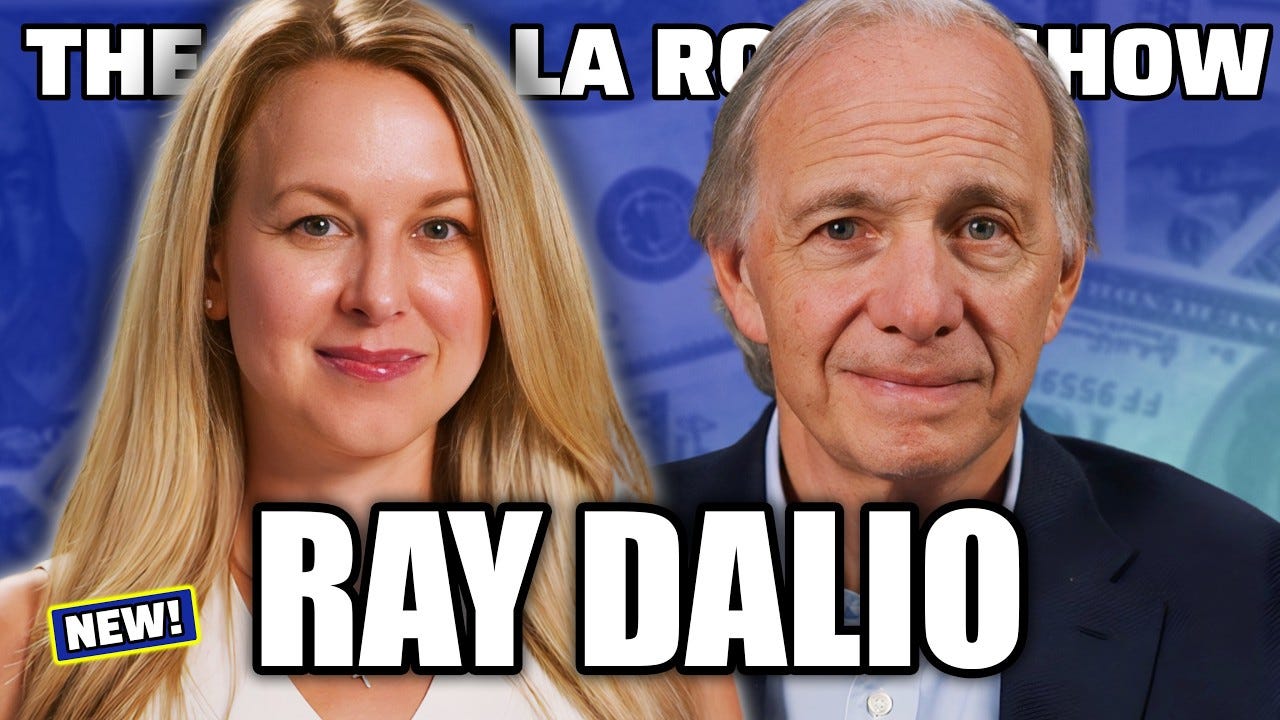
The US government spends $7 trillion a year and takes in $5 trillion, Ray Dalio said, and by his own indicators the stock market is in a bubble.
Most bubble talk asks whether a new technology will pay off. Dalio said that is not the test: a bubble pops when owners have to sell their wealth for money to pay debts or taxes, and he said that condition is now in place.
"The bubble before 1929 was a fabulous technology revolution." — Ray Dalio
Ray Dalio, Founder of Bridgewater Associates, on The Julia La Roche Show, was clerking on the floor of the New York Stock Exchange the day Richard Nixon cut the dollar's link to gold in August 1971. He went on to study 500 years of debt cycles and built what the show called the world's largest hedge fund firm.
The full interview is covered here so you can skip it. 34 minutes of audio, 12 minutes of reading.
Here are the 10 calls that matter.
Key Takeaways
A US debt squeeze is likely somewhere in the next 2 years, as rising rates ration credit
Homeowners and mortgage borrowers are the most likely to be squeezed out, he said
The government has to sell $2T of debt a year while foreign buyers pull back
By his indicators, markets are in a bubble, and the ingredient that pops one is in place
Stocks now offer very low returns over bonds, he said, after bond yields rose and stocks climbed
He is short debt and puts 5–15% of a balanced portfolio in gold
He keeps about 1% in Bitcoin and does not recommend it
The hyperscalers are overpriced, he said, while companies being changed by AI are not priced in
He sees the midterm elections through 2028 as a period of greater vulnerability
1. Five Forces, 500 Years
The episode is a fireside chat recorded for the 9th annual Greenwich Economic Forum. The host introduced Dalio as founder of Bridgewater Associates and head of the Dalio Family Office, and asked him to lay out the five forces he uses to read the world.
A devaluation in 1971 taught him to study history before his lifetime
He was clerking on the stock exchange floor on August 15, 1971, when Nixon said Americans could no longer exchange dollars for gold. He expected a crisis, but stocks went up a lot. Studying history, he found that Franklin Roosevelt had done the same thing on the radio in March 1933, with the same effect. The 1930s, he said, showed him what happens in a debt crisis when interest rates hit zero, which is what happened in late 2007, and he said the firm made a lot of money from it. He then studied the last 500 years and put the work into a book.
The five forces, as he listed them
The long-term debt cycle. Debt is easy to take on when there is little of it. As interest and repayments grow against incomes, they create a squeeze he compared to plaque building up in the circulatory system.
Internal political and social conflict. Large gaps in wealth and values lead to populism and differences between left and right that become irreconcilable.
The geopolitical order. The US won World War II and set the rules for a multilateral system: the United Nations, a world court, the World Trade Organization and the World Health Organization. He said that order is over, replaced by one where power decides outcomes, and the result is greater conflict.
Acts of nature. He expects a super El Niño, an unusually strong warming of the Pacific that disrupts weather, in the next year.
"Interestingly, droughts, floods and pandemics have killed more people than wars." — Ray Dalio
Technology. Life expectancy and income per person rise over time with new inventions, and the other cycles happen around that rise.
"And so technology right now and most importantly AI is certainly going to change the world." — Ray Dalio
The five are linked, he said: a breakdown in the economy affects the political and the geopolitical. Debt, the internal order, the geopolitical order and nature are all moving in a disadvantageous direction, and AI is the open question.
