

Moonshots with Peter Diamandis · Oct 5, 2026 · 39m · 25m saved
With Astro Teller, Co-founder and Captain of Moonshots at X, Alphabet's innovation lab
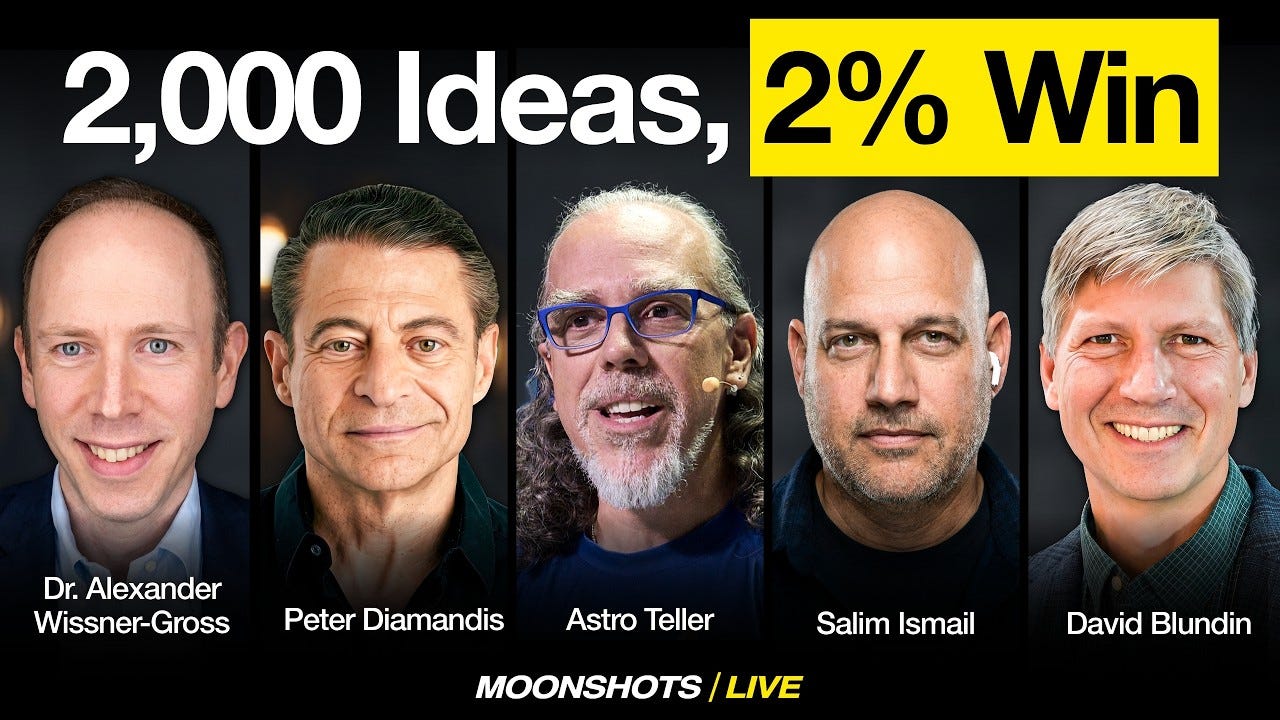
X has given code names to about 2,000 ideas in 16 years, and between 35 and 50 of them have graduated, Astro Teller said.
Most companies, he said, reward managers for small, guaranteed gains. X is built to pursue long shots, and Teller said the cost of getting each graduate through that process has fallen by about two-thirds since X started.
"I am like the crown prince of failure, but it's not because I like to fail, it's because you learn nothing when you're right." — Astro Teller
Astro Teller, co-founder and Captain of Moonshots at X, on Moonshots with Peter Diamandis, has run Alphabet's research lab since he co-founded it about 16 and a half years ago. Google Brain and Waymo both started there. He holds a PhD in artificial intelligence. The interview was recorded on stage at the Moonshots Live 2026 event, with the host, three co-hosts and audience questions.
The full interview is covered here so you can skip it. 39 minutes of audio, 14 minutes of reading.
Here are the 16 principles that matter.
Key Takeaways
A moonshot needs a huge named problem, a science-fiction product and a breakthrough technology
About 2,000 ideas got X code names in 16 years, and 35 to 50 graduated
Google Brain started at X and produced TPUs and the Transformer, the T in ChatGPT
Clean water only changes the world at about a penny a liter, and X's best work so far came in near 10 cents
Nearly everyone picks a 1-in-100 shot at $1B over a guaranteed $1M, and almost no boss lets them
X's cost per graduate is down about 3x in 16 years, partly because of AI
Teller knows how to build X's culture with a few hundred people, not a few thousand
Rejecting a real moonshot costs X nothing, while chasing a false one can cost tens of millions of dollars
A room-temperature superconductor flake is the first 5% of a business
1. What Makes a Moonshot
The host asked what it takes to come up with and launch a moonshot.
Teller said a moonshot has three parts
"First, there has to be a huge problem with the world that you can name and you want to solve." — Astro Teller
"If you can't name the huge problem, then it's arguably an academic exercise." — Astro Teller
The second part is a product or service that sounds like science fiction but would resolve the problem if it could be built. The third is a breakthrough technology that gives at least a small chance of building it. X calls the combination a moonshot story hypothesis: it does not mean the team will win, but it can be tested.
A moonshot team needs audacity and humility in equal measure
"The first one is you have to have very high audacity." — Astro Teller
"But the second thing you have to have in equal measure is humility." — Astro Teller
Without humility, he said, a team goes ruinously far before finding out it is one of the 99% that fail. He described the right attitude at the start:
"I'm proud that I'm trying this, but it probably won't work." — Astro Teller
