

Top Traders Unplugged · Oct 2, 2026 · 1h 4m · 56m saved
With Cem Karsan, founder and CIO of Kai Volatility Advisors
Cem Karsan says 45% of the S&P 500 now trades with negative beta, meaning those stocks move the opposite way from the index they sit inside.
Most strategists describe today's market as merely narrow, led by a handful of AI names. Karsan, a former market maker whose firm once represented 13% of daily S&P 500 options volume, says the number is evidence of something closer to structural fragility: a market so dependent on one trade that almost half of it now moves in the opposite direction of the whole.
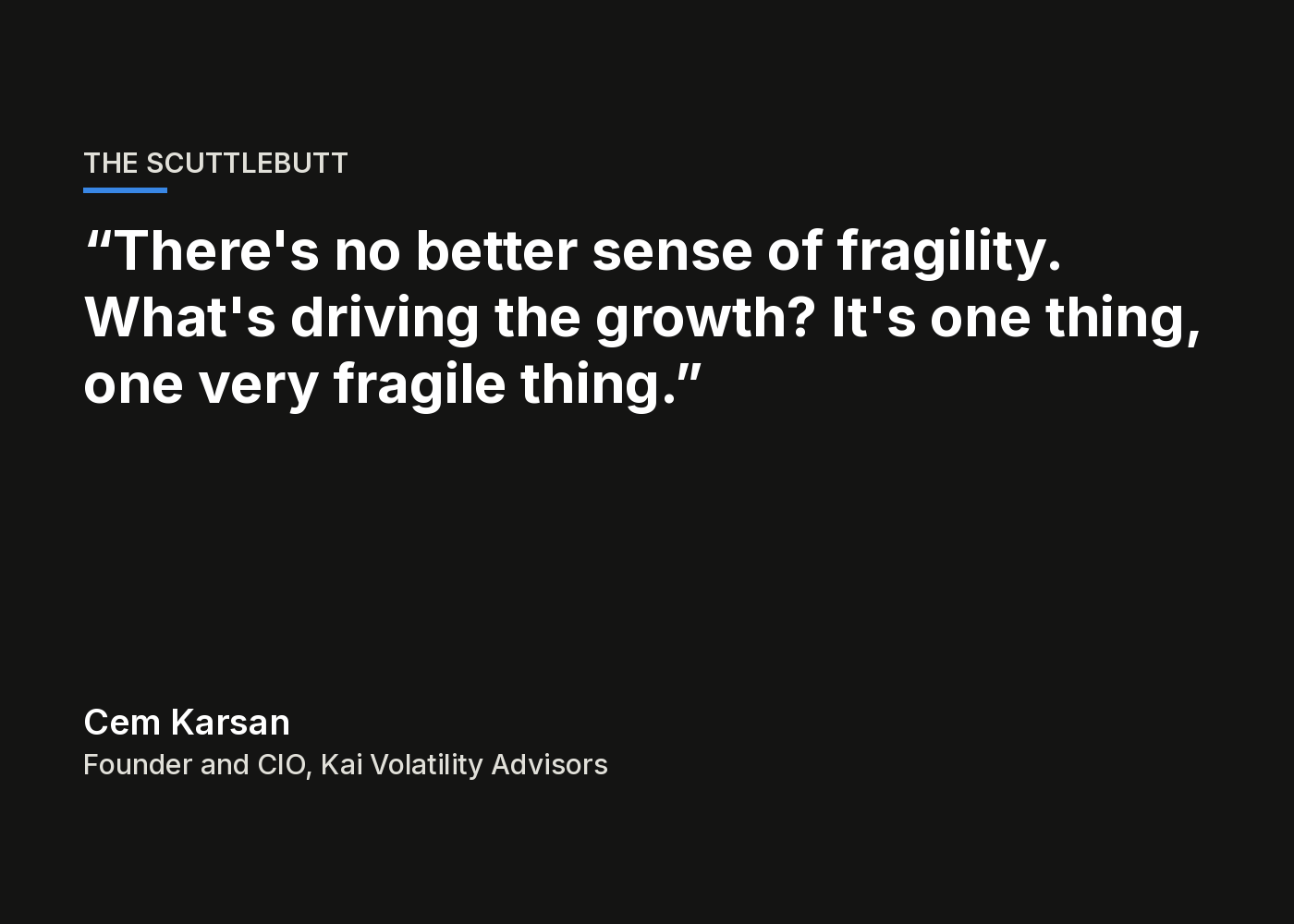
"There's no better sense of fragility. What's driving the growth? It's one thing, one very fragile thing." — Cem Karsan
The full interview is covered here so you can skip it. 1 hour 4 minutes of audio, 8 minutes of reading.
Here are the 8 takeaways that matter.
Key Takeaways
45% of the S&P 500 has negative beta, which Karsan calls the clearest sign of market fragility
Companies that refinanced debt at near-zero rates in 2020-21 are now rolling it over five to seven years later, at much higher cost
AI earnings growth is largely an accounting effect of rising valuations, not real profit, Karsan said
When a startup's valuation jumps from $380 billion to $2 trillion, the gain shows up as earnings
Karsan expects a "coming Treasury crisis" within roughly six months that forces the Fed into quantitative easing
The 2025 tariff "V-bottom" sell-offs and recoveries were engineered, not accidental, he said
He expects the 10-year Treasury yield to reach 5.5% to 6% before any policy reversal
Washington may respond to a market shock with a sovereign-wealth-fund-style plan to buy equities directly
Karsan thinks the 2026 midterms raise the odds of a contested election, not just a change of control in Congress
1. The Refinancing Wall
Karsan said the market's current fragility starts with simple arithmetic. Nearly everyone refinanced debt in 2020 and 2021, when interest rates were at or near zero, and the average duration on that debt is five to seven years.
Debt taken out at 2-2.5% in 2021 is now coming due and has to be refinanced near 7.5%
"2021 Plus five to seven years is when 2026 to 2028. Okay, so this is what happens, by the way, if you have something that has a 5% yield business you invest in and you. And you borrowed at two and a half, that's pretty good, pretty happy for the last five, six years. Now borrowing is seven and a half. You have a decision to make. Do you go borrow more and keep as a negative yield? Now do you sell the 5% asset?" — Cem Karsan
He said this rollover wave, concentrated in sovereign, corporate and private debt including real estate, is one of several forces now pushing bond yields higher and competing for capital with everything else in the economy.
