

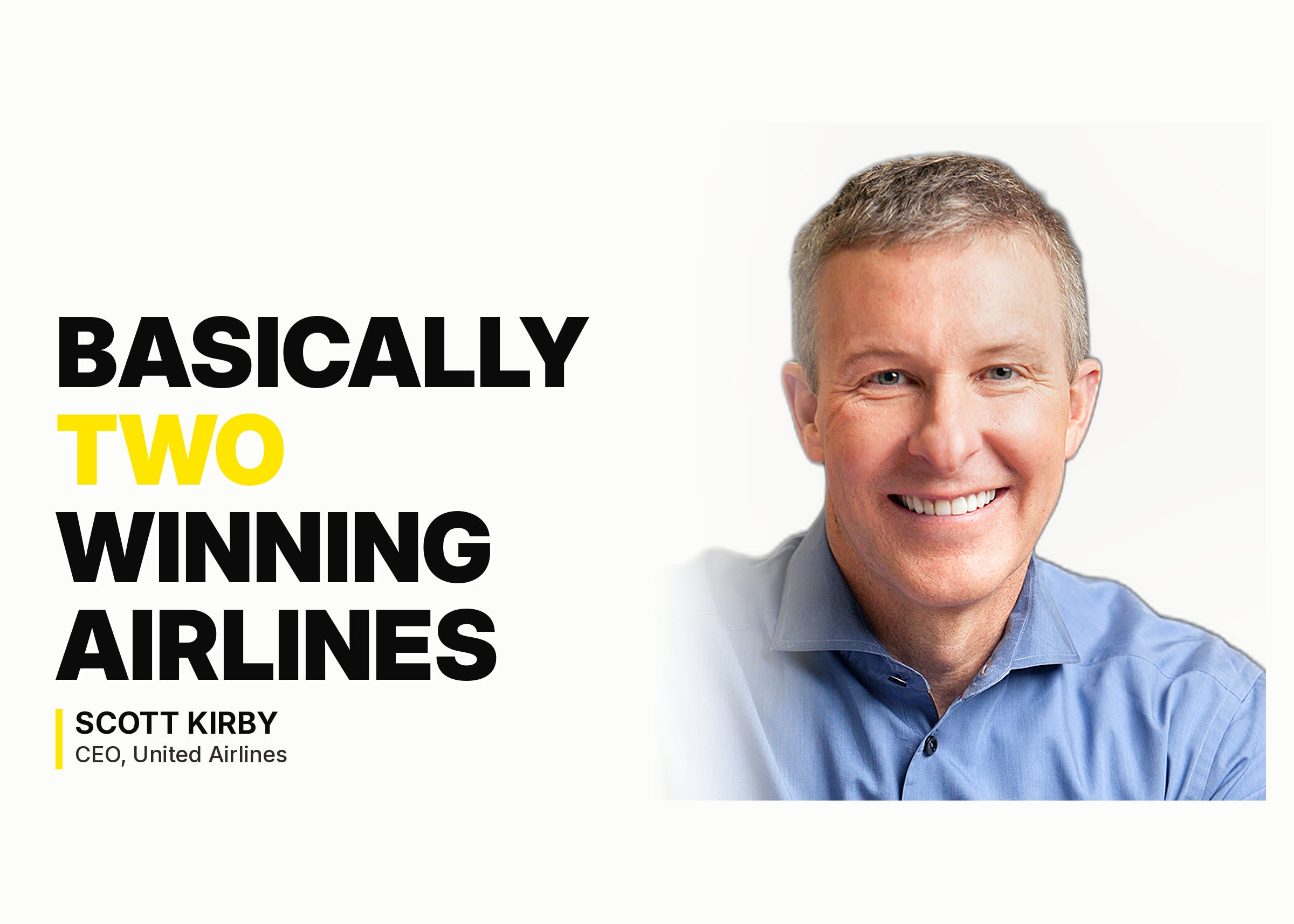
Scott Kirby, United Airlines' CEO, said on Cheeky Pint that six of 10 US airlines will lose money this year. He described an industry that now has two winners, United and Delta.
Kirby was one of 28 people quoted in this issue. The others ranged from Wendell Weeks, who said Corning's AI customers now pay cash upfront for the factory capacity built to serve them, to Carol Tomé, who put UPS's addressable market at about $923B after its pullback from Amazon, to Stephen Schwarzman, who said Blackstone made 2.2 times its money on real estate bought in 2007, when nearly every other buyer went bust.
"This year, six of 10 US airlines are going to lose money... the structure of the industry that's different today is there are basically two winning airlines in the US: United and Delta." — Scott Kirby, CEO at United Airlines, on Cheeky Pint (Read summary)
We scanned 753 shows and 14 hours of audio, wrote 20 summaries, and pulled 60 quotes into this 19-minute read.
Here is what mattered.
Macro
Freight data runs about 6 months ahead of government data and shows no AI slowdown, Fuller says
Craig Fuller said FreightWaves' data shows the strongest US industrial economy in perhaps a decade, driven most by spending on AI data centers, with cheaper energy and defense spending behind it.
"The freight data is usually six months before the broader government data... there's nothing in the data that suggests that this party is not going to continue." — Craig Fuller, Founder and CEO at FreightWaves, on Thoughtful Money (Read summary)
About 20% of US freight moves because of housing, which is still weak, Fuller estimates
He counts appliances, furniture, TVs and paint, and said the remodeling boom that followed the pandemic has run its course.
"As much as 20% of the volume of freight in the United States is indirectly related to housing... it's keeping a pretty substantial drag on freight volume." — Craig Fuller, Founder and CEO at FreightWaves, on Thoughtful Money (Read summary)
A 5% 10-year yield now pays investors to hold Treasurys, UBS's Brown says
Evan Brown spoke the day before the Fed's rate decision.
"Now with a 5% coupon on the ten year yield, that's doing a lot of work for you... you are getting paid now to own bonds." — Evan Brown, Lead Global Multi-Asset Portfolio Manager at UBS Asset Management, on Fast Money
Tech stocks have fallen from over 30 times forward earnings to 19, Brown says
Prices fell while profits rose, so the sector now costs less for each dollar it is expected to earn.
"Tech has de-rated. In fact, I think it's gone from a forward multiple of over 30 to 19. So we have seen quite a repricing with earnings improving." — Evan Brown, Lead Global Multi-Asset Portfolio Manager at UBS Asset Management, on Fast Money
Financials
Robinhood's net deposits pass $68B for the year, already an annual record
Shiv Verma, Robinhood's CFO, said October alone brought in more than $13B, including $6B the Dell family gave to Trump accounts, the government-opened investment accounts for children that Robinhood runs.
"October net deposits are over 13 billion the month... that includes six billion of the Dell family gift to Trump accounts... this brings our total year-to-date net deposits to over 68 billion. This is already a new annual record." — Shiv Verma, CFO at Robinhood, on Robinhood's earnings call (Read summary)
Robinhood's bank became the top destination for cash leaving its brokerage
"This quarter, for the first time, Robinhood banking became the number one withdrawal destination for Robinhood brokerage customers. This is actually even before it's generally available." — Vlad Tenev, Chairman and CEO at Robinhood, on Robinhood's earnings call (Read summary)
A 25bps move in rates changes Robinhood's revenue by about 1.5%, its CFO says
"The actual math is for every 25 basis point hike or decline, it's about a one and a half percent change to revenue... big picture, we like being diversified, and a rate hike is a tailwind... we've got a business that does well in both." — Shiv Verma, CFO at Robinhood, on Robinhood's earnings call (Read summary)
Robinhood's customers buy most heavily on the market's worst days, Tenev says
Vlad Tenev was asked about retail trading after the sell-off in AI stocks.
"Our customers, they tend to be younger, they tend to be technooptimists... they use sell-offs as a buying opportunity... On down days, we tend to see some of our strongest net buying." — Vlad Tenev, Chairman and CEO at Robinhood, on Robinhood's earnings call (Read summary)
87% of SoFi's products are no longer loans, its CEO says
"We now have eight businesses that are generating $100 million of annual revenue or more... 87% of our products are now non-lending products." — Anthony Noto, CEO at SoFi, on Bloomberg Tech
Morningstar bought PitchBook for its data, a lesson Kapoor took from LinkedIn
Kunal Kapoor said Morningstar spent more on PitchBook than on any earlier acquisition, in the same month Microsoft bought LinkedIn.
"I didn't understand the LinkedIn deal at the time in terms of pure numbers. And then someone just whispered in my ear, 'It's about the data.' And then suddenly my world opened up." — Kunal Kapoor, CEO at Morningstar, on Executive Decisions with Steve Sedgwick (Read summary)
Crypto and Digital Assets
Tokenized US stocks mainly serve investors outside America, CZ says
Changpeng Zhao, Binance's founder, said Americans already have brokerage access. Most people abroad do not, and Asian traders who do are stuck with overnight trading hours.
"Most people cannot even open a US brokerage account... the trading hours will be from like midnight to 6:00 a.m." — Changpeng Zhao, Founder at Binance, on The Rollup (Read summary)
Whole national stock markets trade $50M a day, one New York trader's volume, CZ says
He said putting those companies' shares on a blockchain, in front of Binance's users, would give them the trading volume they lack.
"Some large countries with a 100 million people, their daily trading volume on their entire stock market is 50 million US. That's one trader in New York, right?" — Changpeng Zhao, Founder at Binance, on The Rollup (Read summary)
Robinhood's own blockchain ranks in the top 5 by volume after one quarter
"On July 1st we launched the Robinhood Chain mainnet, and in its first quarter it's already a top-five chain by volume and revenue. So far we've seen over 100 billion in DEX volume... and over 50 million in chain fees." — Vlad Tenev, Chairman and CEO at Robinhood, on Robinhood's earnings call (Read summary)
AI-built trading programs narrow the gap with market makers, Federa says
Austin Federa's company, DoubleZero, runs dedicated fiber networks for fast trading data, the same kind Wall Street firms have used for two decades.
"AI inference is still too slow to really trade on, but you can have AI build you a trading program, and then you can hook that up to double zero data... you're not Jane Street overnight, but you are closing the gap tremendously between click trading on a UI and what a market making firm is doing." — Austin Federa, Co-Founder at DoubleZero, on The Wolf Of All Streets (Read summary)
Crypto has spread use of the dollar abroad and helped US security, Federa says
"I think that crypto has been one of the best things for U.S. national security to come out of the financial industry in 30 years... we have dollarization continuing to expand internationally at a time when the U.S. has more currencies pushing back against it than it's had in our lifetime." — Austin Federa, Co-Founder at DoubleZero, on The Wolf Of All Streets (Read summary)
Alternatives and PE
Blackstone's 2007 office purchase was almost 4 times the previous record deal
"We bought the largest real estate office complex in the world. It was a $39 billion deal. The largest deal that had been done before was like $10 billion." — Stephen Schwarzman, Co-Founder and CEO at Blackstone, on Leaders with Francine Lacqua (Read summary)
Nearly every 2007 real estate buyer went bust, but Blackstone made 2.2 times its money
"Everybody who bought real estate, except one company, went busted... and we made 2.2 times our money." — Stephen Schwarzman, Co-Founder and CEO at Blackstone, on Leaders with Francine Lacqua (Read summary)
Consumer
Royal Caribbean captures only 20-25% of its customers' spending, Liberty says
Jason Liberty gave the figure as the case for Royal Caribbean's deal for Sandals.
"We today get about 20 to 25% of our customers' wallet." — Jason Liberty, CEO at Royal Caribbean, on Squawk on the Street (Read summary)
Cruises still cost much less than land vacations, Liberty says
He said that gap is what gives cruise lines room to raise prices.
"We still trade at a pretty significant discount to land based vacations." — Jason Liberty, CEO at Royal Caribbean, on Squawk on the Street (Read summary)
GLP-1 drugs are cutting food and drink volumes in freight data, Fuller says
Food and beverage is one of the fastest-falling categories in FreightWaves' data.
"I'm on a GLP-1. I've been on one for three years now. I've lost 50 pounds... when you multiply it by the 10-plus million people that are on them, that data starts to show up." — Craig Fuller, Founder and CEO at FreightWaves, on Thoughtful Money (Read summary)
Sports
Haslem sold his restaurant franchises to buy into soccer clubs
Udonis Haslem said franchise ownership was tedious, down to how the pickles are ordered, and depended on the operating partners. He sold his Starbucks, Subway, Auntie Anne's and Einstein Bros. locations.
"As investors, we're just investors. We're just a face. We'll show up, we'll shake hands and kiss babies. But on the day-to-day, we're running it." — Udonis Haslem, Vice President of Basketball Development at the Miami Heat, on Forbes: The Enterprise Zone (Read summary)
Haslem now owns stakes in Ipswich Town and Italy's Frosinone
"We own a couple soccer teams right now... we have the Ipswich team in the Premier League, and then Serie A, we have Frosinone out of Italy." — Udonis Haslem, Vice President of Basketball Development at the Miami Heat, on Forbes: The Enterprise Zone (Read summary)
John Madden committed to EA's game after NFL players disputed their ratings
Bing Gordon said Madden first dismissed an early seven-on-seven version of the game.
"The turning point was when players came up to him and said, 'Coach, you got my ratings wrong'... he called up Sandy Montag and said, 'I need to find out what's going on here. This is not just a license — this is a life's work.'" — Bing Gordon, Co-Founder at Electronic Arts, on Squawk Pod (Read summary)
Technology & AI
Corning's AI customers pay upfront for new capacity, which telecom buyers never did
Wendell Weeks led Corning back from the collapse of the telecom bubble, when the company borrowed to build capacity on its own.
"What we ask for is upfront cash to fund the capacity we're putting in place... that was not done back then. We simply return the cash to our customers with the profit stream we create when we actually deliver the volume." — Wendell Weeks, Chairman and CEO at Corning, on Squawk Pod (Read summary)
Most of Corning's AI revenue comes from the largest cloud companies, Weeks says
Elon Musk had warned that smaller AI cloud providers, the so-called neo-clouds, could fail as financing costs rise.
"Far and away the majority of our revenue is aimed at those major hyperscalers... all of which have super strong balance sheets... have very little exposure at this moment to the neo-clouds." — Wendell Weeks, Chairman and CEO at Corning, on Squawk Pod (Read summary)
An Nvidia-linked deal will raise Corning's fiber capacity by 50%
"We're going to increase our amount of fiber capacity by 50% with their investment, we're going to have a ten-fold increase in optical connectivity." — Wendell Weeks, Chairman and CEO at Corning, on Squawk Pod (Read summary)
Corning's CEO and Bloomberg drew opposite conclusions from Anthropic's IPO filing
"What you see there is really strong profitability from providing customers inference tokens, strong growth, and their top concern is being constrained by compute. We provide the networking for that compute." — Wendell Weeks, Chairman and CEO at Corning, on Squawk Pod (Read summary)
Bloomberg's AI reporter read the same filing as a test of whether the business can make money at all.
"Over $80.7 billion net loss on revenue of $16.3 billion in the first six months of 2026... what the S1 didn't show is what's going to happen in future quarters." — Shirin Ghaffary, AI Reporter at Bloomberg News, on Bloomberg Tech
Anthropic held $130B of cash to fund its buildout, a Bloomberg credit analyst says
"I don't think most people realize that Anthropic was sitting on $130 billion of cash... the financing for Anthropic to build the AI future that they're promising is there." — Robert Schiffman, Credit Analyst at Bloomberg Intelligence, on Bloomberg Tech
Broadcom's AI debt pays 8.5% to 9%, which weakens the case for its stock, Faber says
Broadcom is lining up debt from banks and Blackstone to fund AI infrastructure for Anthropic.
"You can get Broadcom risk now and get paid pretty nicely for it — eight and a half, nine percent... It does raise the question as to why bother buying the stocks if you can get almost double-digit returns as a senior creditor." — David Faber, Anchor at CNBC, on Squawk on the Street
US chip subsidies have mostly paid for Chinese-made laptops, Luckey says
Palmer Luckey said Anduril is building its own computer, Blue Chip, after failing to get other companies to make one without Chinese parts.
"American semiconductor subsidies have really just been a subsidy of Chinese-made laptops... we want to make sure that America is capturing that entire value chain here." — Palmer Luckey, Founder at Anduril Industries, on Bloomberg Tech (Read summary)
An Anduril attack drone is a laptop without the keyboard and screen, Luckey says
"The only difference between an Anduril attack drone and a laptop is a keyboard and a screen." — Palmer Luckey, Founder at Anduril Industries, on Bloomberg Tech (Read summary)
Anthropic keeps passwords and keys out of reach of its AI agents
Angela Jiang said that when an agent's request leaves Anthropic's system, a proxy adds the credential it needs, so the agent never holds it.
"On egress, we have a proxy that goes and pulls the right credential out and injects it... the agent is never in the same place where the credentials are." — Angela Jiang, Head of Product, Claude Platform at Anthropic, on Latent Space (Read summary)
Anthropic's engineers hit 12 of 13 speed targets in 3 days
Katelyn Lesse said the team ran a two-week sprint to make Claude.ai faster, treating the engineering work like research.
"We hit 12 of the 13 targets in three days." — Katelyn Lesse, Head of Platform Engineering at Anthropic, on Latent Space (Read summary)
Resume screening may wrongly reject 98% of applicants, Greenhouse's CEO says
Daniel Chait said Greenhouse's voice AI interviewer can talk to every applicant, not only the few who clear a resume screen.
"Today we may be screening out 98%. Maybe in the future we're only screening out 20% or something." — Daniel Chait, Co-Founder and CEO at Greenhouse, on Summation with Auren Hoffman (Read summary)
Steve Jobs dismissed games reaching 400M people a month as too small
"I said, 'Steve, games reach 400 million people every month.' And he goes, '400 million people? We don't care about anything that doesn't start with a billion.'" — Bing Gordon, Co-Founder at Electronic Arts, on Squawk Pod (Read summary)
VC & Startups
Venture investors are paid to tell founders never to quit, Chait says
Chait's first startup failed in the dot-com crash. He named never giving up as the worst advice founders get.
"There's a venture capital industry that's highly incentivized to tell you to keep going no matter what." — Daniel Chait, Co-Founder and CEO at Greenhouse, on Summation with Auren Hoffman (Read summary)
Industrials and Transport
Only United and Delta are winning in US aviation, Kirby says
Kirby said brand loyalty protects the two from the losses spreading through the rest of the industry.
"This year, six of 10 US airlines are going to lose money... the structure of the industry that's different today is there are basically two winning airlines in the US: United and Delta." — Scott Kirby, CEO at United Airlines, on Cheeky Pint (Read summary)
Passengers are switching flights for Starlink's fast Wi-Fi, Kirby says
Kirby said customers told him they were choosing regional flights because those planes had Starlink, which led United to widen its rollout.
"Free was never the value proposition. Fast is the value proposition, and there's only one option for fast. It's Starlink, that is the only option." — Scott Kirby, CEO at United Airlines, on Cheeky Pint (Read summary)
UPS sizes its market at $923B after pulling back from Amazon
"We have assessed the addressable market to be about $923 billion... we serve every step of a supply chain, and we're going to lean into that in a meaningful way." — Carol Tomé, CEO at UPS, on Bloomberg Talks (Read summary)
UPS's healthcare revenue has more than doubled to over $13B under Tomé
Carol Tomé said UPS built cold-storage shipping for COVID-19 vaccines and has kept growing the business since, while moving fewer, higher-value packages overall.
"When I got here, our healthcare revenue was less than $6 billion. By the end of this year, it will be more than $13 billion." — Carol Tomé, CEO at UPS, on Bloomberg Talks (Read summary)
UPS customers expect daily volume to rise about 25% into the holiday quarter
"Based on forecasts that we receive from our customers, we expect our volume, our average daily volume, to increase about 25% from the third quarter to the fourth quarter." — Carol Tomé, CEO at UPS, on Bloomberg Talks (Read summary)
Boeing has $745B of orders waiting, and Ortberg says the risk is narrowing
"The uncertainty in our financial performance is narrowing. We're definitely reducing the risk going forward... We're going to be smart about this, stay disciplined. We have $745 billion of backlog." — Kelly Ortberg, CEO at Boeing, on Squawk on the Street (Read summary)
Boeing expects positive cash flow this year; a Fast Money trader doubts its output
"We're going to have positive cash flow for this 2026, which is the first time in several years... that cadence will continue to grow year on year, and we'll get to that $10 billion target and beyond." — Kelly Ortberg, CEO at Boeing, on Squawk on the Street (Read summary)
Steve Grasso compared the number of 737s Boeing builds each month with what it needs to change investors' view.
"So the break-even on that — they're at 41, 42 planes per month. They need to be somewhere in the mid-50s to actually change the narrative on the story... Boeing can't figure out how to get to 47." — Steve Grasso, Trader on the Fast Money panel, on Fast Money
Railroads are a way to own the AI buildout without owning AI, Fuller says
"If you want to invest in an AI stock and benefit from the AI data center buildout, the railroads are fantastic positions to own... there's a real business there that isn't dependent on AI." — Craig Fuller, Founder and CEO at FreightWaves, on Thoughtful Money (Read summary)
Materials & Energy
Energy is 40% of heavy manufacturing's costs, which favors the US over Germany, Fuller says
Fuller said cheap natural gas, not oil, is what powers US industry, while Germany shut down much of its energy base.
"Energy is 40% of the cost of product in heavy manufacturing. It's far more important than labor." — Craig Fuller, Founder and CEO at FreightWaves, on Thoughtful Money (Read summary)
Policy
Airlines pay all of the FAA's fees while private jets fly almost free, Kirby says
Kirby called air traffic control United's biggest constraint, and said yearly budgets cannot pay for modernization projects that take years to finish.
"Airlines pay 100% of the fees. The FAA is airline-funded... essentially, it's free to fly private jets. They're a really powerful lobby." — Scott Kirby, CEO at United Airlines, on Cheeky Pint (Read summary)
AI developers must answer for what their models do, Solomon says
David Solomon has argued that AI needs rules and that the people who build the models must take responsibility for them. He compared it with his own firm's trading systems.
"I could never imagine someone at Goldman Sachs saying to me, 'The trading platform went off and did something awful on its own. We couldn't stop it.'" — David Solomon, Chairman and CEO at Goldman Sachs, on Goldman Sachs Exchanges (Read summary)
Defense spending would hold up even after a Democratic sweep, Luckey says
"I think even with a blue wave, you're not necessarily going to see a huge change in defense spending... most people on the red and the blue side agree that America needs to be investing in new technology." — Palmer Luckey, Founder at Anduril Industries, on Bloomberg Tech (Read summary)
Geopolitics
China's AI is now about 6 months behind the US, Schmidt says
"A year or two ago, it looked like China was a year or two behind. Now it looks like they're six months behind, and there are many studies that show this." — Eric Schmidt, Former CEO and Chairman at Google, on Masters of Scale (Read summary)
Chinese labs match US methods with about one-tenth of the energy, Schmidt says
He described this as China's answer to US limits on exports of advanced chips.
"They're so smart they figured out a way to do the kind of algorithms we develop, and use the knowledge we develop, with essentially one-tenth of the energy." — Eric Schmidt, Former CEO and Chairman at Google, on Masters of Scale (Read summary)
Chinese open models cost at least 3 times less per token, and US labs copy them
"The token cost is at least three times cheaper... the moment the Chinese invent something in open source, we copy it in America. Thank you, China." — Eric Schmidt, Former CEO and Chairman at Google, on Masters of Scale (Read summary)
Nuggets of Wisdom
When rivals shrink, a contrarian bet only has to avoid being badly wrong, Kirby says
Kirby placed one of the largest aircraft orders in history during the pandemic, while other airlines were retiring planes.
"This is one of those cases because everyone else is shrinking, we don't have to be right. We just have to be not totally wrong." — Scott Kirby, CEO at United Airlines, on Cheeky Pint (Read summary)
Amex's best ideas threatened its own products, Chenault says
"We should run the risk of cannibalizing an existing business... the best innovations that we did at the company actually threatened an existing product." — Kenneth Chenault, Former CEO at American Express, on HBR IdeaCast (Read summary)
Buffett told Chenault he would be judged on Amex's results 10 years after he left
"Warren Buffet said... 'Ken, I'm going to judge you by how the company does under your leadership, but I'm going to equally judge you by how the company does at least 10 years after you leave.'" — Kenneth Chenault, Former CEO at American Express, on HBR IdeaCast (Read summary)
Star hires brought in to change a culture usually fail, Kapoor says
"I made some rash decisions because I thought we really needed certain kinds of talent in our company... you bring them in with sort of this hero mentality, and the culture spits them out and they never adapt." — Kunal Kapoor, CEO at Morningstar, on Executive Decisions with Steve Sedgwick (Read summary)
Other
Alpha School's AI engine teaches 10 times faster, its founder says
Joe Liemandt said Alpha students spend two hours a day on academics and the rest of the day on skills such as leadership and public speaking.
"Instructional design and delivery hasn't changed for 100 years... cognitive science and learning science plus the advent of LLM's, you can build a learning engine that teaches kids 10 times faster." — Joe Liemandt, Founder and Principal at Alpha School, on a16z (Read summary)
Alpha refunds tuition if a student's business does not earn $1M in profit
"We guarantee that you'll start a business that will earn a million dollars of profit while you're in high school, or we give you all your tuition back." — Joe Liemandt, Founder and Principal at Alpha School, on a16z (Read summary)
If this was worth your time, send it to someone who has to follow all of this too.
What did you think of today’s edition? Hit ‘reply’ to this email, send us a message, leave a comment, or join the chat!
Get the latest market chatter as it happens: