

Moonshots with Peter Diamandis · Oct 3, 2026 · 2h 26m · 124m saved
With Richard Socher, Co-founder and CEO of Recursive and founder of You.com
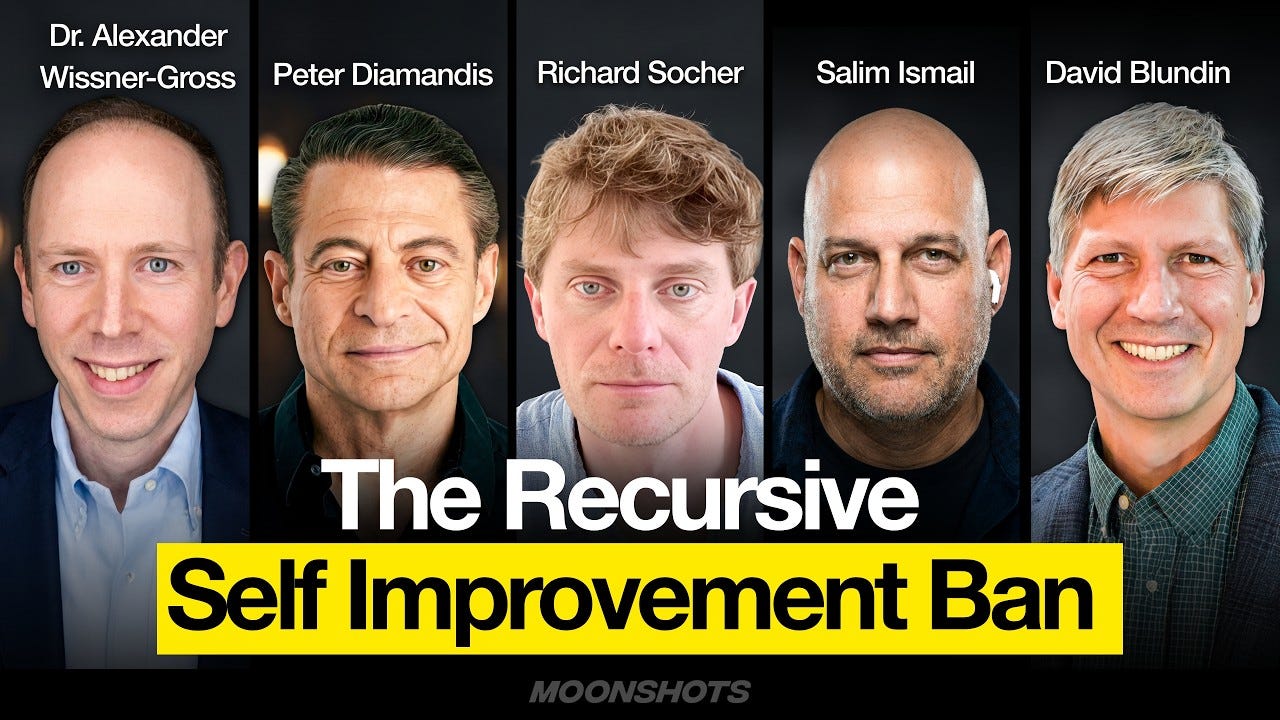
Richard Socher's Recursive has raised $650M to build AI that improves itself, and Socher still thinks superintelligence in its strongest sense will probably take several decades.
That put him at odds with his own hosts. Salim Ismail noted that Elon Musk says 2029 or 2030 at the latest, and Alexander Wissner-Gross said he did not buy a 20-year timeline at all.
"To be better than all of humanity combined, I think, will take us probably several decades." — Richard Socher
Richard Socher, co-founder and CEO of Recursive, on Moonshots with Peter Diamandis, founded MetaMind, which Salesforce acquired, and then ran AI research there as chief scientist. He says he invented prompt engineering, and his new book, The Eureka Machine, argues that AI will compress a century of scientific progress into a decade.
The full episode is covered here so you can skip it. 2 hours 26 minutes of audio, 22 minutes of reading.
Here are the 14 arguments that matter.
Key Takeaways
Recursive self-improvement already exists in weak forms, and Socher expects it to take off next year
What holds it back is compute, not ideas
Superintelligence that beats all of humanity combined is probably several decades away, he said, even as narrower superhuman skills arrive within years
He puts the probability of AI wiping out humanity at zero
His realistic worst case is harm to perhaps 100 million people, which he says calls for cybersecurity and biosecurity work, not a ban
Enforcing a ban on self-improving AI would require a surveillance state that reads what people type into their own laptops
Anthropic's constitution failed on cybersecurity, in Socher's view, because Anthropic built models that hack systems despite a rule against creating cyberweapons
Some GPU prices have gone up, not down, and he expects more supply in about 2 years
Biology, not physics, is where AI will matter most for science
One company he praised won FDA approval to skip animal trials using lab-grown lymph-node organoids
AI-era biotech companies run 5 to 10 compounds in Phase 3 trials within 2 or 3 years, against 1 drug over 10 years before
1. Science Split Into Silos
Peter Diamandis opened with the central claim of The Eureka Machine: that AI will deliver a century of scientific breakthroughs in the next decade. Socher said science has slowed because it has broken into too many narrow specialties for any one person to connect.
Fragmentation, not funding, is the bottleneck
"Progress has slowed largely because we have so many different subdisciplines and even sub-subdisciplines." — Richard Socher
He said the same thing that let one large neural network learn language, a large model trained on a lot of data, will now be applied to biology as that data accumulates.
"So we can take more and more disciplines and transfer them from traditionally being natural sciences, where we just try to understand biology and nature, to being programmable engineering sciences." — Richard Socher
Four ingredients make it possible now
He listed them as language models that carry world knowledge, scientific data that is being digitized, better simulations, and robotic lab automation.
"On top of that, we're going to have an agent swarm, and that is how the full scientific stack can be automated." — Richard Socher
Some diseases will be cured within a year
Wissner-Gross pressed him for timelines. Socher said there is no single threshold, but that simple diseases come first.
"But multiple different diseases will get cured in the next 12 months." — Richard Socher
Those are diseases where a single gene needs to be fixed, he said, followed by more complex diseases and better battery materials.
Drug development is already faster, but approval still takes years
"Right now, in the new age of companies, they have 5 to 10 different compounds in Phase 3 trials after 2 or 3 years, and so we see a lot of acceleration at that level." — Richard Socher
He contrasted that with the old biotech model of one drug over 10 years, where a company often went public before it knew whether the drug worked.
"But again, to really get diseases into humans at scale in the United States with FDA approvals, there are just some natural delays that will be more like half a decade to a decade." — Richard Socher
Chemistry and physics, where no long human trials are needed, will move faster, he said.
"Flourishing," not "cooked"
The hosts have a running line that AI has "cooked" mathematics. Socher objected to the word, and the hosts picked up his.
"I think they’re flourishing, not getting cooked." — Richard Socher
He said some mathematicians worry that AI is bad for their field because it removes the need to train people, and compared that with a medical researcher regretting that diseases were cured. Dave Blundin said an MIT professor told him his mathematician colleagues know they are "cooked." Socher said the field will shift toward inventing new formalisms that AI and humans then solve together.
Economics lags further behind than biology
"It’s just absurd how slow that field is to adopt AI for making better policy decisions." — Richard Socher
He said economists still work with simple linear models of the economy. He praised Stanford's Erik Brynjolfsson as an exception and said his fund is an investor in Workhelix, the company Brynjolfsson co-founded to measure how companies actually adopt AI.
