

a16z · Oct 21, 2026 · 38m · 30m saved
With Adit Abraham, Co-Founder & CEO of Reducto
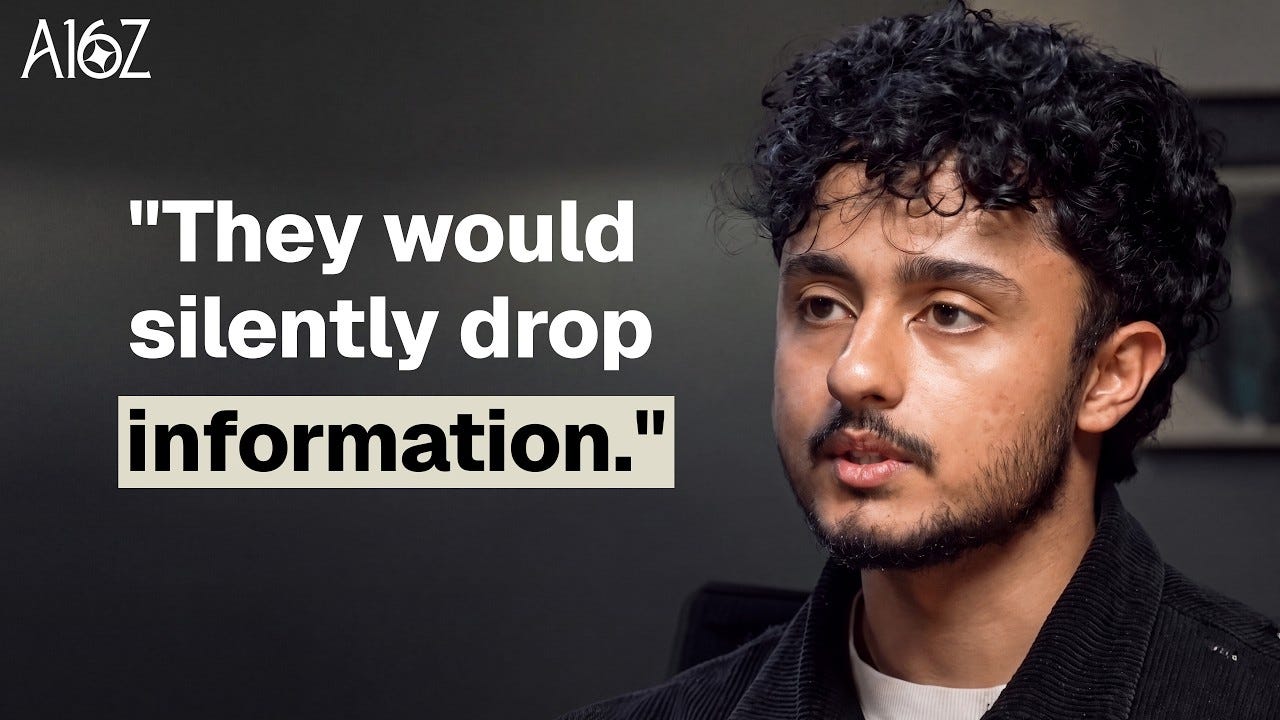
Reducto crossed its seven billionth processed page on the morning Adit Abraham, its co-founder and CEO, recorded this a16z interview, and it now handles billions of pages a month at a list price of one cent a page.
Most of the AI industry is racing to build smarter models. Adit's argument is that agents are held back by something duller: they cannot yet read the PDFs and spreadsheets where white-collar work actually lives with the accuracy a human reader had.
"So much white collar work across healthcare and legal and finance and insurance is in things like PDFs and spreadsheets... you read from them, you write to them, and they catalog that knowledge." — Adit Abraham
Adit sells to the largest hedge funds, private equity firms and enterprises, and his company has spent years catching the errors that general models make on scanned tables, dense blueprints and patient files.
The full interview is covered here so you can skip it. 38 minutes of audio, 8 minutes of reading.
Here are the 7 lessons that matter.
Key Takeaways
A misread field in a document is a wrong patient outcome or a wrong financial decision, not a minor bug
Multi-step work cannot run on 90% accuracy per page, because the mistakes compound
Reducto's agents now beat human annotators at structured extraction on many tasks
For a hedge fund, faster document ingestion is treated as a direct source of alpha
Adit says AI benchmarks "have become marketing"
One benchmark's own publisher collapsed once a little noise was added to the test documents
In the hardest healthcare files, OCR accuracy falls below 50%
The labs are in an arms race for superintelligence, which leaves document reading to specialists
1. Documents Hold the Real Work
Reducto started in 2023 on a different problem, memory, when context windows were tiny. The founders had a computer-vision background, and early AI-native companies kept telling them their document-processing tools were the weak point. The pivot followed.
Adit's reframing is that if agents are going to do the work of healthcare, legal, finance and insurance staff, they need the same fidelity a human reader brought to the paperwork. In those fields an error is not cosmetic.
A misread checkbox in healthcare is a patient outcome, not a typo
"It's not an oops to say, 'Oh, I messed up a checkbox.' It's like, 'Oh, that's a patient's outcome, right?'" — Adit Abraham
