

Founders · Nov 18, 2026 · 1h 0m · 53m saved
With Brian Armstrong, Co-founder and CEO of Coinbase
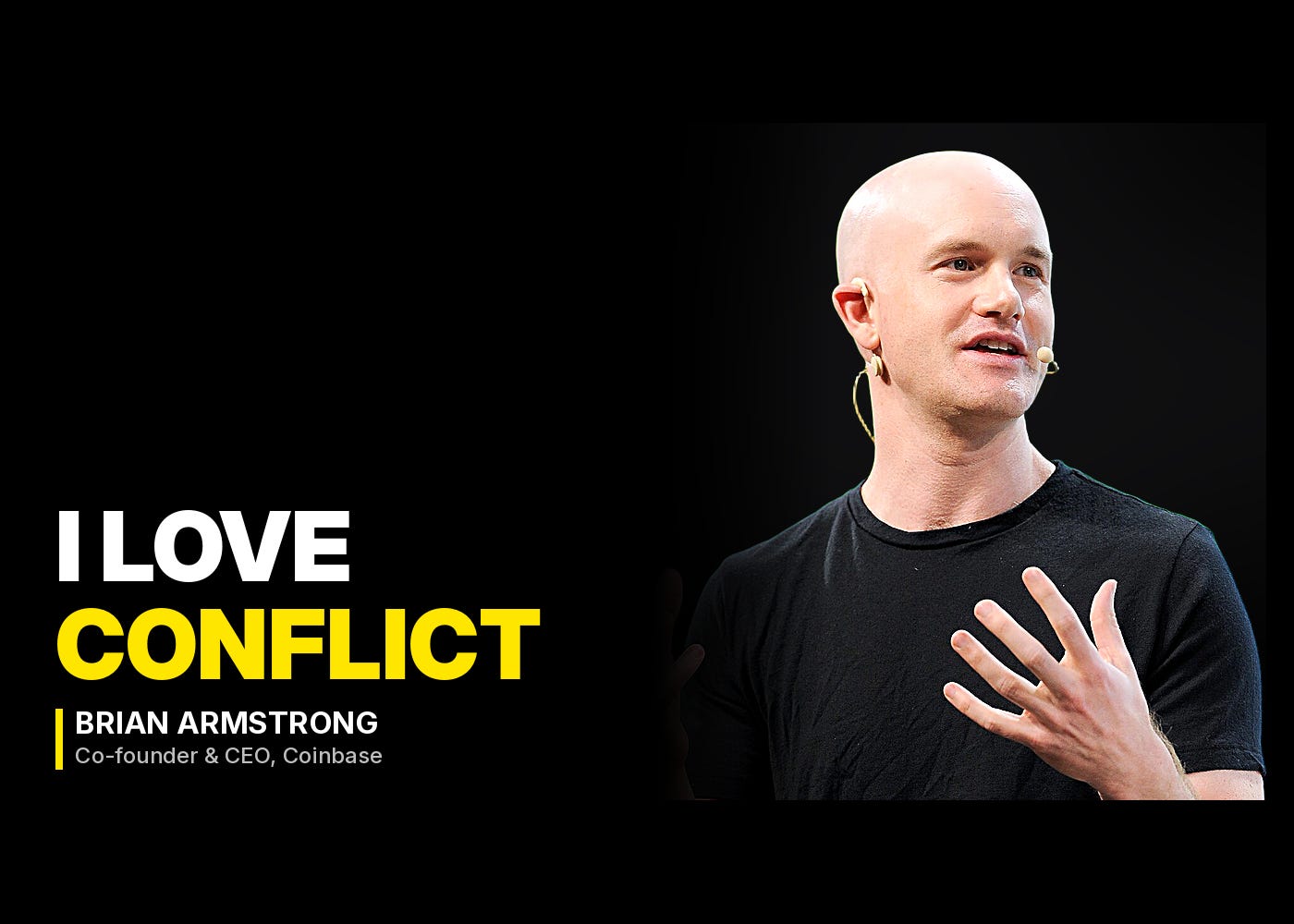
Photo: TechCrunch, CC BY 2.0 via Wikimedia Commons
Brian Armstrong says he deliberately reprograms his own habits by writing down and repeating target beliefs, the same way a neural network updates its weights through reinforcement. One of them, repeated until it stuck: "I love conflict."
"I need to reprogram my brain to not think of this as super stressful, but think of it as it's me getting valuable things done to move forward towards the goal ... I love conflict, I love conflict, I love conflict." — Brian Armstrong
Brian co-founded Coinbase in 2012 and has run it through a decade of regulatory fights and crypto cycles, and he says he's still never satisfied with the product he built.
The full interview is covered here so you can skip it. 1 hr of audio, 7 min of reading.
Here are the 6 takeaways that matter.
Key Takeaways
Brian reprograms his own habits by repetition, the way a neural network updates its weights
He calls his permanent dissatisfaction with the Coinbase app fuel, not self-criticism
Brian now runs on "probably seven or eight lead agents," each overseeing its own sub-agents, cleared through a prioritized inbox
Most employees use "auto" mode, which picks the model per task instead of making a human choose
A Coinbase model fine-tuned on internal data already outperforms the frontier labs on compliance drafting
"Coinbase Brain" rebuilds a running knowledge base per employee, team and GitHub repo every night
Brian expects agent-to-agent transactions to reach "five nines" of global GDP within ten years
He calls decentralized AI a moral obligation, not just a business choice
Coinbase is cutting vendors as industrywide cyber incidents roughly double year over year
All fintech combined captures only about 4% of global financial-services revenue, against TradFi's 96%
Brian lays out four levels of AI-driven investing, ending in "a private banker in your pocket"
1. Rewiring His Own Habits
Brian says he treats his own habits as something to be trained, the same way a model is trained — writing down a target belief and repeating it until it overrides the old one. One target: a goal of starting a billion-dollar company in his 20s. Another, later: overcoming his fear of hard CEO conversations.
Brian says he's never satisfied with the Coinbase product, and treats that discontent as fuel rather than self-criticism
"I kind of always feel like it's not good enough ... I don't think I'll ever feel like it's done or good enough. To me, it's still so broken based on what it could be." — Brian Armstrong
He frames this as a deliberate choice to aim for long-run fulfillment over moment-to-moment happiness.
"The point of the game of life is not happiness, and it's not comfort or anything like that. It actually should be difficult. It's like a video game. If it was easy, it'd be boring." — Brian Armstrong
