

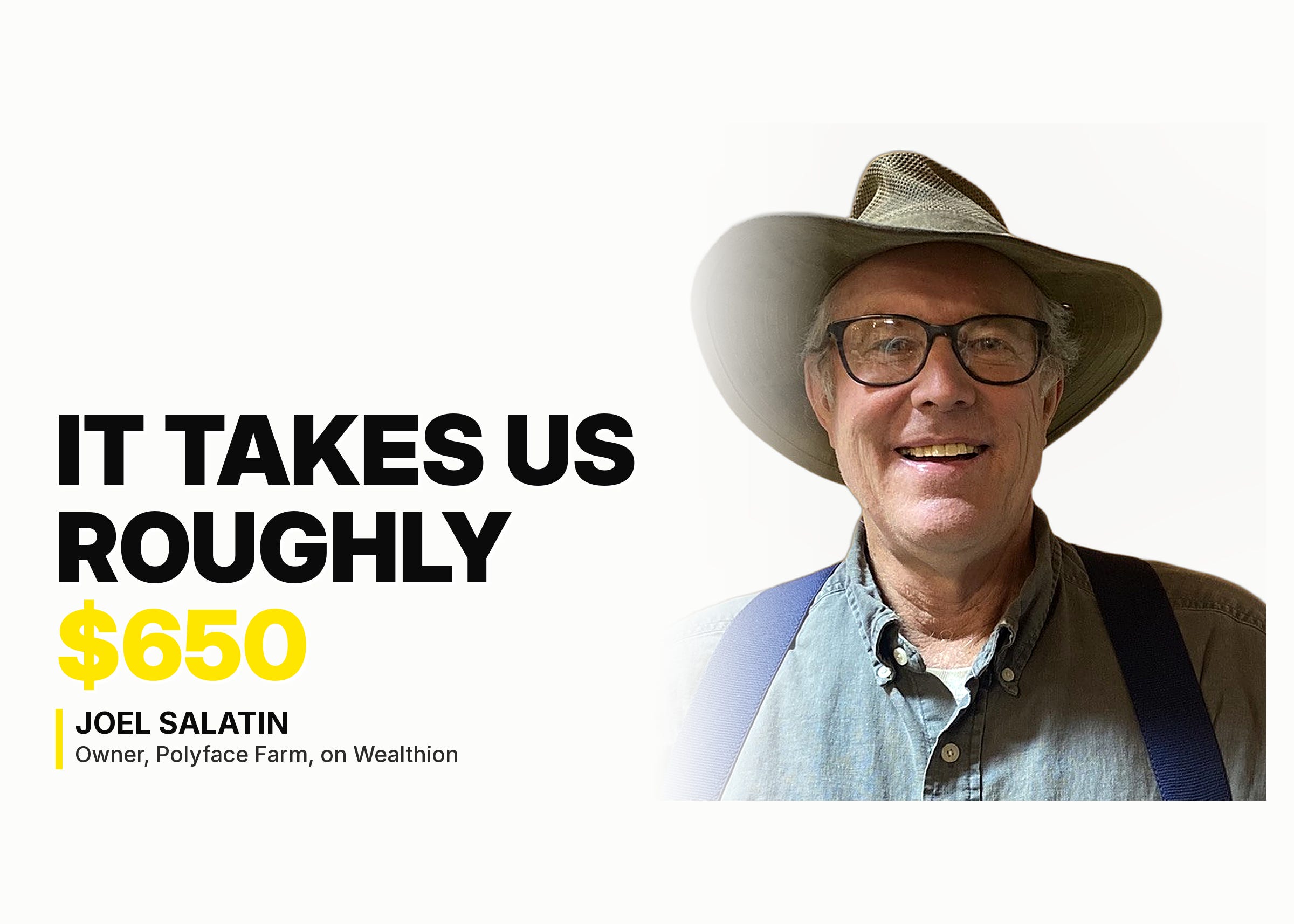
Joel Salatin said on Wealthion that his small slaughterhouse spends roughly $650 to process one beef animal. Tyson does the same work for $150, and part of the gap is fixed costs a federally inspected plant carries at any size, down to an office and a bathroom for the inspector.
Salatin was one of 22 people quoted in this issue. The others ranged from Stéphane Bancel, who said Moderna's melanoma vaccine showed a 42% improvement over Keytruda alone, to George Kurtz, who said likely AI-agent intrusions doubled two months in a row, to Nick Kokonas, who ran a private phone line that kept him 20 seconds ahead of Goldman Sachs.
"It takes us roughly $650 to do to a beef what Tyson does for 150... we still have to have an office for the inspector, a bathroom for the inspector." — Joel Salatin, Owner at Polyface Farm, on Wealthion (Read summary)
We scanned 753 shows and 14 hours of audio, wrote 20 summaries, and pulled 52 quotes into this 18-minute read.
Here is what mattered.
Macro
Funds selling options for income may be what keeps dip-buying working, Tchir says
Peter Tchir said income-oriented funds now sell options on the S&P 500, the Nasdaq 100 and single stocks at a scale no earlier cycle saw. He is watching derivative-income ETFs for outflows as the sign the strategy is breaking.
"I suspect it's part of why buy-the-dip has been so successful... if it breaks, it gets really ugly very quickly." — Peter Tchir, Head of Macro Strategy at Academy Securities, on The Wolf Of All Streets (Read summary)
International
Most Mexican household wealth sits outside the financial system, Aureo's research finds
Gustavo Flores Echaiz traces the pattern to Mexico's bank nationalization in the 1980s and the peso crisis of 1994, which left households trusting property over banks.
"About 90% of Mexico's household wealth is in non-financial assets. In the United States, it's almost the opposite." — Gustavo Flores Echaiz, Co-Founder and CEO at Aureo, on Onramp Bitcoin Media (Read summary)
BBVA offers Bitcoin custody in Spain but cannot at home in Mexico, Flores says
Mexico's central bank has barred banks and fintechs from offering crypto services directly, so companies like Aureo register only as anti-money-laundering reporting entities.
"Even the biggest banks in Mexico, like BBVA, already offer Bitcoin brokerage and custody services in Spain... However, here they cannot do it." — Gustavo Flores Echaiz, Co-Founder and CEO at Aureo, on Onramp Bitcoin Media (Read summary)
Financials
Large companies still run compliance investigations by hand, Gill says
Confide, which Pav Gill founded, sells software that puts case management, policies, risk and audits for both staff and AI agents into one record.
"One of the biggest enablers of governance failures is data fragmentation... you still have very, very advanced big companies relying on Jira and Slack and Excel spreadsheets just to do investigations." — Pav Gill, Founder and CEO at Confide, on Fintech Insider Podcast (Read summary)
A private phone line gave Kokonas a head start on Goldman Sachs
Nick Kokonas saw that New York desks trading Nasdaq-100 ETFs relayed prices to Chicago by phone. After reading the CFTC rulebook and finding no rule against it, he had a dedicated line installed between his firm's two desks.
"I've got a 20-second time window on Goldman Sachs. They can't beat me." — Nick Kokonas, Co-Founder at Tock, on My First Million (Read summary)
Huntington's small-business software is a bid to win the bank account early, Bittner says
Huntington's Vijay Konduru described 1866 Studio, a tool built on Google Cloud that walks owners through registration, licensing, planning and financing.
"If you just had it in one platform, that does seem interesting to me... it is very painful for consumers to change their bank account. Even more so for businesses. So I see this as Huntington trying to get in early to that process." — Maia Bittner, Chief Product Officer at Imprint, on Fintech Insider Podcast (Read summary)
Acorns bought Gen Z finance app Frich to reach future investors sooner, Bittner says
Acorns is shutting the app down, which the panel read as a sign that the users, not the product, were the purchase.
"This is a growth and customer-acquisition play, specifically by moving earlier... the hardest part of fintech is frequently customer acquisition." — Maia Bittner, Chief Product Officer at Imprint, on Fintech Insider Podcast (Read summary)
Crypto and Digital Assets
AI has already broken a leading candidate for post-quantum encryption, Chitra says
Tarun Chitra said McEliece, a scheme designed to survive quantum computers, fell to a shortcut an AI found. He argues for quantum money, which rests on physics rather than on a math problem staying hard.
"In the last few weeks, people have broken a bunch of crypto systems that people have been trying to build for the post-quantum world — like McEliece — and AI found a way to break it." — Tarun Chitra, Founder and CEO at Gauntlet, on The Rollup (Read summary)
Rollups that shut down ran out of demand, not technology, Chitra says
Rollups are separate networks that settle onto Ethereum. Chitra said the ones that closed were paying to stay alive with no matching demand.
"In a world of very good agentic coding where you trust its security, you can one-shot a rollup on demand and then destroy it... if you look at the rollups that shut down, it was purely economic." — Tarun Chitra, Founder and CEO at Gauntlet, on The Rollup (Read summary)
McGlone says Bitcoin's falling volatility means the trade is over; Weisberger says it means institutions are buying
"The annual volatility of Bitcoin versus gold has now dropped to about 1.2. It's the lowest ever... it's a pigeon among a flock of pigeons... This is the way we are. Trades over." — Mike McGlone, Senior Commodity Strategist at Bloomberg Intelligence, on The Wolf Of All Streets (Read summary)
"Bitcoin is a nascent asset, and as a result its volatility is going to be higher. The fact its volatility is down is because it's being institutionalized." — Dave Weisberger, Co-Founder at CoinRoutes, on The Wolf Of All Streets (Read summary)
Alternatives and PE
A Blackstone data-center debt fund trades at a discount with its cash uninvested; Weisberger warns discounts can widen
BXDC, which Academy Securities underwrote, now trades below its issue price with no investments announced. Tchir said he could not tell whether that is an early warning or a buying opportunity.
"I'm going to mention one weird stock... It's BXDC, a Blackstone Digital Infrastructure REIT... they raised 2 billion, there's 1.9 billion of cash sitting in there... and they have not yet made an investment." — Peter Tchir, Head of Macro Strategy at Academy Securities, on The Wolf Of All Streets (Read summary)
"When Grayscale's Bitcoin trust first went down to a 25% discount, I saw all these people say, 'I could buy Grayscale at a 25% discount, this is amazing'... it went to a 50% discount, and they ended up being the bodies that floated to the top of the pool." — Dave Weisberger, Co-Founder at CoinRoutes, on The Wolf Of All Streets (Read summary)
Consumer
Food-safety rules carry the same fixed costs at any plant size, Salatin says
Joel Salatin said four packers, Tyson, Cargill, JBS and National Beef, process most of America's beef. He argued the fix is removing rules that fall hardest on small plants, not antitrust suits.
"It takes us roughly $650 to do to a beef what Tyson does for 150... we still have to have an office for the inspector, a bathroom for the inspector." — Joel Salatin, Owner at Polyface Farm, on Wealthion (Read summary)
Polyface needs far less equipment per dollar of sales than the average farm, Salatin says
Salatin's farm rotates cattle, broiler chickens, laying hens and turkeys across the same ground and sells retail, which keeps machinery and buildings to a minimum.
"The average farm in America right now, it takes $4 of depreciable capital... to generate $1 in annual gross sales... our average on our farm is 50 cents to a dollar." — Joel Salatin, Owner at Polyface Farm, on Wealthion (Read summary)
Turning chickens into pot pies would lift revenue per acre 10x, Salatin says
"If we could take that chicken and turn it into a chicken pot pie... that chicken would suddenly be worth $200. We've just jumped from $12,000 to $120,000 per acre by being able to access the retail dollar." — Joel Salatin, Owner at Polyface Farm, on Wealthion (Read summary)
Moderna's personalized melanoma vaccine cleared a bar three earlier trials missed, Bancel says
Stéphane Bancel said the Phase 3 result, presented at the ESMO cancer conference with partner Merck, measured recurrence-free survival against Keytruda alone at two years.
"We think it's a landmark study. It was a 42% improvement versus Keytruda. For context, there were three large studies done before us trying to improve on Keytruda, and they all failed." — Stéphane Bancel, CEO at Moderna, on Bloomberg Talks (Read summary)
The therapy is made without patient cells, which Bancel says makes it easy to scale
That sets it apart from CAR-T treatments, which are built from each patient's own cells.
"We have no cells in the manufacturing process. It's basically in water with enzymes. It's highly scalable." — Stéphane Bancel, CEO at Moderna, on Bloomberg Talks (Read summary)
Once Upon a Farm built a kids' electrolyte line on its own research among parents
The company's co-founder said those parents found only sugar-heavy adult products on shelves, which led to this month's Electrolyte Blends pouches.
"Nearly half of parents of kids ages six to twelve were actively looking for electrolytes to feed their kids." — Jennifer Garner, Co-Founder and Chief Brand Officer at Once Upon a Farm, on Bloomberg Talks (Read summary)
YouTube, not Hollywood, is the competitor gaining share on Netflix, Hastings says
Reed Hastings left Netflix's board in June.
"The competition between Hollywood and Disney is all pretty stable. It's YouTube that's really gaining share. They don't commission content — people put it up on spec, and there's incredible amounts of creativity. They have three million paid creators fighting for attention." — Reed Hastings, Co-Founder and former Chairman at Netflix, on On with Kara Swisher (Read summary)
Netflix walked away from Warner Bros. Discovery on price, Hastings says
"At the price that we had bid, we were really happy. Then the price went up a bunch, and it seemed a bridge too far... We could have done it. It's not can't, but chose not to." — Reed Hastings, Co-Founder and former Chairman at Netflix, on On with Kara Swisher (Read summary)
Businesses that sell time slots still price slowly, and Kokonas sees a large prize in fixing that
Kokonas co-founded Tock, the restaurant reservation platform. He argues a table at 9pm on a Tuesday and one at 7pm on a Saturday should not cost the same.
"I genuinely believe that geofenced — meaning localized, dynamic and variable pricing for time-slotted businesses — is something someone's going to make hundreds of billions of dollars with." — Nick Kokonas, Co-Founder at Tock, on My First Million (Read summary)
The Alinea Group paid its investors every quarter from 2005 to 2023, Kokonas says
Kokonas rejects the idea that restaurants are a bad business. Alinea, the Chicago restaurant he backed with chef Grant Achatz, holds three Michelin stars.
"Our investors got quarterly distributions from the time I started it in 2005 all the way to when I sold it in 2023, and then they got 8x their initial investment walking out the door... overall it was like 27 or 28x." — Nick Kokonas, Co-Founder at Tock, on My First Million (Read summary)
Banks and the SBA lend more readily to franchises because more of them survive, Smereczniak says
Alex Smereczniak said underwriters can point to hundreds of same-brand locations to judge the risk, which they cannot do for a single independent shop.
"The five-year success rate of a franchise is like 78% versus 50% on an independent business over the same five-year period." — Alex Smereczniak, Co-Founder and CEO at Franzy, on Founder's Story (Read summary)
Most franchise systems lose money until they are large, so they depend on franchise fees
"Most franchise brands are not profitable as a whole until they get to 60 or 70 locations open, off the royalty stream." — Alex Smereczniak, Co-Founder and CEO at Franzy, on Lifetime CashFlow Through Real Estate (Read summary)
Technology & AI
Companies should treat AI models as already compromised and contain them, Nadella says
Satya Nadella said he no longer believes alignment, meaning a model reliably doing what its makers intend, will arrive on its own as models scale. In a zero-trust architecture, no user or program is trusted by default.
"The best posture, if you want to continue to use these sophisticated models, is to treat them inside a zero-trust architecture... Let's create an engineered environment that can contain any malfunctioning agent before it does any harm." — Satya Nadella, CEO at Microsoft, on 20VC (Read summary)
Microsoft will license its MAI models' weights rather than release them openly
Weights are the trained parameters that make up a model.
"We will have the MAI models that will not be open weight — I think of it more as licensed weights... I want to turn this into a simple, straightforward software business, as opposed to a network-effects intelligence business." — Satya Nadella, CEO at Microsoft, on 20VC (Read summary)
Unilever moved its order-to-cash system to a cheaper Microsoft model, Nadella believes
Order-to-cash is the process that runs from taking an order to collecting payment.
"Take the Unilever example: they've built an agentic system for order-to-cash, automated, plus they handle trade claims. They start with a frontier model and then substitute — I think they're using an MAI model now because it's lower cost, and they control it." — Satya Nadella, CEO at Microsoft, on 20VC (Read summary)
Likely AI-agent intrusions doubled in each of the last two months, Kurtz says
George Kurtz said attackers with little skill can now use AI agents to run attacks that once needed a nation's resources.
"It is an exponential increase in what we're seeing with agentic attacks... likely agentic incidents doubled from July to August and then again from August to September." — George Kurtz, Co-Founder and CEO at CrowdStrike, on The Compound and Friends (Read summary)
AI labs buy security from outside so the model is not policing itself, Kurtz says
CrowdStrike counts frontier AI labs as customers, including one eight-figure deal.
"There's a bit of church and state... do you want to go to the auditors and regulators and say the same thing that we're building that might go off the rails, we're using to protect it? It defeats the purpose." — George Kurtz, Co-Founder and CEO at CrowdStrike, on The Compound and Friends (Read summary)
Coding agents download code no one has vetted, reversing decades of security practice, Kurtz says
"We took the security model which was we don't run untrusted code... we turned it on its head, which is we're going to give agents incredible identity in terms of its privilege and then allow it to download anything from the internet and not check it." — George Kurtz, Co-Founder and CEO at CrowdStrike, on The Compound and Friends (Read summary)
Simile replaces survey-based market research with simulated panels, Park says
Joon Sung Park's company builds AI models of how individual people behave, trained on interviews with real panelists. Conjoint and max-diff analyses are survey methods that measure which product features buyers value most.
"Conjoint analysis, max-diff analysis — the traditional analysis that researchers had to run today that would have taken sometimes hundreds of thousands of dollars, sometimes millions, over many years. We can run them in simulation, almost instantly." — Joon Sung Park, Co-Founder and CEO at Simile, on Sourcery with Molly O'Shea (Read summary)
An EV ad that tested well would have lowered car sales market-wide, Park says
The simulation found the message changed how buyers saw gasoline cars as well as the new electric model.
"This particular messaging... actually shifted people's perception of non-electric vehicles and globally lowered the sales within that entire market." — Joon Sung Park, Co-Founder and CEO at Simile, on Sourcery with Molly O'Shea (Read summary)
Video grew into a large share of Venice.ai's business without being planned, Voorhees says
Erik Voorhees runs Venice.ai, a privacy-focused service that gives users access to models from several AI labs and stores their content only on their own devices.
"We vibe-coded a video studio... and it quickly became about 30% of our usage." — Erik Voorhees, Founder at Venice.ai, on CoinDesk Podcast Network (Read summary)
Amateur filmmakers can now finish a film on AI credits, Voorhees says
Venice's Lumara Film Festival drew submissions almost entirely from amateurs.
"They have fallen in love with the ability to create an entire film with $10,000 of credit on Venice. You can make a full movie now." — Erik Voorhees, Founder at Venice.ai, on CoinDesk Podcast Network (Read summary)
OpenAI's computer-use agents now work faster than the average person, Weinstein says
Computer use means an AI agent operating software the way a person does, through the screen, mouse and keyboard.
"We've gotten computer use now to a place where it's faster than the average human at using a computer. And I think we're getting really close to a place where it is superhuman." — Ari Weinstein, consumer computer-use lead at OpenAI, on a16z (Read summary)
Enterprise demand centers on systems of record such as procurement and finance, Sun says
"ERPs, CRMs... every single system of record... procurement is a big one we see. Finance is another really interesting category... that's the boring part. Market research is another one we see a lot." — James Sun, enterprise computer-use lead at OpenAI, on a16z (Read summary)
VC & Startups
The League measured willingness to pay with an upgrade button that charged nothing, Bradford says
Amanda Bradford said she used the result to show investors that a membership fee could work before The League had any billing system.
"Do you want to upgrade to heavy hitter?... we charged your card, now you're a heavy hitter... it was a total fake-out, but about 15% of people pushed the button." — Amanda Bradford, Founder at The League, on This Week in Startups (Read summary)
The League capped its launch at 500 members on purpose, Bradford says
"It's really better to have 500 people that are obsessed with your app than trying to open it to like 5,000 people and figure out what you're doing wrong." — Amanda Bradford, Founder at The League, on This Week in Startups (Read summary)
Franzy was built to replace brokers who kept most of the franchise fee, Smereczniak says
Franzy lists about 4,000 franchise brands and charges the brands a flat fee instead.
"These business brokers sat in the middle and they took 60% commissions. They only showed concepts that paid them the most money." — Alex Smereczniak, Co-Founder and CEO at Franzy, on Founder's Story (Read summary)
A plumber's leaky website wastes thousands of dollars of leads a month, Dickerson says
James Dickerson owns Diesel Dudes, a mobile diesel-repair business in Charlotte, North Carolina, and builds marketing funnels for trades businesses.
"They're spending like $13,000 a month on leads. If the page loses about 20% of those, they've got $2,600 kind of going nowhere... one plumbing job pays for 13 of those leads." — James Dickerson, Owner at Diesel Dudes, on The Startup Ideas Podcast (Read summary)
Callers hung up on an AI receptionist, so Dickerson sells booked jobs instead of AI
"I've tested voice agents for my boring business, like an AI receptionist to answer the call... I got so many voicemails from people being like, is this a dumb AI thing? And just hanging up." — James Dickerson, Owner at Diesel Dudes, on The Startup Ideas Podcast (Read summary)
Factory, a coding-tools company fifth in its market, is winning anyway, Nadella says
"It's fascinating to see how elastic the demand is for software development — the IT backlogs were huge and none of us recognized it. I was taught you had to be top one or two in a market to win in venture. We're in, you know, Factory, which is fifth — and it's winning. This breaks all the rules of venture." — Satya Nadella, CEO at Microsoft, on 20VC (Read summary)
Robot Ventures sized its Nous Research bet by counting GitHub forks, not revenue, Chitra says
Robot Ventures led Nous Research's latest round. Chitra said reported revenue in AI is often unreliable.
"I started indexing a bunch of forks... this is a way of measuring brand sentiment about a company via the people who forked it, versus revenue." — Tarun Chitra, Managing Partner at Robot Ventures, on Delphi (Read summary)
In AI, as in crypto, the money goes to the agent software and the compute providers, Chitra says
A harness is the software that runs an AI agent for its user, such as Claude Code or Nous's Hermes.
"I think that market structure looks like crypto: all the money goes to the top and the bottom. What's the top? The harnesses. What's the bottom? Inference providers." — Tarun Chitra, Managing Partner at Robot Ventures, on Delphi (Read summary)
Materials & Energy
Big investors asked StrikePoint Gold to raise more than it planned, Allen says
Mike Allen said the money funds the Northumberland gold project in Nevada, which StrikePoint bought from Newmont.
"We initially announced a bought deal of $140 million Canadian... the feedback that we got from some of the larger institutions was... if you only raise $140 million, you're not going to be well-financed." — Mike Allen, President and CEO at StrikePoint Gold, on Mining Stock Daily (Read summary)
A shortage of drill casing in Nevada is holding up exploration, Allen says
"There's not casing to be had in Nevada for another six weeks... there's no point in bringing in an RC rig if you can't case the hole." — Mike Allen, President and CEO at StrikePoint Gold, on Mining Stock Daily (Read summary)
McGlone reads gold's high against Treasuries as a signal to sell
"We're seeing gold peak versus treasuries from the highest level... since 1983... this is just the most significant selling-when-they're-yelling example I've seen in the stock market in 25 years." — Mike McGlone, Senior Commodity Strategist at Bloomberg Intelligence, on The Wolf Of All Streets (Read summary)
Policy
Any plan to monetize gold would end its role as a reserve asset, Tchir says
Tchir pointed to Judy Shelton's past interest in schemes that would turn gold into a source of funding, such as gold-linked certificates.
"I would not touch gold right now... any chance they try and monetize gold in any way, shape or form... sends a red flag that the US no longer views gold as a reserve status." — Peter Tchir, Head of Macro Strategy at Academy Securities, on The Wolf Of All Streets (Read summary)
Nuggets of Wisdom
Kokonas found his trading edge by reading regulations he says few others had read
"Read the rules. There are laws, and the CFTC had regulations that were like this thick, and all the people on the board at the Merc and the Amex probably never read them. They had lawyers... and lawyers probably never read them either." — Nick Kokonas, Co-Founder at Tock, on My First Million (Read summary)
Back the farmer, not the farmland, Salatin says
Asked where he would put $1 million in agriculture, Salatin said to find a farmer who is already selling direct and adding value, and invest in that person.
"I don't see a great future in simply buying land that is continuing to be abused and unprofitable... Find your person, and invest in that person's savvy." — Joel Salatin, Owner at Polyface Farm, on Wealthion (Read summary)
If this was worth your time, send it to someone who has to follow all of this too.
What did you think of today’s edition? Hit ‘reply’ to this email, send us a message, leave a comment, or join the chat!
Get the latest market chatter as it happens: