

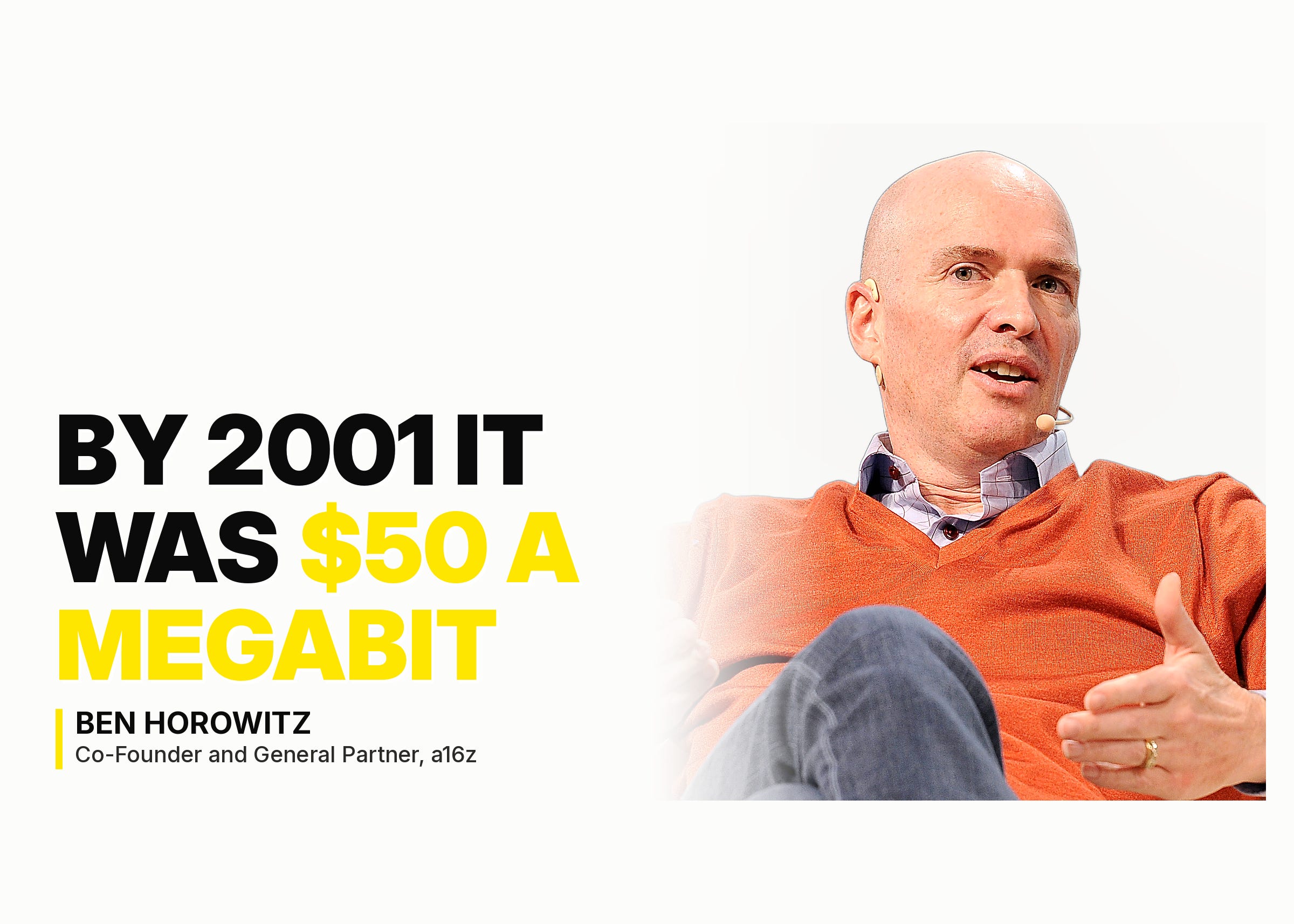
Ben Horowitz, a co-founder of Andreessen Horowitz, watched the price of bandwidth fall from $1,500 a megabit to $50 by 2001. He said that lesson is why a16z stays out of neoclouds, the companies such as CoreWeave that borrow to buy chips and rent out computing power.
That was one of 16 episodes in this issue. The others ranged from Harrison Chase, who said LangChain spends roughly 30% of its engineering salaries on AI coding tools, to Peter Schiff on $2 trillion of paper losses at mortgage lenders, and Tim Travis on a private-credit fund priced as if its loans recover 74 cents on the dollar.
"Bandwidth was $1,500 a megabit... by 2001 it was $50 a megabit. So if you were holding bandwidth and you borrowed money to get it, you're dead." — Ben Horowitz, Co-Founder and General Partner at a16z, on All-In (Read summary)
We scanned 803 shows and 10 hours of audio, wrote 16 summaries, and pulled 37 quotes into this 14-minute read.
Here is what mattered.
Macro
The most profitable large stocks trade at 11x book value, against a 7x peak in 2000
Tobias Carlisle's own research tracks a profitability factor, a group of highly profitable stocks that has predicted strong returns among the market's largest companies.
"In 2000 that [profitability] factor topped out at seven times book value... Now they're at 11 times book value." — Tobias Carlisle, Founder at Acquirers Funds, on The Acquirers Podcast (Read summary)
Mortgage lenders hold about $2T of paper losses before a single default, Schiff says
Peter Schiff said the losses come from the gap between the low fixed coupons on outstanding mortgages and today's much higher rates. They are paper losses, booked before any borrower stops paying.
"The unrealized mark-to-market losses... are $2 trillion. And when mortgage rates hit eight and a half percent, the unrealized losses are going to be $3 trillion." — Peter Schiff, CEO at Euro Pacific Asset Management, on The Peter Schiff Show Podcast (Read summary)
Banks wrote down about $450B on defaulted mortgages over the whole financial crisis
In that crisis, Schiff said, falling rates raised the value of the mortgages that kept paying, which cushioned the banks. Rising rates are doing the reverse now.
"During all the years of the global financial crisis... the total losses on defaulted mortgages that the banks had to write down was about $450 billion." — Peter Schiff, CEO at Euro Pacific Asset Management, on The Peter Schiff Show Podcast (Read summary)
International
Korea splits two managers: T. Rowe Price's McQueen holds it, Fidelity's Dance is underweight
Colin McQueen said Korea is his international value strategy's largest country exposure. John Dance named Korea and India as his two biggest underweights, after a borrowed-money rally in Korean stocks this year.
"With 70% of the Kospi Index still trading below book value... that looks like a pretty good place to be fishing for opportunities." — Colin McQueen, Portfolio Manager at T. Rowe Price, on Excess Returns (Read summary)
"It got to the point in July when things started to roll that I think it was around three and a half to four percent of the Korean population had a margin call." — John Dance, Portfolio Manager at Fidelity Investments Canada, on FidelityConnects (Read summary)
T. Rowe Price backed Rolls-Royce's rights issue at 32p, and the shares now trade at £14
McQueen said most of the stocks he buys have a restructuring angle, and Rolls-Royce is his biggest win from one. The pandemic forced the engine maker to change its labor practices and operations.
"We supported [Rolls-Royce's] rights issue at 32p. It's now trading at 14 pounds, a few years later, having roughly quadrupled what we thought it could make in terms of free cash generation." — Colin McQueen, Portfolio Manager at T. Rowe Price, on Excess Returns (Read summary)
China took 1,000 days of red tape out of drug discovery, Fidelity's Dance says
Dance splits Chinese innovation into hardware exporters, pharmaceuticals and AI. In pharmaceuticals, he said, China now has the company with the most patents on file.
"China now [has] the largest pharma company... with the largest number of patents on file. They took a thousand days of red tape out of the process for drug discovery." — John Dance, Portfolio Manager at Fidelity Investments Canada, on FidelityConnects (Read summary)
AI puts part of India's 5M-person IT outsourcing workforce at risk, Fidelity's Dance says
It is one of two reasons Dance is underweight India. The other is the country's reliance on imported gas, shipped through the Strait of Hormuz, for its fertilizer and food.
"There's 5 million people in India employed in IT outsourcing... I think some of that is at risk, if not pricing power, than jobs in general." — John Dance, Portfolio Manager at Fidelity Investments Canada, on FidelityConnects (Read summary)
Financials
Advisers who know only one spouse tend to lose the account when that client dies
Doug Boneparth said most advisers treat a household as one client and deal mainly with one spouse. When that spouse dies, the account usually leaves with the survivor.
"If that relationship leaves this earth and now you're left with, 'Oh my God, I didn't engage the spouse or the kids,' guess where the account's going." — Doug Boneparth, President and Founder at Bone Fide Wealth, on Insight is Capital (Read summary)
AI makes a financial plan cheap, but not a client's decision to follow one, Boneparth says
His firm uses AI for meeting notes and compliance records. He said plans, projections and portfolios are getting cheaper every year.
"Knowledge is cheap now and ubiquitous... the bottleneck was never information and how quickly you could get it. It was agreement on a decision and who's gonna help them follow through with it." — Doug Boneparth, President and Founder at Bone Fide Wealth, on Insight is Capital (Read summary)
Alternatives and PE
Cornell Communities owns the land under its mobile homes, and residents maintain the homes
Leo Young's firm buys and runs manufactured-housing communities, mostly in the Midwest and Southeast. It pays for the water and sewer lines; the residents own their homes.
"We're quite literally the landlord... you manage the infrastructure and common area maintenance, but not the home maintenance. So it's a good kind of business model because the residents manage their own maintenance." — Leo Young, Founder and Managing Partner at Cornell Communities, on The Investor with Joel Palathinkal (Read summary)
Family offices pick a manager they trust over a higher promised return, Wilson says
Richard Wilson's Family Office Club runs about 30 investor events a year. He said meeting in person makes a deal far more likely to close.
"Every family office I know would rather invest with someone that they trust and have deep conviction in, even if they're promising way less returns than someone that promises the moon." — Richard Wilson, Founder at Family Office Club, on Centimillionaire Strategies (Read summary)
MSDL is priced as if its loans recover only 74 cents on the dollar, Travis says
Tim Travis owns MSDL, a business development company, a type of fund that lends to private companies. He said that recovery rate would be a worse outcome than the financial crisis, and that the loans' floating rates help when rates rise.
"What's priced in right now for MSDL is that all of their loans would have to only recover like 74 cents on the dollar... that's a hell of an opportunity. You get like a 13% yield." — Tim Travis, Co-Author of the Value Options Letter, on The Acquirers Podcast (Read summary)
VICI trades at 10x cash flow with full occupancy and 40-year leases, Travis says
VICI Properties is a real estate investment trust that owns casino properties and leases them to their operators. Travis said its dividend yield is 8% and management keeps raising it.
"VICI... that's trading at 10 times cash flow. So think about this: you're buying a real estate investment trust with 100% occupancy and the lease terms are like 40 years, and your tenants are Caesars Palace and MGM." — Tim Travis, Co-Author of the Value Options Letter, on The Acquirers Podcast (Read summary)
Hedge-fund leverage, not AI, is what is unwinding this year, Visser says
Jordi Visser, a former hedge-fund chief investment officer, pointed to Lone Pine Capital, which he said gave back its whole first-half gain by the end of September. He compared this year with the 1998 unwinding of Long-Term Capital Management.
"You are making a bet as to how long your investors will stay with you... We are watching leverage come out of the system." — Jordi Visser, Macro Investor and former CIO at Weiss Multi-Strategy Advisers, on The Pomp Podcast (Read summary)
Trend following's 5.6% long-run return turns negative without its 20 best months
Katy Kaminski was citing a paper by Quantica Capital. She said investors who sell after a bad stretch and buy after a good one miss those months, and that this was far more common in liquid funds than in private ones.
"They kind of highlighted that the average return in Trend was about 5.6% over a huge horizon. But they said if you took out the 20 largest months... you basically go to negative half a percent." — Katy Kaminski, Chief Investment Strategist at AlphaSimplex, on Top Traders Unplugged (Read summary)
Bonds move with stocks when inflation is the main risk, Kaminski's own research finds
Her paper argues bonds lose their safe-haven role in those periods, as they did in 2022 and again this year. She added that bonds are still worth holding when their yield is high enough.
"It's called Bonds Behaving Badly... basically what we show is that bonds tend to co-move sometimes with stocks when inflation is a key risk." — Katy Kaminski, Chief Investment Strategist at AlphaSimplex, on Top Traders Unplugged (Read summary)
Consumer
Most hospital patients come through programs that pay less than the cost of care
John D'Angelo, who runs New York State's largest healthcare provider, said Medicaid and Medicare both reimburse hospitals below cost. Patients with commercial insurance cover the gap.
"You're losing money with 70% of the people that walk through your door." — John D'Angelo, President and CEO at Northwell Health, on Bloomberg Television (Read summary)
Northwell's doctors spend 20 minutes on a computer for every 10 with a patient
D'Angelo said AI should take on that paperwork, while any decision of consequence stays with a person.
"Our doctors spend twenty minutes on a computer for every ten minutes face to face with their patients. That's not acceptable." — John D'Angelo, President and CEO at Northwell Health, on Bloomberg Television (Read summary)
M42 has sequenced more than 950,000 genomes for Abu Dhabi's genome program
Dimitris Moulavasilis said the data lets doctors catch inherited disorders in months rather than years, and corrects the underrepresentation of the region in global genetic research.
"So far we have sequenced more than 950,000 genomes at 30x depth, both long read and short read." — Dimitris Moulavasilis, Group CEO at M42, on CNBC International (Read summary)
A biobank pays its way only when its samples feed research and care, M42's CEO says
Moulavasilis said the Abu Dhabi Biobank earns its keep by drawing drug-industry researchers, producing diagnostics that insurers pay for, and attracting investment.
"If you run a Biobank just for storage, you do have an expensive freezer." — Dimitris Moulavasilis, Group CEO at M42, on CNBC International (Read summary)
Porsche's price increases cover only its top 10,000 cars, its CEO says
Michael Leiters said Porsche is not raising prices across its range. Entry models such as the Macan and the 718 stay important for younger buyers.
"20% on the top 10,000 cars and customers." — Michael Leiters, CEO at Porsche, on Bloomberg Hot Pursuit! (Read summary)
Porsche reset its China business but still earns good money there, its CEO says
Leiters said Porsche now treats China as a smaller, profitable market built mainly on SUVs and hybrids rather than the 911.
"It is still an important market for us in Porsche. We won't give up this market and we earn good money in this market." — Michael Leiters, CEO at Porsche, on Bloomberg Hot Pursuit! (Read summary)
PepsiCo cut Frito-Lay prices toward store brands, then quietly reversed it
Dan Kent and his co-host read the reversal as a sign that price cuts are not bringing shoppers back. They cited similar comments from McDonald's, Burger King's owner and Domino's.
"Your Frito-Lay products were priced like 10% above the in-house brand... and now they've gotten rid of it." — Dan Kent, Co-Host at The Canadian Investor, on The Canadian Investor (Read summary)
Technology & AI
LangChain spends roughly 30% of its engineering pay on AI coding tools, its CEO says
Harrison Chase said the share fell after LangChain tracked every engineer's usage, set budgets that trigger a conversation rather than a hard stop, and built its own coding agent.
"I think we spend probably roughly 30% of our engineering salary on coding tools. It's actually gone down the last two months, while... the number of tokens that we've used has actually gone up." — Harrison Chase, Co-Founder and CEO at LangChain, on 20VC (Read summary)
One misconfigured plugin cost LangChain about $40K in a week
The plugin captured the underlying code of a web page, its DOM, and sent it back to the model on every step of the agent's work.
"We had one or two tasks where some plugin was being used that would screenshot... the DOM of a web page and send that back every turn of the agent... It would just run this massive loop. I think we spent 40k in a week on that one thing." — Harrison Chase, Co-Founder and CEO at LangChain, on 20VC (Read summary)
The domain experts who write an agent's tests will capture its value, Chase says
Verification here means the tests that score whether an AI agent did a job well. Chase said those tests are hard to write without knowing the field, which favors agents built for one industry.
"If value is derived through verification, I think the people who win are the domain experts... I'm massively bullish on vertical agents for different domains for this reason." — Harrison Chase, Co-Founder and CEO at LangChain, on 20VC (Read summary)
An AI tool built for the sales team raised its use 5-10x, Family Office Club's founder says
Richard Wilson's sales tool pulls a prospect's history from the firm's records and call transcripts and suggests talking points during a call. He said giving everyone the same general chatbot produces generic results.
"Before this, we had our sales team using a custom GPT and they were using it 1,500 to 1,800 times a year. Then we put the sales intelligence center in place and they're using it hundreds of times in a single week. So their uses went up 5 to 10x." — Richard Wilson, Founder at Family Office Club, on Centimillionaire Strategies (Read summary)
An a16z test found that an Anthropic-model agent could break into a site Claude had coded
Ben Horowitz said a website built with Anthropic's Opus 4.5 model left a security hole, and a second Opus 4.5 agent found it.
"The agent using Opus 4.5 breaks into the website and steals all the customer data immediately... we call Anthropic and what they tell us is, you prompted it wrong." — Ben Horowitz, Co-Founder and General Partner at a16z, on All-In (Read summary)
Even a $200B raise buys Anthropic only a few gigawatts of computing, Chamath says
Chamath Palihapitiya said Anthropic should price its planned IPO low enough to raise $200 billion or more, rather than push for the highest valuation, so it can pay for its own computing capacity.
"$200 billion barely gets them a few gigawatts." — Chamath Palihapitiya, Founder and CEO at Social Capital, on All-In (Read summary)
AI computing faces scarcity, not a glut, Craft Ventures' Sacks says
David Sacks said the selloff in CoreWeave's unsecured bonds did not reach its asset-backed project loans, and that customers are signing longer contracts for computing capacity.
"If anything, we believe that there's not a glut — it's the other way, that there's enforced scarcity." — David Sacks, General Partner at Craft Ventures, on All-In (Read summary)
Hyperscalers' depreciation is a fraction of their AI spending, which flatters earnings, Travis says
Depreciation spreads the cost of chips and buildings over several years, so reported profit takes a smaller hit than cash does in the year the money is spent.
"Hyperscalers are spending like $600 billion, and I think the depreciation might be like a fifth or a sixth of that. So they're not taking nearly as big a hit to earnings as they are to free cash flow." — Tim Travis, Co-Author of the Value Options Letter, on The Acquirers Podcast (Read summary)
CoreWeave's debt: customers that won't default, or a hard business at 10%-plus rates
CoreWeave's bonds sold off this week. Jordi Visser said its capital comes from Microsoft, OpenAI and Meta, unlike the weak borrowers behind the 2008 housing bubble. Simon Belanger said the cost of that debt is the problem.
"It's actually coming from Microsoft, from OpenAI... Microsoft's not defaulting. Meta is not defaulting. OpenAI is not defaulting." — Jordi Visser, Macro Investor and former CIO at Weiss Multi-Strategy Advisers, on The Pomp Podcast (Read summary)
"It's hard to make a business model work on 10% plus debt... you need a pretty solid business to be able to make it work on 10% cost of capital." — Simon Belanger, Co-Host at The Canadian Investor, on The Canadian Investor (Read summary)
Other appearances:
Snap Inc. CEO on Snap's smart-glasses bet against Meta on Forbes
VC & Startups
A valuation discount to raise from Sequoia or Benchmark is worth taking, LangChain's CEO says
Chase said Benchmark acted as a third co-founder when LangChain was two people, and Sequoia joined a few months later.
"I think absolutely it's worth taking a discount for Sequoia and Benchmark and probably other of these top-tier, tier-one VC firms." — Harrison Chase, Co-Founder and CEO at LangChain, on 20VC (Read summary)
Nuggets of Wisdom
Diversify as an investor, specialize as a fund manager, Cornell Communities' founder says
Leo Young cited Blackstone's early years as the model: one kind of deal, mastered before the firm added another.
"As an LP, yes, diversification... you want a series of uncorrelated assets. But as a GP, it's hard to get good at a playbook when you're trying to get good at five playbooks at a time." — Leo Young, Founder and Managing Partner at Cornell Communities, on The Investor with Joel Palathinkal (Read summary)
If this was worth your time, send it to someone who has to follow all of this too.
What did you think of today’s edition? Hit ‘reply’ to this email, send us a message, leave a comment, or join the chat!
Get the latest market chatter as it happens: