

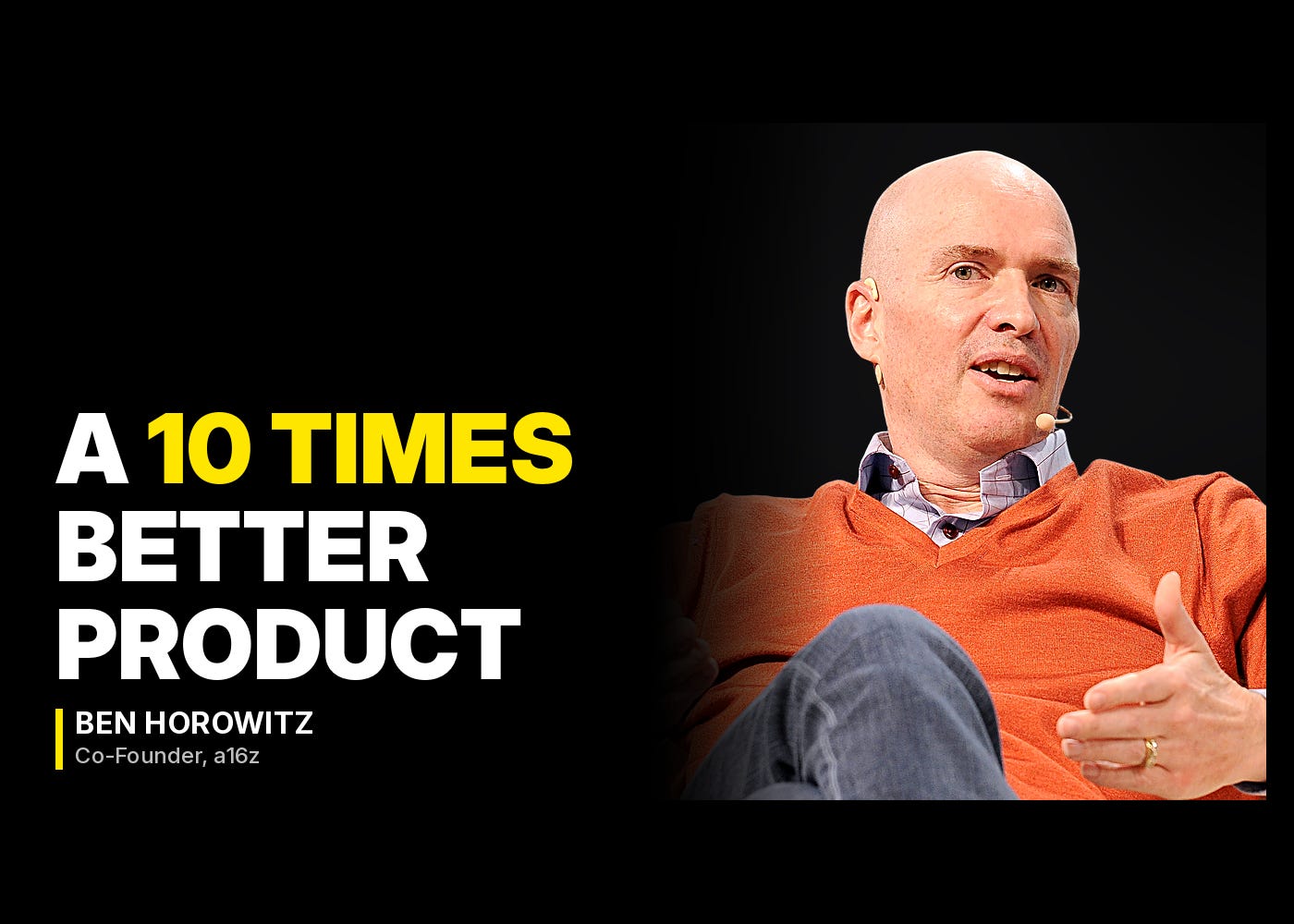
Photo via Wikipedia (Wikimedia Commons: TechCrunch Disrupt San Francisco 2018 - day 2)
Ben Horowitz, co-founder of a16z, told the firm's own show that a startup needs a product roughly 10 times better to pull users away from an incumbent like ChatGPT.
Most critics of AI startups say they have no moat because they sit on someone else's model. Ben said the moat comes from possession, specialized models and proprietary usage data, and that being slightly better wins nothing.
"You're not a great entrepreneur unless you feel like you don't have a choice but to build a company."
Ben took Opsware public on $2 million of trailing revenue when the alternative was bankruptcy, then co-founded a16z in 2009 and rebuilt how a venture firm helps founders win.
The full interview is covered here so you can skip it. 42 minutes of audio, 10 minutes of reading.
Here are the 9 lessons that matter.
a16z · Oct 24, 2026 · 42m · 32m saved
With Ben Horowitz, Co-Founder at a16z
Key Takeaways
AI is a "probabilistic computer" that reaches giant audiences almost instantly, because the internet it runs on is already built and adopted
Netscape had 90% browser share in 1996 and still only 55 million users
Instagram sold for $1B with 13 people, but Ben doubts tiny teams can hold a big outcome against better-funded rivals
The "GPT wrapper" critique is wrong, Ben said, because AI apps like Cursor run about 14 models and gather proprietary usage data
Possession is "nine-tenths of the law," so a rival needs a product roughly 10x better, not slightly better
A VC's core job is momentum, helping one founder beat a rival with the same idea and an equally good team
a16z split into vertical teams in 2011 after concluding software would create 150 scalable startups a year, not 15
Opsware went public on $2M of trailing revenue because the only other option was bankruptcy
Founders fail more from hesitation than from bad judgment, Ben said, by delaying painful calls that are obviously necessary
1. AI is a new computer
Ben opened by separating AI from the internet boom it is most often compared to. The internet was a network that needed adoption before it was worth much, while AI arrived on a network that already existed.
AI is a probabilistic computer, the next step after mainframes, PCs, smartphones and the internet
"I think in this era, AI is the new computer, like very clearly. It's a probabilistic computer where we previously had deterministic computers." — Ben Horowitz
Ben placed AI in a long line of computing shifts that added to each other rather than replaced each other. Each new kind of computer, in his telling, sat on top of the ones before it.
Netscape dominated a small internet, while AI can reach a giant user base almost at once
"At Netscape in 1996, we had 90% browser share and we had 55 million users... the whole internet wasn't that big... Whereas with AI, when it works, almost instantly you can get to a giant number of users." — Ben Horowitz
Many of those 55 million users were on dial-up. Ben said that slow adoption is why the dot-com and telecom crashes came before the internet "got there," a lag AI does not face.
