

Summation with Auren Hoffman · Nov 10, 2026 · 54m · 45m saved
With Omer Ismail, CEO of OnePay
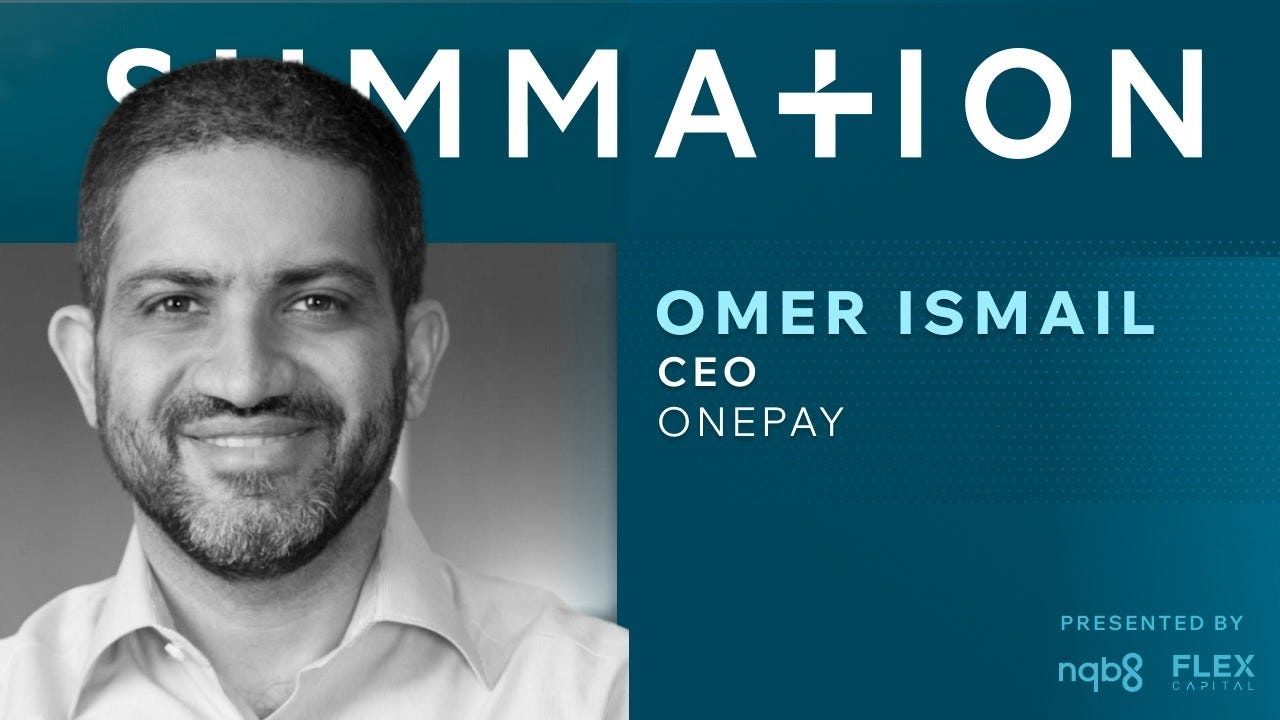
Walmart has around 150 million weekly shoppers, and about 90% of Americans live within ten miles of one of its stores. Omer Ismail, CEO of OnePay, told Auren Hoffman, founder of SafeGraph, on Summation that this lets OnePay sign up customers for its banking app at effectively zero acquisition cost.
Most fintechs spend heavily on marketing and need high margins to pay for it. Omer says OnePay can hand those savings back as lower fees, and that its real rival is not another app.
"Our biggest competition is customer inertia. There are tens of millions, hundreds of millions of Americans that could be saving more because they are paying extra in areas where they shouldn't be, or their money isn't working as hard for them as it should be." — Omer Ismail
Omer ran Marcus, Goldman Sachs's consumer bank, until 2020, when it had about $1 billion of revenue and more than 10 million customers. He immigrated from Pakistan with no credit history, which shaped one of OnePay's newest products.
The full interview is covered here so you can skip it. 54 minutes of audio, 9 minutes of reading.
Here are the 9 takeaways that matter.
Key Takeaways
OnePay gives AI agents a separate sub-account with a hard spending limit, so they never touch a customer's full balance
Walmart supplies customers at zero acquisition cost, which lets OnePay charge lower fees
OnePay's agent, Penny, moves money with permission instead of only offering insights, as Mint did
Omer estimates a good agent could save the average consumer "thousand, few thousand dollars a year"
OnePay partners with banks rather than becoming one, in exchange for FDIC-insured deposits
A teen account built on secured credit-card rails gives a teenager a credit score by 18
Marcus taught Omer that big companies struggle to start new businesses, which is why OnePay sits outside Walmart
Omer calls experience overrated and hires for hunger and grit
1. Hide the Complexity
Omer described OnePay's product around three tenets. It hides the complexity of the US financial and regulatory system, returns the value that fees and high-cost credit now take from customers, and personalizes offers to each person.
Omer Ismail would rather top up a savings goal than pay flat cashback
A flat 1-2% cashback is generic. Omer would rather add money to a customer's named savings goal, such as a bike for their child. The internal test for simplicity is whether his mother or sister would be comfortable using the product.
He sees the first generation of fintech as point solutions, a checking account in one app and a buy-now-pay-later loan in another. The next generation will hold the whole wallet and act as a one-stop shop, which means OnePay has to recommend a competitor's product when it is better.
"The promise of AI in my mind is... lower someone's bills, cancel your subscriptions, pay off high-cost debt so that you can refinance it, earn more on your savings." — Omer Ismail
