

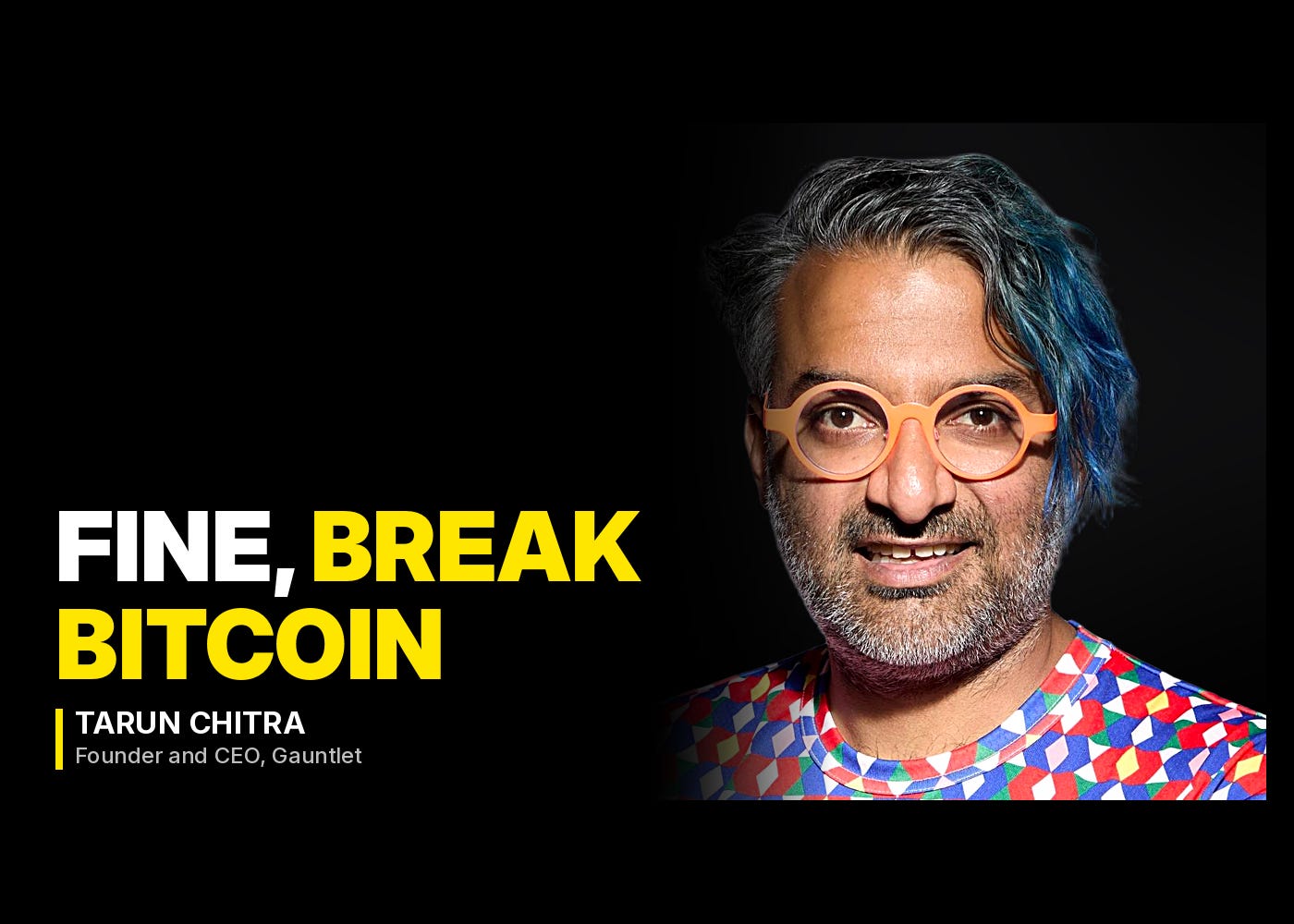
Photo via fortune.com
In the weeks before this conversation, Tarun Chitra said, AI systems broke McEliece — a classical cryptosystem that had been considered a leading candidate for the post-quantum world.
Most of crypto treats the idea of AI breaking all of cryptography as a distant, unanswerable hypothetical. Tarun built an entire episode around arguing that something would actually survive it.
"What happens if all cryptography breaks? Suppose AI breaks the assumptions of everything we know — breaks Bitcoin, breaks Ethereum, breaks ZK. What do we have left?"
Tarun founded and runs Gauntlet, a risk-management firm that has advised on parameters for major DeFi protocols, and spent the episode making the case for an idea from 1974 that he says most of the industry has forgotten.
The full interview is covered here so you can skip it. 23 minutes of audio, 7 minutes of reading.
Here are the 6 takeaways that matter.
The Rollup · Oct 26, 2026 · 23m · 16m saved
With Tarun Chitra, Founder and CEO of Gauntlet
Key Takeaways
AI systems recently broke McEliece, a classical cryptosystem considered a leading post-quantum candidate, Tarun said — distinct from quantum computers breaking crypto through brute force
Several L2s shut down for a straightforward economic reason, Tarun said: they paid a continuous cost to stay alive with no matching demand
Ethereum's highest-value role is being a hard-to-forge registry of identity and assets, not a "world computer," Tarun said, agreeing with a new Vitalik Buterin paper
Quantum money, a 1974 idea, generates a one-time private key from an unmeasurable quantum state — something Tarun compares to biometric information intrinsic to its holder
The no-cloning theorem makes quantum states resistant to both classical and AI attacks, unlike private keys generated from a seed, which an entropy failure can expose
In a world of trustworthy agentic coding, you can spin up a rollup for one application and destroy it when the demand ends, Tarun said
1. What Survives If AI Wins
Tarun opened by framing the entire conversation around one question that he says most crypto builders avoid.
Tarun built the episode around what survives if AI breaks every cryptographic assumption crypto relies on
"What happens if all cryptography breaks? Suppose AI breaks the assumptions of everything we know — breaks Bitcoin, breaks Ethereum, breaks ZK. What do we have left?"
He argues builders have mostly treated that scenario as meaning they'd simply be sitting ducks, and spent the rest of the conversation making the case that something does in fact survive it.
