

AI hyperscaler debt will overtake the big US money-center banks as the bond market's largest concentration risk within the next year and a half, Loren Moran, a fixed income portfolio manager at Wellington Management, said on Wall Street Week.
"Harkening back to when we think about post-GFC and thinking about money center bank concentration, which typically has been the largest source of concentration risk in the market that we've dealt with, The AI hyperscaler trade will easily overtake the U.S. money center banks in terms of concentration over the course of the next year and a half." — Loren Moran, Fixed Income Portfolio Manager at Wellington Management, on Wall Street Week (Read summary)
That was one bond manager's read of one credit market. Below are 48 more quotes from 48 other speakers tonight. Jamie Dimon says it is government borrowing, not AI, that is crowding other borrowers out of capital; Pat Gelsinger expects more AI data-center projects to default as power supply falls behind demand; and Ray Dalio puts 5% to 15% of a portfolio in gold as the right hedge against debt.
We scanned 562 shows and 15 hours of audio, wrote 20 summaries, and pulled 49 quotes into this 21-minute read.
Here is what mattered.
Macro
SpaceX's IPO was priced at $1.4 trillion but only $80 billion of that actually traded, Jenny Johnson says
"I THINK A GREAT EXAMPLE IS SPACEX IPO. I THINK IT WENT OUT AT LIKE $1.4 TRILLION BUT THEY ONLY FLOATED ABOUT $80 BILLION. I CAN'T REMEMBER EXACTLY. THAT'S MONEY YOU CAN TRADE IN THE MARKET. THE REST IS WEALTH. DON'T ASSUME WEALTH CAN TRANSLATE INTO MONEY UNTIL IT DOES." — Jenny Johnson, CEO at Franklin Templeton, on Bloomberg Television
Government borrowing, not AI, is what is crowding out other borrowers, Jamie Dimon says
"I mean, the crowding out is coming from the government. So governments around the world are borrowing record sums of money, which is inflationary, by the way, including our government, which is huge." — Jamie Dimon, CEO at JPMorgan, on Wall Street Week
5% to 15% of a portfolio in gold is the right diversification against debt, Ray Dalio says
"the opposite of debt, as a store of wealth, is gold. And if you create a diversification — I'm not touting gold, I'm saying, as a diversification, that if you did an optimization of risk and return, somewhere between five and 15% of one's portfolio in gold is a good asset." — Ray Dalio, Founder at Bridgewater Associates, on CNBC International Live
Nvidia alone earned more in a year than the entire Russell 2000 combined, Charlie Bilello says
"And it's hard to believe, but Nvidia's net income over the last 12 months, $193 billion. So just a huge number. But if you add up all of the companies in the Russell 2000, their net income was actually down 14 billion over the last year." — Charlie Bilello, Chief Market Strategist at Creative Planning, on Creative Planning (Read summary)
No one is prepaying their mortgage anymore, which is pushing Treasury yields up a different way, Jurrien Timmer says
"I think part of it is actually technical, and this gets into a topic that Tom loves, which is the whole negative-convexity hedging in the mortgage-backed securities market — no one is prepaying mortgages because everyone is out of the money on their mortgage, since yields are rising. So the duration of the Bloomberg MBS index is going up while the duration of the Treasury index is going down." — Jurrien Timmer, Director of Global Macro at Fidelity, on Bloomberg Podcasts
France could be the Orange County of 2027, not a data-center borrower, Thierry Wizman says
"We're not going to see a financial stress at a hyperscaler, or someone who's been financing data centers. Certainly not yet. Where we're going to see it is the guys who are not in that industry, but are getting hurt by the high yield, the movement in yields. And by the way, France could be the Orange County of 2027." — Thierry Wizman, Global Currencies & Interest Rate Strategist at Macquarie, on Bloomberg Surveillance (Read summary)
Other appearances:
Regions Asset Management Chief Market Strategist on the equity risk premium turning negative with the 10-year at 5.3% on Money Life with Chuck Jaffe
International
JioStar's Vice Chairman says 80% of Bollywood's revenue is domestic while 80% of Hollywood's comes from outside the US
"Right now, 80% of the revenue generated by Bollywood is internal, domestic. 80% of Hollywood is actually external." — Uday Shankar, Vice Chairman at JioStar, on Bloomberg Television
China cannot make the renminbi a reserve currency because it does not import enough, Maria Vassalou says
"In other words, you need to be a big importer in order to be the reserve currency. And that's just — you need to be a big importer, and you need to be a producer of safe assets, because if you hold renminbi, you don't have anything to invest them in, whereas if you receive dollars, then you invest them in Treasuries, you earn a yield." — Maria Vassalou, Head of the Pictet Research Institute, on Masters in Business (Read summary)
French 10-year yields have risen twice as much as Germany's since June, Barclays' Rohan Khanna says
"Now remember bond yields have risen everywhere. Ten-year German yields have risen by about 60 to 70 basis points. Ten-year OAT yields have risen by about 120 to 130 basis points. And across the EGB complex you've seen yields go up. So it's not just a France story, but the widening that you see in OAT Bunds is a reflection of idiosyncratic, French-specific dynamics where you have deficits, you have a budget that has to be decided and, on top of that, you have political uncertainty. The market's telling you that the level of uncertainty and the challenges that the French policymakers face are causing a buyer strike." — Rohan Khanna, Head of European Rates Strategy at Barclays, on Barclays Brief
90% of an Australian AI data-center company's revenue backlog comes from two customers, one for a Malaysian site that does not exist, Ed Zitron says
"90% of its revenue backlog comes from two customers, Meta, as mentioned, and an unnamed major global technology company, as well as, though this wasn't in the prospectus, a multi-year deal to provide compute to OpenAI out of data centers in Malaysia that do not exist and, let's be honest, will never exist." — Ed Zitron, Host at Better Offline, on Better Offline
Germany is losing up to 10,000 auto-manufacturing jobs a month, the Hinrich Foundation's Deborah Elms says
"I WOULD POINT TO THE GERMAN AUTO SECTOR. WHERE THE PROBLEMS ARE VERY STARK. IF YOU ARE LOSING MANUFACTURING JOBS AT UP TO 10,000 JOBS A MONTH, THAT IS AN ACUTE CHALLENGE DOMESTICALLY THAT NEEDS TO BE SORTED OUT." — Deborah Elms, Head of Trade Policy at the Hinrich Foundation, on Bloomberg Television
Financials
Lazard is hiring more managing directors so each deal team can be leaner, Peter Orszag says
"I think the most exciting thing for junior bankers today is the opportunity to change the way that we work, so that you have leaner deal teams. We're hiring more managing directors, so there will be more deal teams, but on each deal team, a leaner deal team." — Peter Orszag, CEO at Lazard, on Bloomberg Television (Read summary)
Shareholder rights have deteriorated sharply in the last few years, Norway's wealth fund CEO Nicolai Tangen says
"We generally have to be invested in the companies for the long term. And the problem is that shareholder rights have deteriorated pretty sharply over the last few years. Shareholder rights, that is your ability to vote. It means that one share has got one vote. It means that you have the ability to sue a company and a board and so on." — Nicolai Tangen, CEO at Norges Bank Investment Management, on In Good Company with Nicolai Tangen (Read summary)
AI-linked investment-grade bonds have widened 75 basis points in a year, against zero for everything else, Jeffrey Gundlach says
"But if you break it into two sectors, AI investment grade and investment grade excluding AI, you see to two totally different things. Investment grade excluding AI has not widened at all. AI investment grade over the past year has widened 75 basis points and that was as of a couple weeks ago. It's probably more than that now. Go to the high yield market. high yield market spreads are out a little bit on average, but again, if you do the non AI high yield bond market, it's pretty close to its tights. If you do the AI high yield bond market, it's out by over 150 basis points." — Jeffrey Gundlach, CEO at DoubleLine, on DoubleLine Capital (Read summary)
Triple-C bond spreads have broken above 1,000 basis points, and a five-year real-estate loan now costs 8-9%, Peter Boockvar says
"If you look at the lowest in high yield, being the triple-Cs, the triple-C credit spread relative to Treasuries has now broken above a thousand basis points. The yield in triple-C is 15%. So you are already seeing an immediate impact, particularly for those companies that are refinancing. So, keep in mind, what was five years ago — 2021 — it was an epic, euphoric market. You had the whole meme-stock craze, the SPAC craze. If you had a heartbeat and a pulse and a PowerPoint presentation, you were able to raise money. Well, those that borrowed — they did it in equity, but even on debt, call it 3%, you were able to get a loan, particularly in real estate. That loan right now, if it comes through, that five-year loan, you're going to pay 8 to 9%." — Peter Boockvar, CIO at Bleakley Financial Group, on RiskReversal Pod (Read summary)
Other appearances:
Susquehanna International Group Head of Prediction Markets on data-center developers hedging against tenant-bankruptcy risk on Money Stuff: The Podcast
Crypto and Digital Assets
Stablecoins are not a threat to Mastercard, they're a foundation it wraps a business around, Michael Miebach says
"I THINK IT IS YET ANOTHER TECHNOLOGY TO MOVE MONEY. I DON'T LOOK AT IT AS A THREAT AT ALL. I LOOK AT IT AS AN OPPORTUNITY. ALL OF THESE PAYMENTS STILL NEED TO DO WHAT CONSUMERS EXPECT FROM ME, THAT THEY ARE WELL PROTECTED. IF SOMETHING GOES WRONG, WHAT HAPPENS? THE STABLECOIN IS THE FOUNDATION. WE PUT A WRAPPER AROUND IT AND THAT'S WHAT WE DO AND HOW WE MAKE MONEY." — Michael Miebach, CEO at Mastercard, on Bloomberg Television
Bitcoin ETF flows are down from 2024's peak but still up cycle over cycle, Bitwise's Matt Hougan says
"And what you want to do is compare 2026 over 2022. And what you can see is while the flows have come down from sort of the glory days of ETF launching, they're up significantly cycle over cycle." — Matt Hougan, Chief Investment Officer at Bitwise Asset Management, on The Wolf Of All Streets (Read summary)
Alternatives and PE
400 Capital avoids lending against data-center buildings because power equipment, not the building, is the real asset, Chris Hentemann says
"So we've taken this approach that data center financing for the shell — it's questionable whether we like the alternative-use case on that, just philosophically. We looked at a lot of it, we continue to look at it, we'll see how those things evolve — they're a little bit of a stretch in that context. But what we do like is we recognize that power is in huge demand — power's got some old school technology, not new technology, that has, let's call it, depreciation schedules and secondary markets and, most importantly, alternative uses, beyond whether it works in around the data center or not, that we tend to like." — Chris Hentemann, Founder and CIO at 400 Capital Management, on Alpha Exchange (Read summary)
Too many CLOs are forming with equity returns that are modeled too optimistically, Shiloh Bates says
"The incentive for the CLO manager is always to form new CLOs quickly because that's how they get paid. They get paid a management fee when they call the capital. Because of that, there's too many CLOs forming in my opinion. And they're forming with equity returns, modeled or projected equity returns that are poor." — Shiloh Bates, Chief Investment Officer at Flat Rock Global, on The CLO Investor Podcast (Read summary)
Consumer
Las Vegas Sands doesn't see prediction markets as a threat because live entertainment is a different product, Patrick Dumont says
"WE DON'T REALLY OFFER THE SAME EXPERIENCE THAT THEY DO. WE ARE VERY MUCH RELATED TO PEOPLE TO PEOPLE REACTION. IT IS ABOUT THE EXPERIENCE YOU GET LIVE. YOU HAVE A GREAT DINNER. YOU STAY IN WONDERFUL HOTEL ROOM. WE LIVE ENTERTAINMENT THAT YOU SEE. IT IS A COMPLETELY DIFFERENT EXPERIENCE THAN WHAT YOU WOULD GET LOOKING AT YOUR PHONE PLACING PREDICTION MARKET BETS. IT IS A DIFFERENT PRODUCT." — Patrick Dumont, CEO at Las Vegas Sands, on Bloomberg Television
Lab-grown diamonds went from 1% of a $100B-a-year market in 2015 to almost 30% last year, Astria London's Natalie Morrison says
"$100 billion market a year. The lab grown diamond industry was 1% of the market in 2015, 5% in 2021, almost 30% last year, although we don't know the exact number." — Natalie Morrison, Founder at Astria London, on Bloomberg Businessweek
60 podcasts on the Black Effect Network do very well on revenue and listenership, Charlamagne Tha God says
"but then I've also built this amazing business, this amazing infrastructure with iHeart called the Black Effect Podcast Network. We have, you know, 60 podcasts on our platform, and we do very well when it comes to, you know, revenue, advertising dollars, when it comes to, you know, listenership." — Charlamagne Tha God, Host at iHeartRadio, on Bloomberg Talks
Paramount Skydance's $82 billion of new debt means the math on streaming consolidation is very difficult, Scott Galloway says
"The key number here is the following: $82 billion in new debt on a combined entity. That means massive cost cutting. It's a company betting that its balance sheet — that they'll be able to pull off what no one's pulled off so far, and that is streaming consolidation that works better than streaming competition. The math is very difficult. It's the same bet Warner Media made with AT&T, and lost." — Scott Galloway, Professor at NYU, on Pivot
Sports
Bids for the NBA's 12 planned European franchises are running into the hundreds of millions, Adam Silver says
"THEY'RE COMING IN FROM A COMBINATION OF EXISTING BASKETBALL CLUBS, SOME OF THE BIG SOCCER BRANDS IN EUROPE, AND, IN OTHER MARKETS, PEOPLE STARTING CLUBS FROM SCRATCH. VERY POSITIVE IN TERMS OF VALUATIONS — MANY HUNDREDS OF MILLIONS OF DOLLARS FOR FRANCHISES. IT'S A SORT OF ONCE-AND-FOREVER OPPORTUNITY TO BE THE NBA TEAM IN LONDON, PARIS, MADRID, MUNICH — SOME OF THE TOP MARKETS IN EUROPE AND IN THE WORLD. AND THAT'S HOW PEOPLE SEE THOSE OPPORTUNITIES." — Adam Silver, Commissioner at the NBA, on CNBC Television
The New York Liberty went from crowds under 2,000 to a sellout, with every business metric doubling, CEO Sam Zussman says
"When the size bought the team seven years ago, they actually played it at the gymnasium in Westchester, in front of less than 2000 people. And, you know, over time, we've invested in the team. We're building a training facility in Greenpoint, and we won the championship in 2024. We look forward to doing that again. And you now see that we're playing mostly in front of a sellout crowd with, business metrics doubling every year, attendance, merchandise, viewership, sponsorships." — Sam Zussman, CEO at Brooklyn Sports and Entertainment, on Bloomberg Television
Technology & AI
Logitech's gross margins run near 44%, unusual for a hardware maker, CEO Hanneke Faber says
"Our gross margins have been excellent — in the 44% range, which for hardware companies is absolutely kind of unique and outstanding. How do we do it? Mainly from designing for value." — Hanneke Faber, CEO at Logitech, on Bloomberg Podcasts
Work that took 50 people across several subteams can now be done by one person running an AI agent, Writer's CEO May Habib says
"What used to happen in three, four subfunctions of teams encompassing 50 people can now be done by one person operating an agentic system. And the intelligence that we have today so far outweighs what has actually been absorbed. Like, all of our organizations are mostly still operating on 2024 vintage AI, right?" — May Habib, CEO and co-founder at Writer, on Forbes
AI model traffic on gateways like OpenRouter has flipped from 70% closed models to 70% open ones in six months, ReflectionAI's Misha Laskin says
"Well, I think you're kind of starting to see the trajectory now, which is that maybe 6 months ago, it was majority closed minority open when you go to any gateway like OpenRouter or versell and it's flipped almost exactly from 7030 closed open to 7030 open close. Now I think that's only going to accelerate." — Misha Laskin, Co-Founder and CEO at ReflectionAI, on No Priors
Hallucinations are the main thing limiting today's language models, but they're fixable, Ilya Sutskever says
"Now on the point of hallucinations and it has a propensity of making stuff up indeed it is true right now these neural networks even ChatGPT makes things up from time to time and that's something that also greatly limits their usefulness but I'm quite hopeful that by simply improving this subsequent reinforcement learning from human feedback step we could just teach it to not hallucinate." — Ilya Sutskever, Co-Founder & Chief Scientist at Safe Superintelligence Inc. (former Chief Scientist, OpenAI), on Eye On A.I. (Read summary)
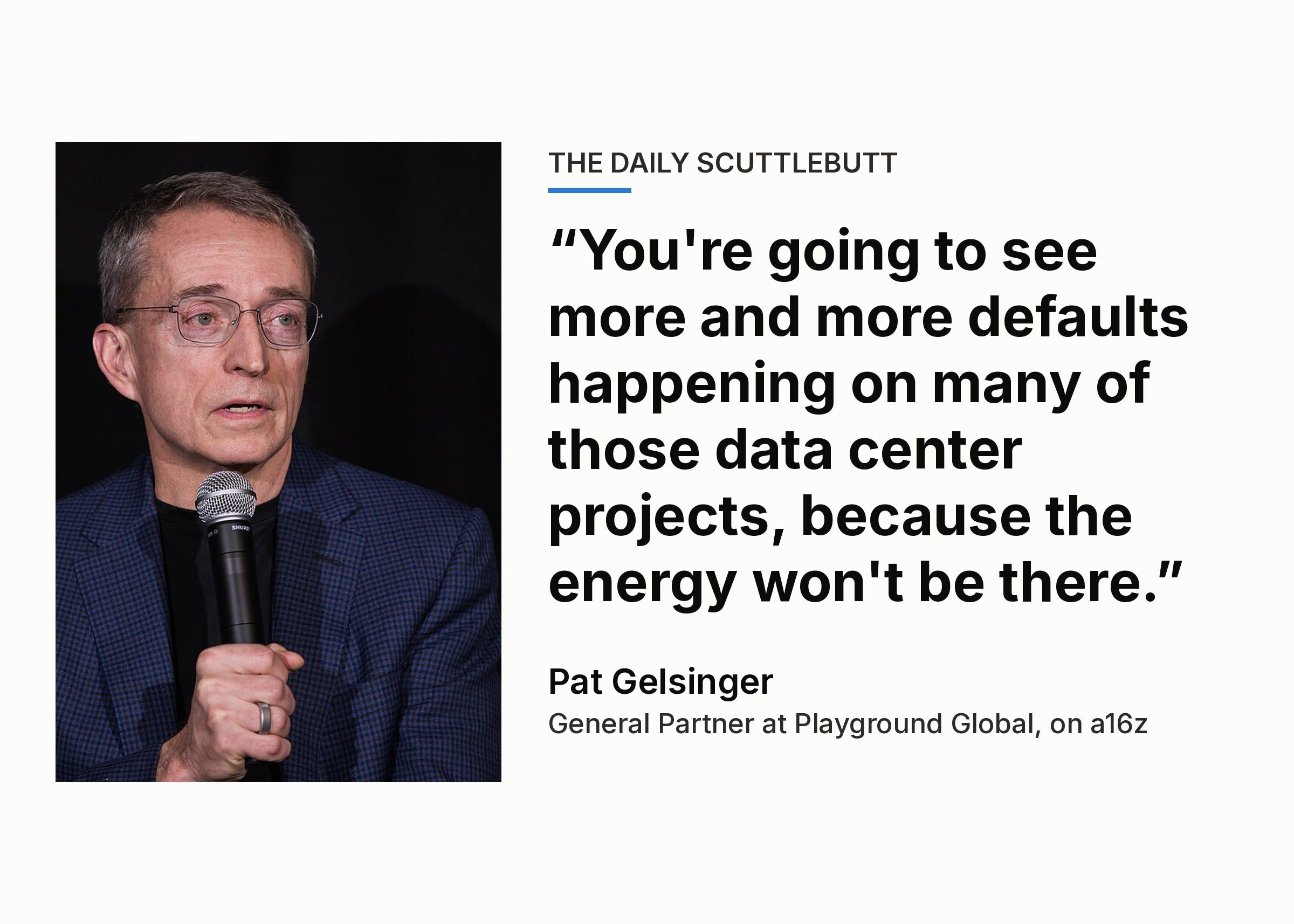
More AI data-center projects will default because the power to run them will not be there in time, Pat Gelsinger says
"Gas turbine lead times are only eight years at this point, so we really have a difficult environment to scale up rapidly. But, one, we just need more capacity. And fundamentally, energy capacity somewhat dampens how euphoric we can get on AI, right, because why build a new data center and buy the million GPUs if I can't power them, right. And I think you're going to see more and more defaults happening on many of those data center projects, because the energy won't be there." — Pat Gelsinger, General Partner at Playground Global, on a16z (Read summary)
Traditional software companies are buying AI startups because the talent they need is sitting inside one, Kleiner Perkins' Ilya Fushman says
"What you're starting to see is companies that have historically been grounded in SaaS and traditional software reinvent themselves through acquisition. And I think that's a important point for all these companies to think about, because the talent required to become an AI organization is probably sitting out there in a startup somewhere." — Ilya Fushman, Partner at Kleiner Perkins, on Bloomberg Tech (Read summary)
Three of the four hyperscalers are now net free-cash-flow negative, running the same policy as the government they blame, David Rosenberg says
"At what point does the interest rate in the corporate sector break the back of all this borrowing by the hyperscalers cuz then all of a sudden you might find they scale back their borrowings. That might be the genesis for bringing interest rates back down more reasonable levels. We all blame the government, all blame the government, government this. Meanwhile, three of the four hyperscalers are now basically net cash flow negative, right? Net free cash flow negative, right? So they're running the same policy that the government is. They're running deficits on their balance sheet." — David Rosenberg, Founder at Rosenberg Research, on DoubleLine Capital (Read summary)
Eight or ten people who don't trust each other are self-regulating one of the most dangerous technologies, Walter Isaacson says
"So the notion that you have a group of people trying to self-regulate when they don't trust each other is a problem, and it's actually a systemic problem here, which is, you're building one of the most powerful but also most dangerous technologies, and you have maybe eight or 10 people that nobody exactly trusts in charge — that's probably not the best way to do things." — Walter Isaacson, Biographer of Elon Musk and Professor at Tulane University, on CNBC Television
Other appearances:
Oceans Co-Founder and General Partner on why AI is eroding the moats that protected SaaS companies on How I Invest
Davis Funds & EquityCompass Portfolio Managers on the question of whether five competing hyperscalers can all earn back their AI spending on The 100 Year Thinkers
VC & Startups
A startup funded from laid-off workers' own severance budgets would not be viable if it charged them directly, Chieh Huang says
"A lot of those folks are getting not only retraining budgets from their previous employer, but also severance budgets. And so when you think about how much severance is actually paid throughout the United States, it's a very, very large pool of capital. I totally agree, if we were to go to those folks who were affected and charge them for our services, this is not a viable business." — Chieh Huang, Founder and CEO at Pelgo, on CNBC Television (Squawk Pod)
A $10 million seed at a $50 million valuation sets a bar the next round has to clear, True Ventures' Puneet Agarwal says
"So, like, putting the extreme stuff aside, the bigger you raise, the higher the hurdle you have to hit. And so if you raise 10 million bucks at 50 post, well, your next round should be at least 100 pre, to show progression — which means that, okay, well, the next person looking at your deal is going to look at, okay, they're not going to care that you made a bunch of progress with the 10 million off that first round, they're going to look at, have you hit the metrics that actually deserve a triple-digit valuation of some kind?" — Puneet Agarwal, Managing Partner at True Ventures, on Build Mode (Read summary)
Industrials and Transport
Ford will commit $1 billion to new Michigan suppliers for advanced manufacturing and rare-earth magnets, Jim Farley says
"Ford's going to commit a billion dollars of purchasing for new companies that are going to be building advanced manufacturing, new capabilities, even magnets and rare earth that we used to buy overseas. And now we're going to buy here with the help of JPMorgan, as well as the state of Michigan." — Jim Farley, CEO at Ford, on Wall Street Week
Ryan Petersen, CEO at Flexport, says about 30 freighters a day now fly data-center equipment from Taiwan to the US
"In both air and ocean freight, the price of fuel has been a huge barrier. Airfreight, about 40% of the cost to cross the Pacific, is from the fuel surcharges. It will be interesting to see if that is enough to impact the price, because a huge amount of the price is driven by the demand for data centers. We are seeing about 30 freighters per day flying from Taiwan to the United States with data center equipment. To put that in context, about 8% of the entire market's [airfreight capacity is] data center equipment. That is projected to grow three times over the next year. The fuel price will help, but that will be more demand than there is space in the world. It will not be enough airfreight capacity to keep up — that is our forecast going into next year." — Ryan Petersen, Founder and CEO at Flexport, on Bloomberg Television
A minute of data-center downtime can trigger financial penalties under uptime contracts, Generac's Aaron Jagdfeld says
"But at the end of the day, if you're running a data center, if you own and operate a data center, the problem is if you have even a minute of downtime in that data center, you're on the hook, oftentimes you have service level agreements that you've got with your customers that guarantee uptime, and there are actual penalties, financial penalties, to not providing that uptime." — Aaron Jagdfeld, CEO at Generac, on CNBC Television
Materials & Energy
China's growing fossil-fuel use cancels out every emissions cut made by the rest of the world, Britt Harris says
"And most people don't know that the emissions in Europe have been coming down since 1985. The emissions in America have been coming down since 1995. They need to go down more, but they've been coming down for 10 or 20 years, 30 years. China, who is coming to match up with this industrial enlargement their use in fossil fuels, hydrocarbons at such a rate that their usage is Cancels out the entirety of every reduction in the rest of the world. And you say, well, they should stop it. Here's the deal. You cannot get out of poverty without hydrocarbons." — Britt Harris, Former CIO at Bridgewater, TRS and UTIMCO, on Backtest (Read summary)
Tanker freight rates are 100 times higher than a year ago, which will keep crude prices from falling, Kpler's Michelle Brouhard says
"We know that freight rates are the highest — they're a hundred times higher than where they were this time last year. And I think the problem that we're really starting to see, and the reason that we're going to have a really hard time seeing crude prices come down, are these extremely high freight rates that we're seeing." — Michelle Brouhard, Head of Policy and Geopolitical Risk at Kpler, on Bloomberg Podcasts
Gold usually falls, not rises, on a military shock that was not completely out of the blue, Adrian Day says
"I think there is a big misunderstanding about how gold reacts to geopolitical events, particularly military events, assuming that they are not completely out of the blue like 9/11 — they tend to have a negative effect on gold, not a positive one." — Adrian Day, President at Adrian Day Asset Management, on David Lin
Policy
Spectrum deals have topped $100 billion and the FCC expects to bring in $100 billion more within two years, Chairman Brendan Carr says
"At the FCC, we've seen probably over a hundred billion dollars in deal flow in spectrum alone, and we've reinvigorated the FCC's work on spectrum auctions. We're probably going to bring over a hundred billion dollars of spectrum into the market over the next two years." — Brendan Carr, Chairman at the FCC, on CNBC Television
The administration suspended Microsoft from converting H-1B workers to permanent residents, JD Vance says
"WE HAVE DECIDED TO SUSPEND THE PERM PROGRAM FOR MICROSOFT, WHICH MEANS THEY WILL NO LONGER BE ABLE TO APPLY, THEY WILL NO LONGER BE ABLE TO TAKE THOSE H-1B'S AND APPLY FOR PERMANENT RESIDENCE STATUS WITHIN THE UNITED STATES OF AMERICA." — JD Vance, Vice President of the United States, on Bloomberg Television
Nvidia donated $1 billion of compute to the White House AI initiative, with AMD, Anthropic, OpenAI and Google adding more, Michael Kratsios says
"SO THE COMPUTE IS ACTUALLY BEING DONATED. THE BIGGEST CONTRIBUTOR IS Nvidia WITH $1 BILLION. AMD CAME IN WITH ABOUT 500 MILLION AND A NUMBER OF OTHERS. ANTHROPIC DID 150, OPENAI DID 200, GOOGLE DID 150." — Michael Kratsios, Director at the White House OSTP, on CNBC Television
Affordability, not any single policy, is the issue that will decide the midterms, Patrick McHenry says
"So the primary issue is affordability: life is less affordable today than it was two years ago. The pitch for President Trump 2.0 was to make things better, like he did pre-COVID, that the economy was roaring, wages were rising, a real feeling of prosperity." — Patrick McHenry, Former Chair of the House Financial Services Committee, on Bloomberg Talks
Geopolitics
Iran only needs to strike one or two tankers to freeze the entire marine insurance market, David Satterfield says
"And the Iranians don't have to be very good at targeting commercial vessels, carrying oil through the strait. They just have to strike one or two, and that paralyzes the entire insurance industry." — David Satterfield, Director at the Baker Institute, on Backtest
US secondary sanctions, not sabotage, were the real way to have stopped Nord Stream, Bojan Pancevski says
"But the biggest flaw in that theory was the very obvious thing that people who dealt with the issue knew, which is that sanctions are much more powerful than explosives, because the Americans have extremely powerful sanctions, so-called secondary sanctions — when they sanction a project, nobody will dare deal with it commercially. So if they had put sanctions on Nord Stream, like they did in fact after the full-scale invasion, nobody in Germany or Europe would have been able to buy gas from that pipeline — the Russians would have been able to pump the gas, but to what avail, nobody could have been purchasing gas." — Bojan Pancevski, Chief European Political Correspondent at The Wall Street Journal, on Reinvent Money
Nuggets of Wisdom
14 of the last 17 US presidential terms since 1929 produced positive stock returns, Dimensional's Jake DeKinder says
"there've been 17 presidential terms going back to 1929 and of those 17, 14 of those terms are associated with positive returns for the US stock market." — Jake DeKinder, Investment strategist at Dimensional Fund Advisors, on Dimensional Fund Advisors (The Informed Investor)
If this was worth your time, send it to someone who has to follow all of this too.
What did you think of today’s edition? Hit ‘reply’ to this email, send us a message, leave a comment, or join the chat!
Get the latest market chatter as it happens: