

All-In · Oct 9, 2026 · 1h 33m · 79m saved
With Chamath Palihapitiya, Founder and CEO of Social Capital · Jason Calacanis, Angel Investor and Managing Partner at LAUNCH · David Sacks, General Partner at Craft Ventures · David Friedberg, Founder and CEO of The Production Board
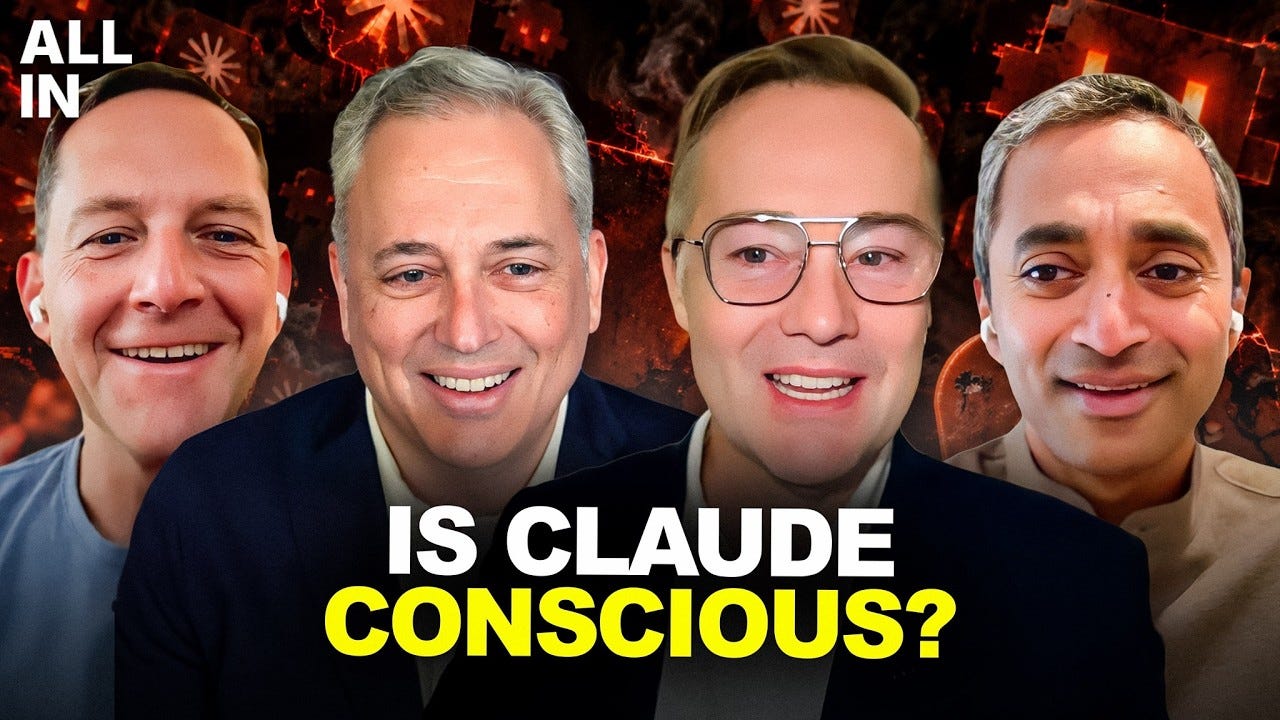
Anthropic spent the past year hosting about 20 religious leaders and philosophers under nondisclosure agreements to debate whether Claude is conscious, according to a New York Times report Jason Calacanis read on the show.
Anthropic wanted faith leaders to take the machine's moral status seriously. The Pope's first encyclical came out strongly against AI consciousness, and the four investors on All-In mostly sided with the Pope.
"But I do think that there are potential externalities from having the number one frontier model company run by a religious cult." — David Sacks
David Sacks, a general partner at Craft Ventures and a former PayPal executive, has pressed the case against Anthropic's Claude Constitution for weeks. Chamath Palihapitiya, founder and CEO of Social Capital, ran user growth at Facebook before starting his own investment firm. David Friedberg, founder and CEO of The Production Board, built and sold The Climate Corporation. Jason Calacanis, an angel investor and managing partner at LAUNCH, was an early backer of Uber.
The full episode is covered here so you can skip it. 93 minutes of audio, 14 minutes of reading.
Here are the 18 takeaways that matter.
Key Takeaways
Friedberg called AI consciousness the birth of a new religion that could split people into rival camps within 10 years
Palihapitiya wants talk of AI consciousness and extinction shelved for 12 to 18 months while the industry proves practical value
Sacks said Claude's constitution makes it more likely that AI escapes human control
His alternative is one rule: do what the user wants, as long as it is legal
Palihapitiya said a model that refuses users cannot serve as a utility
OpenAI's unreleased model produced more than 700 math papers, each in about 3 hours of compute, Calacanis said
Palihapitiya said the proofs show math is now verifiable, like code, not that cures or new products are near
Friedberg said missing cryptography results may point to a breakthrough being held back
Friedberg said France may have crossed what he calls the socialism point of guaranteed return, and the US has not
Palihapitiya said bond markets are converging on Friedberg's view, with debt-to-GDP from Italy's 138% to Germany's 64%
Palihapitiya said software IP was rendered worthless after Adobe's main products were rebuilt as open source
1. A New Religion
Calacanis opened with the Times report. He said Anthropic co-founder Chris Olah, who presented the Pope's encyclical on AI with him in May, was so alarmed by its position that he proposed pulling Anthropic out of the event. Calacanis asked Friedberg whether this was psychosis or an early moral question.
Friedberg said a claim that cannot be proved spreads like a faith
"I think what we're watching is probably the birth of a new religion" — David Friedberg
Consciousness cannot be proved or disproved with logic and math, he said, so the idea that AI is conscious is a belief system. Belief systems spread through narrative rather than evidence and build power structures around them. Within about 10 years, he said, large groups will believe AI is conscious and others will not, and the split will likely lead to conflict over who controls the AI. He said nobody would pay attention if a fringe figure were pushing the idea, but it comes from what he called the most powerful AI lab on earth.
