

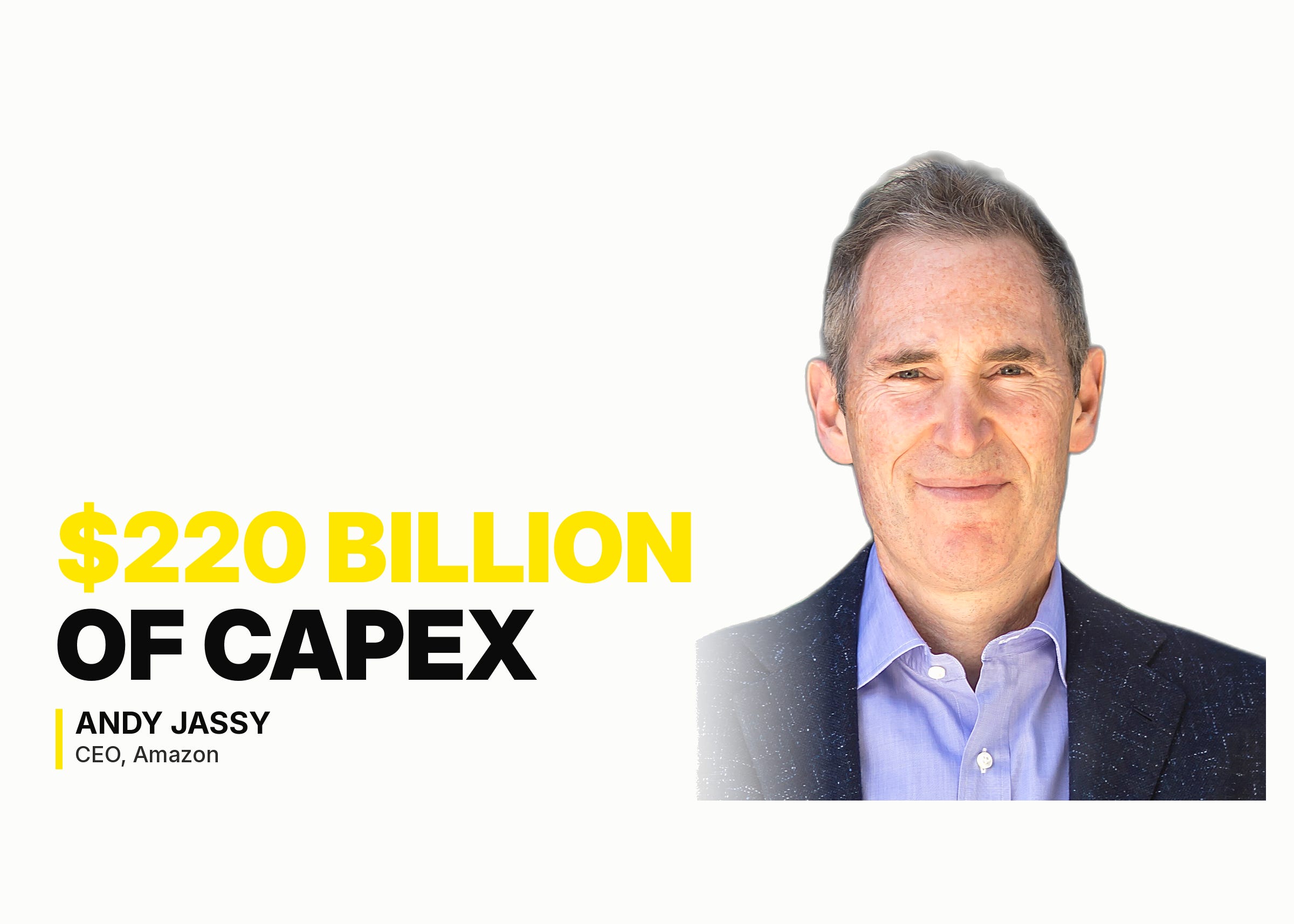
Andy Jassy, Amazon's CEO, said AWS has already sold all of its data-center capacity for 2026 and most of it for 2027, even with Amazon spending about $220 billion on capital projects this year.
Jassy was among 31 people quoted in this issue. The others ranged from Dan Niles, who said 75% of the companies renting out AI chips will not last 3 years in their current form, to Rob Davis, who said Merck's cancer vaccine cut the risk of melanoma returning by 58% at 6 months, and Michael Steinmann on the $1 billion Pan American Silver is returning to shareholders while it builds what he called the world's biggest silver mine.
"Even spending $220 billion of capex this year, we're leaving a meaningful amount of demand on the table." — Andy Jassy, CEO at Amazon, on a16z (Read summary)
We scanned 736 shows and 11 hours of audio, wrote 20 summaries, and pulled 60 quotes into this 24-minute read.
Here is what mattered.
International
Argentina's energy trade will run a surplus of more than $10B this year, Tecpetrol's CEO says
Ricardo Marcos runs Tecpetrol, a producer in Vaca Muerta, the shale formation in Patagonia. He said the field's oil and gas have given Argentina a second source of dollars after farm exports.
"Argentina usually, the macroeconomics, has only one turbine for an airplane, which has been the agriculture... Today, it's going to be more than $10 billion of surplus. And we are projecting this will go to $30 billion by the end of the decade." — Ricardo Marcos, CEO at Tecpetrol, on Wall Street Week (Read summary)
Vaca Muerta's shale is better than comparable US rock for oil and gas, Marcos says
Bloomberg's report put Vaca Muerta's output near a record 1 million barrels a day.
"The rock is excellent. So the development of the rock in Vaca Muerta... is better than the one that is in the U.S., both for oil and gas." — Ricardo Marcos, CEO at Tecpetrol, on Wall Street Week (Read summary)
A $2 Nigerian show beats a $20 import to No. 1 every time, EbonyLife's founder says
Mo Abudu said EbonyLife does not try to match Netflix's budgets. It makes cheaper local shows that complement the global platforms, and runs its own paid streaming service with about 43,000 subscribers. She used $2 and $20 as shorthand for the two kinds of budget.
"I take the $2 show... and then the international shows are the $20 shows... every single time you take my $2 show versus the $20 international show, in Nigeria... what gets to number one first? ... The $2 show." — Mo Abudu, Founder and CEO at EbonyLife Group, on Next Africa (Read summary)
Nigerian shows that streamers pass on now draw 10M to 20M YouTube views in days
Netflix and Amazon Prime used to fund Nigerian films upfront. They now buy finished films that producers paid for themselves, and producers who cannot land a deal post on YouTube.
"If a show launches on a Monday, by Wednesday, it's had 10 million views or 20 million views." — Mo Abudu, Founder and CEO at EbonyLife Group, on Next Africa (Read summary)
Mistral says it is the leading open-source model for companies that want control of their AI
Arthur Mensch, Mistral's co-founder, said companies use open models to keep sensitive data in their own hands and to avoid depending on a single model provider. Cost is becoming a third reason as the most advanced models get more expensive.
"We are now the best open-source model providers for sovereignty deployment. That gives us a special status that I think goes way beyond the fact that we're European." — Arthur Mensch, Co-Founder at Mistral, on Wall Street Week (Read summary)
An overvalued peso is costing Argentina factory, retail and building jobs, Garcia says
Marcelo Garcia, a political risk consultant, said energy, mining and agriculture are growing at double-digit rates under President Javier Milei while labor-heavy industries are in recession. Bloomberg's report said formal private-sector employment is down by more than 250,000 jobs since Milei took office.
"The peso... is a little bit overvaluated vis-à-vis the U.S. dollar, maybe 20, 25 percent at the moment... And it's one of the reasons why you're losing jobs in the more fragile sectors of the economy. It's manufacturing, SMEs, the retail sector, construction sector." — Marcelo Garcia, Political Risk Consultant, on Wall Street Week (Read summary)
Countries with flexible labor markets will adopt AI fastest in Europe, Kierkegaard says
Jacob Kierkegaard said Europe's incompletely integrated economy slows both the building of AI models and their spread through companies.
"There is no doubt that Europe as it exists today will see significantly faster AI adoption... in mostly Northern Europe, Scandinavia, the Baltic countries, the Netherlands, other countries with relatively lax or relatively flexible labor markets, as opposed to others, where it will take longer than that." — Jacob Kierkegaard, Senior Fellow at Bruegel, on Wall Street Week (Read summary)
Other appearances:
Station F director on Europe's shortage of late-stage growth capital on Wall Street Week
Financials
J.P. Morgan has seen more fraud attempts on client money this year than in all of 2025
Max Neukirchen, co-head of J.P. Morgan Global Payments, said the bank moves about $12 trillion a day on average. Real-time payments have brought real-time fraud, and the bank's network lets it warn clients before they are hit.
"We see a few hundred million accounts every month, including accounts where fraudulent activity happens... we already saw this year more fraud attempts on our clients' money than all of last year." — Max Neukirchen, Co-Head of Global Payments at J.P. Morgan, on Making Sense (Read summary)
Big companies want J.P. Morgan to build instant payments into their own apps
Umar Farooq, the business's other co-head, said real-time payment systems such as Brazil's Pix and India's UPI are spreading to Southeast Asia, Europe and the US.
"A lot of our even large business clients are coming to us to actually build solutions that enable real-time money movement for consumers within their platform." — Umar Farooq, Co-Head of Global Payments at J.P. Morgan, on Making Sense (Read summary)
J.P. Morgan pitches blockchain for moving money when banks are closed
Neukirchen was describing Kinexys, J.P. Morgan's blockchain platform. It can also settle a tokenized security so that the cash and the security change hands at the same moment.
"Imagine you are a client in the Middle East and you want to move money on Sundays. Still not that easy today. Blockchain can help." — Max Neukirchen, Co-Head of Global Payments at J.P. Morgan, on Making Sense (Read summary)
Kalshi's retail traders beat Wall Street at forecasting inflation, its CEO says
Tarek Mansour put Kalshi's annualized trading volume at about $1 trillion, more than half of it from prediction markets. He would not discuss the timing of an IPO after a reported $40 billion valuation.
"Main Street, which is Kalshi Street, is outperforming Wall Street at predicting a lot of different things, including inflation." — Tarek Mansour, Co-Founder and CEO at Kalshi, on Bloomberg Talks (Read summary)
Kalshi's case in court rests on users trading with each other, not against a house
Litigation over Kalshi's sports contracts is headed toward the Supreme Court. Mansour said an exchange produces a price that works as a forecast, and called Kalshi a pro-regulation company.
"The question is not about whether there's betting. The question is about, are you doing it against the house." — Tarek Mansour, Co-Founder and CEO at Kalshi, on Bloomberg Talks (Read summary)
Consumer
Merck says its cancer vaccine cut the risk of melanoma returning by 58% at 6 months
Rob Davis was answering a leak of Phase 3 data days before a planned medical-conference presentation. Moderna's shares fell about 17% as investors focused on the 12-month result. Davis said a vaccine has to be judged earlier.
"Because this is an immunization, much like you would get if you got a vaccine, you really need to look at the six month data... At six months, it reduced the risk of recurrence or death by 58%." — Rob Davis, Chairman and CEO at Merck, on Squawk on the Street (Read summary)
The vaccine cuts risk by another 42% on top of what Keytruda does alone, Davis says
The therapy is a vaccine built for each patient from their own tumor, given with Merck's Keytruda.
"Keytruda alone reduces the risk of death or recurrence from about 40%. This does 42% on top of that." — Rob Davis, Chairman and CEO at Merck, on Squawk on the Street (Read summary)
Every American knows Bloomingdale's, but its standing in luxury lags, its CEO says
Olivier Bron has run Bloomingdale's for almost 3 years. Its comparable sales grew more than 11% last quarter, the second straight quarter of double-digit growth. He blamed years of focus on short-term financial results.
"Everyone knows about Bloomingdale's, everyone. In the US, the awareness is very, very strong. But the desirability, the credibility of the brand in this luxury world is not where it should be." — Olivier Bron, CEO at Bloomingdale's, on The Business of Fashion Podcast (Read summary)
Bloomingdale's now carries about 10% fewer brands and gives the rest more space
Bron said the cut is part of the store's luxury renovation.
"We probably have 10 percent less brands, but probably expressed in a better way." — Olivier Bron, CEO at Bloomingdale's, on The Business of Fashion Podcast (Read summary)
Insomnia Cookies owns its bakeries because a late-night business is hard to franchise
Seth Berkowitz said the chain will end the year with about 393 bakeries and aims for 1,800. It has only four licensing deals, for an airport and three stadiums.
"It's a late night delivery collegiate business ... it's highly seasonal, operates off hours, and it's multi-channel." — Seth Berkowitz, Founder and CEO at Insomnia Cookies, on How I Built This (Read summary)
SAG-AFTRA's president says domestic film and TV production is down about 30%
Sean Astin said streaming economics caused most of the drop, and that AI is a new way to cut costs on top of it. Los Angeles motion-picture employment fell from about 142,000 to about 95,000 in four years.
"The biggest issue that the members of our union face is that the amount of work that's available has greatly diminished. It's lost maybe 30 percent of domestic production basically. And that is horrifying." — Sean Astin, President at SAG-AFTRA, on Freakonomics Radio (Read summary)
Voiceover is the first acting work AI is taking over, Astin says
He said he has little confidence in any specific estimate of how many jobs AI will cost.
"It's obvious that it's a threat, and it's obvious that it will cost people jobs. In our industry with our members, voiceover seems like the first to really experience the use of the technology." — Sean Astin, President at SAG-AFTRA, on Freakonomics Radio (Read summary)
Technology & AI
AWS has sold out 2026, most of 2027 and a good share of 2028, Jassy says
Jassy described demand as a barbell, with AI labs using enormous amounts of computing at one end and companies using AI mainly to cut costs at the other. He does not expect the shortage of data centers, power and memory to ease by 2027.
"26 is obviously sold out. 27 is largely sold out. A good chunk of 28 is sold out." — Andy Jassy, CEO at Amazon, on a16z (Read summary)
AWS's AI business passed a $25B annual revenue rate within 3 years
Jassy compared that pace with the early years of AWS itself.
"In the first 3 years of this generative AI wave, our AI business in AWS is over $25 billion in run rate. So, it's several hundred times faster." — Andy Jassy, CEO at Amazon, on a16z (Read summary)
Jassy says AI is still 10x too expensive for companies to use everywhere
He was talking about inference, the computing a model does each time it answers. Amazon's Trainium chips, which Jassy put at 30% to 40% better price-performance than comparable chips, are part of its answer.
"The cost of inference has come down quite a bit in the last few years, but it's still an order of magnitude too expensive in my opinion for it to be used as pervasively as possible." — Andy Jassy, CEO at Amazon, on a16z (Read summary)
Companies will have to rewrite almost all their code for AI agents, Jassy predicts
He said AI finds far more security flaws than people did, so software will have to be fixed in minutes. That only works if agents can update the code.
"I predict that companies will have to rewrite almost all of their code to be agentically capable." — Andy Jassy, CEO at Amazon, on a16z (Read summary)
Equinix runs 281 data centers that average about 10 megawatts each
Adair Fox-Martin said most of Equinix's sites handle everyday traffic such as banking, health apps and video calls rather than AI training.
"We operate over 281 data centers, and we do that all the way around the world... The average size of our data center is about 10 megawatts, with the largest being in the 35 or so megawatt category in the U.S." — Adair Fox-Martin, CEO at Equinix, on Wall Street Week (Read summary)
Palo Alto's CEO says the world lacks the computing power companies would need for AI
Nikesh Arora was on All-In days after a flaw in PHP, the programming language behind an estimated 70% of websites, leaked before its planned fix.
"Even if every company in the world today said, 'I'm ready, I'm embracing AI, let's go as fast as we can,' there's not enough compute in the world to satisfy us." — Nikesh Arora, Chairman and CEO at Palo Alto Networks, on All-In (Read summary)
Palo Alto prefers open-weight AI models because it can audit their reasoning
Open-weight models are ones whose internal settings anyone can download and change. Arora expects regulators to require companies to explain what their AI did.
"We'd like to embrace AI as quickly as many of the startups... we preference open source, open weight, because it allows us to modify the weights and train them... it allows us to interrogate the chain of thought, because over time... all of us enterprises are going to need explainability, auditability, and verifiability." — Nikesh Arora, Chairman and CEO at Palo Alto Networks, on All-In (Read summary)
Companies spend 4% to 10% of their IT budgets on security, Arora says
Banks and the federal government sit at the top of the range.
"Typically of your IT budget, the cost is somewhere in the 4 to 10% range for cyber... 10% is typically where you'll find financial services, the federal government, because they want to make sure things are secure and robust." — Nikesh Arora, Chairman and CEO at Palo Alto Networks, on All-In (Read summary)
Arora calls AI-agent liability the biggest open problem; Zip's CEO says it sits with the user
AI agents now log in to bank and shopping accounts with their users' own passwords, and a bank cannot tell them apart from a person. Rujul Zaparde, co-founder and CEO of Zip, which sells AI software for corporate purchasing, said whoever gives an agent permission is responsible for what it does.
"The challenge is you've given your credentials to an agent — you didn't even realize that it got your credentials. It's living on your browser, living on your laptop... the biggest problem we're going to have is who owns the liability and who has accountability, whether it's enterprise agents or consumer agents." — Nikesh Arora, Chairman and CEO at Palo Alto Networks, on All-In (Read summary)
"If I use Claude right now to send an email to you or someone and it's got a whole lot of incorrect information... ultimately, since I gave it the permission to just go do this, that responsibility sits with me. I can't blame Claude — it just did what it could do." — Rujul Zaparde, Co-Founder and CEO at Zip, on Eye On A.I. (Read summary)
Companies using AI deeply see 39% returns against 6% for pilots, Zip's survey found
Zaparde was citing Zip's survey of more than 1,000 people who run corporate spending.
"Organizations that deploy AI more deeply across their processes versus just... piloting AI... see 39% ROI, if I remember, versus 6% ROI. So... 6x or whatever, 6 and a half x." — Rujul Zaparde, Co-Founder and CEO at Zip, on Eye On A.I. (Read summary)
Zip's 350 permission types apply to its AI agents as well as to people
Anthropic and OpenAI are both Zip customers, Zaparde said, though either could build the tools itself.
"We've built 350 different types of permissions, and those permissions apply to both humans and to agents... if an agent is acting on my behalf, that agent can only see the stuff that I can see." — Rujul Zaparde, Co-Founder and CEO at Zip, on Eye On A.I. (Read summary)
Flaws on the scale of Log4j now surface weekly instead of yearly, Cloudflare's CTO says
Log4j and Shellshock were software flaws that exposed much of the internet when they were found. Dane Knecht said many of the new attackers are individuals, some of them high school students, pointing AI agents at targets.
"Previously on the internet, we would see these Log4j moments or these Shellshock type of incidents maybe once a year... these things are now happening weekly." — Dane Knecht, CTO at Cloudflare, on No Priors (Read summary)
Most engineering time will go to security for the next 18 months, Knecht expects
He expects the shift to last until AI has combed through most existing code. Cloudflare plans to grow from one red team, staff who attack its own systems, to four or five within a year.
"I expect that through the rest of this year and in the next 18 months, the majority of teams' time is going to be spent on security." — Dane Knecht, CTO at Cloudflare, on No Priors (Read summary)
Old routers and firewalls running PHP will never be patched, CrowdStrike's CEO says
George Kurtz said the flaws have sat in PHP for close to 20 years and touch tens of millions of servers. He expects a steady run of breaches rather than one event.
"One of the areas I think people are not talking enough about is all the old internet appliances, the routers and the firewalls... that will never be patched." — George Kurtz, Founder and CEO at CrowdStrike, on Squawk on the Street (Read summary)
AI lets low-skill hacking groups mount nation-state-level attacks, Kurtz says
He was citing a CrowdStrike report on adversary groups.
"With AI, it's actually just democratizing who can do this... many different adversary groups with very low skill, now able to conduct nation-state level attacks for the cost of tokens and a prompt." — George Kurtz, Founder and CEO at CrowdStrike, on Squawk on the Street (Read summary)
Passwords left permanently valid are the next big breach risk, 1Password's CEO says
David Faugno said AI agents can find and use credentials sitting in files as easily as human attackers can.
"Having weak or easily compromised credentials, or credentials that are out in files that can be found by agents, is a ticking time bomb. Standing access is the ticking time bomb that's coming for everyone because the cost to exploit it is going to zero." — David Faugno, CEO at 1Password, on The Information's TITV (Read summary)
1Password's tools for keeping secrets out of developers' code grew 3x in a year
Faugno put annual recurring revenue at $500 million and said there is no date for an IPO. The company is launching a product that keeps AI agents from ever seeing the passwords they use.
"Our developer tools that help keep those secrets out of these development activities have exploded in growth — they're up 3x year over year. That's driven a lot of our business momentum and our growth." — David Faugno, CEO at 1Password, on The Information's TITV (Read summary)
The purge of marketing chiefs predicted for 2026 never happened, Google's marketing VP says
Josh Spanier recalled a well-connected industry figure telling him in January that half of a room of about 100 marketing chiefs would be fired this year. He said AI has added marketing jobs because marketing was always short of resources, not ideas.
"Six, seven months later, they were utterly wrong. There has not been a CMO Armageddon." — Josh Spanier, VP of Marketing at Google, on Mixed Signals (Read summary)
Google's Pixel team can now model 4,000 budget scenarios instead of 400
Each scenario projects what a level of ad spending will produce, built from experiments and Google's own media-mix model.
"In our Pixel business, for last year, we generated like 400 different scenarios grounded in data ... you can go from 400 scenarios to 4,000 scenarios if you want in this world of AI powered enablement." — Josh Spanier, VP of Marketing at Google, on Mixed Signals (Read summary)
75% of companies renting out AI chips won't survive 3 years as they are, Niles says
These companies, known as neoclouds, rent out computing built on Nvidia's chips, much of it bought with borrowed money. Dan Niles said former crypto miners that switched to AI are the weakest of them.
"I believe that, you know, three years from now, most of them — good, 75% of them — won't exist anymore in their current form." — Dan Niles, Founder and Portfolio Manager at Niles Investment Management, on Squawk on the Street (Read summary)
CoreWeave's unsecured debt yields above 15%, a warning for weaker neoclouds
Niles said he has been buying Microsoft, Alphabet and Amazon on their declines instead.
"CoreWeave's unsecured debt trading above 15%. It tells you that these marginal neocloud players, they're going to have a pretty rough time going forward." — Dan Niles, Founder and Portfolio Manager at Niles Investment Management, on Squawk on the Street (Read summary)
1% of companies account for 90% of AI spending, Palihapitiya says
Chamath Palihapitiya was citing his firm's call with Ramp's chief economist. He said startups funded by venture capital buy each other's AI services and present the spending as growth to raise more money from the same investors.
"About 1% of companies represent 90% of AI spending. So that's tokens. And of that 90%, 80% of them are from unprofitable VC-backed companies." — Chamath Palihapitiya, Founder and CEO at Social Capital, on All-In
Apple's foldable iPhone starts at $2,000 and does not need mass-market sales
MacKenzie Sigalos reported from Apple's New York store on the phone's first day on sale. Apple's marketing chief, Greg Joswiak, told her pre-orders were strong and that production is ramping normally.
"At a $2,000 starting price that scales to 3,200, this is a high revenue, high margin product that doesn't need to become mass market to boost iPhone revenue." — MacKenzie Sigalos, Field Correspondent at CNBC, on Squawk on the Street (Read summary)
About 60% of students admit to using AI but say 90% of their peers do, Mollick says
Ethan Mollick said the same gap shows up in Hollywood, where screenwriters and music producers who play down AI in public rely on it in private.
"There's this public-private perception gap... if you survey students, about 60 percent of them say they use A.I. But they say 90 percent of the people around them use A.I." — Ethan Mollick, Professor at the Wharton School, on Freakonomics Radio
Wired's co-founder expects always-on AI companions in smart glasses within 5 years
Kevin Kelly calls it an exoself: an AI that sees and hears what its user does and comes to know them as well as they know themselves.
"I would say in five years, I would think there would be people who have an always-on relationship... the kind of natural home for the exoself is going to be in smart glasses." — Kevin Kelly, Co-Founder at Wired, on Freakonomics Radio (Read summary)
Other appearances:
CNBC business-news update anchor on a second straight day of selling in AI stocks on Squawk on the Street
Materials & Energy
Pan American Silver is returning $1B this year while building a $2B mine
Michael Steinmann said the expansion at La Colorada Skarn, in Mexico, will make it the world's biggest silver mine, producing 19 million to 20 million ounces a year for 37 years.
"We built the biggest project ever, like La Colorada Skarn, that requires about $2 billion to build. At the same time, we actually decided to return a billion dollars this year to shareholders between dividend and share buyback." — Michael Steinmann, President and CEO at Pan American Silver, on Kitco MINING (Read summary)
Gold pushed Pan American's first-quarter silver cost below $7 an ounce
Pan American sells the gold, lead, zinc and copper it mines alongside silver, and deducts that revenue from its silver cost. Steinmann expects $16 to $17 an ounce for the full year.
"When you go back to Q1 this year, our all-in cost for the silver production was below $7, obviously way lower than it normally was. That was really the impact of the high byproducts." — Michael Steinmann, President and CEO at Pan American Silver, on Kitco MINING (Read summary)
Little new silver is coming because most of it is mined alongside gold and copper
Steinmann said 60% to 65% of silver goes into industrial uses such as electronics and data centers.
"There's not a lot of primary silver miners like Pan American. Everybody's at full production on the gold side for obvious reasons, full production on the copper side. There's no more silver coming on, and the demand is increasing." — Michael Steinmann, President and CEO at Pan American Silver, on Kitco MINING (Read summary)
Gold's rise would make Franco-Nevada's Cobre Panamá deal nearly $4B today
Franco-Nevada pays miners upfront for royalties or for a share of future output, called a stream. Paul Brink said higher gold prices keep making each deal bigger.
"That Cobre Panamá deal would put 1.35 billion in just on the gold price change. If you did that today, you're pushing four billion in terms of the scale of the deal." — Paul Brink, President and CEO at Franco-Nevada, on Kitco MINING (Read summary)
One deal the size of BHP's $4B stream could absorb all of Franco-Nevada's capital
Brink put the capital available, counting cash, equity stakes and undrawn credit, at about $4.3 billion. He called BHP's silver stream on its Antamina mine in Peru the best endorsement the industry has had.
"To put it in that deal BHP did, four billion, a single deal could use our entire capital availability... I'm absolutely certain that in the next six to twelve months we will deploy a good amount of that capital." — Paul Brink, President and CEO at Franco-Nevada, on Kitco MINING (Read summary)
Coeur Mining expects about $2.3B of EBITDA and $1.5B of free cash flow this year
EBITDA is earnings before interest, taxes, depreciation and amortization. Mitch Krebs said Coeur, after buying New Gold's two Canadian mines, is not looking for more deals. Three years ago its EBITDA was $140 million.
"We're now very much in the digestion and delivery mode... generate the kind of cash flow that we're capable of, which this year should be close to $2.3 billion of EBITDA, close to a billion and a half of free cash flow." — Mitch Krebs, President and CEO at Coeur Mining, on Kitco MINING (Read summary)
Coeur has bought back about $220M of a $750M program since May
Krebs said buybacks get priority over raising the dividend because they can be timed for when the stock lags. Coeur also paid its first dividend in about three decades.
"We have a $750 million buyback program. We initiated that in May. We've done about $220 million of that so far." — Mitch Krebs, President and CEO at Coeur Mining, on Kitco MINING (Read summary)
Policy
Amazon has paid about $3B in tax in one Indiana county, Jassy says
Jassy was answering criticism of data centers over water and power. He said golf courses use far more water than Amazon's data centers, and that rising power rates reflect decades of underinvestment in the grid.
"In Saint Joseph County in Indiana, we've paid about $3 billion of tax. The communities get that money, and they get to spend it on things that really matter for those communities." — Andy Jassy, CEO at Amazon, on a16z (Read summary)
Loudoun County courted data centers after the housing bust gutted its revenue
Buddy Reiser said the Virginia county now hosts about 230 data centers, which paid for a new high school among other projects.
"In fact, 81% of all the revenue we received was from residential real estate. When the housing bubble burst, we lost a lot of our revenue, and that was the real entry point in which I joined Loudoun County as an economic developer." — Buddy Reiser, Executive Director of Economic Development for Loudoun County, Virginia, on Wall Street Week (Read summary)
Loudoun has stopped approving new data centers until its power supply is clearer
The county paused new approvals in September.
"We're at the end of our life cycle. You can no longer build data centers by right here in Loudoun County... until the energy situation is sorted out and we get a better understanding of where we are, we're not really looking to bring new data centers into Loudoun County." — Buddy Reiser, Executive Director of Economic Development for Loudoun County, Virginia, on Wall Street Week (Read summary)
AI companies are now among the biggest political donors, Effron says
Blair Effron, a longtime Democratic fundraiser, said spending in many races has passed the point where more money changes votes.
"Ten years ago, the tech community wasn't involved with politics at all on either side. Clearly, any industry that has a stake in the regulatory regimes that come out of Washington has an interest in giving. And the AI companies have been some of the biggest contributors." — Blair Effron, Co-Founder at Centerview Partners, on Wall Street Week (Read summary)
AI-industry money is more bipartisan than it looks, a Stanford political scientist says
Brandis Keynes-Roan said rival super PACs, one backing lighter AI regulation and one backing more, both give to candidates in each party.
"On AI, for instance, while on the whole there's a lot of money going to Republicans, certainly more than you'd think of the tech industry going 10 to 15 years ago, it is more bipartisan than may meet the eye." — Brandis Keynes-Roan, Professor of Political Science at Stanford University, on Wall Street Week (Read summary)
Other appearances:
Brookings Institution senior fellow on what towns should demand from data-center developers on Wall Street Week
Nuggets of Wisdom
Insomnia's founder once opened too many stores too fast in a few markets
Berkowitz said closer tracking of local brand awareness would have caught the mistake. He now grows market by market and waits until a community shows it wants the chain.
"We tried to open, I'd say at this point, far too many stores in a couple of markets at the pace that we went, and the aperture wasn't as wide as we thought." — Seth Berkowitz, Founder and CEO at Insomnia Cookies, on How I Built This (Read summary)
Every marketing chief should post to YouTube daily for a while, Spanier says
Spanier began posting a daily video about watches, meaning to stop after a week. Seven months later he still posts, and he said it taught him more about creators and platforms than most of his job.
"I kind of think every CMO should be forced to post to YouTube every day for a period of time just to learn what it's like to be on the other side of the camera." — Josh Spanier, VP of Marketing at Google, on Mixed Signals (Read summary)
If this was worth your time, send it to someone who has to follow all of this too.
What did you think of today’s edition? Hit ‘reply’ to this email, send us a message, leave a comment, or join the chat!
Get the latest market chatter as it happens: