

The MAD Podcast with Matt Turck · Sep 24, 2026 · 1h 10m · 50m saved
With Renen Hallak, Founder and CEO of VAST Data
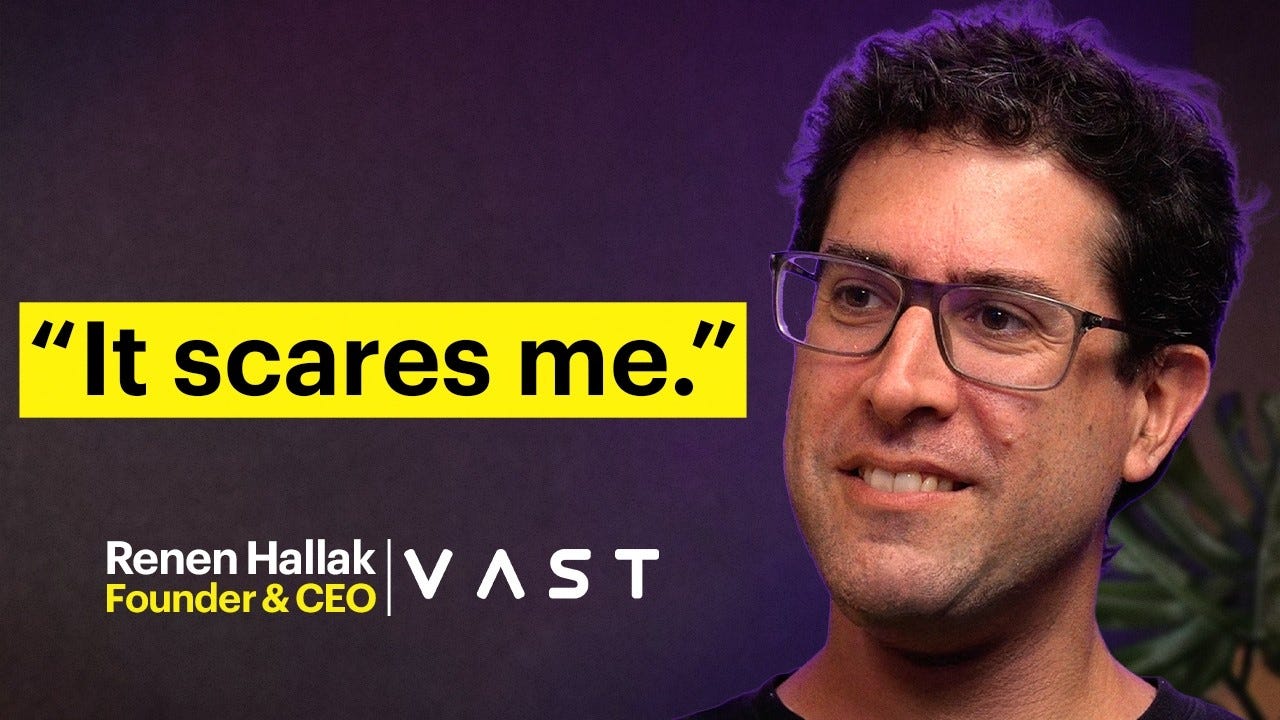
A smaller AI cloud told VAST Data a quarter ago that it would need about 500 petabytes of storage over three years. Last week it came back and asked for 2 exabytes more on top of that, founder Renen Hallak said, and he expects it to come back again asking for tens of exabytes.
Most of the talk about AI is about models and chips. Hallak's company sits in the layer between them, the software that feeds data to the GPUs, and he said demand there is growing faster than anyone planned for.
"I'm not sure it gives me comfort and sometimes it scares me as to how much demand is there and the acceleration in demand because every quarter our customers are coming back to us and telling us they need a lot more than they thought they did."
Hallak, founder and CEO of VAST Data, on The MAD Podcast with Matt Turck, was employee number one at XtremIO, ran its research and development inside EMC after the 2012 acquisition, and founded VAST in 2016. Turck said VAST was most recently valued at $30 billion and powers xAI and some of the largest AI clouds.
The full interview is covered here so you can skip it. 70 minutes of audio, 20 minutes of reading.
Here are the 17 insights that matter.
Key Takeaways
Demand keeps beating forecasts: one AI cloud went from 500 petabytes over three years to 2 exabytes more
Some AI clouds are sold out for the next year and a half, he said
VAST's new product lets enterprises run a lab's model on their own premises without either side seeing the other's data or weights
Old storage designs top out at about 100 nodes; one VAST customer runs tens of thousands in a single system
VAST has no churn, and customers double or triple the data they store on it each year
VAST is profitable because it sells software with high gross margins, he said
The hyperscalers are losing ground to AI clouds, and he called it the innovator's dilemma
Nvidia is VAST's best partner, but the only legal document between them is its investment
Every organization's knowledge will end up in model weights it owns, and he wants a marketplace to lease them
1. The Middle of the Cake
Matt Turck opened with Jensen Huang's picture of AI as a five-layer cake: power, hardware, software infrastructure, models and applications. He asked where VAST sits.
"Right in the middle." — Renen Hallak
An operating system for AI
Everything the old computing stack needed, the new one needs too, Hallak said: managing compute, storage and networking, then a database to make sense of the data and training and inference functions to make sense of the compute. As AI shifts from training toward inference, agents and reinforcement learning, more tools are needed to make it simple, safe, fast and resilient.
"All of that sits in that middle layer." — Renen Hallak
He calls that layer software infrastructure, or the operating system for this new era.
What goes into an AI factory
Turck asked what has to be added to a pile of GPUs to make what Nvidia calls an AI factory. Hallak said data centers look very different from five years ago. Racks that drew 10 kilowatts now draw 500, and they need GPUs instead of CPUs, very fast networks and large solid-state drives instead of 10-gigabit Ethernet and hard drives. AI also works on pictures, video, sound and language rather than numbers in a database, which takes far more space.
"And so every layer of this cake needs to be redone." — Renen Hallak
