

Catalyst with Shayle Kann · Sep 24, 2026 · 33m · 22m saved
With Andrew Nuss, Head of Growth and Strategy, Maritime Division at Anduril
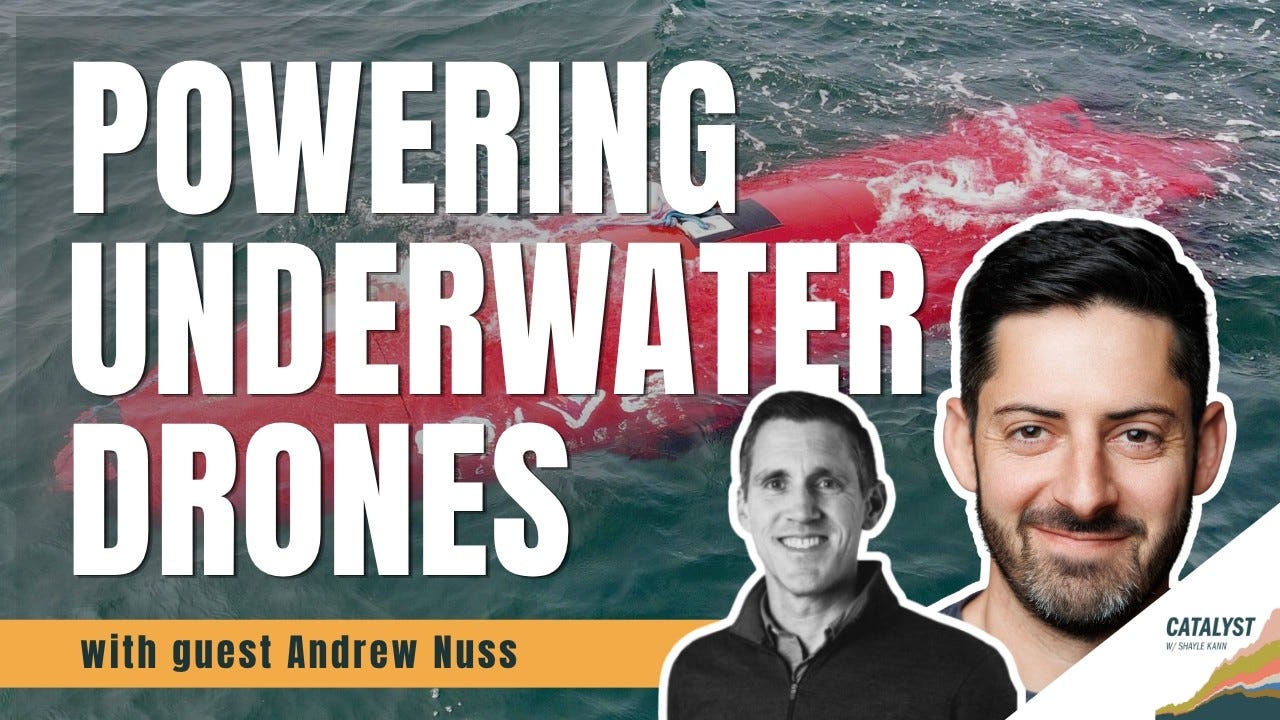
Moving an underwater vehicle one nautical mile takes about a thousand times the energy it takes in the air, Andrew Nuss said, because seawater is about a thousand times denser than air.
Self-driving cars went electric in part because the computer on board is a large share of the energy they use. At sea, Nuss said, pushing the vehicle through the water takes most of the energy, and every vehicle has to carry all of it from the pier because there is nowhere to stop and recharge.
"We don't have the luxury of being able to stop halfway through at a gas station to refill or a recharging station to refill."
Andrew Nuss, head of growth and strategy in the maritime division at Anduril, on Catalyst with Shayle Kann, builds robotic boats and submarines for defense and commercial customers. He said he has set a lot of batteries on fire over the past 10 or 15 years getting them through defense safety testing.
The full interview is covered here so you can skip it. 33 minutes of audio, 11 minutes of reading.
Here are the 12 insights that matter.
Key Takeaways
Water is about 1,000 times denser than air, so propulsion takes most of an undersea vehicle's energy
Undersea vehicles cannot use an off-the-shelf lithium-ion battery, because ocean pressure crushes it
Better autonomy has made energy the main limit on how long these vehicles can operate
Getting a battery certified for use on a Navy ship can take years, and the commercial market moves on in the meantime
Charging depots at sea would let vehicles carry a quarter of the energy and be built smaller, Nuss said
Nuclear-powered cargo ships could sail at 20 to 25 knots instead of 10 to 12, and he guessed 10% to 20% of the market might switch
The whole undersea battery market is a couple hundred megawatt hours today, by his rough guess
Anduril buys no battery cells from adversary countries, and he said tracing that through the supply chain is hard
1. Why the Sea Is Harder
The host, an early-stage investor at Energy Impact Partners, asked what makes energy in maritime defense different. Nuss said Anduril's maritime division is focused on robotic systems for commercial users and for defense customers in the US and abroad.
Salt water and ocean pressure rule out ordinary batteries
"The maritime domain is uniquely hard, I think, in that it is an environment that's particularly harsh." — Andrew Nuss
Salt water damages robotic systems and their power systems, and the pressure increases the deeper a vehicle goes.
"So, you can't just take a commercial off-the-shelf lithium ion battery and put it into an underwater vehicle and expect it to survive subsea." — Andrew Nuss
The vehicles have to power sensors or deliver payloads once they arrive, and first have to get there, whether that means diving to the ocean floor to collect data or crossing thousands of miles on the surface. The main constraint, he said, is energy density: how much energy a vehicle can carry for its size, which sets how long it can stay out.
