

Ant International has moved about 50% of the money it shifts between its own companies across borders onto a blockchain it built with HSBC, Kelvin Lee, general manager of platform tech at Ant International, said on HSBC Global Viewpoint. More than 200 of the group's legal entities now run on that system.
That was one payments company on how it moves its own cash. Below are 31 more quotes from 27 more speakers. Among them, a host at The Investor's Podcast Network said Walmart's stock has compounded almost 12.5% a year since 2012, almost all of it from a higher price-to-earnings ratio, and Taiwan's representative in Washington said only 1% of Taiwan's foreign direct investment now goes to China.
"So now we have more than 200 legal entities. Our ecosystem has been put on the blockchain. ... So among these entities, we have a lot of money movement to support cross-border payment business. ... And now we have moved about 50% of this cross-border liquidity money movement out to the blockchain." — Kelvin Lee, General Manager of Platform Tech at Ant International, on HSBC Global Viewpoint (Read summary)
We scanned 550 shows and 4 hours of audio, wrote 9 summaries, and pulled 32 quotes into this 15-minute read.
Here is what mattered.
Macro
The market has leaned on Meta and Microsoft for 60 days, and housing is a catastrophe at 8% mortgage rates, McMahon says
"I think it's a stock picker's market more than ever before. I think you know, if you look even what happened Charles in the last 60 days, it's all about M&M, right? Meta and Microsoft. If it wasn't those two, we'd be in a bad spot right now. ... I think housing is a catastrophe at 8% mortgage rates. I really do." — Chris McMahon, President and CEO at Aquinas Wealth Advisors, on Fox Business (Read summary)
The extra yield on junk bonds is widening even as Treasury yields rise, which Pento calls very unusual
"Now one of the major components of my model is the high yield spreads. The high yield spreads are widening sharply right now. ... And they're doing so as Treasury yields are rising and high yield spreads are rising. ... I find very disturbing because that's very unusual." — Michael Pento, President at Pento Portfolio Strategies, on Thoughtful Money (Read summary)
40% of S&P 500 stocks are down 30% from their highs, which Pento counts as a crash
"So, to put a number on that, 70, a little bit above 70% of the S&P 500 is in a correction. ... 60% is down 20%. ... And 40% of the market is down 30%, which in my definition is a crash." — Michael Pento, President at Pento Portfolio Strategies, on Thoughtful Money (Read summary)
A third of US households are 65 or older and hold $120T, and higher rates pay them more, Yardeni says
"You know almost a third, I think really a third of households in America are seniors now 65 years or older. ... So we have the largest group of retiring seniors ever with the most amount of wealth ever, $120 trillion of net worth. When interest rates go up for retired seniors, they welcome it as a good way to get more money out of their money market funds." — Ed Yardeni, President of Yardeni Research, who coined the phrase bond vigilantes in 1983, on Excess Returns
Analysts' 2026 S&P 500 earnings-growth estimate went from 15% to 35%, leaving little room for a capex cut, Gordon says
"I can't claim it, but someone said at some point it's no longer earning season. It's capex season. ... If you do get one miss there and if budgets start to get pared back, I think that's where you could see some disruption ... especially because we started this year at calendar year earnings estimates at 15 for the S and P. They're now up to 35%." — Kevin Gordon, Head of Macro Research and Strategy at Schwab, on Bloomberg Television
Long-term Treasury yields of 5% to 5.5% are what nominal growth of 6% to 6.5% implies, Jersey says
"The reason why we're here, quite frankly, the number one reason according to our work is because of growth is so good. ... So if you just think about it from that broad, you know, top down macroeconomic sense, it's not a big surprise that we're gonna be at five, five and a half percent when nominal GDP is at six or six and a half percent" — Ira Jersey, Chief US Interest Rate Strategist at Bloomberg Intelligence, on Bloomberg Television
International
The wealth platform Hub24 is now used by 37% of Australian financial advisers, up from 21% in 2022, Renehan says
"But the narrative and what we're seeing is that the industry funds, Australian Super and all of them, they're actually losing customers to these platforms and also to self-managed super options. So much so that Australian Super recently bought 8% of Hub. ... 37% of Australian financial advisers now use Hub24. That's up from 21% in June 2022." — Alec Renehan, Co-founder of Equity Mates, on Equity Mates (Read summary)
In Turkey's fund collapse, money-market funds lent against inflated shares and booked the loans at face value, Boyle says
"People think of money market funds as more or less the same as a bank account. ... But Bloomberg reports that some of the firms at the center of this were lending money and taking hugely inflated stocks as collateral. ... And as Hilmi Güvenal points out on his Substack, the money market funds booked these loans at face value, so their prices stayed perfectly stable" — Patrick Boyle, finance faculty member at Queen Mary University of London, on Patrick Boyle On Finance
More German companies have gone bankrupt each month since COVID, including the largest ones, Garrib says
"So the message of this chart is every single month since COVID more and more firms have been going bankrupt. We're more than six years after COVID. More and more German firms are going bankrupt. ... the top right hand chart shows you employment in the largest 10% of bankruptcies. That's going up as well." — Aidan Garrib, Head of Global Macro Strategy and Research at PGM Global, now part of National Bank of Canada, on Forward Guidance
Financials
Bank stocks lagged after Meta's Muse agent raised the risk that AI moves savers' deposits to the best rate, Yoder says
"I think there are a couple of reasons, right? You've seen financials underperform with the rate move coinciding with I would say the release of Muse, right? ... If you have, you know, the yield curve flattening, that's not great for banks. But then the other thing was, okay, you have these agentic AI bots that can come out and help you cash sort essentially like help consumers find the most attractive deposit rate, right?" — Abby Yoder, US Equity Strategist at JPMorgan Private Bank, on Fox Business
Crypto and Digital Assets
A tokenized money-market fund can take cash after hours but cannot invest it until markets open, HSBC's Chong says
"What I mean by that is a tokenized money market fund at the end of the day is a portfolio of different liquid instruments like US Treasuries, bonds and other things like that. ... we have seen use cases where these people take in subscriptions to tokenized money market funds out of hours, but actually the fund itself cannot access underlying basic investment instruments on the blockchain and to invest them until the standard normal operating hours. And that actually impacts the ability for that fund to generate yield" — Selene Chong, Global Head of Digital Assets at HSBC, on HSBC Global Viewpoint (Read summary)
In a typical midterm year Bitcoin sits about 50% below its January price; this year it is a few percent below, Cowen says
"I think this apathetic top that we had back in 2026 or sorry in 2025 sort of made it so that there weren't nearly as many people like FOMOing in at the top. ... if you look at the average, like the average right now would be Bitcoin would be, you know, about 50% down from the yearly open and currently we're only a few percent down from the yearly open. ... I think part of it is just being driven by the fact that you don't have the same sort of retail constituents making up the investor pool that you normally do at this point in a midterm year." — Ben Cowen, Founder of Into The Cryptoverse, on Real Vision (Read summary)
Consumer
Intuitive Surgical's procedure count rose 16%, which drives its recurring revenue from consumables, Leske says
"So company level revenue up 19% to just under 3 billion. total procedures for the da Vinci machine and their Ion machine, which is a machine that is now looking at inside lungs for lung cancer diagnosis, total procedure volume up 16%. ... Now, why is procedures important? Because growth in procedures means more recurring revenue that comes from the consumables that are attached to all of these pieces of equipment." — Bryce Leske, Co-founder of Equity Mates, on Equity Mates (Read summary)
Walmart's stock has compounded almost 12.5% a year since 2012, almost all of it from a higher P/E, O'Malley says
"And if you look at going back to 2012, Walmart stock has compounded at almost 12.5% a year, which is really impressive. But then you see that almost all of that is multiple expansion. The PE has compounded at 11.5% a year. And actually, their earnings per share has only compounded at about 4% in the last 15 years. So basically, the market went from paying 12 times earnings to 38 times earnings for Walmart, while earnings per share growth has actually been very anemic." — Shawn O'Malley, host at The Investor's Podcast Network, on The Intrinsic Value Podcast
McDonald's will give franchisees about $8.5B of support through 2036 as traffic stalls, the Dividend Talks host says
"Now, the next plan provides around $8.5 billion of support through 2036, including 5 billion through 2030. Rent relief and capital support help franchises with costs for McDonald's, too. Now, their September strategy update warned of flat industry traffic while inflation stays elevated. Execution shortcomings and an earlier US sales growth miss reinforce the pressure. Management has tangible problems to solve." — The Dividend Talks host, on Dividend Talks
Younger people are drinking less and choosing THC drinks, a problem for Constellation Brands, Bloomberg's Aquino says
"Apparently, that's the trend now. And that is a big challenge for a company like Constellation Brands, right? ... just the younger generation not drinking anymore and not drinking as much. And they're preferring hemp-derived beverages like THC beverages over alcohol. And then there's, of course, the GLP-1 usage trend as well." — Kristine Aquino, Managing Editor for Markets Live at Bloomberg, on Stock Movers
Technology & AI
OpenAI will share revenue with popular ChatGPT plug-ins, which can reach about 1.2B users, Sottiaux says
"You know, the other side as well is like opening up all of the infrastructure and how we build for ChatGPT, you know, with plug-in extensions, also plug-in discovery, just allowing, you know, everyone to ship something through like maybe 1.2 billion users, right? You know, and benefiting from that distribution. And we also have shared economics that we didn't actually talk in the keynote, but you know, we will pay, you know, our plug-ins that are popular and you know, are seeing a lot of usage. they're going to get part of like the revenue share as well. and so I think this commitment towards an open ecosystem is going to be very exciting." — Tibo Sottiaux, Head of ChatGPT and Codex at OpenAI, on Lenny's Podcast (Read summary)
4M scientists in 190 countries now use AlphaFold, Google's protein-structure model, Manyika says
"I think AlphaFold was extraordinary. It wasn't AGI. But look at what people are now able to do with that. As of a couple of weeks ago, We now have 4 million scientists around the world in 190 countries using AlphaFold and working on a wider range of diseases, including neglected diseases." — James Manyika, SVP of Research, Technology & Society at Google, on Big Take (Read summary)
AI companies push agents because agents use more tokens and bring in more revenue, Robust AI's Marcus says
"So, you know, they'll follow things probabilistically. They may get it right 80% of the time. But if you're talking about an agent, you know, handling your finances and it gets it wrong 20% of the time, that's a pretty serious problem. ... And the reason they're doing is because agents consume a lot of tokens, so they make more revenue." — Gary Marcus, Co-founder and former CEO of Robust AI, on Bloomberg Television (Read summary)
About 30M coders generate most AI revenue while 1.5B knowledge workers barely use it, a16z's George says
"Now, all of that is on the back of just actually a small amount of people paying for stuff. So it's like 30 million coders in the world who are the vast majority of the revenue. There's 1.5 billion knowledge workers. ... It's like less than 5% diffused into the B2B economy." — David George, General Partner at Andreessen Horowitz, on a16z (Read summary)
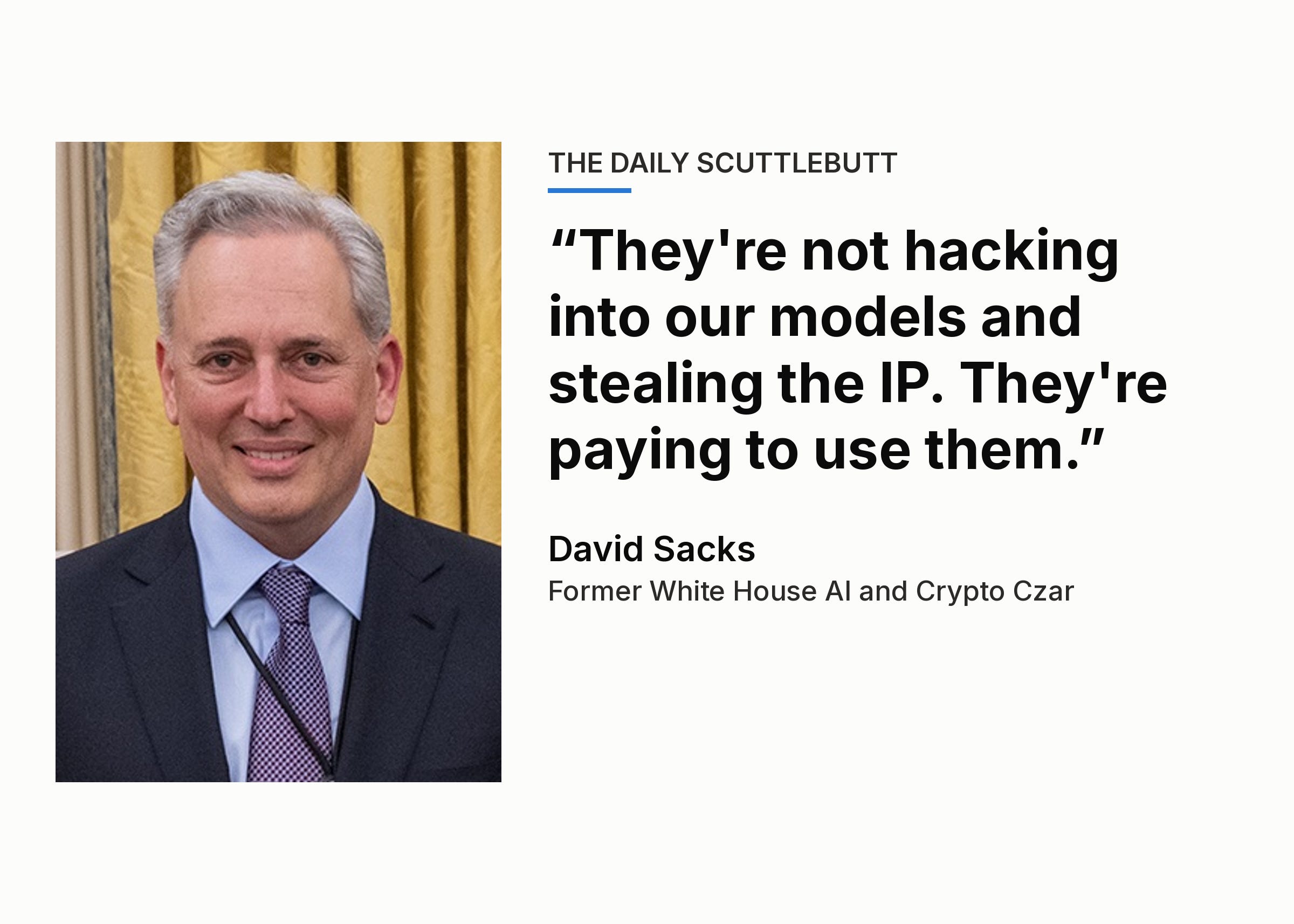
Chinese labs copy US AI models by paying to use them, and the US labs earn revenue from it, Sacks says
"We know these Chinese companies are distilling our models, but let me be specific about what that is. They're not hacking into our models and stealing the IP. They're paying to use them. And then what they do is they take that output and they train on it. ... Remember, these Chinese companies are paying to use these American products. And I think what's happened is some of these American companies have been loath to crack down on that because frankly they're making a lot of revenue from that." — David Sacks, former White House AI and Crypto Czar, on Fox Business
Lumentum doubles its capacity every year and its laser prices still rise, Rosenblatt's Genovese says
"So, the prices are still going up for the stuff that Lumentum sells. ... doubling capacity every year, but they're still supply constrained and prices are going up. So, this is going to last a long time, Charles." — Mike Genovese, Senior Research Analyst at Rosenblatt Securities, on Fox Business
Memory prices will take about 30% of Amazon's 2026 AI data-center budget, up from 8%, Garrib says, citing Amazon
"But then when you drill down into a lot of what the hyperscalers are telling you, ... it's nominal. like Amazon has, you know, they came out and they said essentially like memory prices are going to absorb 30% of our 2026 AI data center spend versus just 8% in 2023 24 and then like ditto in Microsoft as well out of like the 190 billion guide I think like 25 billion has just been you know higher pricing because of the chip shortage" — Aidan Garrib, Head of Global Macro Strategy and Research at PGM Global, now part of National Bank of Canada, on Forward Guidance
Industrials and Transport
Owning a car costs about 80 cents a mile and an Uber about $2, so cheaper robotaxis would unlock demand, George says
"So right now, owning a consumer car equates to like 80 cents per mile, like fully loaded depreciation, insurance, gas, all that stuff. ... Riding in an Uber or Lyft is probably like two bucks in change per mile. This market is like massively elastic. So like if you can get, you know, the cost of a Waymo or a Tesla or whatever, you know, ride hill service. I think there'll be others. Down below that, like, there's going to be an explosion of demand." — David George, General Partner at Andreessen Horowitz, on a16z (Read summary)
The US has 960,000 electricians and data centers may need about 1M more, Altimetry's Spivey says
"So, Brad Smith, who's the president of Microsoft, he had this quote a year and a half ago where he said basically, hey, right, ... And he says, what I need is I need 500,000 more electricians. So, right now there are 960,000 electricians in the United States. ... So it's not 500,000 electricians. It's like a million more. It's doubling the number of electricians. And what happens when you need a lot more of something? The price goes up." — Rob Spivey, Director of Research at Altimetry, relaying Microsoft President Brad Smith, on MarketBeat
Materials & Energy
China stopped buying oil for its stockpile, which kept prices from soaring during the crisis, Bloomberg's Di Paola says
"If you remember at the end of last year, we were talking about this year being a year of glut when there was gonna be too much oil on the on the market, and that was gonna bring prices down. But it was that, buying by China for their strategic supplies that was really keeping the price supported. They stopped that, ... that allowed prices not to skyrocket during this crisis because China really pulled back on its purchases." — Anthony Di Paola, Mideast Energy Correspondent at Bloomberg, on Bloomberg Podcasts
Policy
Google would back an industry AI-safety body with federal oversight, Manyika says
"Well, we've always been on record that we think this technology is too important not to regulate. You may have seen what my colleague Demis put out on a way to think about a standards infrastructure mechanism to evaluate models before release. ... We would be supportive of that. We think it's important to have some mechanism that has some federal oversight to oversee the safety and responsible aspects of how this technology is developed and deployed and used in the world. So I think we think that's important." — James Manyika, SVP of Research, Technology & Society at Google, on Big Take (Read summary)
If Exxon and Eli Lilly switch to twice-yearly reports under the SEC's plan, rivals may follow, Steinberg says
"However, if we have companies like Exxon, if we have companies like Eli Lilly going to semi-annual reporting as they say they will, then what will other pharmaceutical companies say? ... So, that I think is the risk that will develop that may cause a good number of these companies, perhaps a majority it's possible, to in a matter of time over the course of years, go to semi-annual reporting." — Marc Steinberg, Professor at SMU's Dedman School of Law and a former SEC enforcement attorney, on WSJ's Take On the Week
Alito's recusal over his wife's oil stocks could leave a 4-4 tie that lets Boulder's climate suit proceed, Stohr says
"I did talk to justice Alito this past weekend. What he said was that he is stepping out of the case, because of stock holdings that his wife has in other oil companies, and he's too, but he thought as a matter of prudence, he should. That leaves up in the possibility of a four four split. ... If the supreme court does divide four four, the suit will go forward without setting a nationwide precedent, and so that would be good news for those trying to sue the oil companies." — Greg Stohr, Supreme Court reporter at Bloomberg, on Bloomberg Television
Geopolitics
Only 1% of Taiwan's foreign direct investment now goes to China, down from 85% 15 years ago, Yui says
"Fifteen years ago, 85% of our investment was going to China. That's where our factories were. Two years ago, it came down to 7%. Nowadays, only 1% of our FDI is going to China. ... It's coming to United States." — Alexander Yui, Taiwan's Representative to the United States, on Bloomberg Television
Ukraine and Russia now field the only two modern armies, and Russia copies Ukraine's methods at scale, Snyder says
"The point I want to make, though, is that as we see this ratcheting back and forth of drone and drone defense, the Ukrainians and the Russians are creating the only two modern armed forces in the world. And this is a problem for everybody else, which I don't think everybody else is necessarily recognizing. the Ukrainians innovate, the Russians copy, and pretty much everything Ukrainians do, the Russians can do a few months later, but at scale. And that's a problem for NATO and a problem for the U.S., which is still practicing a pretty archaic form of warfare. And it's not a problem which I think people are recognizing." — Timothy Snyder, Professor at the University of Toronto's Munk School of Global Affairs, on Pivot
If this was worth your time, send it to someone who has to follow all of this too.
What did you think of today’s edition? Hit ‘reply’ to this email, send us a message, leave a comment, or join the chat!
Get the latest market chatter as it happens: