

Semafor · Nov 16, 2026 · 21m · 14m saved
With Jacob Helberg, Under Secretary of State for Economic Affairs · Christophe Fouquet, President and CEO of ASML
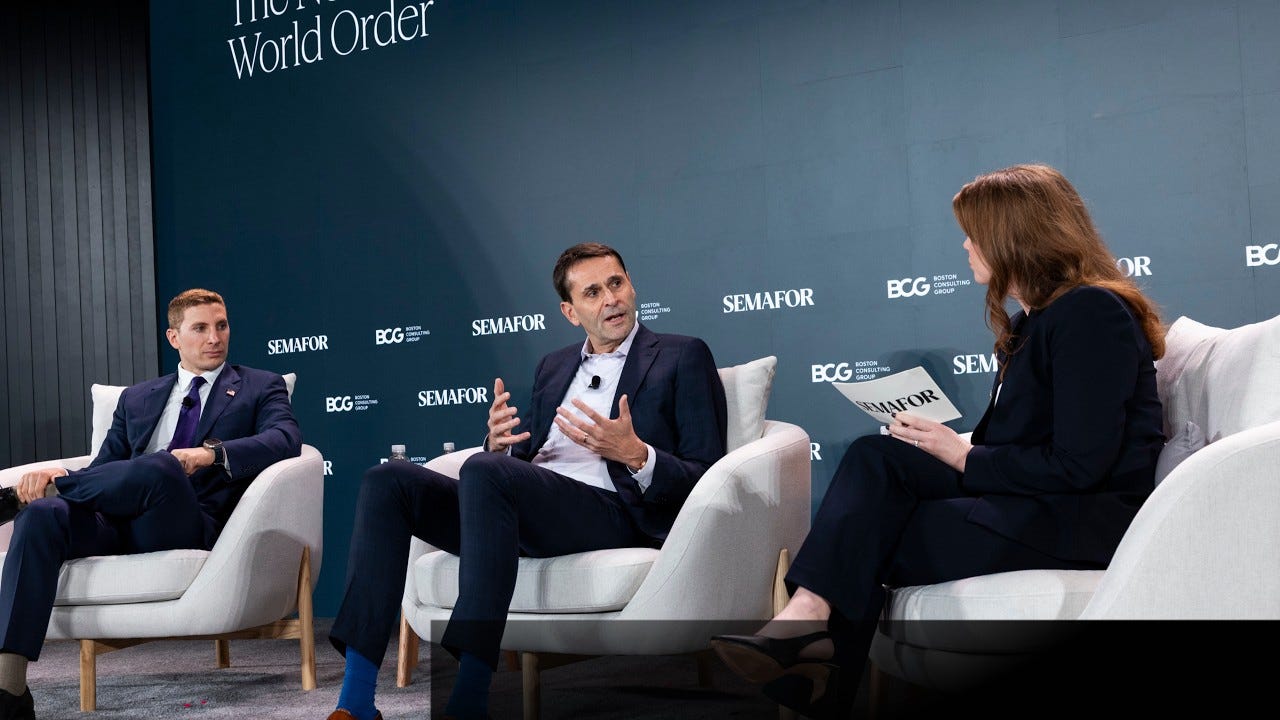
ASML's most advanced chipmaking machines have been barred from export to China for almost 10 years, Christophe Fouquet, president and CEO of ASML, said on Semafor's Silicon Valley & The World, alongside Jacob Helberg, the US Under Secretary of State for Economic Affairs.
Congress is now weighing rules that would go further and could stop ASML from servicing the machines it has already sold in China. Christophe said walking away would leave those factories running and cost ASML only its oversight of its own equipment.
"We have many data that show if you stop service, the fab keeps going. The only thing that happens is you lose control of your equipment." — Christophe Fouquet
Christophe runs the company whose lithography systems sit at the center of the chip export fight. Jacob is the State Department's senior economic official and has testified to the House Foreign Affairs Committee on how the US should weigh export limits against market share.
The full interview is covered here so you can skip it. 21 minutes of audio, 7 minutes of reading.
Here are the 8 arguments that matter.
Key Takeaways
Washington and Silicon Valley read the Nvidia affair differently: national security against loyalty to a founder
The US has to stop pretending there is no trade-off between export limits and market share, Jacob said
ASML's EUV machines have been kept out of China for almost 10 years under rules that already exist
Stopping service does not stop a Chinese chip factory, Christophe said; it only costs ASML control of its tools
AI demand is straining ASML's entire supplier base, not one bottleneck
Pax Silica rests on shared definitions, not on cutting out allied suppliers such as Ericsson, Samsung and SK hynix
Europe is about 1% of ASML's revenue, which is why Christophe bets on collaboration over self-sufficiency
1. DC and Silicon Valley Split
The interview opened on the controversy around Jensen Huang and Nvidia. The night before the taping, the Commerce Department issued an interim rule closing a remote-access loophole tied to the related investigation. Jacob said the affair had exposed a real gap in outlook between Washington and the tech industry.
Jacob Helberg says the two places weigh the Nvidia affair on different scales
"In DC, we're very, very focused on national security. And in Silicon Valley, we've seen an outpouring from the tech industry of support for Jensen." — Jacob Helberg
The industry's support rests on its belief that a founder-led company cannot simply swap in a new leader. Jacob put that view in terms of scale.
"Building a five trillion dollar company is extraordinarily rare, and it's not easy or common to be able to replace the founder interchangeably with anyone else and expect a similar outcome." — Jacob Helberg
The State Department takes part in inter-agency consultation, Jacob said, but authority over export controls sits with Commerce. The administration hopes the investigation reaches the truth quickly, because it sees a strong national-security case for Nvidia staying a leader in innovation.
