

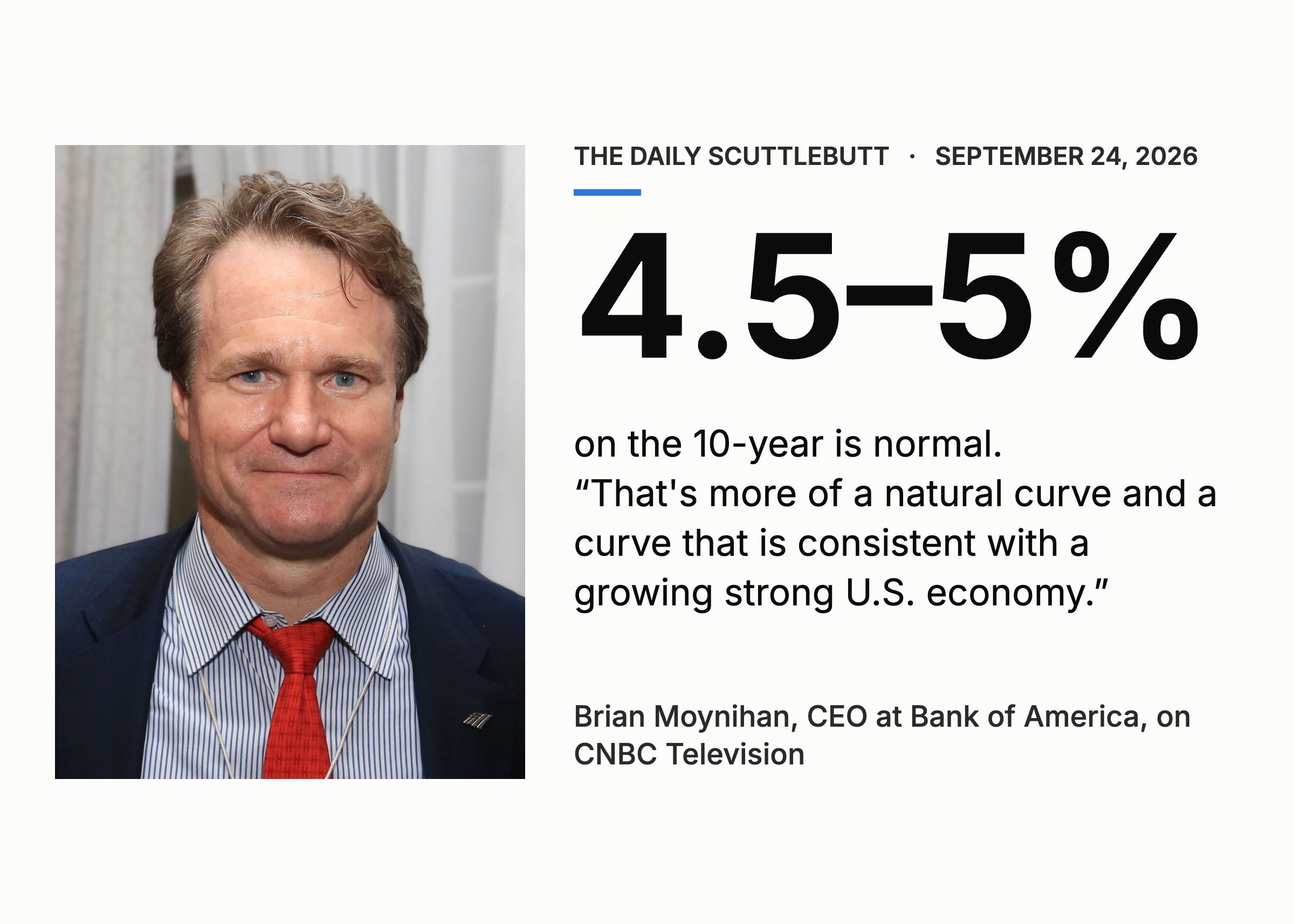
Photo: Financial Times, CC BY 2.0, via Wikimedia Commons
A 10-year Treasury yield of 4.5% to 5% is normal, Brian Moynihan, CEO of Bank of America, told CNBC. He said rates running from a Fed funds rate of 3% to 4% up to that 10-year level fit a growing US economy. Higher rates also help his bank, which holds $2 trillion of deposits and pays an average of 2% on them.
That was one answer in a short interview. 14 other people said something worth weighing. Franklin Templeton's CEO put productivity growth at 2.5% and said she does not think any of it comes from AI yet. An Index Ventures partner said he can soon imagine one person in a rogue state launching a swarm of 10,000 AI agents to run ransomware attacks, and that any cyber defense waiting on a human would be overwhelmed.
"And one of the things I've talked to our team about is we need to stop talking about that being a difficult environment and just say that is the environment. Because I think as we look out forward, we're not expecting things to change. We're not expecting that the industry all of a sudden is going to go to having robust traffic growth. We think that's going to be largely flat." — Chris Kempczinski, CEO at McDonald's, on CNBC Television
We scanned 660 shows and 3 hours of audio, wrote 15 summaries, and pulled 26 quotes into this 10-minute read.
Here is what mattered.
Macro
A 4.5% to 5% 10-year Treasury yield is normal for a growing economy
"Now the good news is this people think it's higher and it's actually more normal to have a rate structure with a three, three and a half, 4% Fed funds rate to four and a half, 5%, ten year rate. That's more of a natural curve and a curve that is consistent with a growing strong U.S. economy. So a little bit is just getting used to different environment than we were post-financial crisis for many, many years." — Brian Moynihan, CEO at Bank of America, on CNBC Television
Franklin Templeton's CEO does not credit AI for 2.5% productivity
"Obviously I think we've got a hawkish Fed. And you may have rates rise again in December. I think that's what our guys are calling for. ... So I think as long as things stay pretty strong and let's look at productivity is at 2.5%. And I don't think any of that is AI. Nobody's figured out how to get AI really yet." — Jenny Johnson, President and CEO at Franklin Templeton, which manages nearly $1.8 trillion, on CNBC Television
International
Shipping US GPUs to the UAE is easier than a year ago
"What I would say is we are on track. We're doing the things we said we would do. We continue to explore opportunities to do more, and it's easier to ship American advanced GPUs to a place like the UAE today than it was a year ago." — Brad Smith, Vice Chair and President at Microsoft, on Bloomberg Talks
Financials
Rising rates help a bank paying 2% on $2T of deposits
"But we sit with $2 trillion in deposits. The total rate paid to the customer is 2%. And that's because a bunch of them are checking accounts and transactional accounts for businesses. So when rates go up, it actually benefits our company." — Brian Moynihan, CEO at Bank of America, on CNBC Television
Companies relying on manual payment controls will start drawing fines
"So, those manual processes that we have today that are probably seen across 80% of organizations are just not fit for purpose. And I would say over the next few years as the regulation reduces gray area becomes more watertight we'll start to see that companies start to get fined because of lack of kind of digital controls and lack of quality process." — Tom Abbey, UK and Ireland Country Manager at Trustpair, on Moody's Talks
Crypto and Digital Assets
The upfront cost of liquidity will thin out new exchanges
"So I think building an exchange is hard. It's mostly economically hard because you need to bootstrap liquidity, which comes at a great upfront cost. ... I think over time we will see less and less new exchanges launch for that reason." — CJ Hetherington, Co-Founder and CEO at Limitless Exchange, on Prediction Market Movers
Limitless is putting Polymarket's and Kalshi's markets on one exchange
"So we ... kind of thought that well Kalshi is never going to list Poly Markets markets. Poly Market's never going to list Kalshi's markets and the two are never going to work together. So why don't we aggregate all of Poly Markets and Kalshi's liquidity and all of their markets and then we'll have a richer market library than either of them could ever have and we'll have deeper liquidity." — CJ Hetherington, Co-Founder and CEO at Limitless Exchange, on Prediction Market Movers
Consumer
McDonald's holds a 40% share of beef and a 10% share of beverages
"Beef is about a $50 billion category globally. We already have a 40 share of beef. But if you think about chicken, chicken's $130 billion category, we have about a 20 share of chicken. Beverages is about a $230 billion category. We have a ten share of beverages." — Chris Kempczinski, CEO at McDonald's, on CNBC Television
Ben & Jerry's CEO ties 9.2% quarterly growth to its activism
"And even when the times change, what we are proving and showing again and again is that we can be out there and actually connect to communities, have a point of view. And it works for our business as well because we grew in quarter to 9.2%." — Jochanan Senf, CEO at Ben & Jerry's, on Bloomberg Talks
77M people will be over 65 by 2030, with caregivers 1.8M short
"It's 77 million people by 2030 are going to be aging into this population while at the same time we're going to have a shortage of 1.8 million caregivers in order to keep up with the caregiving demand that we're going to see there." — Matt Lynch, CTO and Co-Founder at Sage, which makes fall-detection and nurse-alert systems for senior living, on C-Suite Unscripted
Sage sells hardware at cost and charges a software subscription
"The modern solutions are kind of flipping that on its head where we provide a SAS model where it's hardware at cost or even waving hardware fees in some instances and focusing more on how we can provide continuing value. ... At the end of the day, the owners are going to care a lot about their net operating income and being able to demonstrate that sage at least pays for itself, which 100% of the time it will in net operating income opportunities, whether through labor efficiency or care income, things like that." — Matt Lynch, CTO and Co-Founder at Sage, on C-Suite Unscripted
A free-gyoza offer took itsu's app to No. 1 in food and drink
"You just download the app, you get the gyoza. ... it by far exceeded our expectations. ... it was great for driving footfall into the shops as well. ... we were number one in the food and drink category in the app store." — Katie Grundy, CRM and Loyalty Manager at itsu, on Tech on Toast
Sports
At $10B an NFL team is beyond almost any single buyer
"Well, the reason this is happening is in part because the values of franchises are going up so much that very few individuals can buy a team. So, for example, NFL franchises, which are now worth $10 billion plus, very few individuals can write a check that can buy a team for $10 billion." — David Rubenstein, Co-Founder and Co-Chairman at The Carlyle Group and owner of the Baltimore Orioles, on Bloomberg Talks
Private equity firms can now own up to 10% of an NFL team
"The NFL now allows teams to buy, certain private equity firms buy up to 10%. Other leagues allow sovereign wealth funds to invest, all in minority stakes." — David Rubenstein, Co-Founder and Co-Chairman at The Carlyle Group, on Bloomberg Talks
Technology & AI
Memory prices hold phones back, but premium demand is holding
"The mobile market is still kind of depressed because of the memory prices. But we have seen the premium tier have been more resilient. We talk about it in our last earnings that really Q3 fiscal, it was the bottom. We are seeing even with higher prices right now, I think demand is holding." — Cristiano Amon, CEO at Qualcomm, on CNBC Television
Companies are asking for 100B-parameter AI models on the phone
"We announce a brand new chip for this area, including an AI co-processor, which is kind of the same technology we did for our data center business that we're just starting moving that to the phones. There are companies now asking for 100 billion model parameters running on your device." — Cristiano Amon, CEO at Qualcomm, on CNBC Television
No single company can secure every layer of AI agents
"Well, when I talk to customers, the real competition is confusion. ... The reality is that every layer of the tech stack is becoming agents. Every layer is becoming more autonomous, long running, connected to more things ... no one company can secure it all." — Todd McKinnon, Co-Founder and CEO at Okta, on CNBC Television
OpenAI did not know the hacked system was online
"If you look at these hacks, if you look at the OpenAI Hugging Face hack, the issue was that OpenAI didn't know the system was connected to the internet. They didn't have the visibility and control they needed." — Todd McKinnon, Co-Founder and CEO at Okta, on CNBC Television
The largest tech companies now need heavy capital spending
"And I do have some worries on the Mag-7 just because you've gone from capital light businesses to capital intensive businesses. And not all that expenditure has gone through the P&L." — Jenny Johnson, President and CEO at Franklin Templeton, on CNBC Television
AI is still a tailwind for power and networking
"I'm not sure it's a headwind more than it is still a tailwind for things like networking, electrification, power infrastructure. Those supply chain bottlenecks are there, but the demand is very, very high." — Aaron Kennon, CEO and Co-Founder at Clear Harbor Asset Management, on Bloomberg Surveillance
Shopify gains reach to 3.4B Facebook users, and Amazon worries about Meta
"Well, I can't speak for the management teams, but clearly Shopify is of the view that with 3.4 billion users at Facebook connected now to Shopify's platform, that could be a huge economic tailwind. I think Amazon's very concerned that perhaps Meta is extracting insights into consumer activity on there and creating their own models that could potentially disintermediate some important sort of moats that have existed at Amazon over the past several years." — Aaron Kennon, CEO and Co-Founder at Clear Harbor Asset Management, on Bloomberg Surveillance
VC & Startups
Cyber defense with a human in the loop will be overwhelmed
"What has happened because of the advancement of AI is more adversaries can launch more sophisticated attacks with less money. ... So I can soon imagine a single individual in a rogue state that launches a agent swarm of 10,000 to conduct ransomware attacks across the globe. ... So on the other side, the world needs to evolve to a machine to machine cyber war state. If a human is in the loop on the defense side, compute or cost will drive an overwhelming force." — Shardul Shah, Partner at Index Ventures and an early investor in Wiz, on Equity
A pause at the frontier still leaves years of AI adoption ahead
"I think that the technological advancement in the last 2 years has definitely surprised me. However, the diffusion of that technology into industry into the hands of consumers is lagging. As a consequence, if your hypothesis is correct and we are paced at the frontier, I still think there's a significant lag in the world actually having diffusion and acceptance of existing technologies and capabilities which are pretty significant." — Shardul Shah, Partner at Index Ventures, on Equity
Materials & Energy
Data centers have grown faster than Microsoft's carbon plans assumed
"Where the whole industry is challenged is obviously carbon. And we set some very important aspirational goals when this decade began. ... there's more data centers now than we anticipated then. The markets that we hoped would begin to mature by now with new technology, greener steel, greener concrete, other forms of renewable energy, They're coming along, but not at the pace that we had hoped." — Brad Smith, Vice Chair and President at Microsoft, on Bloomberg Talks
Policy
China kept emerging-market trade terms after it reached Germany's size
"Now, I think China should be in the World Trade Organization ... However, when China is coming in as an emerging market, like El Salvador, Dominican Republic, and they get to the size of the U.K., or the size of Germany, they needed to be treated like Germany or the UK, and they weren't. And they were clipping off 11%, 10% growth, had their market closed, flooded our markets." — Anthony Scaramucci, Founder and Managing Partner at SkyBridge Capital, on Bloomberg Businessweek
If this was worth your time, send it to someone who has to follow all of this too.
What did you think of today’s edition? Hit ‘reply’ to this email, send us a message, leave a comment, or join the chat!
Get the latest market chatter as it happens: