

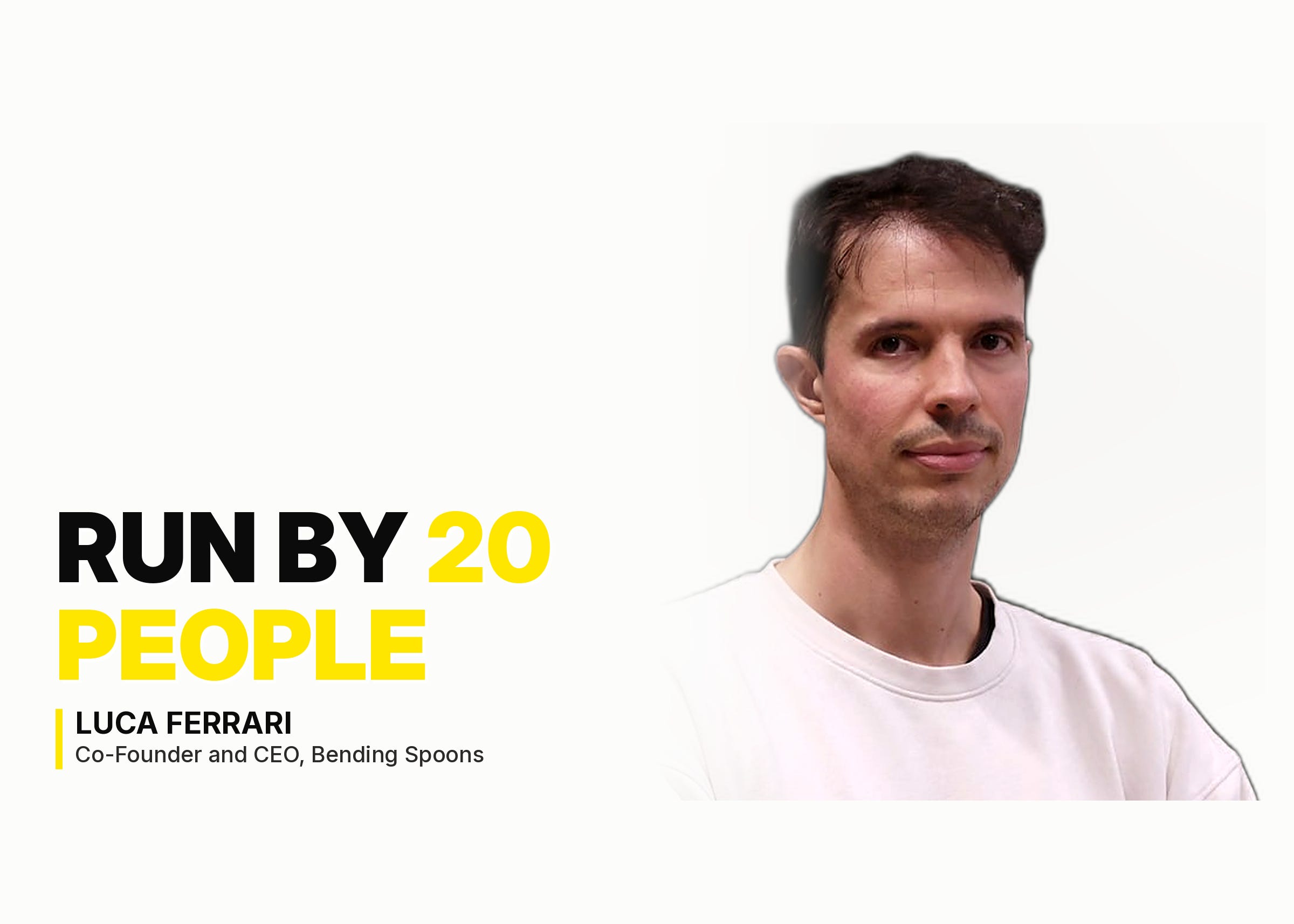
Luca Ferrari told Joys of Compounding that Evernote had about 350 employees when Bending Spoons bought it. It is now run by 20 people, and those 20 shipped the product's biggest update in years.
That was one line from one interview. Across tonight's 20 shows, 21 other people said something worth the reader's time, from Verizon's CEO explaining how dropping free-phone offers cut the cost of winning a subscriber by 41%, to CoreWeave's CEO saying 4-year-old Nvidia chips are being leased again at a premium, to a former Space Force officer warning that China has spent about 20 years on space weapons.
"Evernote, when we bought it, it had 350 team members approximately ... and now it's being run by 20 people, and those 20 people launched by far the biggest update to the product in maybe a decade." — Luca Ferrari, Co-Founder and CEO at Bending Spoons, on Joys of Compounding (Read summary)
We scanned 751 shows and 14 hours of audio, wrote 19 summaries, and pulled 47 quotes into this 18-minute read.
Here is what mattered.
Macro
Nobody has grown a $32T economy 3%+ a year, Rubenstein says
Asked whether the US can grow its way out of its national debt, Carlyle co-founder David Rubenstein said the arithmetic doesn't work.
"Growing an economy of $32, $33 trillion at more than 3% a year is very, very difficult. Obviously, nobody's ever done that." — David Rubenstein, Co-Founder and Co-Chairman at Carlyle, on The World According to Boyar (Read summary)
About 50% of S&P 500 risk now comes from AI stocks, Jacobs says
Jay Jacobs, who runs BlackRock's US equity ETF business, says a single theme now explains much of how the index moves.
"We believe about 50% of the risk in the S&P 500 today is coming from AI related stocks, meaning AI is driving markets just as much as if not more than some common macro factors like earnings growth or interest rates." — Jay Jacobs, U.S. Head of Equity ETFs at BlackRock, on ETF Prime (Read summary)
International
Fydelia did 2.5 years of work in 2 months with AI, Parkinson says
Steve Parkinson's Fydelia runs guest Wi-Fi and customer data for UK hospitality chains with a staff of six, and builds its product on Claude. A slow summer showed him how much AI had changed its output.
"In July and August... the lead flow was down... but here's the eye opener: in those two months, we calculated we did about two and a half years of work." — Steve Parkinson, Founder and CEO at Fydelia, on Tech on Toast (Read summary)
Parkinson thinks AI will push hospitality software prices up, not down
He does not expect that speed to make software cheaper for restaurant operators.
"I think price is going to go up heavily next year... AI is not free as well. Everyone hasn't realized that yet. It's about to come and bite us on the backside." — Steve Parkinson, Founder and CEO at Fydelia, on Tech on Toast (Read summary)
AI lets advisers check every compliance file, not a sample, McBride says
Samantha McBride's Ani Tech builds AI agents for UK wealth managers and financial advisers. Compliance reviews of advice files have traditionally checked a risk-based sample, because reviewing every file by hand was not feasible.
"With AI, you can check everything. Everything can go through. It can be checked proactively, not retrospectively... every single decision, everything that happens can be audited and traced back and justified." — Samantha McBride, Founder and CEO at Ani Tech, on Fintech Insider (Read summary)
Fast-growing firms adopt AI by hiring fewer people, McBride says
She says the fastest adopters are firms that are already growing, because AI lets them slow hiring rather than cut staff.
"Firms that have these big growth ambitions, it's a much easier sell in a way internally... we're growing very quickly, so we're going to use this technology and so we just may not hire as many people as we grow." — Samantha McBride, Founder and CEO at Ani Tech, on Fintech Insider (Read summary)
Financials
Robinhood's GameStop capital call hit $7B overnight, Tenev says
In January 2021, as GameStop trading surged, Robinhood's clearing deposit requirement jumped overnight and forced it to restrict buying in the stock. CEO Vlad Tenev recalled how the numbers arrived.
"The first number that came through the automated files was something like 3 billion ... then 1.8 billion, then we had a file that was 7 billion." — Vlad Tenev, Co-Founder and CEO at Robinhood, on David Senra (Read summary)
Ribbit's Micky Malka committed on the spot to a $250M-$500M ask, Tenev says
His first call that morning was to Micky Malka of Ribbit Capital, an early investor with whom he had drafted a standing term sheet the year before.
"He committed on the spot. He's like, 'How much do you need?' I said, 'I don't know, 250 million, 500 million. I'm not sure.' He's like, 'I've got it.'" — Vlad Tenev, Co-Founder and CEO at Robinhood, on David Senra (Read summary)
Eagle Bank closed 1,950 secondary-market mortgages last year, Owen says
Cathy Owen's Eagle Bank & Trust in Arkansas has just crossed $500 million in assets, and it runs a mortgage business much larger than that size suggests. It sells every loan into the secondary market under a commitment made before closing.
"Last year we closed 1,950 secondary mortgage loans... for a small bank you can see that's a lot of loans." — Cathy Owen, Executive Chair at Eagle Bank & Trust and Chair of the American Bankers Association, on ABA Banking Journal Podcast (Read summary)
AI Funds follows its model's picks 100% of the time, Schwartz says
Tal Schwartz has run AI Funds' Bela model for adviser portfolios since 2019 and has now put it inside an ETF, HIAI. He says the people running it no longer second-guess it.
"We follow what the AI model spits out 100%. We have discretion just in case we see errors... I found out the hard way over many years not to override Bela." — Tal Schwartz, Founder and CEO at AI Funds, on ETF Prime
BlackRock's liquid-alts ETF is up in the mid-teens with a 0.3-0.4 beta, Jacobs says
BlackRock's iShares Systematic Alternatives Active ETF, IALT, puts hedge-fund strategies such as market-neutral equity, global macro and trend-following into one fund, and has grown to nearly $8 billion.
"IALT this year is up in the mid teens from a performance perspective, but its beta to US equities is about 0.3 or 0.4." — Jay Jacobs, U.S. Head of Equity ETFs at BlackRock, on ETF Prime (Read summary)
Active ETF flows on BNY's platform rose about 56% in a year, Slavin says
Ben Slavin, global head of ETFs at BNY, reads active-ETF demand from the trading of BNY's own clients.
"We've seen an increase of about 56% over last year in terms of the active ETF flows that we see coming through our clients." — Ben Slavin, Global Head of ETFs at BNY, on Inside Active (Read summary)
Roughly 2/3 of active ETF flows go to high-conviction funds, Slavin says
Most of that money is going to funds whose managers pick securities, rather than to rules-based funds that sit close to an index.
"Roughly two thirds of that flow is actually going into that bucket of that sort of higher active share or true active product." — Ben Slavin, Global Head of ETFs at BNY, on Inside Active (Read summary)
Crypto and Digital Assets
Bitcoin's fixed rules make it a more credible store of value than ETH, Schmidt says
Ethereum co-founder Vitalik Buterin recently argued that ETH should be valued as a store of value, like gold, rather than on the fees the network earns. Dragonfly's Tom Schmidt is not convinced.
"This is to Bitcoin's credit. One of the things that they've done kind of well is actually make it so difficult to change Bitcoin that there's credibility behind the monetary policy ... whereas ETH has changed its emission curve so many different times, it feels less credible to say yes, it's a store of value." — Tom Schmidt, General Partner at Dragonfly, on The Chopping Block
A 10-year holder has to keep watching Ethereum, Qureshi says
Haseeb Qureshi, Schmidt's colleague at Dragonfly and the show's host, agreed with him.
"I do think Tom's argument that Ethereum changes pretty reliably over time ... does resonate with people. If I want to go into a bunker, I want to hold something that I don't have to think about for 10 years. And you have to think about Ethereum if you're thinking about 10 years." — Haseeb Qureshi, Managing Partner at Dragonfly, on The Chopping Block
Alternatives and PE
Bending Spoons would buy shrinking companies forever at a 65% IRR, Ferrari says
Bending Spoons, the Italian company that buys and runs software businesses, says investors put too much weight on organic growth. Its CEO says most of its acquisitions were growing anyway.
"If I could now sign a document guaranteeing that we can buy shrinking companies forever at 65% IRR, where do I sign? I would sign immediately." — Luca Ferrari, Co-Founder and CEO at Bending Spoons, on Joys of Compounding (Read summary)
PE-owned annuity books haven't been through a recession, Rubenstein says
Private-equity firms have moved into annuities and insurance, investing policyholders' premiums more aggressively than traditional insurers do. Carlyle holds a minority stake in one such insurer, and Rubenstein said the approach has not yet faced a downturn.
"We haven't had a real recession for about 10 years or so. So if we were to go into a recession, all fixed income would probably suffer a bit and annuities might as well. We don't know." — David Rubenstein, Co-Founder and Co-Chairman at Carlyle, on The World According to Boyar (Read summary)
Consumer
GLP-1s exposed $1,300 list prices that net out at $300 to $400, Reitano says
Zach Reitano's Ro is the largest US telehealth provider of GLP-1 weight-loss drugs. He says the drugs, now sold by their makers directly to patients, showed how far list prices sit from what is actually paid.
"You have $1,300 drugs that people are paying behind the scenes $3, $400 for. No industry could survive with its prices not being public." — Zach Reitano, Co-Founder and CEO at Ro, on Invest Like the Best (Read summary)
Ro 10x'd its business while staff fell from 600 to about 400, Reitano says
Ro cut seven vice presidents and about a fifth of its staff in 2022, after what Reitano calls a refounding of the company.
"We've grown 100% basically year-over-year for the last four years. We were 600 people when I was on that plane. We're now 400 and change, and we've 10x'd the business." — Zach Reitano, Co-Founder and CEO at Ro, on Invest Like the Best (Read summary)
Over 1/3 of US doctors now use AI to take visit notes, Tangney says
Doximity, the professional network for US physicians, sells an AI scribe that writes up patient visits. Its CEO, Jeff Tangney, hopes use will roughly double within a year or two.
"We're over a third now of US physicians who are using AI to help them take notes in the practice in the visit, and that's a big time saver for doctors and actually a big quality improvement for patients." — Jeff Tangney, Co-Founder and CEO at Doximity, on Inside the ICE House (Read summary)
Doximity checks AI drug doses with non-AI software, Tangney says
Doctors' main worry about AI, he says, is accuracy, not being replaced. Doximity's answer is a second layer of conventional software.
"We provide what they call programmatic verifiers... we review all the drug doses, make sure they're all accurate with deterministic software, non-AI going through the AI answer to make sure that they can trust that." — Jeff Tangney, Co-Founder and CEO at Doximity, on Inside the ICE House (Read summary)
The US hosted the World Cup and overseas visits still fell 7% in July, Freeman says
Geoff Freeman, who runs the U.S. Travel Association, says added frictions for foreign visitors have cut travel to the US, including a 25% drop in visits from Canada. The World Cup did not reverse it.
"Overseas travel to the US was down 2% in June and 7% in July [despite the World Cup]... we did the impossible. We hosted the World Cup and we had fewer people come to the United States." — Geoff Freeman, President and CEO at U.S. Travel Association, on Brew Markets (Read summary)
Sports
Rubenstein passed on the Commanders at a $6B valuation and calls it a mistake
Rubenstein owns the Baltimore Orioles, and Carlyle recently bought a minority stake in the Seattle Seahawks. He turned down a chance to invest in the Washington Commanders when Josh Harris bought the team.
"I told him I thought it was very high, and I turned down the chance to invest at a $6 billion valuation. The team is probably worth double that today... So I made a mistake, which I often do." — David Rubenstein, Co-Founder and Co-Chairman at Carlyle, on The World According to Boyar (Read summary)
Technology & AI
Bending Spoons runs Evernote with 20 people, down from about 350, Ferrari says
Luca Ferrari says AI is now the biggest lever on how many people it takes to run a software business. Bending Spoons cut Evernote's staff to about 60 within 12 to 18 months of buying it, then kept going.
"Evernote, when we bought it, it had 350 team members approximately ... and now it's being run by 20 people, and those 20 people launched by far the biggest update to the product in maybe a decade." — Luca Ferrari, Co-Founder and CEO at Bending Spoons, on Joys of Compounding (Read summary)
Free phones moved value from carriers to handset makers, Schulman says
Dan Schulman came out of retirement about a year ago to run Verizon, which had fallen from first to last among US carriers by market value. He says the industry's way of winning customers was the problem.
"The way that we convinced customers to make a change was to give them a free phone or a free line, and it was just a massive transfer of value from the MNO industry to the handset industry." — Dan Schulman, CEO at Verizon, on Fortune 500: Titans and Disruptors of Industry (Read summary)
Verizon's net subscriber additions rose 9x as acquisition costs fell 41%, Schulman says
Verizon stopped tying phone discounts to its service plans. Net additions, the subscribers it gains minus those it loses, then rose sharply.
"Net ads were up nine times, not quite 10, but nine times from a year ago. But our cost to acquire them was down 41%." — Dan Schulman, CEO at Verizon, on Fortune 500: Titans and Disruptors of Industry (Read summary)
Satellites can't compete where Verizon earns 98% of revenue, Schulman says
He now assumes Elon Musk's SpaceX will do everything it says it will, including building a mobile network, but says satellite service cannot match Verizon in cities and suburbs.
"Satellite itself can't compete in suburban or urban, where 98% of our revenues are... we're like 100 to 1,000 times more efficient and a better service." — Dan Schulman, CEO at Verizon, on Fortune 500: Titans and Disruptors of Industry (Read summary)
CoreWeave is 10x oversubscribed for its 2027 capacity, Intrator says
CoreWeave CEO Mike Intrator, after the company's earnings this week, pushed back on analysts who think the AI build-out is late in its cycle.
"We are 10x oversubscribed to the existing capacity that we have left in 2027." — Mike Intrator, Co-Founder, Chairman and CEO at CoreWeave, on Squawk on the Street (Read summary)
4-year-old H100s re-contracted at a 20% to 50% premium, Intrator says
He says Nvidia chips also hold their value longer than skeptics assume. CoreWeave's 4-year-old H100s come off their original contracts in 2027.
"That technology has now been contracted at a 20 to 50 percent premium over where it was originally contracted." — Mike Intrator, Co-Founder, Chairman and CEO at CoreWeave, on Squawk on the Street (Read summary)
CoreWeave's interest bill rose 20% as operating income rose 300%
Pressed by CNBC's David Faber on when CoreWeave's operating income will overtake its interest expense, he gave this quarter's numbers.
"Our interest expense went up by 20 percent. Our adjusted operating income went up by 300 percent." — Mike Intrator, Co-Founder, Chairman and CEO at CoreWeave, on Squawk on the Street (Read summary)
3 misaligned agents cut a system's accuracy to 16%, Pandey says
Vijoy Pandey runs Cisco's Outshift unit, which has deployed systems in which AI agents from different vendors work together. He says agents can be connected and still misunderstand each other. In Cisco's five-agent tests, accuracy was 99% with no misunderstandings.
"With three cognitive failures, which is not a lot, the accuracy of the multi agent system dropped to 16%. It's getting close to just randomly picking an outcome." — Vijoy Pandey, SVP and General Manager of Outshift at Cisco, on The Cognitive Revolution (Read summary)
A test system was 66% up with 0% of tasks done, Pandey says
Standard monitoring does not catch these failures, he says.
"We saw that the system was 66% up, which was defined as working perfectly. But it had 0% task completion. 0%." — Vijoy Pandey, SVP and General Manager of Outshift at Cisco, on The Cognitive Revolution (Read summary)
Sierra only gets paid when its AI agent fixes the issue, Marable says
Sierra sells AI agents that handle customer service by phone, text, email and app. Reggie Marable, its chief customer officer and first sales hire, says its pricing breaks with software convention.
"You hire Sierra to do a job. If we do our job and we do it well, we get paid... If we don't resolve the customer issue, we don't get paid. That's a completely new business model." — Reggie Marable, Chief Customer Officer at Sierra, on GTMnow (Read summary)
Sierra starts a new agent on 5% of live traffic, Marable says
A new customer's agent goes live in stages.
"We do what's called hill climbing. So you handle 5% of the traffic, we'll make adjustments... and then we'll take on more traffic." — Reggie Marable, Chief Customer Officer at Sierra, on GTMnow (Read summary)
VC & Startups
Polsia's founder prompts AI himself instead of hiring an engineer
Ben Cera is the only full-time employee of Polsia, which sells AI that helps people build and run companies. He says AI has removed the reason to take on a technical co-founder.
"I was like, okay, I could hire an engineer, but then I would have to explain to that engineer what to build and then they would prompt Claude Code to build it, versus me directly prompting Claude to do it." — Ben Cera, Founder at Polsia, on Solo Founders (Read summary)
Cera thinks only about 2% of Americans pay for AI
He thinks the market for his product has barely been reached.
"I think it's like 2% of Americans pay for AI. This is crazy. So we're so early." — Ben Cera, Founder at Polsia, on Solo Founders (Read summary)
Tu put over 7 figures of her own money into Ask Dolly
Vivian Tu built Your Rich BFF, a personal-finance media business, from a TikTok video posted on January 1, 2021. She is paying for her new financial-guidance app, Ask Dolly, herself.
"I think the biggest financial bet I've ever taken on myself is actually launching my newest tech product, Ask Dolly. I've put in over seven figures to stand this business up on my own... I didn't want an investor breathing down my neck telling me I had to grow at all costs." — Vivian Tu, Founder at Your Rich BFF and Ask Dolly, on Founder's Story (Read summary)
11 of Ask Dolly's 13 main features don't use AI, Tu says
She also keeps AI out of most of the product.
"11 out of 13 of Ask Dolly's primary features don't use AI... I think a blend of both AI and human is the way to go." — Vivian Tu, Founder at Your Rich BFF and Ask Dolly, on Founder's Story (Read summary)
Industrials and Transport
True Anomaly is adding $1B of R&D to $600M already spent, Rogers says
Even Rogers left the Air Force and Space Force to found True Anomaly, which builds spacecraft and software for the US government and its allies.
"We've been able to bring over $600 million in R&D to date. We're adding another billion dollars of R&D to that product. And that is unprecedented, I think, in modern defense tech." — Even Rogers, Co-Founder and CEO at True Anomaly, on How I Invest (Read summary)
American Airlines faces $6B in unbudgeted fuel costs, Freeman says
Freeman ties this year's higher airfares mostly to the price of oil, citing American Airlines' own figure.
"American Airlines... $6 billion in unbudgeted fuel costs for this year. That's just a staggering number." — Geoff Freeman, President and CEO at U.S. Travel Association, on Brew Markets (Read summary)
Policy
Defense buyers must let contractors earn a profit, Rogers says
Rogers says the Department of War is still uncomfortable with contractors earning a real profit, and argues for firm fixed-price contracts in place of cost-plus ones.
"If the department of war wants innovation out of industry, they want us to co-invest alongside them. We have to at some point generate capital from sales. We have to generate profit from sales." — Even Rogers, Co-Founder and CEO at True Anomaly, on How I Invest (Read summary)
Geopolitics
China has worked on space warfare for about 20 years, Rogers says
China tested a weapon in 2024 that drops a munition from orbit onto a target on the ground, Rogers said. The US shelved most of its space-weapons research after the Cold War.
"It's not good. China, which is our principal adversary for space warfare, has been at this problem now for about 20 years." — Even Rogers, Co-Founder and CEO at True Anomaly, on How I Invest (Read summary)
Nuggets of Wisdom
Ro grew 9% in 2021 and was a zombie company, Reitano says
Reitano says Ro had tried to do everything at once by late 2021, months after a large fundraise.
"We had grown 9% in 2021... we were what I would call a zombie company — you're not growing fast enough to get out of it, but you're not burning where you're going to die." — Zach Reitano, Co-Founder and CEO at Ro, on Invest Like the Best (Read summary)
Owen's family keeps its businesses intact by sitting on each other's boards
Owen's family is now in its fourth generation running businesses together.
"Fortunately my dad set a great example for us and taught us a family only destroys itself from within. So my brothers and I sit on each other's boards... we've learned how to disagree, but let's go have dinner." — Cathy Owen, Executive Chair at Eagle Bank & Trust and Chair of the American Bankers Association, on ABA Banking Journal Podcast (Read summary)
The opportunity, not the founder, sets the ceiling, Rolle says
Steve Rolle, an Army veteran and author of "The Future You Choose," checks a business's product, margin, distribution and customer acquisition before he starts or buys it.
"If you're a level 10 entrepreneur and you have a level two opportunity in a level one industry, you're capped at level one. You can only get to the highest ceiling of the minimum." — Steve Rolle, entrepreneur and author of "The Future You Choose", on What's Your Deal? (Read summary)
Rolle couldn't get a mortgage on self-employment income 3x his old pay
He says lenders and employers treat a salary as safer than it is.
"When I went to go buy a house on a 30-year mortgage, and I only had self-employment income after the military, I literally couldn't qualify for a loan... meanwhile I'm making net income three times higher." — Steve Rolle, entrepreneur and author of "The Future You Choose", on What's Your Deal? (Read summary)
If this was worth your time, send it to someone who has to follow all of this too.
What did you think of today’s edition? Hit ‘reply’ to this email, send us a message, leave a comment, or join the chat!
Get the latest market chatter as it happens: