

Blue Owl Capital's loan losses over the last 10 years came to 12 basis points, Doug Ostrover, co-chief executive of the private credit firm, said on Semafor's Compound Interest. Depending on the index, he said, the syndicated loan market, where banks arrange loans and sell them on to many investors, has lost 60 to 100 basis points.
That was one lender's account of its own loans. Below are 39 more quotes from 39 other speakers. Steve Eisman, a former senior portfolio manager at Neuberger Berman, said Anthropic and OpenAI supply 70% of the AI cloud revenue at Microsoft, Amazon and Google. Patti Poppe, PG&E's chief executive, said each gigawatt of new demand from large users such as data centers, priced properly, can cut her customers' rates 1%, while Connecticut's governor, Ned Lamont, said he told data centers to bring their own power.
"So our loan losses over the last 10 years have been 12 basis points. Almost all those loans have been repaid, cycled through, but 12 basis points. It’s a fraction of the syndicated market. In fact, depending on the index, the syndicated market is 60 to 100 basis points." — Doug Ostrover, Co-CEO at Blue Owl Capital, on Compound Interest from Semafor Business (Read summary)
We scanned 573 shows and 14 hours of audio, wrote 20 summaries, and pulled 40 quotes into this 18-minute read.
Here is what mattered.
Macro
Raising the overnight rate does little when real borrowing happens at longer maturities, BlackRock's Rick Rieder says
"Real financing doesn't happen at the overnight funds rate. It happens out the yield curve. You think about the mortgage market, the credit market, the securitization market, it happens further out the yield curve. Moving the front end of the yield curve just doesn't have the effect on inflation, doesn't have the effect on financial velocity it has historically. Are we gonna slow GPU purchasing because the funds rate is up another 25 basis points?" — Rick Rieder, Chief Investment Officer of Global Fixed Income at BlackRock, on Bloomberg Television
AI investment runs above 3.5% of GDP and at least a third of it is borrowed, J.P. Morgan's Kay Herr says
"First, I think if you look at the investment that people are putting into this. It's running like north of three and a half percent of GDP. That's a big investment. and at least a third of it, if not more, is being debt financed. So that's a glut of supply on it." — Kay Herr, Chief Investment Officer of US Global Fixed Income, Currency & Commodities at J.P. Morgan Asset Management, on Bloomberg Surveillance
Bond yields become a real problem for the economy at 6% or more, above nominal growth, Ed Yardeni says
"One way to try to assess the impact of the bond market on the economy is to look at the bond yield, the 10-year bond yield, which is almost 5.5% relative to nominal GDP growth on a year-over-year basis. And that's running about 6%, 6.5%. I would say that the bond vigilante concept would be a real concern if we started to see the bond yield get up to 6% and higher. Because I think once you get above nominal GDP, you do start to slow it down." — Ed Yardeni, President and Chief Investment Strategist at Yardeni Research, on Bloomberg Talks
Electricians building data centers have seen their wages rise about 100% in 2 years, the St. Louis Fed's Alberto Musalem says
"On the demand side, I hear frequently people that are trying to build a hospital but can't find the electricians to build a hospital because the electricians are working building data centers. And the wages of those electricians have gone up something like 100 percent over the last two years." — Alberto Musalem, President of the Federal Reserve Bank of St. Louis, on Bloomberg Talks
Other appearances:
Ray Dalio on a US debt squeeze within 2 years and a stock market already in a bubble on The Julia La Roche Show
Santiago Capital CEO on how revaluing US gold, still booked at $42 an ounce, could hand the Treasury about $1T on Macro Voices
Fairlead Strategies Founder and Managing Partner on why her sector ETF holds only 50% in stocks on Excess Returns
TJM Institutional Services Market Strategist on what would make a Warsh-led Fed buy bonds on Thoughtful Money
Nasdaq Dorsey Wright Head of Investment Insights on why foreign stocks may beat the US 2 years running, a first since 2007 on The Nasdaq Dorsey Wright Podcast
Ritholtz Wealth Management CEO and CNBC's Investment Committee on why rate-sensitive stocks will stay down through earnings on Halftime Report
International
Only about 60M to 80M Indians can pay Western prices for media, so Indian media has to target global markets, JioStar's Uday Shankar says
"There are about 60, 80 million people who can pay as much as consumers in the Western world for media content. But after that, it just keeps, paying capacity starts to get very limited. So in this country, if you really want to unlock the economic value of media or soft power, you have to target the global markets very, sharply." — Uday Shankar, Vice Chairman at JioStar, on Emerging: The New Economy Podcast
UBP is cutting its exposure to Europe, especially France, and adding Japan as a hedge against a French crisis, Kieran Calder says
"And so from an equity point of view, we've been actively reducing exposure to Europe, particularly France, and looking for other places to allocate. So Japan is one place where we've become recently more overweight, really as an antidote to the risk that this time it blows up in France and takes Europe with it." — Kieran Calder, Head of Equity Research for Asia at UBP, on CNBC International Live
Tech hardware is often more than half of Asia's broad stock indices, which ties them to US cloud spending, Platinum's Cameron Robertson says
"So I think if you look at like broad-based indices and stuff, you'll often find that tech hardware is actually today more than half of the index, which is pretty wild. You think that you're going to Asia for diversification, but actually doubling down on US hyperscaler spend." — Cameron Robertson, Portfolio Manager at Platinum Asset Management, on Equity Mates (Read summary)
Financials
About 75% of each additional dollar of Robinhood revenue goes to EBITDA, by design, its CFO says
"If you do the hard work up front and you take a lot of fixed costs and you spend the time doing that and you minimize the variable costs, what happens is you can work for really thin margins, but then as it scales, all of it drops to the bottom line and your incremental margins are really high. So if you look at Robinhood's incremental margins, it's about 75% goes directly to EBITDA. That's by design." — Shiv Verma, CFO at Robinhood, on Run the Numbers
Walmart's customer base lets OnePay sign up customers at effectively no acquisition cost, its CEO says
"I think one is just customer access and distribution is incredibly hard and incredibly expensive. And we did not have it in the context of the Marcus business when we started at Goldman. And the fact again, by virtue of the benefits of a large corporate like Walmart that serves tens of millions, hundreds of millions of customers, we have the ability here to acquire customers at zero customer, effectively zero customer acquisition cost." — Omer Ismail, CEO at OnePay, on Fintech One-on-One
Paper losses on banks' bond holdings are 5% of their tangible capital, against 19% in 2023, KBW's CEO says
"IN 2023, THE INDUSTRY'S BOND MARKET MARKS WERE 19% OF TANGIBLE CAPITAL IN THE LAST QUARTER. THE INDUSTRY'S NEGATIVE BOND MARKS WAS 5%, CONSIDERABLY BETTER. THIS IS NOT THE SYSTEMIC ISSUE IT WAS IN." — Tom Michaud, CEO at KBW, on Squawk on the Street
Other appearances:
1543 Capital Portfolio Manager on banks selling protection on AAA CDO slices for 10bps a year before 2008 on Odds on Open
Creative Planning Chief Investment Strategist on long-short indexing that can harvest tax losses of 20% to 70% a year on Creative Planning
PWL Capital CIO on why daily leverage resets are not what erodes leveraged ETF returns on The Rational Reminder Podcast
Fairlead Strategies Founder and Managing Partner on bank stocks being oversold on The Exchange
Crypto and Digital Assets
AI agents need digital money, which adds demand for Bitcoin while its supply stays fixed, Anthony Pompliano says
"So, Bitcoin, stablecoins, many of these products, AI agents need digital money. And so, now you're expanding the total addressable market. In Bitcoin's case in particular, you are not increasing the supply. And so, Bitcoin is one of the only assets in the world where when demand increases, supply stays constant." — Anthony Pompliano, Chairman and CEO at Silvia, on Phil Rosen (Read summary)
Crypto money is moving into perpetual futures, pre-IPO companies and blockchain versions of AI stocks, Kraken's co-CEO says
"So I think what you've also now seen is a new rotation towards perpetuals but also pre-IPO companies, and then again tokenized equities, and the types of tokenized equities is again based, focused on AI." — Arjun Sethi, Co-CEO at Kraken, on CNBC International Live
Alternatives and PE
Higher-risk real estate funds that sold properties last year took an average 25% loss, StepStone's Margaret McKnight says
"Their marks are often quite a bit higher than where properties are trading. So, if they sell, they have to recognize a loss. And the sales last year again were low, distributions were low, but the average loss on the sale was 25% out of a non-core fund, which is not at all surprising to us when we look at how much those have dropped in value versus asset prices." — Margaret McKnight, Partner and Head of Portfolio Solutions at StepStone Real Estate, on InsuranceAUM (Read summary)
Bond markets are saturated, so cloud providers are borrowing from Apollo, Blackstone and Goldman Sachs, the WSJ's Ben Dummett says
"They're in talks with Apollo and Goldman Sachs. Blackstone is another lender. These new names are coming into play as lenders because the traditional bond markets where the likes of Oracle and so on have relied on getting their financing have become saturated. So that's forcing cloud providers to seek out other alternative sources of lending." — Ben Dummett, Dealmaking Reporter at The Wall Street Journal, on WSJ What's News
Other appearances:
HarbourVest Partners Managing Director and Senior Market Strategist on private markets trailing public markets over the past 3 to 5 years on Inside the ICE House
RCM Alternatives Managing Director and Partner on discretionary macro managers coming back into favor on The Derivative
Consumer
Price cuts turned Frito-Lay's North American volumes from a small decline to small growth, PepsiCo's CEO says
"AND THE INVESTMENTS WE MADE IN PRICE HAVE HELPED US TO GO FROM A NEGATIVE LOW SINGLE DIGIT VOLUME TO POSITIVE LOW SINGLE DIGIT VOLUME GROWTH. SO THAT'S A BIG PIVOT IN THAT BUSINESS." — Ramon Laguarta, Chairman and CEO at PepsiCo, on Squawk on the Street
Paramount Skydance expects its cash flow to rise from $4B next year to $10B by 2030, David Ellison says
"We're projecting, mid-single digits, top line revenue growth on a company that's already producing close to $70 billion of revenue. We have $6 billion of synergies in the deal. ... we're also going to be going from $4 billion in cash flow next year when you remove transaction costs to 10 billion by 2030. So, we are absolutely in a position to where we can grow the business and delever simultaneously and create a tremendous amount of value for all stakeholders." — David Ellison, Chairman and CEO at Paramount Skydance, on Squawk on the Street
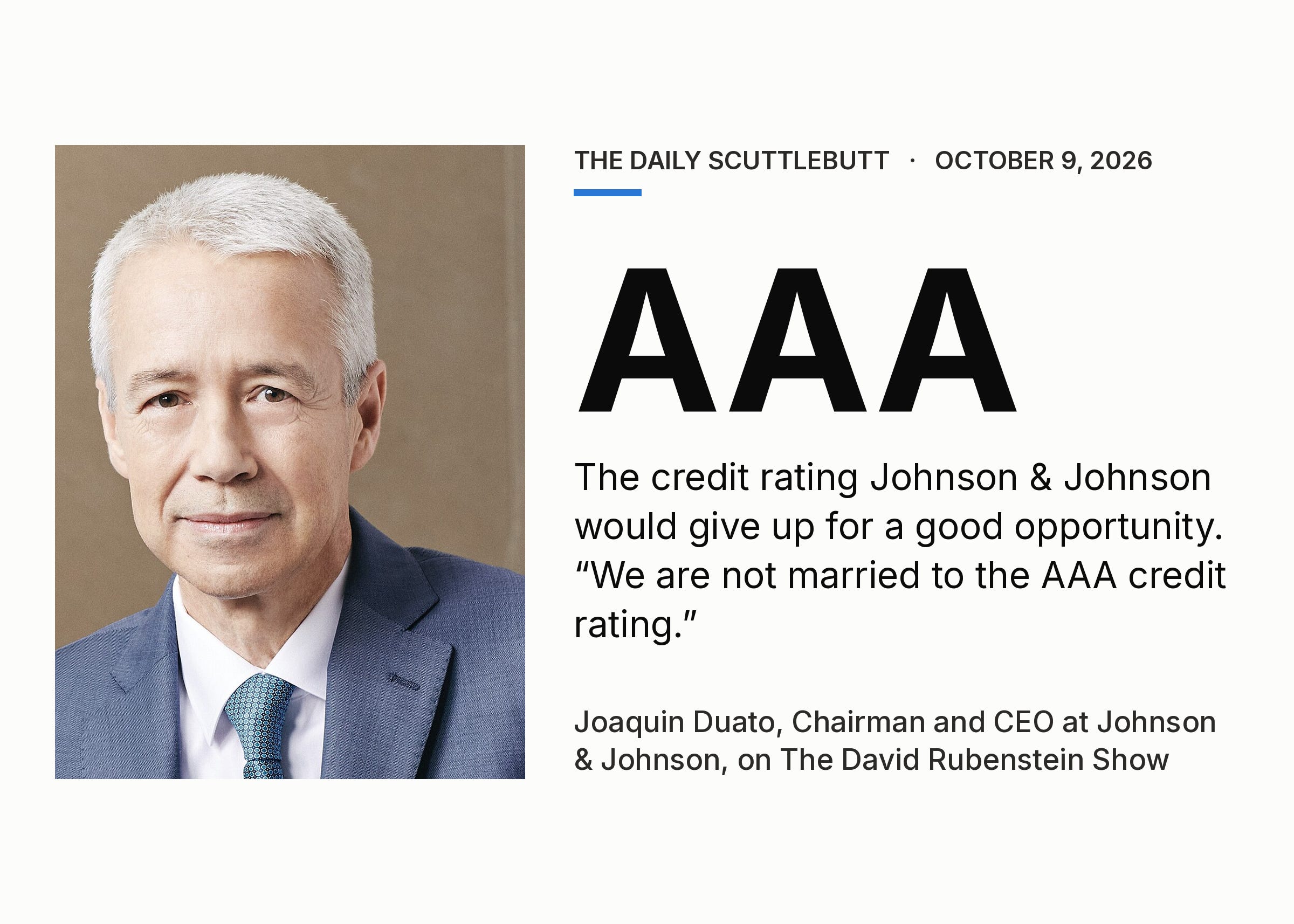
Johnson & Johnson would give up its AAA credit rating for a good opportunity, its CEO says
"We are not married to the AAA credit rating. If a good opportunity would come along, we would be happy not to have ... a triple-A credit rating, but it's a sign of our financial discipline, and our investors like it." — Joaquin Duato, Chairman and CEO at Johnson & Johnson, on The David Rubenstein Show
A hemp THC drink was the No. 2 seller last year at the largest US liquor chain, says Nate Cooper, whose firm backs the brand
"So in the largest liquor retailer in the country last year, the number one selling SKU in the chain was Tito's vodka, 750 ml, and the number two was Nowadays, which is our hemp THC beverage. In Minnesota, in some of their liquor stores, the category is making up 15 to 20% of their sales." — Nate Cooper, Managing Partner and Founder at Barrel Ventures, on Power Players with Brian Sozzi
Sports
Athlos gives its athletes equity because their personal brands are building the league, co-founder Gabby Thomas says
"And that's why Athlos exists the way it does right now, where we have a model where we are co-owners, we are earning equity when we go compete in these early stages, because our personal individual brands are what is building this league." — Gabby Thomas, Co-Founder at Athlos, on The Deal with Alex Rodriguez and Jason Kelly
The smart money in European soccer takes a cut of TV and stadium revenue rather than club equity, Breakingviews' Jon Sindreu says
"So, to the point we were making, I think the smart money essentially is the one that takes money from the top and not the bottom. And the top can also be, yes, a hybrid part of the capital stack for sure. Like, Apollo, Sixth Street, the types of deals where they get a chunk of the TV revenue, a chunk of the stadium revenue, those types of deals, I think, are where the smart money is going." — Jon Sindreu, Global Economics Editor at Reuters Breakingviews, on Viewsroom
Technology & AI
Some newer AI clouds and other providers get 30% to 60% of business from 1 or 2 customers, while AWS's largest is in single digits, its CEO says
"I think you go to a some of these whether they're neoclouds or some of the other providers out there and you know you'll see sometimes concentrations of 30 40 50 60% with one or two customers we're nowhere near that obviously we're you know singledigit percentages at the highest and usually it's less than that" — Matt Garman, CEO at Amazon Web Services, on a16z
Positron's memory costs 4.5 times what it did a year ago and could double again, its CTO says
"I was looking at a quote that we had a year and a week ago and for memory and it's gone up four and a half times since then. I really hope that this isn't the case, but I wouldn't be surprised if this is going to end up being a another doubling over the next year." — Thomas Sohmers, CTO at Positron, on The Cognitive Revolution
Anthropic and OpenAI supply 70% of the AI cloud revenue at Microsoft, Amazon and Google, Steve Eisman says
"So, now go down the food chain to the hyperscalers. If you look at Microsoft, Amazon and Google, 70% of their AI revenue is from Anthropic and OpenAI. 70% of their AI of their AI cloud revenue is from Anthropic and OpenAI. If you do simple math, that's like 25% to 30% of total cloud revenue. Then if you go to Oracle, which is even more concentrated, over half of its backlog is just from OpenAI." — Steve Eisman, Host of The Real Eisman Playbook and Former Senior Portfolio Manager at Neuberger Berman, on In the Money with Amber Kanwar (Read summary)
Companies are moving AI spending to standard models rather than the most advanced ones, Big Technology's Alex Kantrowitz says
"But I think investors are looking at what's going on in AI. They understand that companies have been pulling back some of their spend, and routing some of their spend to AI models that are standard, and not the frontier, not the best ones. And I think the market is just waiting for a moment where, if they see something go wrong, they're going to pull back way more than they did today." — Alex Kantrowitz, Founder at Big Technology, on CNBC Television
VC & Startups
It may be easier than ever for a startup to outraise its rivals and leave them short of capital, USV's Michael Mignano says
"It's potentially easier than ever to out raise your opponent and suck the oxygen out of the room. And so one thing we think about when we see founders who are building great products and telling great stories is this founder gonna be able to raise a lot of capital because it's going to be expensive to win and that's going to matter a lot." — Michael Mignano, Partner at Union Square Ventures, on TBPN (Read summary)
Switching software products has become easy because AI agents can do the migration, Sheel Mohnot says
"I think it doesn't happen overnight I think what happens is seatbased pricing probably shrinks software creation gets easier there probably more competitors you can do a lot more with the general models the interface gets disintermediated and then I think one that is probably more true now than ever is like switching costs have gone away. It's just so easy to switch from one product to another because AI can do the switching for you. Agents can do the migration." — Sheel Mohnot, Co-Founder and General Partner at Better Tomorrow Ventures, on This Week in Startups (Read summary)
BMW says only one Figure robot worked at a time in a 2025 pilot that Figure's founder described as a fleet, Forbes reports
"BMW tells Forbes that just one Figure robot worked at a time, with a second on site to rotate in while the other one recharged." — Kieran Meadows, Editor and Host of the Forbes Daily Briefing, presenting Antonio Pequeño's reporting, on Forbes
Industrials and Transport
Honeywell sold 3 businesses and bought 6 while it split into 3 companies, its CEO says
"So if you see one thing we did differently in Honeywell Technologies is not only we spun the company into three, between aerospace, Honeywell Technologies and specialty chemicals, we also transformed our portfolio simultaneously. So we spun off — we divested three businesses and we acquired six businesses in the same period of time. The reason we did that was we did not want a new start after the spin to say, oh now we have new innings, now we have to transform our portfolio." — Vimal Kapur, Chairman and CEO at Honeywell Technologies, on Semafor's The CEO Signal
Most transport companies pass fuel costs on to customers, so the risk from fuel is lost demand, Citi's Ari Rosa says
"For most transportation companies, fuel is actually a pass-through cost, and so it's really their customers that bear that cost. The bigger concern as it relates to fuel is really around demand destruction, right?" — Ari Rosa, Transportation Equity Research Analyst at Citi, on BNN Bloomberg
Materials & Energy
Each gigawatt of new large demand, priced properly, can cut PG&E customers' rates 1%, its CEO says
"For every gigawatt of new large demand priced properly, we can reduce rates by 1%. So when I shared with you, we have 12 gigawatts of demand, that could be 12% rate reduction for all customers, rebuilding the grid funded by tech. That's pretty amazing." — Patti Poppe, CEO at PG&E, on At Barron's
New power-generation equipment probably is not available until 2030, Solaris's CEO says
"AVAILABILITY FOR NEW EQUIPMENT IS PROBABLY 2030. WE'RE IN THE PROCESS OF BUILDING OUT SIGNIFICANT AMOUNT OF INFRASTRUCTURE RIGHT NOW. SO TODAY WE OPERATE ABOUT 4000MW OF POWER, ... ABOUT 1000MW. THAT IS POWER THAT WE OWN. SO WE OPERATE FOR THIRD PARTIES AS WELL. WE'RE ROLLING OUT ANOTHER 2500MW OVER THE COURSE OF THE NEXT TWO YEARS." — Bill Zartler, Chair and CEO at Solaris Energy Infrastructure, on CNBC Television
Oil is a normal price plus an unusual shipping cost, and the danger is in natural gas, Goldman's Michele Della Vigna says
"In oil, I think the market is correct not to panic. In some way, we are back to a normal oil price plus an abnormal transportation cost. Right. Where I think the danger is in natural gas." — Michele Della Vigna, Head of EMEA Natural Resources Equity Research at Goldman Sachs, on Bloomberg Television
Other appearances:
CNBC trading panel on why crude oil needs a risk premium if the US will not deter Iran on CNBC's Fast Money
Policy
Washington is going after Chinese goods lightly assembled in a third country to get a lower tariff, Jamieson Greer says
"Where we tend to get influxes of sometimes it's secondhand, right? You get Chinese inputs or goods to a third country, they do a little screwdriver work, a little assembly work, and they send it to us. That technically counts as a good from another country with a preferential duty rate, but maybe fundamentally it's Chinese. So, we're trying to get at all of these things right now." — Jamieson Greer, US Trade Representative, on Squawk Pod
Connecticut told data centers to bring their own power so they would not raise electricity prices, Governor Ned Lamont says
"WELL, MY ISSUE WITH DATA CENTERS WAS MORE ABOUT THE FACT THAT IT WOULD SUCK AS MUCH ELECTRICITY AS SOUTHERN CONNECTICUT AND JACK UP ELECTRIC PRICES. SO I SAID, LOOK, IF WE'RE GOING TO DO ANYTHING ON DATA, YOU BETTER BRING IN YOUR OWN POWER ALONG WITH YOU." — Ned Lamont, Governor of Connecticut, on CNBC Television
If Democrats win either chamber of Congress, next year's debt-ceiling fight is the issue investors should watch most, Schwab's Mike Townsend says
"If Democrats win the House, the Senate, or both this November, then a debt ceiling fight next year will be particularly tricky, as the Democrats would have to reach a deal with President Trump on a plan. Democrats would likely ask for significant concessions on policy issues they favor in exchange for their vote. But doing so could risk a financial meltdown. Debt ceiling stalemates in recent years have resulted in market downturns, increased volatility, rising bond yields, downgrades of the U.S. credit rating, and even the risk of an unprecedented default. It's the issue for investors to pay the most attention to." — Mike Townsend, Managing Director of Legislative and Regulatory Affairs at Charles Schwab, on WashingtonWise
Geopolitics
Washington watches oil volumes while Tehran watches Brent above $100, diesel above $6 and the bond market, Eurasia Group's Gregory Brew says
"If the US is watching volumes out of the region, I think the Iranians are watching price. They're seeing Brent Front month stay above 100. They're seeing diesel stay above $6 a gallon in the US. They're watching the bond market." — Gregory Brew, Senior Analyst at Eurasia Group, on BNN Bloomberg
Companies see an investment case in making Gulf infrastructure harder to disrupt, McKinsey's Ziad Haider says
"However, many companies see a real investment imperative in that region on the horizon. They want to invest in different forms of resilience, whether it's hardening digital infrastructure and data centers or diversifying and building out pipeline networks. There's a whole investment thesis on resilience in the Gulf that we'll see play out in time" — Ziad Haider, Partner and Global Director of Geopolitics at McKinsey, on The McKinsey Podcast
Nuggets of Wisdom
Every company's competitive advantage is either widening or eroding, the Motley Fool's Jon Quast says
"I view all companies as either building a moat, or their moat is eroding. I don't believe that any business is stuck in one place." — Jon Quast, Analyst at The Motley Fool, on Motley Fool Hidden Gems Investing
Investors, traders and speculators differ by the question they ask, not by what they buy, Orion's Daniel Crosby says
"An investor asks what an asset is worth. A trader asks when to buy and sell it. A speculator asks which direction it might move next. ... Indeed, the line between these categories is about the question being asked, not the instrument being used." — Daniel Crosby, Chief Behavioral Officer at Orion, on Standard Deviations
If this was worth your time, send it to someone who has to follow all of this too.
What did you think of today’s edition? Hit ‘reply’ to this email, send us a message, leave a comment, or join the chat!
Get the latest market chatter as it happens: