

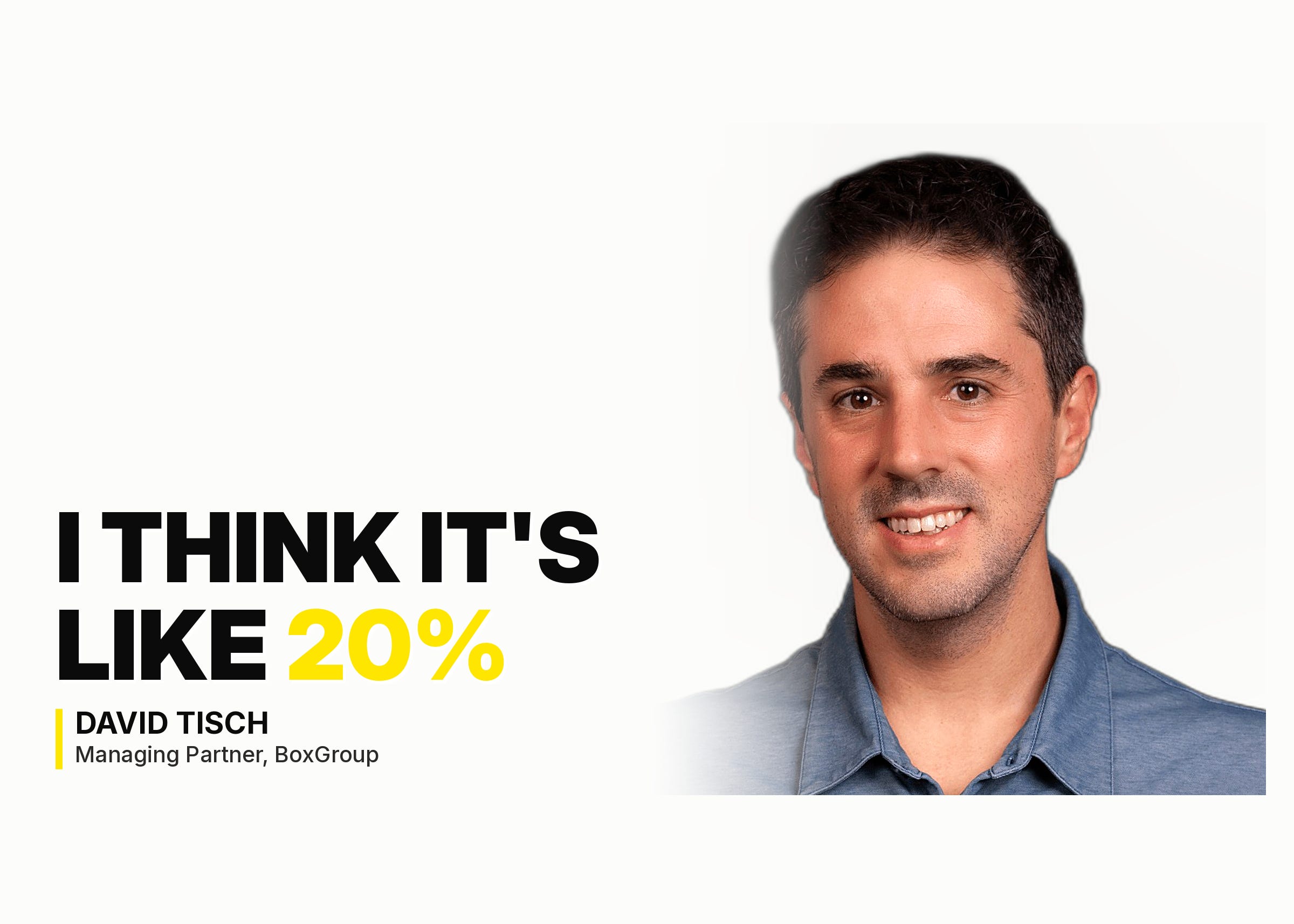
Seed funds that make a few large bets say they win 90% of the deals they want, according to David Tisch, managing partner at BoxGroup. He told 20VC he thinks the real figure is closer to 20%.
Tisch was one of 17 people quoted in this issue. The others ranged from Philip Johnston, who said data centers in orbit become cheaper than ones on the ground once launch costs fall below about $500 a kilo, to Joseph Kim, who said financial-data connectors from some well-known providers returned errors more than 40% of the time in OpenAI's tests, to Himanshu Sahay, who said Arch was lending against Bitcoin at 16% two and a half years ago.
"Every concentrated manager will say that we win 90% of the deals we want to win. And I think that's total BS. I think it's like 20%." — David Tisch, Managing Partner at BoxGroup, on 20VC (Read summary)
We scanned 819 shows and 13 hours of audio, wrote 14 summaries, and pulled 39 quotes into this 17-minute read.
Here is what mattered.
Macro
A 60/40 portfolio still took a large loss in 1987, when stocks and bonds moved in opposite directions
Alan Dunne, founder and CEO of Archive Capital Advisors, said the correlation between stocks and bonds says little on its own about where either ends up. In the 1987 crash, investors fled to Treasuries, but not in the size a portfolio of 60% stocks and 40% bonds needed.
"Bond yields went from 7% to 10%. The equity market went up 35% between January and August... negative correlation by itself isn't enough to prepare a portfolio." — Alan Dunne, Founder and CEO at Archive Capital Advisors, on Top Traders Unplugged (Read summary)
Dunne would hold fewer bonds and let trend-following funds trade the rest
Dunne said the 60/40 debate has split into all-or-nothing positions on bonds. He would keep a core bond holding smaller than 40% and hand more of the bond exposure to trend-following or macro managers, who buy and sell bonds as prices move.
"If you allocate to something like trend or macro, you're still getting fixed income exposure in a managed way... you've effectively got a passive core bond exposure complemented with a tactically managed bond exposure." — Alan Dunne, Founder and CEO at Archive Capital Advisors, on Top Traders Unplugged (Read summary)
Lance Roberts says bonds are there for stability, so swapping them for Bitcoin or gold defeats the purpose
Lance Roberts, chief investment strategist at RIA Advisors, said bonds held their value while stocks fell this week. He trimmed his firm's longer-dated bonds after their rally, with the 10-year Treasury yield near 4.95%.
"The reason you own bonds is because they lack volatility... adding volatility to your safety money becomes very problematic in a downturn." — Lance Roberts, Chief Investment Strategist at RIA Advisors, on Thoughtful Money (Read summary)
RIA Advisors moved money from growth stocks to value stocks on October 5
Roberts said this week's losses in Google, Amazon and Meta came from investors rotating into value stocks such as Walmart, Costco and Berkshire Hathaway, not from a broad sell-off. His firm made the same move four weeks earlier.
"Go back four weeks, October the 5th, we talked about that we had sold our growth, reduced our growth allocation and added to our value allocation." — Lance Roberts, Chief Investment Strategist at RIA Advisors, on Thoughtful Money (Read summary)
The firm holds 10% to 15% of its portfolios in cash and plans to raise its stock allocation from 60% to about 65% before year-end.
Financials
Arca, a wealth manager, gives AI agents all the work except advising clients
Arca recently raised $48.5M in a round led by General Catalyst. Its agents prepare analysis, track deadlines and send recommendations to human advisors without being asked.
"The role of AI at Arca is not to replace the advisor. It is to replace all of the work around the advisor." — Aman Singh, Lead AI Engineer at Arca, on Latent Space (Read summary)
Arca's agents can propose trades but cannot place them
Aman Singh said any rule touching money movement, trading or client messages is fixed in code, so the agent has no discretion over it. A person with the proper authority places the trade through Arca's custodian.
"At the moment, we are not doing autonomous trading with agents... the agents will propose that we make trades, and it is fully up to our experts to figure out if that is the right trade to be making." — Aman Singh, Lead AI Engineer at Arca, on Latent Space (Read summary)
Stig Brodersen bought S&P Global at $399 for its ratings business
S&P Global holds about 45% of the credit-ratings market, against 40% for Moody's. Stig Brodersen bought the stock the morning of the show, his first new position in more than a year. In his account, an issuer is better off paying for a second rating than going without one.
"If you have a Moody's rating, you also need an S&P rating... it's actually mandated... but also there's adverse selection here." — Stig Brodersen, Host at The Investor's Podcast
Hari Ramachandra says S&P Global's real earnings multiple is closer to 39 than 23
Hari Ramachandra pushed back. AI startups such as AlphaSense, funded by S&P's own bank customers, are going after its Market Intelligence data business. Strip most of that business out, he said, and the stock trades near 39 times earnings, not 23.
"If you deduct 80% of their market intelligence revenue and translate it into earnings, then they will be at 39... almost in my calculation." — Hari Ramachandra of The Investor's Podcast Network, on The Investor's Podcast
Apollo and Brookfield own large insurers that benefit from favorable private credit ratings
Private ratings, issued by agencies including Moody's, S&P and Kroll, can lower an insurer's cost of capital. Chris Whalen, chairman of Whalen Global Advisors, said the asset managers that own insurers gain from favorable ones.
"The wolf is already in the hen house... the Apollos and the rest of them, the Brookfields, for example, all of them have very large insurance company strategies." — Chris Whalen, Chairman at Whalen Global Advisors, on The Julia La Roche Show (Read summary)
Insurance regulators backed down on private ratings after the industry threatened to sue
The National Association of Insurance Commissioners had asked how private ratings were reached. Whalen said no one now reviews an insurer's ratings or assets until the company fails, and he expects that to bring federal regulation of insurance.
"If you have life insurance or if you have an annuity that's issued by one of these companies, there's nobody looking out for you." — Chris Whalen, Chairman at Whalen Global Advisors, on The Julia La Roche Show (Read summary)
Chase bought about $1B of mortgage-servicing rights from United Wholesale Mortgage, Whalen says
Servicing rights are the right to collect payments on a pool of mortgages for a fee. Whalen said UWM needed the cash to repay a $1.5B capital infusion from Oaktree.
"We had a nice little scoop. We found out... that Chase had bought a big chunk of conventional servicing from United Wholesale Mortgage." — Chris Whalen, Chairman at Whalen Global Advisors, on The Julia La Roche Show (Read summary)
He called UWM's target of $1.8B in asset sales a little ambitious.
Crypto and Digital Assets
Arch lent against Bitcoin at 16% two and a half years ago; its retail loans now cost about 10.49%
Himanshu Sahay, co-founder of Arch, said loans under $250,000 now carry an annual percentage rate of about 10.49%, including the origination fee. Larger loans go as low as 7.25%.
"Two and a half years ago we were lending at 16%, and that was market at the time." — Himanshu Sahay, Co-Founder at Arch, on Onramp Bitcoin Media (Read summary)
Arch keeps each borrower's Bitcoin at a separate address the borrower can see
Sahay said proof of reserves, the snapshot many crypto lenders publish of one pooled wallet, says nothing about a given client's coins at a given moment.
"We do not hold assets ourselves. We hold everything in qualified custody at Anchorage... we go one step beyond that: we segregate the client assets and then we share the address with the borrower." — Himanshu Sahay, Co-Founder at Arch, on Onramp Bitcoin Media (Read summary)
Sahay's test for a Bitcoin lender: ask how its rate can be so low
Arch never lends out the Bitcoin its borrowers pledge, a practice known as rehypothecation. The lenders that did it, Celsius and BlockFi among them, failed in 2022 when depositors all asked for their money at once.
"If the interest rate is artificially lower, always ask how and why. And if a lender declines to answer that, then there's probably something going on with your assets in the back end that helped them bring that rate down." — Himanshu Sahay, Co-Founder at Arch, on Onramp Bitcoin Media (Read summary)
Chainlink's co-founder says a tokenized asset adds nothing unless it beats the original
Sergey Nazarov said a better product means markets that trade every day of the year, fund values updated every minute instead of monthly, and yield on tokenized gold.
"Tokenization in and of itself is not enough to create value for real-world assets as a trend. What you need is for the tokenization to create an onchain financial product or asset that's better than the traditional version." — Sergey Nazarov, Co-Founder at Chainlink, on The Rollup (Read summary)
Nazarov expects the largest volume from linking markets outside the US
Nazarov named Dubai, Singapore, Euroclear and SGX, the Singapore Exchange, as places to connect so that money held abroad can reach US stocks and bonds.
"Where I think the really huge volume is, is not even going to be something like Swift and DTCC, which are already heavily ingrained in the US system. I think it's actually going to be a lot of international." — Sergey Nazarov, Co-Founder at Chainlink, on The Rollup (Read summary)
No DeFi protocol is built for a stablecoin issuer freezing its balance, Leshner says
Binance lost an estimated $5B in a hack about three hours before The Chopping Block taped. About half of it was in stablecoins, and Tether and Circle froze a large share of those within hours. Robert Leshner, co-founder and CEO of Superstate, said the lending and trading protocols that hold USDC have no plan for the day an issuer freezes their own balance.
"I don't think the DeFi protocols on the aggregate have solved for this issue yet... most protocols still don't necessarily know how to account for it. Has anyone ever frozen a protocol's USDC balance? Not really." — Robert Leshner, Co-Founder and CEO at Superstate, on Unchained (Read summary)
Circle had rehearsed freezing stolen funds long before Binance was hacked
Nemil Dalal ran USDC at Coinbase before joining Y Combinator. He said Circle acts fastest on a court order or on a hack the victim itself confirms, as Binance could.
"When I was running USDC at Coinbase, we and the Circle team literally practiced for moments like this. We would have exercises where we would say, 'Something has been attacked. How do we manage it?'" — Nemil Dalal, Visiting Partner at Y Combinator, on Unchained
Leshner says perpetual futures beat dated futures for every use
Intercontinental Exchange, the owner of the NYSE, signed an agreement with trade.xyz to offer regulated perpetual futures to US customers, pending approval from the Commodity Futures Trading Commission. Perpetual futures never expire, so a holder does not have to roll into a new contract. Leshner conceded that institutions dislike the funding payments that keep their price in line.
"My view is perps are a superior form factor versus dated futures. They are superior... for everything." — Robert Leshner, Co-Founder and CEO at Superstate, on Unchained (Read summary)
Dragonfly's Rob Hadick says institutions still rely on dated futures and options
Rob Hadick said institutions care most about credit risk and a trusted clearing house on the other side of the trade, and that their focus on both has sharpened since FTX failed.
"I have a perspective that perps are still very much a retail product... dated futures and options still serve a lot of the derivative needs of the institutions." — Rob Hadick, Managing Partner at Dragonfly, on Unchained
Consumer
Good American's $1M first day set it up to fail, its co-founder says
Good American, the denim brand Emma Grede co-founded with Khloé Kardashian, sold about $1M in its first 24 hours. Investors and retailers then kept asking what came next, and often the answer was more jeans.
"It set me up to fail in a way because it was so huge and like amazing out of the gate." — Emma Grede, Co-Founder and CEO at Good American, on Founder's Story (Read summary)
Good American overreached into swimwear, activewear and shoes
Grede said the company assumed its wide size range would sell any product. Customers came for the fit and the fabric. Ten years on, Good American has 120 employees and revenue in the hundreds of millions of dollars.
"Whatever we did turned to gold until it didn't." — Emma Grede, Co-Founder and CEO at Good American, on Founder's Story (Read summary)
Tobias Carlisle says Deckers, at $77, is priced for no growth
Deckers owns Hoka running shoes and UGG boots. Tobias Carlisle, founder of The Acquirer's Fund, said it has a $10.6B market value, $1.6B in net cash, no debt and a share price of 11 times earnings, after trading above $200 before April's tariffs. Revenue rose 10% to $5.5B in the year to March 2026.
"At $77, this is being priced as if it has no growth." — Tobias Carlisle, Founder at The Acquirer's Fund, on The Investor's Podcast (Read summary)
Deckers spends 80% of its free cash flow buying back its own shares
The buybacks so far were done at $102 to $104 a share, above today's price. Carlisle said buying at the current price still adds value for the shareholders who stay, even if the company stops growing.
"Buybacks are 80% of free cash flow... share count fell 7% year-over-year." — Tobias Carlisle, Founder at The Acquirer's Fund, on The Investor's Podcast (Read summary)
Hari Ramachandra says Novo Nordisk's price assumes it will never produce another successful drug
Novo Nordisk, the maker of Ozempic and Wegovy, is down about 40% from its 52-week high and trades near 12 times forward earnings. Eli Lilly now holds about 60% of the market for GLP-1 drugs, the class that includes Ozempic. Ramachandra said success for amycretin, Novo's drug in late-stage trials, could lift returns to 18% to 22%.
"What we are paying for is... an assumption that they'll not be able to innovate and come up with something new." — Hari Ramachandra of The Investor's Podcast Network, on The Investor's Podcast
Jordi Visser prefers Eli Lilly's health-care revenue to the AI infrastructure trade
Jordi Visser, a macro investor at VisserLabs, cited Lilly's latest quarter: revenue of $24.4B, up 39% and about $2B above analysts' estimates.
"The great thing about Eli Lilly in this world of AI infrastructure trades is they are making money on the health care problems in the United States where the spending... is guaranteed every year. It is non-cyclical." — Jordi Visser, Macro Investor at VisserLabs, on The Pomp Podcast (Read summary)
Technology & AI
Starcloud's CEO puts the breakeven for orbital data centers at a $500/kg launch cost
Launching on SpaceX's Falcon 9 costs about $5,000 a kilo today. Philip Johnston said a satellite gets sunlight around the clock and needs about eight times fewer solar cells per watt, with no land permits or batteries to pay for. He expects SpaceX's own cost on Starship to fall to $20 to $40 a kilo.
"If the launch cost gets below around $500 a kilo, then it will be much cheaper to do this in space than terrestrially." — Philip Johnston, CEO and Co-Founder at Starcloud, on Sourcery with Molly O'Shea (Read summary)
Starcloud built its first satellite for about $2.5M against a $75M to $100M quote
Starcloud 1 reached orbit 21 months after the company was founded, carrying the first Nvidia H100 chip flown in space. Starcloud has raised $450M in total.
"They told us it would cost $75 million to $100 million to do StarCloud 1. We did it for about $2.5 million." — Philip Johnston, CEO and Co-Founder at Starcloud, on Sourcery with Molly O'Shea (Read summary)
Chip failures, not cooling, are the bigger risk to Starcloud's economics
The chips are the largest single cost. Before launching Starcloud 2, the company ran its chips hot for three months to catch the failures that cluster early in a part's life.
"If the chips have... like a 10 or 20% higher failure rate in space than they do on the ground, then the whole economics of the model fall apart." — Philip Johnston, CEO and Co-Founder at Starcloud, on Sourcery with Molly O'Shea (Read summary)
OpenAI found error rates above 40% in some outside financial-data connectors
The connectors use MCP, the Model Context Protocol, a standard way for an AI model to pull data from an outside service. Joseph Kim, head of financial services at OpenAI, said the results are why ChatGPT for Financial Services bundles earnings transcripts and other data itself, at an extra cost to customers.
"We tested all these MCPs. And what we found was the error rates were really really high. Some of the MCPs that we connected, some big names, 40% plus error rate on their MCPs." — Joseph Kim, Head of Financial Services at OpenAI, on Latent Space (Read summary)
OpenAI's finance head expects a $1B business to be built on a single ChatGPT plugin
Kim said his team built on the same plugin tools available to any outside company. What a startup would add is the last 20%: its own data, design or integrations.
"I really do think that there's going to be a billion-dollar business built on top of a ChatGPT plugin. But 95% of what we built was something that absolutely a startup could do, another company could do." — Joseph Kim, Head of Financial Services at OpenAI, on Latent Space (Read summary)
Visser says Microsoft's buyout offer to 27% of its staff is a fight between labor and capital
Microsoft offered voluntary buyouts to 60,000 employees. Visser put the pay and benefits at roughly $400,000 a person, or about $24B a year in savings while revenue keeps growing.
"I think this is becoming a labor versus capital story that is much, much bigger than people realize because we're just entering the productivity boom." — Jordi Visser, Macro Investor at VisserLabs, on The Pomp Podcast (Read summary)
Whalen thinks about half of the planned data centers will not get built
Whalen pointed to the shortage of electricity and to towns organizing against new data centers. He also said Nvidia is financing customers who buy chips they cannot yet use.
"Probably half of the data centers that are currently planned can't happen. We just don't have the resources to do it." — Chris Whalen, Chairman at Whalen Global Advisors, on The Julia La Roche Show (Read summary)
VC & Startups
Tisch says a concentrated seed fund courts 120 to 150 companies to land 30
A concentrated fund makes a few large bets and asks for a big ownership stake in each. Tisch said such a fund has to offer terms to far more companies than it ends up backing, and the companies that accept skew toward the ones other investors wanted less.
"There is an adverse selection in the concentrated model... I think you actually offer that deal to upwards of 120, maybe 150 companies to get your 30." — David Tisch, Managing Partner at BoxGroup, on 20VC (Read summary)
The fastest-growing startups now give up 3% to 8% per later round, not 12% to 20%
That is one reason Tisch said BoxGroup's small stakes matter less than critics think: they shrink less on the way to an exit. He said he was wrong years ago to doubt BoxGroup's own model, because he did not see exits getting bigger.
"In the companies that tend to hockey-stick very quickly, the Series B, C, D are dramatically less dilutive... they are raising these later-stage rounds at 3 to 8% dilution instead of 12 to 20%." — David Tisch, Managing Partner at BoxGroup, on 20VC (Read summary)
Rogo was turned down by 39 of the 40 Series A investors it approached
BoxGroup backed Rogo, which builds AI tools for finance, at the seed stage. Its founder, Gabe Stengel, then went out to raise a Series A. Sequoia and Kleiner Perkins invested after the one investor who said yes led the round.
"We sent it out to 40 Series A lead investors. He got fully passed on by 39 of them." — David Tisch, Managing Partner at BoxGroup, on 20VC (Read summary)
Other appearances:
a16z New Media team on Cosign, a professional network built for AI agents to search, on a16z
Nuggets of Wisdom
Grede says a personal brand is probably the biggest waste of an early founder's time
Grede said a brand formed around her only after the company existed. She makes an exception for creators whose content is the business.
"Personal brand in the female entrepreneurship circle is as overrated as it comes and is probably the single biggest waste of time." — Emma Grede, Co-Founder and CEO at Good American, on Founder's Story (Read summary)
Dunne's lesson from Arini: investors extrapolate short track records
Arini Capital Management, a credit hedge fund, raised about $7.5B in a short time on strong early returns. Dunne said it is now down 22% to 25% for the year.
"It shows you how people tend to extrapolate relatively short track records and assume they'll continue." — Alan Dunne, Founder and CEO at Archive Capital Advisors, on Top Traders Unplugged (Read summary)
If this was worth your time, send it to someone who has to follow all of this too.
What did you think of today’s edition? Hit ‘reply’ to this email, send us a message, leave a comment, or join the chat!
Get the latest market chatter as it happens: