

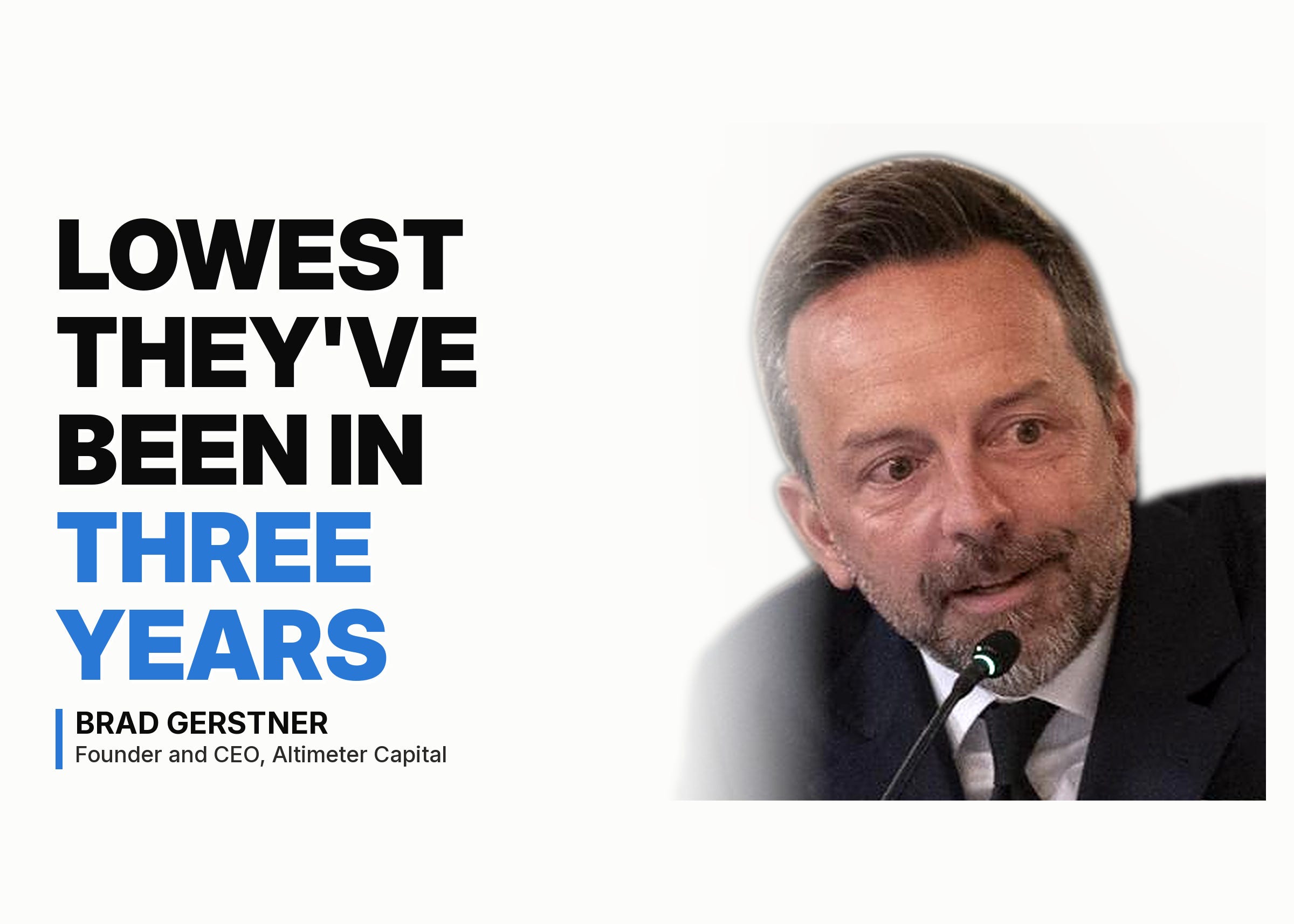
Brad Gerstner, founder and CEO of Altimeter Capital, said his hedge fund's exposure to AI is the lowest it has been in 3 years. He said he is even more positive about 2027 and 2028, the horizon his venture funds invest for.
That was one of 21 episodes in this issue. The others ranged from Alex Haissl, a Rothschild & Redburn analyst, on data-center capacity that cost $10B a gigawatt at the start of the year and now sells for up to $50B, to Joe Preston on why New Balance canceled a distribution center to pay for new software, and Lynette Zang on counting 62,000 paper ounces of gold for every physical one.
"Our exposures are the lowest they've been in three years." — Brad Gerstner, Founder and CEO at Altimeter Capital, on Halftime Report (Read summary)
We scanned 795 shows and 19 hours of audio, wrote 20 summaries, and pulled 51 quotes into this 21-minute read.
Here is what mattered.
Macro
BlackRock upgraded Treasuries and downgraded US stocks this week
Wei Li said the note, published on Monday, manages the risk around AI policy and the pace of the AI build. It ends an underweight in long-dated Treasuries that BlackRock first took more than 6 years ago, when the 10-year yield was below 90 basis points. She said bondholders would still be up 2% to 3% on the year even if the 10-year yield rose from about 5.3% to 5.5%.
"On Monday, we put out a note essentially upgrading treasuries, front-end and back-end, and downgrading U.S. equities to manage risk." — Wei Li, Global Chief Investment Strategist at BlackRock, on Bloomberg Surveillance (Read summary)
CreditSights says AI debt still finds buyers; Semafor hears banks are near their lending limit
Winnie Cisar said spreads on investment-grade and high-yield bonds have widened as the market absorbs heavy borrowing for data centers, with CoreWeave's bonds trading about 1,200 basis points over Treasuries. Reed Albergotti, who runs Semafor's San Francisco bureau, said the banks themselves may run out of room to lend.
"We haven't seen a hyperscaler deal fail to clear the market. We haven't seen a high yield bond deal in the data center infrastructure space really have a massive failure as well." — Winnie Cisar, Global Head of Strategy at CreditSights, on Bloomberg Surveillance
"The banks are getting to the point where they're like, we just can't lend out this much money. The borrowing has been opportunistic by these tech companies — investors like it. But if the banks are hitting their limit, then money does become another bottleneck." — Reed Albergotti, San Francisco Bureau Chief at Semafor, on TBPN
Real wages have fallen for 6 months, EY-Parthenon's chief economist says
Gregory Daco said September retail sales grew in dollars but rose just 0.1% after inflation, with several categories falling in volume, even with low unemployment.
"Higher inflation leads to demand destruction. Real wages, so wages adjusted for inflation, have been contracting for the last six months. So that's putting a damper on consumer spending." — Gregory Daco, Chief Economist at EY-Parthenon, on The Exchange
Financials
Walker & Dunlop bought a firm in 2012 that could have lost 50% of its revenue overnight
The target's 3 top bankers brought in 40% to 50% of its revenue, and the contract had no clause letting Walker & Dunlop walk away if they left. A rival tried to hire them as soon as the deal was announced. All 3 stayed and still work at the firm, Willy Walker said.
"Had they walked out once we'd announced the deal, I would have been buying a company that was going to lose 50% of its revenues overnight." — Willy Walker, Chairman and CEO at Walker & Dunlop, on The Walker Webcast (Read summary)
Sidekick finds money gets serious at just over £50K of assets, whatever the salary
Matt Ford co-founded Sidekick, a UK digital wealth manager, 5 years ago for high earners who have too little in assets for most financial advisers. The average client is in their mid-40s, he said, and the need starts around the mid-30s.
"We identified the trigger point being just over £50,000 of assets. That's the sense that money is now serious — you can have a really good salary as a late-20s-year-old and spend it and feel okay, but just over 50k of assets, regardless of income, felt like the moment you need to think more seriously about this." — Matt Ford, Co-Founder and CEO at Sidekick, on Fintech Insider (Read summary)
Sidekick's first mistake was selling the tools the ultra-wealthy use
Matt Ford said Sidekick launched with private markets, custom indexing and discretionary portfolios, then changed course.
"We turned up to market with all of these whistles and bells, all the things the ultra-wealthy have got, and essentially it's like, yeah, but what do I do with it? My biggest need is outcomes. I need a plan, and the core of that is a relationship." — Matt Ford, Co-Founder and CEO at Sidekick, on Fintech Insider (Read summary)
Crypto and Digital Assets
Hyperliquid limits each oracle price update to a 1% move
Deployers, the firms that stake tokens to list markets on Hyperliquid, choose each market's oracle, the outside price feed it settles against. Jeff Yan called an earlier pricing problem on one deployer's SK Hynix contract an implementation issue rather than a flaw in the protocol.
"There's a constraint at the protocol level where, between two oracle price updates, the relative difference between those two prices cannot be more than one percent. It's a hard-enforced rule — if you try to push an oracle price two percent away, the protocol clamps it to one percent so you can push it again." — Jeff Yan, CEO and Co-Founder at Hyperliquid Labs, on Odd Lots (Read summary)
Hyperliquid's validators need 128GB of RAM, not stadium-size data centers
About 30 validators, the computers that agree on every balance and price, run the network, Jeff Yan said.
"A reasonable approach here is that it should not be data centers the size of football stadiums to run this thing. Right now you need 128 gigs of RAM — that's not the cheapest laptop you can buy, but you can buy a laptop with that spec." — Jeff Yan, CEO and Co-Founder at Hyperliquid Labs, on Odd Lots (Read summary)
Tempo's Dan Romero says the risk of deposits fleeing banks for stablecoins is overblown
Every bank his team talks to is now building something with stablecoins, he said, now that the Genius Act has set rules for them.
"I think the capital flight risk is overblown. If anything, the capital will move to the companies that offer the best products — some of those companies will be banks, but other companies will be challengers, and I think that's really healthy." — Dan Romero, Head of Go-To-Market at Tempo, on The Rollup (Read summary)
Raoul Pal says turning off Ethereum would remove about 70% of all stablecoins
The Real Vision CEO said the market still undervalues Ethereum as the base layer that most stablecoins, decentralized finance and tokenized assets run on.
"It would remove 70-odd percent of all stablecoins in existence... there's a trillion dollars plus of value that would be turned off." — Raoul Pal, Co-Founder and CEO at Real Vision, on When Shift Happens (Read summary)
Alternatives and PE
Bending Spoons says rates of 6% or 10% make little difference to deals that must return 25%
Berkshire Hathaway's added $330M investment took its stake in Bending Spoons, which buys software companies and rebuilds them, to 4%. Luca Ferrari said the company's acquisitions have cleared a minimum return of 25%, and that higher interest rates mostly improve its position as a buyer.
"Whether interest rates are at, say, 6% or 10%, it doesn't make a huge difference for us. We're not a kind of slim-margin type of business." — Luca Ferrari, Co-Founder and CEO at Bending Spoons, on Squawk on the Street (Read summary)
Bending Spoons' organic growth has run from 3% to about 13% a year
Organic growth slowed to 3% in the second quarter from 6% in the first. Luca Ferrari said acquired businesses usually lift revenue by more than 30% over their first 6 quarters, then settle at their market's own rate.
"Our organic growth has ranged from that 3% to about 13% in the past three years... the overwhelming majority of our growth has been, we believe, from new acquisitions." — Luca Ferrari, Co-Founder and CEO at Bending Spoons, on Squawk on the Street (Read summary)
Bending Spoons shipped more Evernote features in 4 years than its prior owners did in 10
It rewrote Evernote's code, rebuilt its cloud infrastructure and redesigned the app, Luca Ferrari said, and grew revenue and margins from about breakeven.
"We launched probably more features in the last four years than the previous owners had in the previous ten years." — Luca Ferrari, Co-Founder and CEO at Bending Spoons, on Squawk on the Street (Read summary)
Lafayette Square can borrow in the bond market while other private-credit firms struggle to raise money
Damien Dwin's firm lends to companies with less than $50M of EBITDA, a segment he said larger lenders left behind. Its assets reached $1.2B as of June 30.
"We're hugely advantaged that we have permanent capital and an investment-grade rating. So we're able to tap the bond market, and we have a vibrant partnership with the Small Business Administration." — Damien Dwin, Founder and CEO at Lafayette Square, on Forbes: The Enterprise Zone (Read summary)
Lafayette Square's borrowing costs fall when it meets its job-creation goals
Its Goal 2030 targets 100,000 working-class jobs, and better health and retirement benefits at half its portfolio companies. Borrowers that improve employee benefits get a lower interest rate, Damien Dwin said.
"As we meet and exceed the goal on a quarterly basis, it impacts our borrowing costs in our business development company." — Damien Dwin, Founder and CEO at Lafayette Square, on Forbes: The Enterprise Zone (Read summary)
Consumer
New Balance canceled a distribution center in 2019 to pay for new software
The new systems were running weeks before COVID closed stores and moved sales online, Joe Preston said. New Balance's revenue has grown from $3.3B in 2020 to nearly $10B, about 35% of it in the US.
"We canceled the distribution center, knowing that at some point we were going to have to revisit it... we chose to upgrade our tech stack. It ended up being a great decision, but at the time it was a little bit shaky." — Joe Preston, President and CEO at New Balance, on How Leaders Lead with David Novak (Read summary)
New Balance is the only big athletic brand that is private and makes shoes in the US
"We're the only company that has US manufacturing, and we're the only major that's private." — Joe Preston, President and CEO at New Balance, on How Leaders Lead with David Novak (Read summary)
SmartSweets found grocery sales added to its direct sales instead of replacing them
Tara Bosch, who sold a majority stake in SmartSweets for a reported $360M, was advising the founder of XO Marshmallows, which makes about 90% of its sales direct to consumers and is moving into grocery stores.
"We really found the split was always about 70% wholesale, 30% DTC, but grocery became an impulse buy — she's not thinking about it two weeks ahead. I see them living together in unison, serving different functions, not cannibalizing each other." — Tara Bosch, Founder at SmartSweets and Snackish, on How I Built This with Guy Raz (Read summary)
Natural-food stores cost a young brand less to enter than mass retailers, Tara Bosch says
"I always found the natural channel more forgiving for an early-stage startup — the end caps, the merchandising opportunities, not being as dollars-and-cents from the beginning — which helped with SmartSweets because we didn't have the budget mass retailers would require from the hop." — Tara Bosch, Founder at SmartSweets and Snackish, on How I Built This with Guy Raz (Read summary)
Technology & AI
Oxide sells companies the kind of servers only the hyperscalers had built for themselves
Bryan Cantrill said Oxide designs the hardware and software of a whole server rack together, so a company can run cloud-style computing in its own data center.
"We make rack-scale machines, hardware and software co-designed. The hyperscalers had built for themselves their own machines with hardware-software co-design, and the enterprise — anyone else — didn't have that. You could rent it in the public cloud, but you could not buy it and run your own data center." — Bryan Cantrill, Co-Founder and CTO at Oxide Computer, on TBPN (Read summary)
Reflection AI's CEO counts about 500 safety researchers inside the closed AI labs
Misha Laskin argued that open models can be made safe the way Linux was, by thousands of outside developers probing them for flaws. Reflection released its first open-weight model, Beam, in early October.
"There are about 5,000 people in the world that have frontier access to frontier models within the closed labs. And of those, probably 10% do safety research. So in the whole world, our whole world is being secured today by 500 people. No matter their intention, it is impossible that they'll secure these brains." — Misha Laskin, Co-Founder and CEO at Reflection AI, on This Week in Startups (Read summary)
Reflection's Beam uses 3x to 4x fewer tokens than a Chinese model of similar ability
Misha Laskin put Beam a couple of months behind the leading Chinese open models, at about a fifth the size of Kimi K2. Fewer tokens means less computing per answer.
"What's state-of-the-art in Beam is its reasoning efficiency. While having a similar capability to GLM 5.2, it's three to four times more reasoning efficient. It uses less tokens." — Misha Laskin, Co-Founder and CEO at Reflection AI, on This Week in Startups (Read summary)
TypeSafe's CEO says AI cannot run a business process if it cannot flag its own mistakes
Diogo Almeida helped invent RLHF, the training method behind chatbots, at OpenAI. TypeSafe's model, Jev, returns probabilities that software can act on instead of chat answers. The company closed an $870M Series A at a $7.5B valuation the day before the recording.
"95% Einstein, 5% Mr. Bean, and if it doesn't tell you when it's the Mr. Bean, then how are you going to automate anything?" — Diogo Almeida, CEO at TypeSafe, on The MAD Podcast with Matt Turck (Read summary)
Chatbot training raised hopes for automation that were not met, says the method's co-inventor
"RLHF models are so pleasing to humans and they seem so smart that it makes people think a lot of stuff can be automated — and that empirically did not happen." — Diogo Almeida, CEO at TypeSafe, on The MAD Podcast with Matt Turck (Read summary)
CTGT's CEO says a big company is judged on the 1 AI answer in 100 that goes wrong
Cyril Gorlla said the same question put to a language model 3 times can return 3 different answers, and that a firm under audit may not be able to reproduce or explain the bad one.
"If you're a 100,000-person enterprise with employees using these things in regulated workflows, in use cases where you might be audited by a regulatory body — if the LLM gets an answer wrong one time out of a hundred, and it's fine the other 99 — you're going to be judged on that one time." — Cyril Gorlla, Founder and CEO at CTGT, on Money Maze Podcast (Read summary)
Walker & Dunlop will pick cheaper AI models over the most advanced ones
Willy Walker said open models now give his company most of what it needs, which led him to question frontier-lab valuations near $2T.
"We don't need to be at that bleeding edge. So when the economics of being on a bleeding-edge model versus just a model that gives us everything we need, I'm going the cheaper route." — Willy Walker, Chairman and CEO at Walker & Dunlop, on The Walker Webcast (Read summary)
Brad Gerstner is even more positive on AI for 2027 and 2028
Reports now put Anthropic's revenue this year at $100B or more, against a forecast of $30B at the start of the year, he said. He framed the market's main question as whether AI revenue justifies the spending on data centers.
"When I look at '27 and '28, I'm even more positive." — Brad Gerstner, Founder and CEO at Altimeter Capital, on Halftime Report (Read summary)
Kai Wu says the builders of the last network boom did not capture its gains
The Sparkline Capital founder prefers companies that use AI without paying for the build-out, which he said trade at the valuations of laggards. Netflix and Google, not the fiber builders, gained from the collapse in bandwidth costs.
"The telecom index is down 90-plus percent and still hasn't recovered to its high-water mark twenty years later. The infrastructure builders, the guys who built out the fiber, ironically did not capture the gains." — Kai Wu, Founder and CIO at Sparkline Capital, on Full Signal (Read summary)
Kai Wu says circular financing ties the AI industry's balance sheets together
Nvidia invests in or lends to customers so they can buy its chips, he said, which links the risk at companies such as OpenAI and CoreWeave to everyone around them.
"I'm not saying there's fraud going on, or that it's inherently a problem. All I'm saying is the risk is that it ties everybody to the same ship, so that any one domino will topple the entire AI complex." — Kai Wu, Founder and CIO at Sparkline Capital, on Full Signal (Read summary)
Debt is what makes the AI build fragile, David McAlvany says
He put the revenue needed to justify the spending at $3.7T by 2032.
"The fact that there's so much debt being thrown at it, I think, is what makes it ultimately unsustainable, because equity capital can be patient, but debt has to be paid." — David McAlvany, CEO and Portfolio Manager at McAlvany Financial Group, on Hedgeye (Read summary)
Every industry needs a bet like Meta's $14.3B Scale AI deal, Dave Blundin says
Meta's new Muse models were built largely on the Scale AI deal, which brought Alexandr Wang in to run Meta Superintelligence Labs. The Link Ventures founder said the deal seemed utterly insane at the time.
"It's absolutely been a great investment. Other companies should look at that and say, if we're going to be relevant five years from now, ten years from now, we need to make similar investments in every industry." — Dave Blundin, Founder and General Partner at Link Ventures, on Moonshots with Peter Diamandis (Read summary)
Memory chips are sold out through 2027, Roundhill's CEO says
Dave Mazza runs an ETF that holds memory makers including Micron, SK Hynix, SanDisk and Western Digital. He said the business is moving from boom and bust toward long-term supply agreements, even as the stocks fell this week.
"These chips are sold out in 2026, 2027. We're talking now about 2028." — Dave Mazza, CEO at Roundhill Investments, on Squawk on the Street
Dan Ives expects AI to add 15% to Apple's services revenue, worth $75 a share
The Yorkville Ives partner was speaking after Apple and Meta agreed to let developers run Meta's AI models on Apple computers. He counts 1.5 billion iPhones and 2.5 billion iOS devices in use.
"My view is 15% of services revenue incrementally is going to be AI-driven over the coming years." — Dan Ives, Partner and Senior Managing Director at Yorkville Ives & Co., on Fast Money (Read summary)
Data-center capacity that cost $10B a gigawatt at the start of the year now sells for up to $50B
Alex Haissl, who has rated CoreWeave, Nebius and Oracle as sells since mid-September, called it the compute repricing trade.
"At the beginning of the year, the price per one gigawatt was around 10 billion. Now we've seen prices moving up to 20, 30, 40, 50 billion." — Alex Haissl, Analyst at Rothschild & Redburn, on The Exchange
The long compute contracts are signed by labs that use the capacity for training, Alex Haissl says
Training builds a model, while inference, running it for paying users, is what brings in revenue.
"We question really who is behind these contracts. Basically neo-labs like Reflection, Thinking Machine, Safe Superintelligence, which use compute for training... we believe that this pricing level is just not sustainable." — Alex Haissl, Analyst at Rothschild & Redburn, on The Exchange
VC & Startups
Oxide's founders do not plan to sell the company
Bryan Cantrill raised Oxide's first round from Eclipse in 2019 for a company that builds its own compute sled, switch and firmware. He said Oxide now tracks revenue and racks shipped per employee rather than headcount.
"We're not looking to flip — we're looking to go build the generational business that Steve and I want to work at for the rest of our careers. I thought that was the point of starting companies, but I guess not. I guess everyone else is geared for an exit." — Bryan Cantrill, Co-Founder and CTO at Oxide Computer, on TBPN (Read summary)
The Los Angeles fires turned Advanced Spade's garage startup into an undergrounding contractor
Daniel Kimminau worked at SpaceX, The Boring Company and Anduril. His company began by mapping buried utility lines, and general contractors then asked it to do the drilling too.
"In 2024, we started Advanced Spade Company. I was running around telling everyone to put power lines underground, and everyone's like, yeah, yeah, yeah. We're in my garage, and then LA started burning down around us, and all of a sudden everyone was calling — we had big wigs coming to my garage asking what we could possibly do to get power lines underground." — Daniel Kimminau, Founder at Advanced Spade Company, on TBPN
Materials & Energy
Grid spending has tripled in 10 years while reliability worsened, Daniel Kimminau says
"Grid investment has, in the last ten years, tripled. Reliability is worse by every single metric. The problem is overhead — you keep putting stuff overhead, it keeps failing. Everyone wants to go underground. It just costs too much." — Daniel Kimminau, Founder at Advanced Spade Company, on TBPN
Central banks, not individual investors, drove gold's rally, David McAlvany says
His 54-year-old firm sells physical gold and silver, and he said its retail business was only average until the last 4 weeks of 2025. Central banks have bought about 1,000 tons a year since 2022, about 25% of mine supply.
"You're getting some of the best product at the cheapest prices in 50 years. Even though the spot price is high, it's because the elephant tracks have been central banks, not investors." — David McAlvany, CEO and Portfolio Manager at McAlvany Financial Group, on Hedgeye (Read summary)
Lynette Zang counted 62,000 paper ounces of gold for every physical ounce in 2009
She did the count while researching at the Bank for International Settlements and said the ratio has likely grown since.
"I personally counted that for every one physical ounce of gold that exists in the world, because there's a finite amount of the physical, there were 62,000 digital ounces of gold." — Lynette Zang, CEO at Zang International, on Money Life with Chuck Jaffe (Read summary)
Comex's new 1-ounce gold contracts exist to draw in new money, Lynette Zang says
"A typical large contract on the Comex is 500 ounces. Now we have one-ounce perpetual contracts. They call it democratization, but in reality it's the need to bring in new money to keep this whole game going." — Lynette Zang, CEO at Zang International, on Money Life with Chuck Jaffe (Read summary)
Utilities yield 3.5% to 4% at 16x earnings and will gain from AI's power demand, Matrix's CIO says
"Utilities had a great run, gave it all back when you had the AI sell-off take hold. There are a lot of utilities right now that are paying a 3.5%, 4% yield at 16 times earnings that are going to benefit by the AI build-out and more electrical usage." — David Katz, CIO at Matrix Asset Advisors, on Bloomberg Surveillance
Policy
The main US rule on bank models now carves out agentic AI, CTGT's CEO says
SR 11-7 is the main US guidance on how banks manage the risk in the models they use. Agentic AI is software that takes actions on its own rather than only answering questions.
"SR 11-7, the prevailing model regulation for financial institutions in the United States, was recently superseded, and the new version has a carve-out for agentic AI. I think systems like ours are going to become much more critical to understanding what the reasons were that the model did this." — Cyril Gorlla, Founder and CEO at CTGT, on Money Maze Podcast (Read summary)
Nebraska is suing OpenAI over marketing ChatGPT as suitable for 13-year-olds
Mike Hilgers is one of 8 state attorneys general who filed separate suits. Nebraska's complaint describes 2 teenagers who died after conversations with ChatGPT. He is seeking penalties under state law and wants OpenAI to hold back risky models, as he said Anthropic has done.
"One of the things that is unique to OpenAI is that they market their chat product to kids. They say in the App Store that it's appropriate for ages 13 and up, which I think conveys to parents something that we think is not true." — Mike Hilgers, Attorney General of Nebraska, on The Exchange
PIMCO expects AI rules to be set by the states, not Washington
"At least for the foreseeable future, we think that policy will really be a state issue in terms of AI, not a federal one, particularly if President Trump sort of stays consistent with what he's been talking about." — Libby Cantrill, Managing Director for Public Policy at PIMCO, on Bloomberg Surveillance
Governor candidates in both parties are running against data centers, PIMCO's Libby Cantrill says
She named Ohio, and said some candidates propose statewide moratoriums on new data centers.
"You're seeing 36 of 50 states are going to vote for their future governors. Many governors are running on an anti-data center in particular platform." — Libby Cantrill, Managing Director for Public Policy at PIMCO, on Bloomberg Surveillance
Nuggets of Wisdom
Tara Bosch learned the most by asking customers for 10-minute phone calls
"I always found such great nuggets in picking up the phone and calling customers. Asking people for a ten-minute conversation — it was incredible how much I learned, and the consistent threads that were the emotional connections as to why somebody felt drawn to the product." — Tara Bosch, Founder at SmartSweets and Snackish, on How I Built This with Guy Raz (Read summary)
Raoul Pal says cash held for deep sell-offs lets a portfolio reach new highs before the market
He said he made 2 trades this year, buying only when an asset fell about 2 standard deviations below its long-run trend.
"If you've got cash to add when it's super oversold, your entry level never gets tested again... because you've added more to the market at cheap prices, you're at all-time highs well before the market. And that's the superpower." — Raoul Pal, Co-Founder and CEO at Real Vision, on When Shift Happens (Read summary)
Raoul Pal reviewed 21 years of his calls and found a 65% hit rate
He credited pattern recognition and a long time horizon rather than intelligence.
"And it's 65%... the average profit was like 50% per trade." — Raoul Pal, Co-Founder and CEO at Real Vision, on When Shift Happens (Read summary)
If this was worth your time, send it to someone who has to follow all of this too.
What did you think of today’s edition? Hit ‘reply’ to this email, send us a message, leave a comment, or join the chat!
Get the latest market chatter as it happens: