

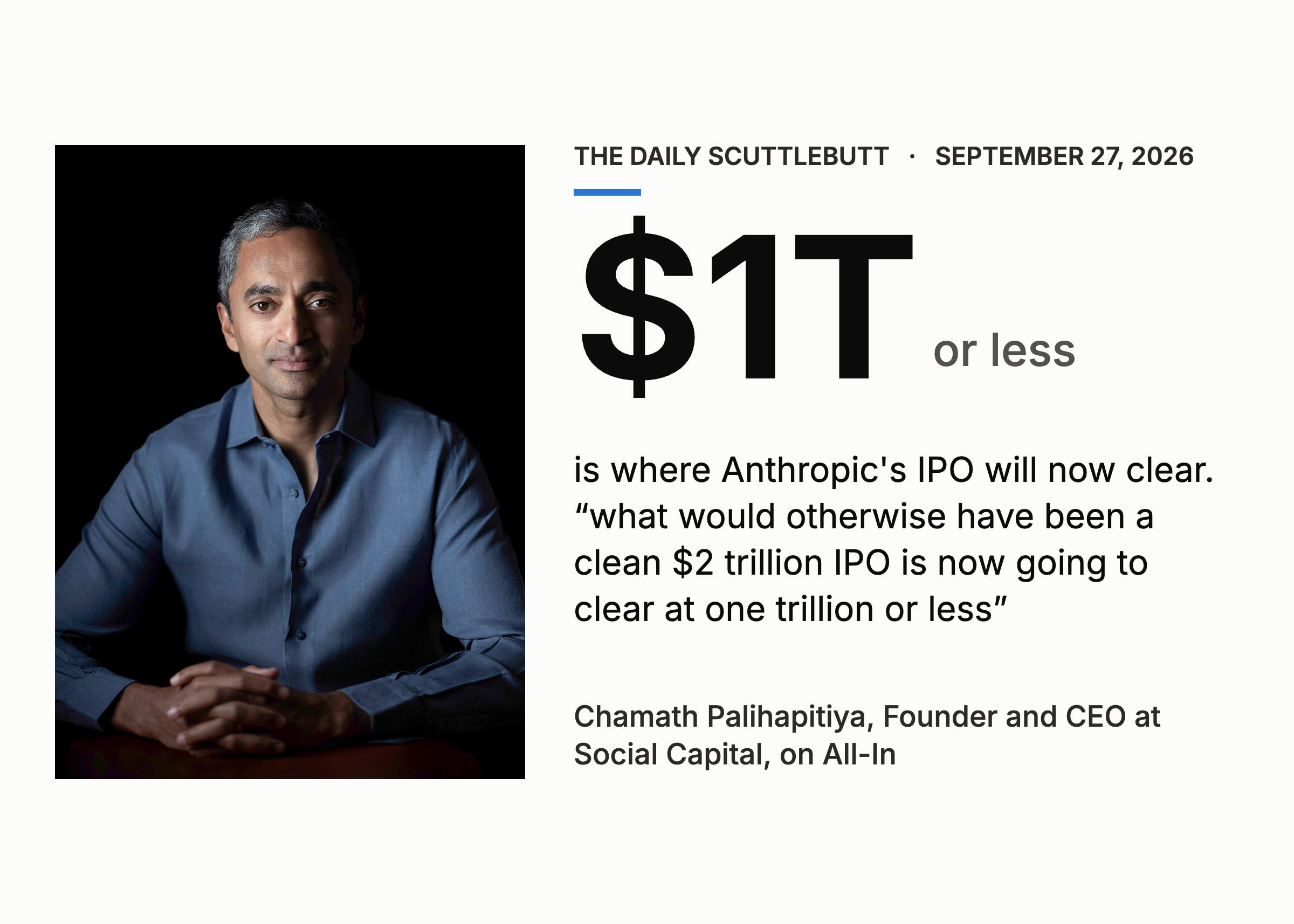
Photo: Cmichel67, CC BY-SA 4.0, via Wikimedia Commons
Chamath Palihapitiya, founder and CEO of Social Capital, said on All-In that an Anthropic IPO that would otherwise have been a clean $2 trillion offering will now clear at $1 trillion or less. The pension systems, hedge funds and mutual funds that buy it will demand a lower price for the risks, he said.
That was one argument from one podcast. Fourteen other summaries from the day carried a claim worth weighing. Cloudflare's chief executive expects bots to generate a thousand times the web traffic humans do within five years, and says advertising cannot pay for it. A BlackRock portfolio manager said the global rise in bond yields matches the rise in growth forecasts almost exactly. Utah's state treasurer explained why the state's rainy-day fund now holds gold.
"That's how you find a market-clearing price — even if you think Anthropic is on a hundred-billion-dollar run rate, what would otherwise have been a clean $2 trillion IPO is now going to clear at one trillion or less, because hedge funds, pension systems, and mutual-fund complexes with fiduciary duties will justify the risk by demanding a lower price. I think it's good for Anthropic in the end, because it clears the noise and forces them to just be a corporation and run the business — and they'll do great." — Chamath Palihapitiya, Founder and CEO at Social Capital, on All-In
We scanned 556 shows and 14 hours of audio, wrote 16 summaries, and pulled 26 quotes into this 11-minute read.
Here is what mattered.
Macro
Utah bought gold because its cash fund lagged inflation
"Basically it acts as a diversifier and can keep up with inflation in inflationary times — in 2023/2024 we weren't keeping up with inflation by investing in the PTIF, which is what the rainy-day funds were 100% allocated to, our short-term money market fund — those rates weren't keeping up with inflation, so we were eroding the purchasing power of the rainy-day funds, whereas gold has tended to keep up with inflation." — Marlo Oaks, State Treasurer of Utah, on Reinvent Money
Global bond yields rose in step with growth forecasts
"If you look at global average nominal GDP — the real rate of activity plus the rate of inflation — the change this year globally on average was an increase of about 50 basis points relative to forecasts at the beginning of the year. That matches almost exactly the average global bond increase. So global bond rates track nominal activity. This isn't the bond market freaking out — this is the bond market recognizing that growth is higher in nominal terms." — Jeffrey Rosenberg, Portfolio Manager at BlackRock, on Bloomberg Money
With inflation this high, bonds no longer hedge stocks
"When you have too much inflation, bonds aren't really a hedge anymore. They're good for income, but for diversification we're going to have to think about broadening our diversifier set away from just the traditional 60-40. We talk about it as 50-30-20 — and that 20 is alternatives and different forms of diversification to add into the portfolio mix." — Jeffrey Rosenberg, Portfolio Manager at BlackRock, on Bloomberg Money
A 4.5% tax-free muni yield is worth about 8% before tax
"My New York State muni-bond portfolio, which I'm invested in, yields 4.5% tax-free — that's the taxable equivalent of just about 8%. If I'd told someone five years ago I could get them an AA-rated 8% yield, their heads would have exploded. It's been so long since bonds paid you to sit and wait." — Barry Ritholtz, Chairman and CIO at Ritholtz Wealth Management, on Bloomberg Money
Most wealthy Americans own ordinary businesses, not tech companies
"We think, and the media focuses obsessively, on tech founders and CEOs, but the average wealthy person in America — somewhere around the top 4 or 5% — most of them don't work for public companies, most of them aren't tech founders. They tend to be ordinary people running regular businesses that they own — dental practices, HVAC, auto dealers ... the top 4%, which is about $25 million net worth, or the top 10%, which is about $5 million liquid net worth." — Barry Ritholtz, Chairman and CIO at Ritholtz Wealth Management, on Bloomberg Money
Utilities are down 9% while the S&P 500 sits near its high
"When you look at RSP, the equal-weighted S&P ... RSP is down 4%, financials 5%, small caps 6.5%, real estate 7%, utilities 9%. So the interest-rate-sensitive sectors are starting to feel interest rates. We don't see it in the S&P 500 because there are 10 or 20 stocks dragging this thing higher — a very small number of AI/technology-specific stocks masking it, making the surface look very calm." — Michael Lebowitz, Co-Portfolio Manager at RIA Advisors, on Thoughtful Money
Without data centers, the US economy has barely grown
"Strip out data-center growth and we've had almost no economic growth. We may be a year from now saying the economy grew 2–3%, but AI data centers added 4% to that number and the rest of the economy was minus a little bit. That's why I think AI spending is so vital right now — its impact is not just on the stock market but on the economy, it's big." — Michael Lebowitz, Co-Portfolio Manager at RIA Advisors, on Thoughtful Money
Fertilizer prices are up 8x in 12 months
"Fertilizer prices have gone up eight times over the past twelve months — way too expensive for most farmers, so they're just not going to use it, which means their yields are going to fall. ... that means higher food prices, because farmers who have to pay more for diesel for their tractors are going to try to raise prices for their products." — Chris Whalen, Chairman at Whalen Global Advisors, on The Julia La Roche Show
If high prices choke off demand, the Fed will cut
"When prices get to a certain point, the trucker or the farmer is just going to park their equipment because it makes no sense to produce or work. That's the big threat — if we start seeing significant demand destruction in this country, which I think is a possibility toward the end of this year going into 2027, then you're going to see the Fed cutting interest rates." — Chris Whalen, Chairman at Whalen Global Advisors, on The Julia La Roche Show
International
Only 4 kinds of business make money in India for decades
"I believe there are fundamentally four businesses in India — fads come and go, but these four are always there, and, at the cost of repetition, these are the ones that will make money. The first is very large-scale manufacturing where you have some kind of regulatory advantage. The second is micro-distribution, where you're reaching the rural pockets. The third is lending. And the fourth is where you're playing cost arbitrage — spending in rupees, earning in a foreign currency, hopefully dollars or euros — today dollars are more attractive." — Asish Mohapatra, Co-Founder and CEO at OfBusiness, on Figuring Out with Raj Shamani
Traders charge small factories 2% to 2.5% a month for credit
"A bank typically charges anywhere between 0.8 to 1% a month as an interest rate, whereas a trader charges between 2 to 2.5% a month — a wide chasm, and these are monthly rates, not annual. So if you can build a business charging between 1.25 and 1.3% a month, there's a business to be made." — Asish Mohapatra, Co-Founder and CEO at OfBusiness, on Figuring Out with Raj Shamani
AT&S could sell 20% to 25% more substrates right now
"Instantly, we could deliver easily 20 to 25% more if we had the capacity fast enough. But we are actually ramping capacity — we're doing it here in Kulim, as well as in China, but we're also ramping in Europe, in Austria." — Michael Mertin, CEO at AT&S, on CNBC International
The layer under the chip now limits AI performance
"The development of computer chips was so fast, and they're so fast now in their calculation procedures — also in the communication procedures between these GPUs and CPUs, the communication to memory — that the communication speed delivered by a substrate is the limiting factor." — Michael Mertin, CEO at AT&S, on CNBC International
Technology & AI
Bots could generate 1,000 times human web traffic in 5 years
"If you extrapolate that out — with the giant caveat that I've gotten every prediction wrong so far — five years from now we think automated traffic will be a thousand times human traffic online. Not because human traffic is going to decline; we think it'll stay around the same. ... And the traditional model for paying for that, advertising, doesn't work for bots. Bots don't click on ads, they don't respond to pretty swirls of paint and what we traditionally think of as a brand." — Matthew Prince, Co-Founder and CEO at Cloudflare, on Decoder with Nilay Patel
His local paper expects more from AI licensing than from ads
"The example that this is actually working: my wife and I own a small local newspaper in Park City, Utah, our hometown. I think we'll make more money off AI licensing deals this year than off digital advertising. The reason is that local media is exactly the sort of thing that's much more valuable in the media world we're going into but was completely decimated in the media world we were coming out of, where what mattered was volume and scale." — Matthew Prince, Co-Founder and CEO at Cloudflare, on Decoder with Nilay Patel
Parallel charges $1 per 1,000 searches; rivals charge $7 to $14
"But more importantly, our web search costs a dollar per thousand for producing that quality, while almost every other web search available right now costs seven, ten, or fourteen dollars — we're delivering at about a tenth of the price." — Parag Agrawal, Founder and CEO at Parallel, on The Twenty Minute VC
Web search could take 5% to 20% of AI inference spending
"Take training and media generation out of it — look at all the GPUs going into inference for running agents, across all models, open and proprietary. I think somewhere between 5 and 20% of that spend needs to go into some sort of web-search stack." — Parag Agrawal, Founder and CEO at Parallel, on The Twenty Minute VC
Token use flipped to 80% open models in 12 weeks
"There's a stat that in just the last twelve weeks, token use has flipped from 80/20 closed-versus-open to 80/20 open-versus-closed. I don't think we've ever seen a chart move that fast in the history of technology markets. That's the biggest risk factor for Anthropic — they were first to get the enterprise onto AI, but as the market shifts to open weights, that's the chart that blows the lid off what needs to go into these S-1s." — Chamath Palihapitiya, Founder and CEO at Social Capital, on All-In
The leading AI labs are only 6 to 12 months ahead
"Anthropic and OpenAI right now are a stable duopoly for frontier intelligence — they have a significant lead and can charge a premium for it. ... But these two companies are on a hamster wheel — the moment they stop being frontier, they go to zero, and the frontier is maybe only six to twelve months ahead of the commodity portion of the market." — David Sacks, General Partner at Craft Ventures, on All-In
Policy
Talkspace wants 1 federal law instead of 50 state ones
"I would love to see a federal solution, so that we don't have to deal with 50 different laws and states and regulatory oversight that's different from state to state. I'm not worried about what we built — I think other people are worried about what they built, because they don't have the safeguards that we put in place, quite honestly." — Jon Cohen, CEO at Talkspace, on WSJ Tech News Briefing
Slingshot dropped the word therapy but kept the service
"We don't call it AI therapy, but when we think about the value proposition to people, it's similar — which is, you have a problem, you can show up, and Ash is there to help you think through that." — Neil Parikh, Co-Founder at Slingshot AI, on WSJ Tech News Briefing
Nuggets of Wisdom
Shorting is a timing call, not a valuation call
"What I've found over the years is that shorting is almost entirely a timing game, not a valuation exercise — you can do the valuation, it's relatively easy, and a lot of shorts are massively overvalued, but you don't know when or how to short them properly. I keep a list of maybe a hundred companies I think are good shorts that are overvalued, and I'm constantly working through the timing on each one — if something's pumping to the moon, clearly I don't want to get involved yet; I want to wait for some kind of peak, a narrative change, or a secondary offering." — Sean Westropp, Founder and Portfolio Manager at Deep Sail Capital, on Planet MicroCap
A company that keeps changing its story is a short candidate
"On the short side there are tells: management changing their story, their business model, or their name every few years — that's a huge tell of someone chasing a trend. You'll notice a lot of companies that were in Bitcoin or crypto are now in AI data centers — first cannabis, then crypto, now AI." — Sean Westropp, Founder and Portfolio Manager at Deep Sail Capital, on Planet MicroCap
A trillion dollars of capital spending is going into one thing
"A trillion dollars of capex is going into building one thing. ... You could just call it a bubble, put it in a box, and go do your other thing, but there's a trillion dollars moving around — don't you want to figure out if you could make some money from it?" — Ahmed Husain, former Global Head of Family Office Strategy at Neuberger Berman, on The Market Huddle
Costs can cut a 10% return to 5%
"You can quickly see how, if you made some behavioral mistakes on the front end that cost you some return, and had tax drag on the back end, you could go from a 10 or 11% annualized rate of return to something more like 7 or 8%. Then if you tack on a management fee, and maybe some fixed income, you could be grinding pretty hard to have your capital compounding at a whopping 5%." — David Fagan, Chartered Professional Accountant at mbf Chartered Professional Accountants, on The Investor's Podcast
Other appearances:
DBi co-founder and managing member on why a hedge-fund replication strategy beat 95% of managers for a decade on The Wall Street Lab
If this was worth your time, send it to someone who has to follow all of this too.
What did you think of today’s edition? Hit ‘reply’ to this email, send us a message, leave a comment, or join the chat!
Get the latest market chatter as it happens: