

Latent Space: The AI Engineer Podcast · Nov 26, 2026 · 1h 12m · 65m saved
With Jeff Barg, Head of AI at Clay
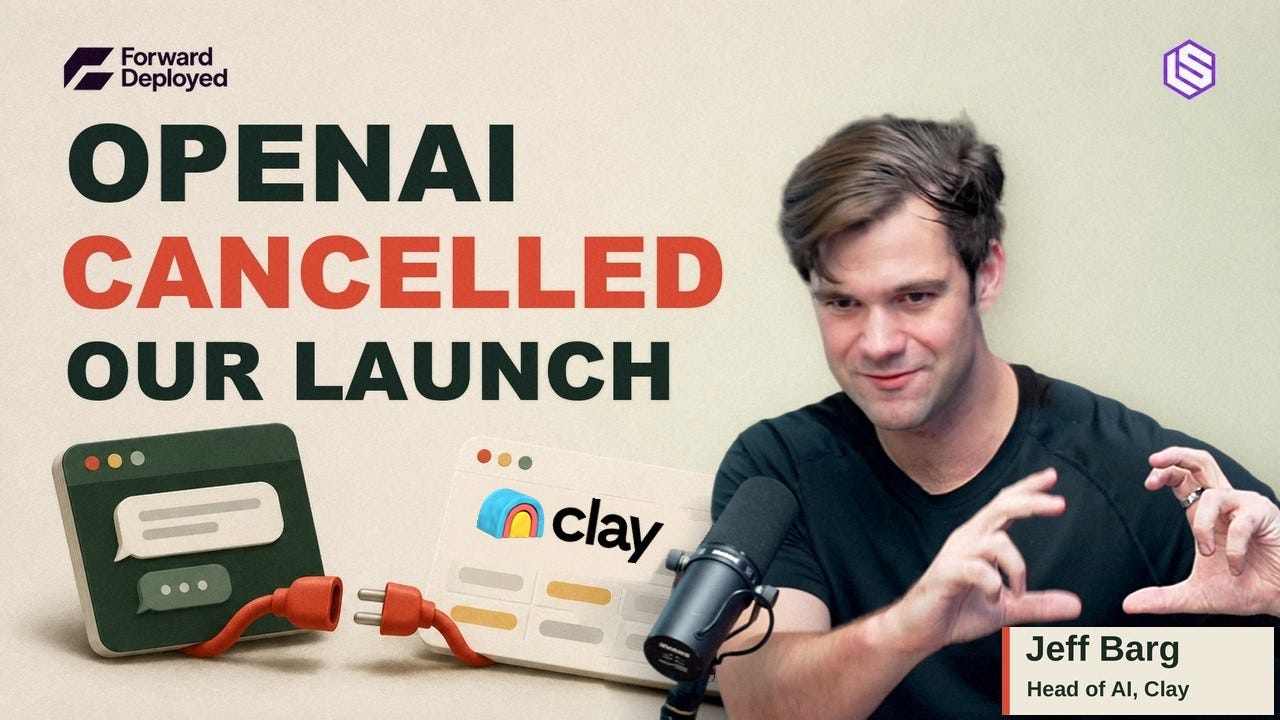
Clay's customers now use the company's own AI agent about as often as they point outside harnesses like Claude Code or Codex at Clay through its CLI. Jeff Barg, Head of AI at Clay, told swyx and his co-hosts on Latent Space that the split is "much closer to 50/50 than I would've thought" — a number that shapes how Clay is building its agent infrastructure.
Most AI-forward companies build their agent to be the best possible agent. Jeff's stated goal is the opposite: that Clay's CLI should give someone pointing Claude Code at Clay roughly the same outcome as using Clay's own first-party agent.
"We explicitly don't want our agent to be markedly better than just using Clay and Claude Code." — Jeff Barg
Jeff joined Clay in late 2024 when it acquired Avenue, the five-person ops-alerting startup he had co-founded, and became Clay's AI lead almost by accident — the company's one AI engineer had already left to start his own company.
The full interview is covered here so you can skip it. 72 minutes of audio, 7 minutes of reading.
Here are the 9 lessons that matter.
Key Takeaways
Usage between Clay's own agent and outside harnesses like Claude Code is close to 50/50, closer than Jeff expected
Clay rebuilt its agent, Sculptor, as a proper coding agent after its first version fell apart on open-ended tasks
Scoring every company in Clay's 40-million-company database with a classifier costs about $1,500 total
Jeff puts enrichment budgets at $1–$10 per qualified lead and $10–$100 per booked call
Post-training a smaller model only pays off once inference spend passes $10–$100 million a year
Customers hate Clay's manual model selector, so Clay is shipping an automatic router instead
Clay kept building its ChatGPT apps integration even after OpenAI postponed the launch with no explanation
1. From Avenue to Clay's AI
Jeff joined Clay in late 2024 when it acquired Avenue, the ops-alerting company he had co-founded and run with five people; Clay itself had about 50 employees at the time.
Jeff Barg says Avenue brought discipline Clay hadn't needed yet
"We joined the company when it was maybe 15 to 20 million in revenue, but the biggest contract was really small... they hadn't really moved into mid-market or enterprise sales yet, and I think that was something that we really knew how to do at Avenue." — Jeff Barg
He shifted into leading Clay's AI work by necessity, after noticing the company had no one actually working on AI.
"We were this really AI-forward company that had zero people working on AI, so it was kind of scary." — Jeff Barg
