

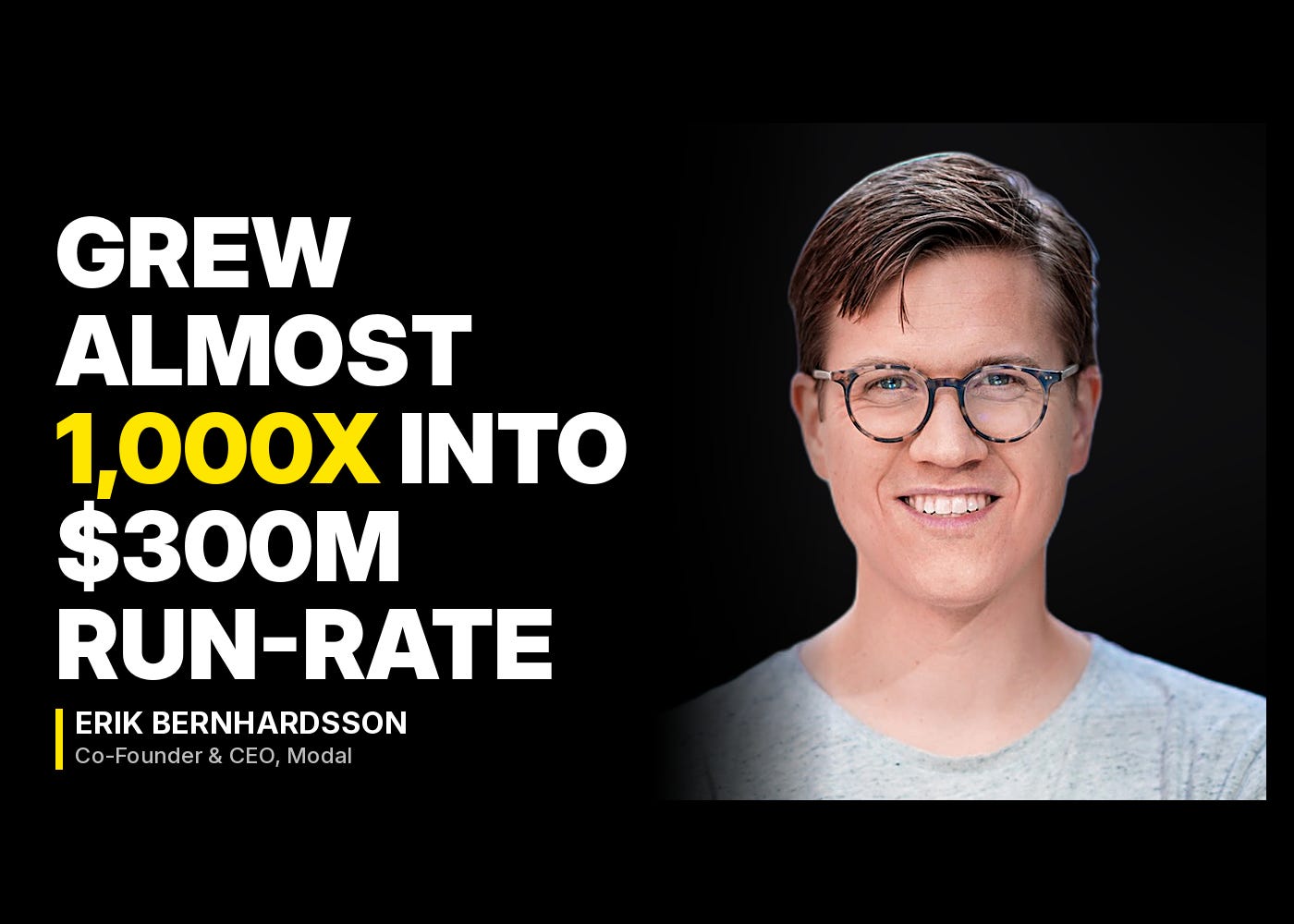
Photo via erikbern.com
Modal's sandbox product, which runs AI-written code in isolated containers, has grown almost a thousand-fold in about a year into a $300 million run-rate business, Erik Bernhardsson, co-founder and CEO of Modal, told Patrick Chase on Unsupervised Learning.
Much of the AI trade treats GPU capacity as a commodity with a published price. Erik described a market still run through late-night WhatsApp groups, chance introductions and conference hotel lobbies.
"I went to GTC last year. It was like an open-air drug market, but like GPUs — walking around, talking to people, trying to get GPUs, meeting people in hotel lobbies, exchanging numbers."
Erik buys that capacity for a living. Modal sources GPUs from 25 different cloud providers and closes two or three compute deals a week, so he sees what capacity costs in practice rather than what is published.
The full interview is covered here so you can skip it. 59 minutes of audio, 7 minutes of reading.
Here are the 8 insights that matter.
Unsupervised Learning · Oct 28, 2026 · 59m · 52m saved
With Erik Bernhardsson, Co-Founder and CEO of Modal
Key Takeaways
Modal's sandbox product is a $300M run-rate business, about a third of the company's revenue
It grew almost a thousand-fold once AI models got good at writing code in 2025
GPU capacity cannot trade on an exchange, because location, networking and reliability make each contract different
Published GPU prices do not match what Modal pays when it buys capacity
DeepSeek's open-source model is what pushed Modal into LLM inference, about a year and a half ago
NeoClouds are leasing businesses for hard assets, not software companies, in Erik's view
GPU buyers pay about 30% upfront and owe the rest in monthly installments, a risk if venture funding pulls back
Most companies will not train their own models, though heavy token users such as Cognition and Cursor already do
1. GPU Deals Are Informal
Erik said finding GPU capacity is less a question of scarcity than of looking further, paying more and signing longer terms. Patrick Chase, a general partner at Redpoint who sat in for Jacob Effron on this episode, asked how that market actually works.
Erik describes GPU supply deals that come through personal connections rather than a formal market
"At some point we got connected with someone who had GPUs because I think our VP of sales' cousin was golfing with someone." — Erik Bernhardsson
Other deals start in WhatsApp groups late at night or in hotel lobbies at Nvidia's GTC conference. Modal works this informal market constantly on behalf of its customers.
