

The Wall Street Lab · Sep 10, 2026 · 1h 9m · 58m saved
With Andrew Beer, co-founder and managing member of DBi (Dynamic Beta Investments)
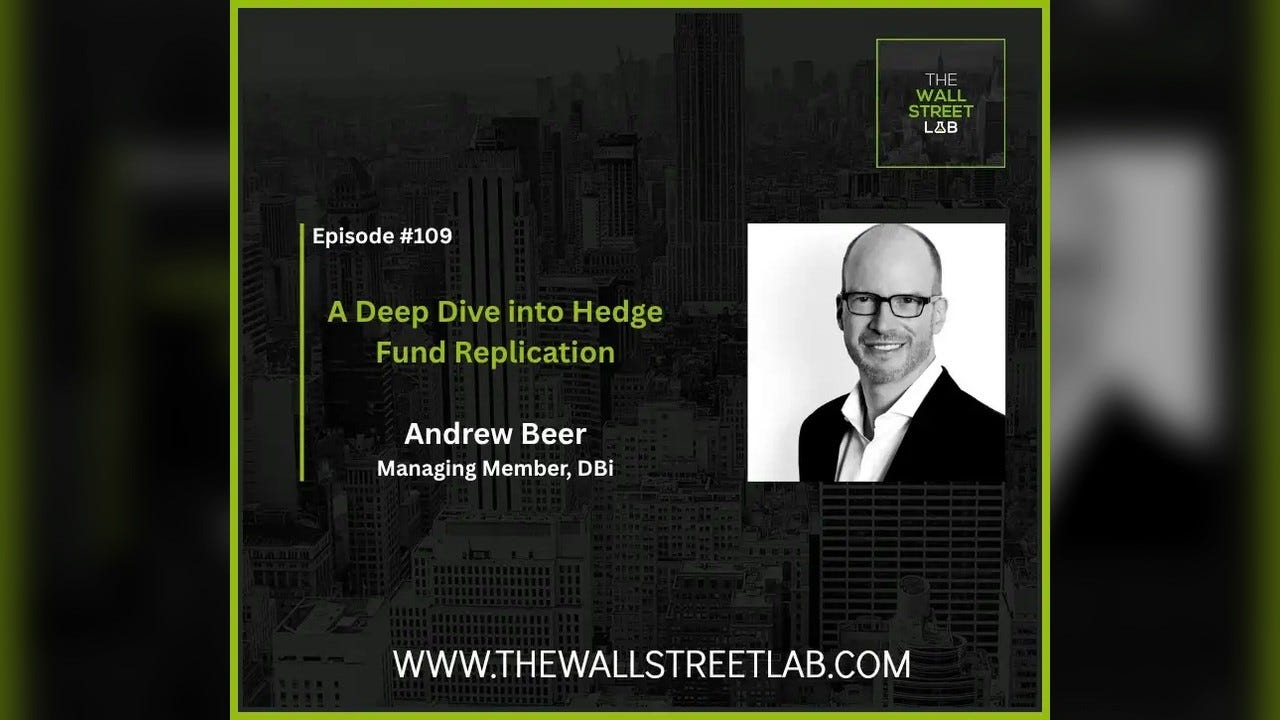
Andrew Beer's hedge fund replication strategy has never changed a single input in the ten years since he built it, and he says it has still beaten roughly 95% of large hedge funds on a risk-adjusted basis over that span.
Most of the industry sells clients on complexity — more instruments, more risk overlays, more PhDs. Beer, who worked for Seth Klarman at Baupost before going quantitative, built a business on the opposite bet: that a simple, repeatable model beats the "spaghetti cannon" almost every time.
"So this very, very simple contraption, this mousetrap that we created, which is called hedge fund replication, has outperformed almost every single large hedge fund — like 95% of large hedge funds, on an absolute or risk-adjusted basis — since we started doing this."
Beer has more than 30 years in the hedge fund industry, from Baupost to co-founding Pinnacle Asset Management and Apex Capital Management, and now runs DBi's managed futures and hedge fund replication strategies, on The Wall Street Lab.
The full interview is covered here so you can skip it. 69 minutes of audio, 11 minutes of reading.
Here are the 8 takeaways that matter.
Key Takeaways
DBi's flagship replication strategy has never changed an input in 10 years and has still beaten roughly 95% of large hedge funds on a risk-adjusted basis over that span
"Trend following" is a name Beer says owes the industry an apology — he calls the strategy "contrarian and tactical alpha" instead
His analogy: showing up at a party at 7pm, not 1am when everyone's already there
The strategy is up 25–27% over the past year, not because of a single crisis but a string of moves — buying oil ahead of Middle East tension, riding gold to 5,500
A weekly 54% edge compounds into near-certainty — about 80% by year-end, into the 90s by year three, the same logic Beer says Roger Federer used to explain winning only 54% of tennis points
A fund of funds quietly replicated its own hedge fund portfolio, beat it, and shut the project down rather than tell clients a cheaper option existed
Complex products can cannibalize the seller's own business if a simpler, cheaper version does just as well — which is why Beer says managers rarely launch one
The CTA industry is a "$300 billion undiscovered gem" that Beer says is marketed in a way most investors don't understand
Private credit exists partly because it didn't mark down in 2022, the year liquid bonds fell 15% and stopped diversifying anything
1. From Baupost to CTAs
Beer entered the hedge fund industry in 1994 almost by accident, joining Baupost Group as a portfolio manager for Seth Klarman while considering a doctorate instead.
Klarman's edge was instinct, not just intellect
"He also just has unbelievable investment instincts — his whole life his brain is just wired to think about the relative value of this car versus that car, or that stock versus this asset class, or this bond." — Andrew Beer
Beer said part of what drew him to Baupost was that Fama and French had just published the academic work identifying the value factor — and Klarman didn't need the paper to already believe it.
The lesson that still shapes his thinking
"Don't assume that just because you think you found something that's cheap relative to everything else, that nobody else knows what they're doing. There are probably a thousand people who know much more about the situation than you'll ever know as a generalist." — Andrew Beer
He said a cheap-looking opportunity that persists usually has a structural reason nobody else can act on it — a regulatory constraint, a mandate that excludes it — and that structural gap is where hedge funds were originally built to sit, outside the limits mutual funds accept.
