

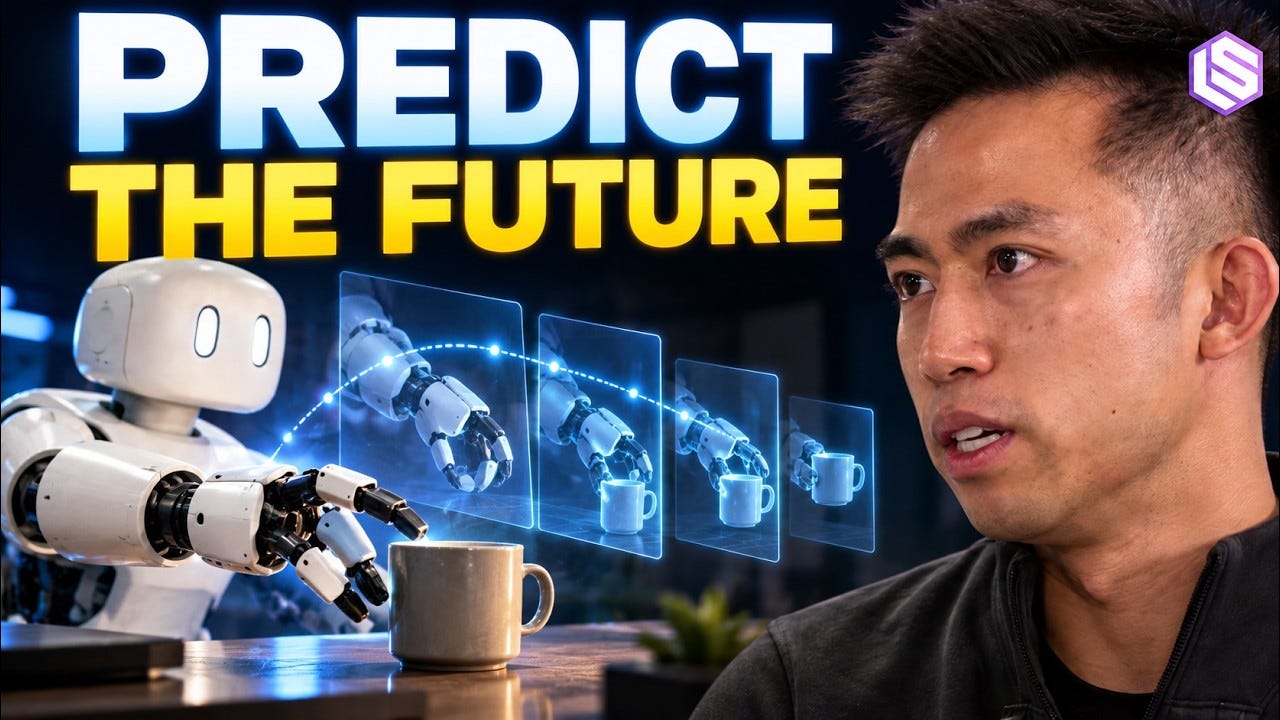
Dyna-2, the robot model Dyna Robotics released ahead of this interview, was pretrained on more than one million hours of human video. Jason Ma, Dyna's co-founder and chief scientist, told Latent Space's Shawn Wang, who goes by swyx, and co-host Vibhu that it is the first model of its kind at that scale.
Most robot models take in camera images and instructions and output only the motions a robot should make. Dyna-2 first predicts what the world will look like next, then uses that prediction to choose its actions.
"The way I think about it is this is kind of analogous to chain of thought... the models are reasoning in the visual, the physics space, and then outputting actions." — Jason Ma
Jason did a PhD in reinforcement learning and robotics at Penn's GRASP Lab, built the Eureka robot-training project at NVIDIA, and worked on Gemini for robotics at Google DeepMind before co-founding Dyna.
The full interview is covered here so you can skip it. 72 minutes of audio, 9 minutes of reading.
Here are the 6 insights that matter.
Latent Space: The AI Engineer Podcast · Oct 13, 2026 · 1h 12m · 63m saved
With Jason Ma, Co-Founder and Chief Scientist of Dyna Robotics
Key Takeaways
Dyna-2 predicts future video before it acts, which Jason compares to a language model's chain-of-thought reasoning
Robotics has no internet of training data, so Dyna pretrains on human video and fine-tunes on a few hours of robot demonstrations
Dyna builds its own robots, with a humanlike upper body on wheels, because legs cost energy, stability and safety
The hard part is a second site, not a pilot: Din Tai Fung expanded Dyna's napkin-folding contract to food cutting
Hardware is the underrated bottleneck, with the most dexterous robot hands still overheating in sustained use
Jason left lab research because he wanted something millions of people would actually use
1. What a World Action Model Is
The interview, recorded at Dyna's office, opened on what a world action model does differently from the vision-language-action models most of the field uses.
Dyna-2 predicts the future state of the world and uses that prediction to produce robot actions
"World action model is a model that's able to predict the future video, the future state of the world... but in addition, you can also use that future generation to also produce actions robots can execute in the physical world." — Jason Ma
The model takes in camera video, readings from the robot's own joint sensors and spoken or written instructions. It is a diffusion transformer, the design the field settled on for producing smooth, precise outputs such as images or robot movements.
Flow matching suits robots because it lets a model re-plan in real time
Jason said flow matching, a variant of diffusion that is simpler to tune and that the field moved to a few years ago, fits robotics especially well. An image model generates its output in one pass; a robot needs to keep re-evaluating its next move as the world changes.
