

Infinite Loops · Nov 12, 2026 · 1h 43m · 95m saved
With Jun Kwak, Co-Founder and CTO of Overjoy
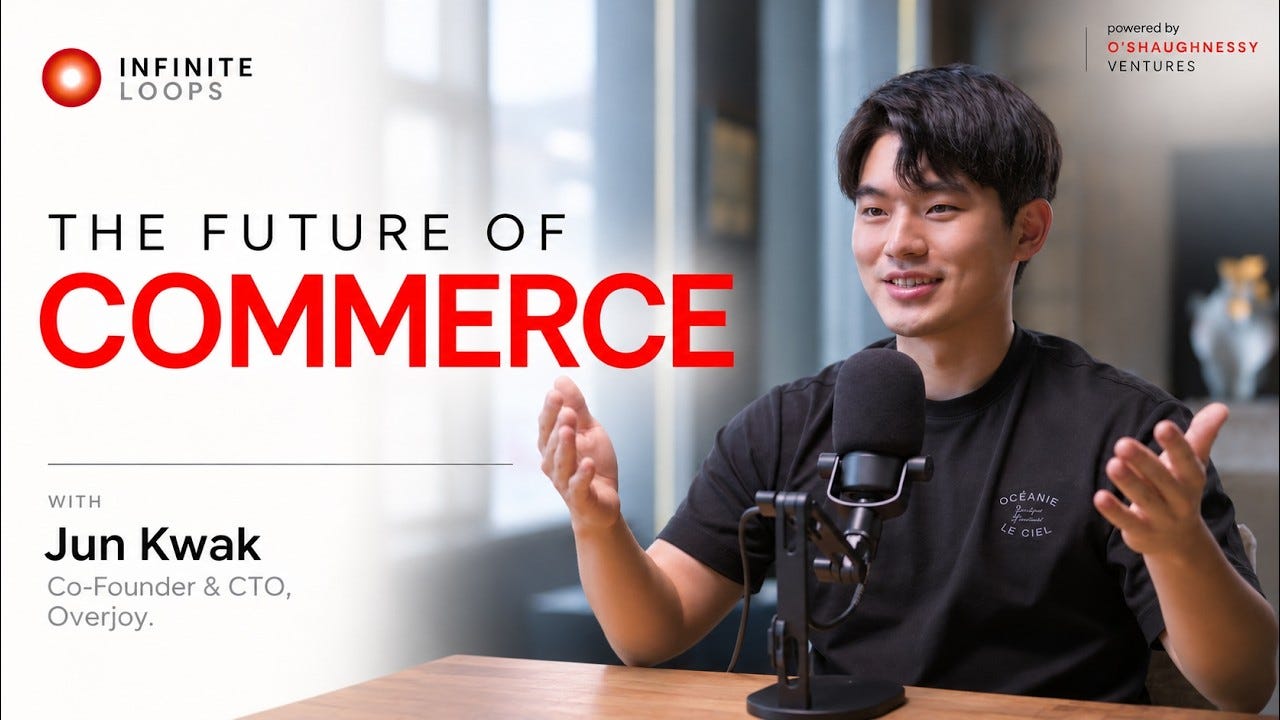
Jun Kwak, co-founder and CTO of the wholesale-growth platform Overjoy, said a two-person leather-goods brand with 10,000 uncontacted past customers went from zero to $15,000 in win-back revenue in 30 days once Overjoy took over its account management, on Infinite Loops.
Most B2B software sells access to tools and leaves the customer to run them. Jun's team tried running the tools for customers instead, and found brands preferred it.
"What if we just deliver the outcome?" — Jun Kwak
Jun debated competitively in Korea, came to Yale as one of the country's first ten Presidential Scholars, and worked at Google AI, Snapchat and Robinhood before co-founding Overjoy with Alex Han.
This Scuttlebutt Summary is available in full to premium subscribers. If you're not one already, please consider subscribing to keep reading.
The full interview is covered here so you can skip it. 1 hour 43 minutes of audio, 8 minutes of reading.
Here are the 8 takeaways that matter.
Key Takeaways
Overjoy pivoted from selling wholesale software to running the sales process as a service
Some customers were reselling Overjoy's own software as consulting, at 20x to 40x the price
A two-person leather-goods brand went from zero to $15,000 in win-back revenue in 30 days
Service customers get 3x bigger sales pipelines than brands self-serving with Overjoy's software
Overjoy's moat is outcome data spanning linked sources — businesses, contacts, orders, inventory — not the software itself
Pairing account managers with engineers produced a 4x gain in operational efficiency in four weeks
Early crises included a frozen Silicon Valley Bank account, a cut OpenAI API, and a near-miss mass email to customers
Of 3 million US e-commerce businesses, only 700,000 currently sell wholesale, a gap Jun compares to Shopify's effect on direct-to-consumer selling
1. From Debate to Founder
Jun traced his path to Overjoy back to winning three national debate championships in Korea by age 15, then growing disillusioned that debate let him argue about problems without solving them. He taught himself to code in high school and, after Yale, worked at Google AI, Snapchat and Robinhood before the itch to build his own company led him into a hacker house, where he met co-founder Alex Han.
Jun says detaching ego from argument became a founder superpower
"It's easy for us to detach ourselves from what we're saying... we both feel fine flipping our stance an hour later because the other side logically makes a lot more sense." — Jun Kwak
That instinct, shared with Alex, helped the team quickly abandon failing ideas — fashion-design tools, crypto tools — before landing on consumer brands' wholesale sales problem.
