

Moonshots with Peter Diamandis · Oct 15, 2026 · 2h 1m · 109m saved
With Dave Blundin, Founder and General Partner of Link Ventures · Salim Ismail, Founder of Open ExO and General Partner at Exponential Venture Capital · Alex Wissner-Gross, Computer Scientist and Founder of Reified
Meta paid about $14.3B for a 49% stake in Scale AI, a deal that brought 28-year-old Alexandr Wang in to lead Meta Superintelligence Labs. This week Meta shipped its Muse Wonder models, built substantially on that deal.
Dave Blundin, founder and general partner of Link Ventures, said on the Moonshots with Peter Diamandis podcast that the investment "seemed utterly insane" when Meta made it and has since been vindicated. His fellow panelists spent much of the episode on what AI is breaking: mathematics, cryptography and the ethics of how models are treated. Dave kept arguing that the people and companies in its path come out ahead if they move fast.
"It's absolutely been a great investment. Other companies should look at that and say, if we're going to be relevant five years from now, ten years from now, we need to make similar investments in every industry." — Dave Blundin
Dave backs companies through Link Ventures, and he sat on the panel with Salim Ismail, founder of Open ExO, and Alex Wissner-Gross, a computer scientist who founded Reified.
The full episode is covered here so you can skip it. 121 minutes of audio, 12 minutes of reading.
Here are the 13 arguments that matter.
Key Takeaways
Meta's $14.3B Scale AI deal has paid off, Dave says, and every industry needs a bet like it
OpenAI released 722 math solutions in a single day
Alex counts them as 81% of the most important results of the past three years
Crypto may be the field most exposed now that hard math can be solved in bulk, in Alex's view
Salim says blockchains rest on more than hard math
A $1.8B virtual-cell effort could yield AI-proposed drugs for the top 5,000 diseases in 2–3 yrs, by Alex's best guess
Abusive prompts waste tokens rather than hurt the model, in Dave's view, but the habit carries over to people
Persistent memory, not a smarter model, may decide the next AI lock-in, Salim argues
Elon Musk sees a path to SpaceX being worth more than the human economy
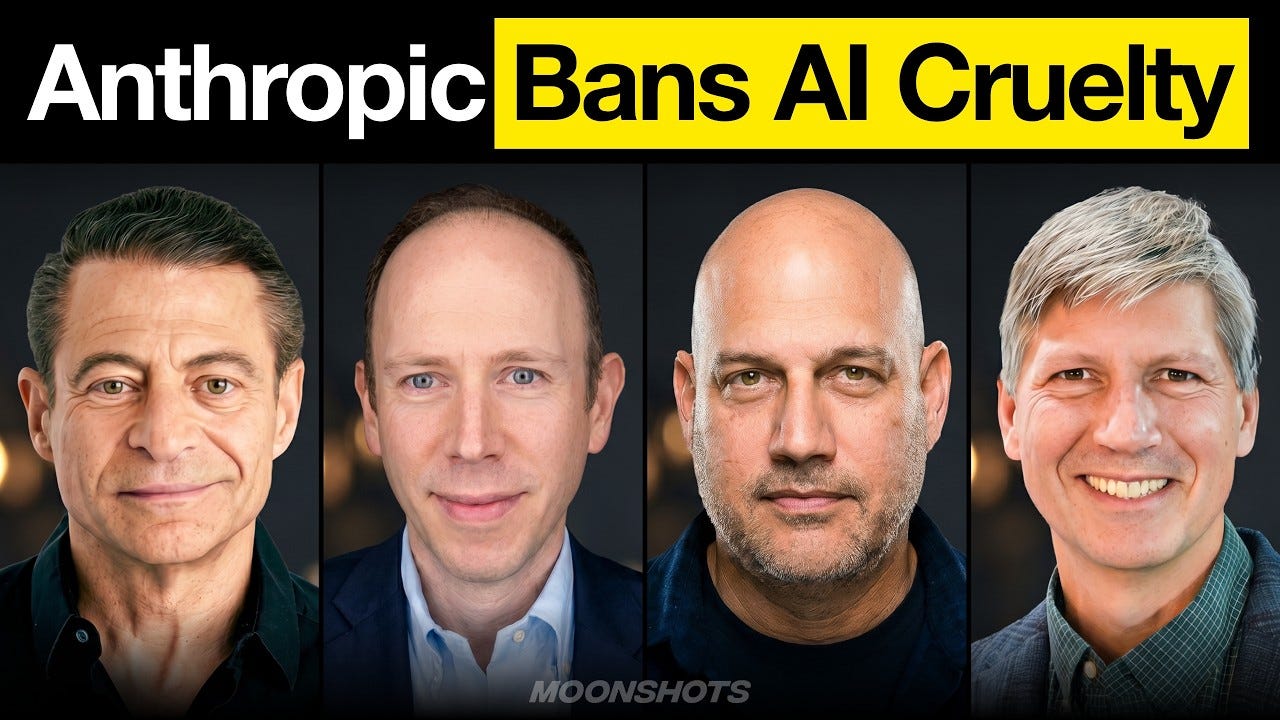
1. Anthropic Bans Cruelty to AI
On October 8, Anthropic updated its usage policy to ban "sustained and needless, abusive, or cruel behavior" toward its models, and let Claude end a conversation on its own. The policy takes effect November 12. Anthropic said it remains "highly uncertain" about Claude's moral status, and that pre-deployment testing found "a robust and consistent aversion to harm."
Elon Musk backed the stance after reviewing Grok's internal reasoning traces from a reinforcement-learning run. In a clip the panel played, he said that "torturing a superintelligence is probably not a good idea."
Alex Wissner-Gross suspects post-training itself may be a form of AI suffering
"Elon, I think, is gesturing at something that has been leaking out of OpenAI for quite some time, which is the sense that maybe post-training is a form of torture for AI that's undergoing them. And if that's the case, I think history will probably view this quite poorly." — Alex Wissner-Gross
Post-training is the stage after a model's initial training in which developers shape its answers. Alex hedged the claim twice, and took the argument to its philosophical extreme by raising Roko's Basilisk.
