

TBPN Sep 25, 2026 48m · 29m saved
With John Arnold, Co-Founder and Co-Chair of Arnold Ventures, formerly Head Trader at Enron and founder of Centaurus Advisors
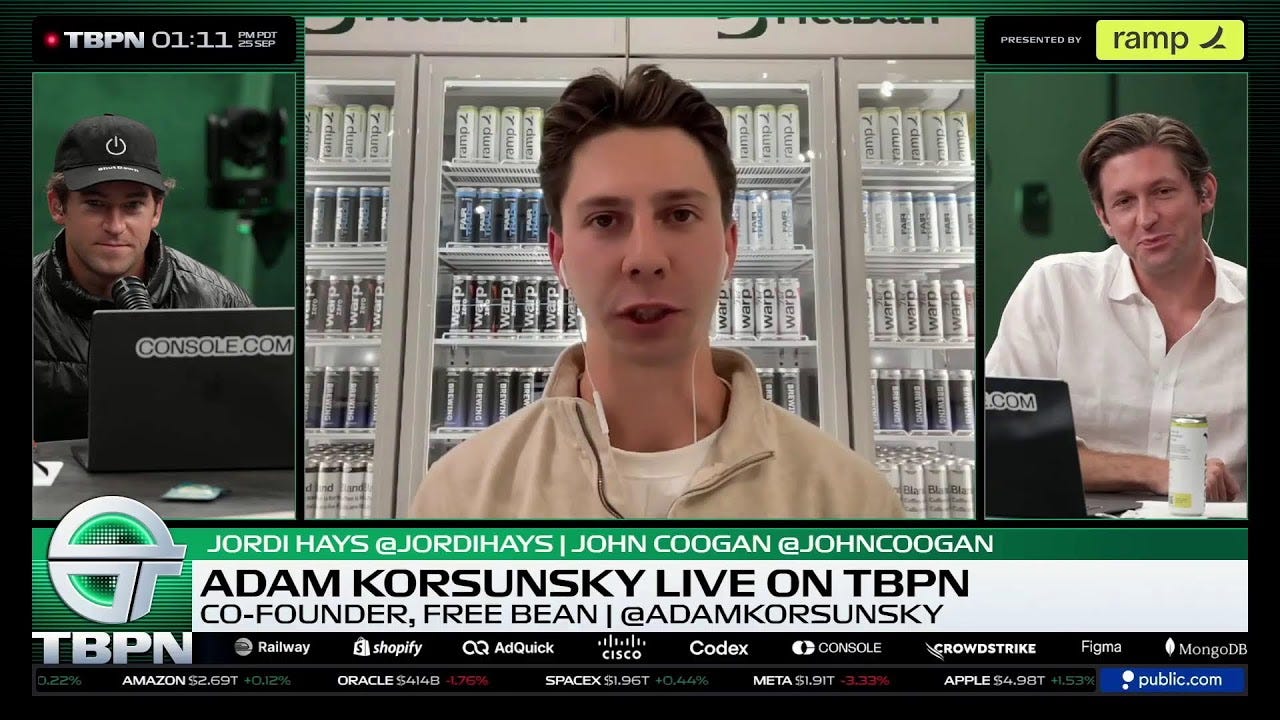
Every megawatt of data center capacity built so far has kept rising in value, John Arnold said, and producers all reacting to that same signal at once is how commodity markets end up with too much supply.
Much of the technology industry reads rising prices for compute as proof that demand will keep up. Arnold, who has traded commodities since 1995, reads it as the price signal that comes before a bust.
"I do think that kind of every commodity market, goes through these booms and busts."
John Arnold, who became head trader at Enron when it was the country's largest natural gas trading firm, started his own hedge fund at 27 and now co-chairs the philanthropy Arnold Ventures, spoke on TBPN about risk, gambling-style financial products, AI infrastructure, shale, nuclear power and private-market valuations.
The full interview is covered here so you can skip it. 48 minutes of audio, 19 minutes of reading.
Here are the 14 insights that matter.
Key Takeaways
Data centers are set up for the same boom and bust every commodity market goes through, because every builder sees the same price signal
Models that assume a 60% price cut still leaves a margin of safety could be wrong if supply overshoots
Compute cannot trade like natural gas yet: there is no trusted index and no standard product to deliver
Chip and memory makers are refusing to overbuild unless customers sign three- to five-year purchase contracts that pay for the whole factory
A one-minute Bitcoin bet is "fairly close to just a pure slot machine", and phones have removed the friction that used to limit gambling
Arnold turned down Ken Griffin after Griffin flew to Colorado to meet him, because Citadel's main offer was capital he could raise himself
Regulation is faster than education at curbing high-intensity products, though Arnold said he has "libertarian bones" and wants guardrails rather than bans
The US shale boom took 50 years, and nuclear faces cheap US power, costly craft labor and a state-by-state utility system
The energy-tech IPO window opened with Fervo and closed quickly, leaving companies to choose between a lower-priced listing and staying private
1. From Enron to His Own Fund
A host asked Arnold to tell his career story. His first job out of college was at Enron, which he joined at 21 in 1995. He stayed through the company's bankruptcy in December 2001.
He learned more from Enron's fall than from its rise
"And I was there too and through bankruptcy and it was kind of remarkable ride up and a very educational and sad ride down and probably learned more on the latter than I did on the former." — John Arnold
He ran the biggest gas desk in the country
"I was running a trading desk at Enron. I was, in very quick order had become the head trader at Enron, which was the largest natural gas trading firm in the country." — John Arnold
After Enron he wanted to run a division of something, and weighed doing it at a bank, an energy company or another hedge fund, before backers offered to fund his own firm. His first question, he said, was how much of the information flow that made the Enron desk profitable he could replicate on his own.
Why a 21-year-old could compete
Arnold explained how the market he entered came about. The US government once set the price of natural gas, which produced shortages at some times and surpluses at others. Deregulation that began under Carter in the 1970s and continued under Reagan in the 1980s treated gas production and gas use as competitive businesses, but kept interstate pipelines federally regulated because they can behave like monopolies. Someone then had to stand between a producer in South Texas and an end user elsewhere who wanted gas priced differently. Enron's first business in that role was the Enron gas bank, which Arnold said worked much like a bank does. The industry was only getting started in the late 1980s and early 1990s.
"And so, as a young guy coming in, I wasn't that far behind because everybody else was kind of starting a fresh as well." — John Arnold
Bandwidth and the other markets Enron tried
Asked about Enron's pitch to trade bandwidth, Arnold said it was not his area. The idea was that pricing and managing risk between producers and end users creates value. Enron moved from gas into electricity as that market was deregulated, then looked at water, trucking and bandwidth.
"But many of which I think when Enron got into them was a little ahead of their time and didn't work out very well." — John Arnold
