

Photo via humanx.co
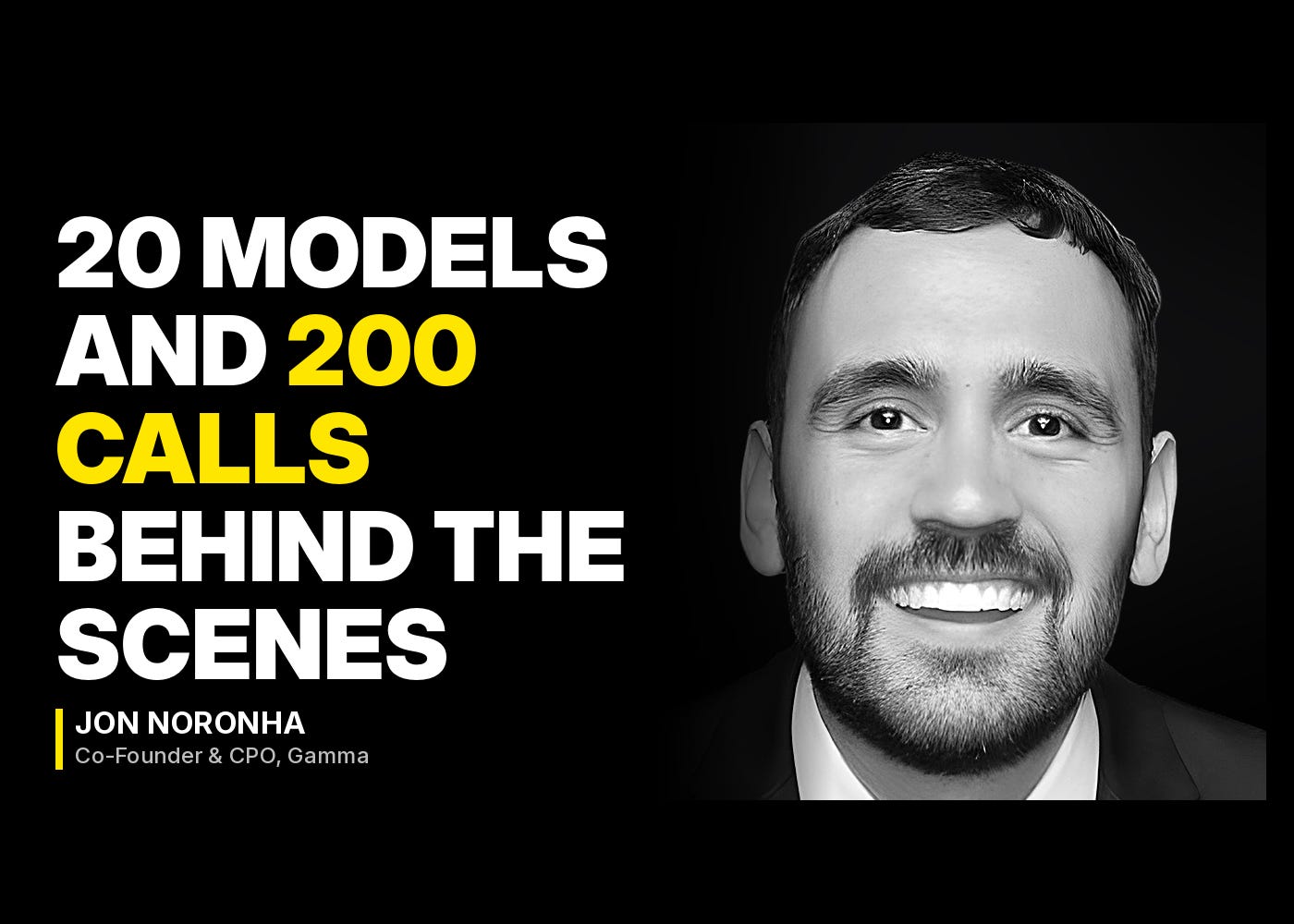
Gamma typically calls about 20 different AI models some 200 times before one presentation reaches the user, Jon Noronha, co-founder and Chief Product Officer of Gamma, told Greg Isenberg on The Startup Ideas Podcast.
Critics of AI apps often dismiss them as thin "GPT wrappers" around someone else's model. Jon argued the reverse: the models are growing more alike, and the product work sits in the layer built around them.
"I always disputed this concept of the GPT wrapper originally, because it implies that 90% of the work is the LLM... I think what harnesses illustrate is that actually the wrapping is most of the work."
Jon co-founded Gamma, which turns notes into presentations, documents, websites and social graphics, and he runs the product that its recent relaunch rebuilt.
The full interview is covered here so you can skip it. 49 minutes of audio, 7 minutes of reading.
Here are the 8 lessons that matter.
The Startup Ideas Podcast · Oct 28, 2026 · 49m · 42m saved
With Jon Noronha, Co-Founder and Chief Product Officer of Gamma
Key Takeaways
The layer around an AI model does most of the work, not the model underneath it
Even OpenAI and Anthropic now spend much of their effort on that layer
One Gamma presentation takes about 20 models and 200 calls, including rounds of automated design checks
Gamma gets 98% of its value from prompts, with fine-tuning added only as an optimization
Creative quality has no objective benchmark, so Gamma refuses to optimize for test scores alone
Gamma's relaunch set out to remove the "AI smell" that lets people spot AI-made work
A slower product converted more users to paying than Gamma's stripped-down fast mode
Everyday AI-image tasks are waiting to become products, such as seeing a couch in a buyer's own room
1. What an Agent Harness Is
Gamma used to chain individual model calls by hand into preset workflows. Jon described the change of the last year or two as the "agentic revolution," in which one higher-level loop does the work, inspects it, calls tools and repeats across many calls.
Jon defines a harness as the tool kit an AI agent uses to act, check itself and finish the job
"The harness is all the tools that agent uses to execute things in its environment, inspect its own work, and deliver something finished to the user." — Jon Noronha
Building a product as an agent means building that loop's harness. It includes the tools the agent uses to ask users what they actually want.
Claude Code is the best-known harness, in Jon's view, because it teaches an agent to work through a codebase
"The most famous agent harness is something like Claude Code... Claude Code teaches the agent how to go through all the files on your system and see what's there." — Jon Noronha
Anthropic's coding agent also runs tests and follows rules such as entering plan mode before it writes code. Gamma's harness does the same job for visual work: choosing an art style, building a story, generating and placing images, and judging whether they look right.
