

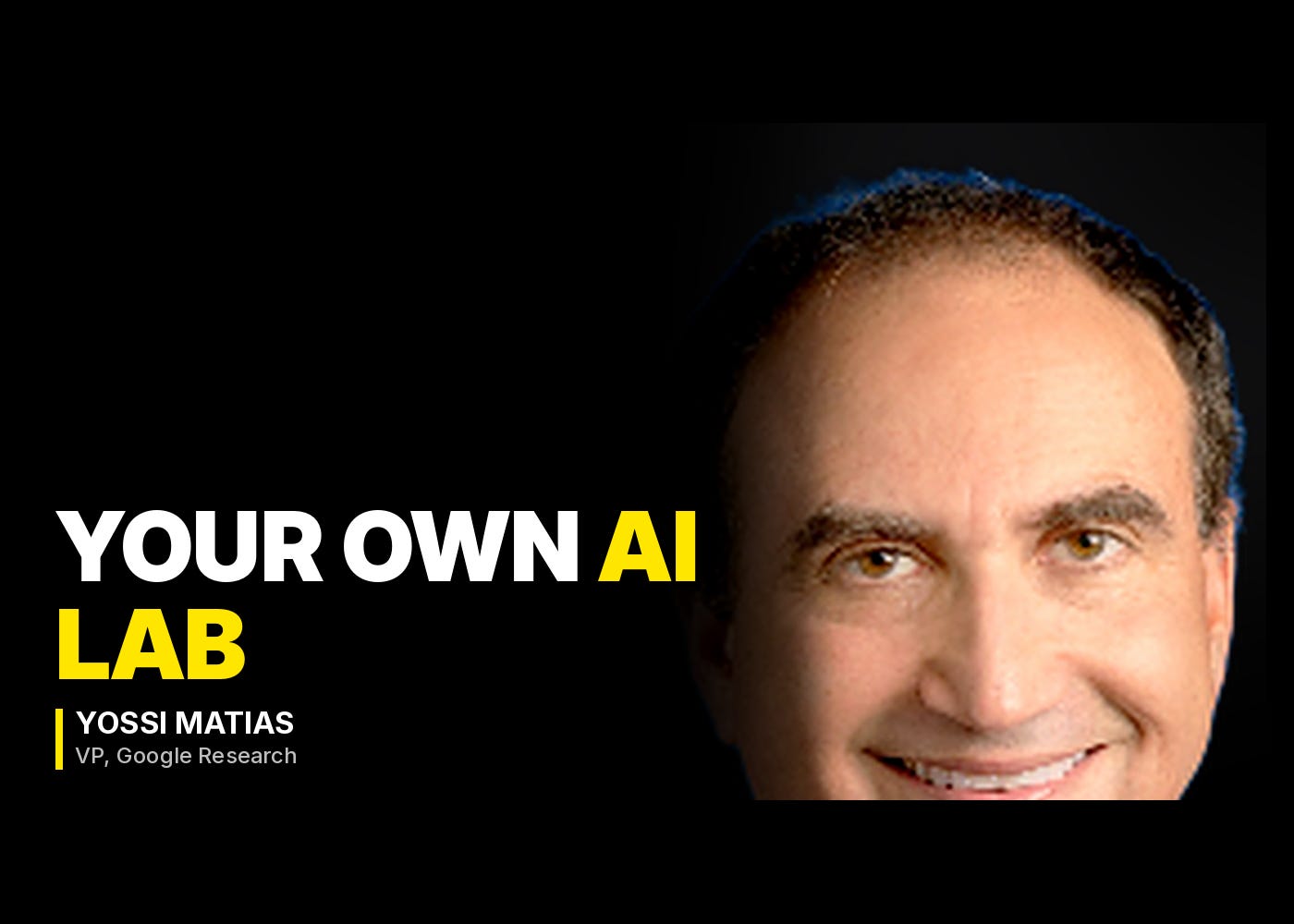
Photo via research.google
The government of Nigeria recently used an AI flood-prediction tool to send relief money to villagers ahead of a flood. Most conversations about AI's future focus on chatbots and productivity. Yossi Matias, VP of Google Research, told Sinead Bovell, a futurist who hosts "I've Got Questions," that the bigger shift is happening quietly in the background — in science, in forecasting, in daily life.
"Once we start using it, and it's good enough, we're actually stopping attention to that. We just use it. And that's, I like to call it as ambient intelligence." — Yossi Matias
Yossi runs the Google Research teams behind projects like Earth AI, the geospatial models now used by governments including Nigeria's to warn communities ahead of floods — work he says is moving from prediction toward action.
The full interview is covered here so you can skip it. 22 minutes of audio, 7 minutes of reading.
Here are the 6 takeaways that matter.
Sinead Bovell · Oct 22, 2026 · 22m · 15m saved
With Yossi Matias, VP, Google Research
This Scuttlebutt Summary is available in full to premium subscribers. If you're not one already, please consider subscribing to keep reading.
Key Takeaways
Every researcher is about to get their own "virtual lab" — an AI collaborator Yossi calls a polymath across disciplines
The researcher's role shifts toward what today looks like a senior advisor or principal investigator
"Ambient intelligence": once AI works well enough, people stop noticing it and just use it
He still finds self-driving cars "magical" even after using them regularly
The government of Nigeria sent relief money to villagers ahead of a flood, using Google's Flood Hub API
Yossi says the next step is turning predictions into action — mobilizing help, not just issuing warnings
"Soft skills" aren't soft, Yossi says — communication, listening and judgment are just skills, and they'll matter more as AI friction falls away
A new job is coming: the "AI-trition" — whoever you call when the AI embedded in your house breaks
His biggest worry isn't a shortage of problems to solve, but making sure Google Research picks the highest-impact ones
1. Every Scientist Gets a Lab
Sinead opened by asking what a scientist's job looks like by 2030. Yossi said the core drivers of science — curiosity, exploring, inventing — aren't changing, but the mechanics are.
AI is becoming every researcher's own "virtual lab" — a polymath collaborator that works across disciplines
"In the world where every researcher may have their own virtual lab... it's essentially an AI collaborator that is a polymath because it treats across disciplines." — Yossi Matias
That shift, he said, up-levels the researcher's job toward what today looks like a senior advisor or principal investigator — asking the right questions and guiding iteration rather than doing the manual legwork.
The researcher's role is moving toward what today looks like an advisor running their own lab
"The researcher becomes what today we think about as advisors or researchers who have their own labs." — Yossi Matias
He called the institutions built around science — "the academic systems and what we're doing" — not yet built for that pace of change, even though he thinks the opportunity is "quite extraordinary."
