

Jeffrey Gundlach said more than 10% of private credit now pays its interest with more debt instead of cash, a practice called payment in kind. The reported 6.3% default rate leaves those loans out, the founder of DoubleLine Capital said, and he put defaults a year from now at probably 22.5%.
That was one argument from one interview. Another 24 summaries from the day carried a claim worth weighing. Graco's CEO said the company's free cash flow has doubled in 5 years while its stock has not. SF Compute's CEO said the risk of an AI bubble sits with the venture capitalists who fund AI labs, not with the cloud companies that rent them chips. Disney's former CEO said he thinks its stock has stalled because the company lacks a growth engine.
"The private credit default rate for the last 12 months is reported to be 6.3%. ... that 6.3 does not include the paying kind labels and there's a lot of paying kind going on. Paying in kind is the most insidious thing you could possibly imagine." — Jeffrey Gundlach, CEO and CIO at DoubleLine Capital, on DoubleLine Capital
We scanned 552 shows and 7 hours of audio, wrote 25 summaries, and pulled 21 quotes into this 10-minute read.
Here is what mattered.
Macro
Bond yields over 5% pay off unless the Fed can hike 6 times in all
"One of the things we've talked about is, can the Fed actually do a total of six rate hikes, go from three and five-eighths to five and an eighth, because if they can't, then bond yields of over 5% are pretty much a gift to you, which is where we think we are. We have already seen that the rise in yields, the 110, 130 basis points back up in yields, is starting to slow the economy." — Bob Michele, CIO and Head of Global Fixed Income, Currency & Commodities at J.P. Morgan Asset Management, on Bloomberg Surveillance
Higher yields are hurting rate-sensitive stocks, and the AI trade is hiding it
"We are already seeing a lot of pain in a lot of interest rate sensitive and consumer facing sectors. I mean, from August 11th to now, consumer discretionary down significantly. Utilities, real estate, financials, all the sectors that are exposed to the interest rate sensitivity they are. What's hiding it all is the resilience of the AI trade." — Nimrit Kang, CIO at North Star Asset Management, on Bloomberg Surveillance
Going from a 4% to an 8% mortgage doubles the monthly payment
"And so if interest rates on a mortgage go from 4% to 8%, you effectively double the monthly payment because pretty much all the monthly payment is interest for like the first 10 years or more of a 30-year mortgage." — Peter Schiff, Founder at Euro Pacific Asset Management, on WTFinance
International
A development lender takes first losses so commercial investors will come in
"What that means sometimes, and this is how I would answer it: we de-risk projects. For example, we often take first loss positions where we provide almost like a guarantee that the first losses will be absorbed by us, which protects your more commercial investors who only have a fiduciary mandate to focus on returns. ... We have to introduce the logic of strong private sector participation in the running of our ports, in the running of our rail infrastructure because it's only through concessioning some of those assets to the private sector that we'll be able to generate the kind of efficiency and productivity that we've seen in other markets." — Leslie Maasdorp, CEO at British International Investment, on BusinessDayTV
South African media risks news written by AI and read by AI
"But the biggest threats to the local environment is that you get the hollowing out of companies. So as more and more content can get written by AI so you lose journalists. But the end result of that is that you get stuff written by AI, read by AI and there's no human interaction there at all." — Chris Borain, Executive Director at IAB South Africa, on BusinessDayTV
Financials
Advisors are moving clients from 60-40 portfolios to 40-30-30
"I think what you see, and it's occurred over the last five years and it's continuing to drive, but is this change in the traditional 60-40 trend portfolio asset allocation into more of a 40-30-30. And so you see increasing exposure into alternatives." — Rich Steinmeier, CEO at LPL Financial, on Bloomberg Surveillance
Commercial property can no longer profit from borrowing below a building's yield
"So I think the commercial real estate industry is having a really tough time because for a long time we've been able to make money by financially engineering outcomes. And now the financial conditions are not super great for those financially engineered outcomes. You can't get a cap rate and an interest rate arbitrage and make money. You can't throw a bunch of people in a room of 140 IQ and do some spreadsheets and figure out how to make money when the interest rates are higher than what you bought the building for on a cap rate. So now you actually have to make the product good." — Zach Lasry, Founder at The Western Company, on Odd Lots
Bond ETF buyers give up the safety of holding bonds to maturity
"However, when you are in a rising rate environment, you have to remind, you know, clients that potentially aren't going to hold those bonds for the duration, the safety of a bond, as everyone knows, comes from holding it to maturity. ... And so there's an educational perspective that needs to be delivered of saying, OK, if you're buying these that are fungible on a daily basis at their net present value, then we're not holding these bonds to maturity." — Rebecca Walser, Founder and CIO at Walser Wealth Management, on Bloomberg Businessweek
Other appearances:
Calculated Risk founder on why changing California's zoning is so hard on Odd Lots
Alternatives and PE
More than 10% of private credit now pays its interest in more debt, not cash
"Lend them $100 and it's 10% and they pay you once a year. ... So, they don't have the $10 at the end of the first year. ... And this is now reported as a performing loan. This is a loan that is on its way to default ... I mean that loan is worth best 60 cents on the dollar once it starts picking you on a good day. So this thing is overmarked by almost 100%. And there's more than 10% of private credit that's in pick mode right now. And it's heading to 15 fairly quickly. ... You're 22 and a half% in defaults probably a year from now on this stuff." — Jeffrey Gundlach, CEO and CIO at DoubleLine Capital, on DoubleLine Capital
The best new venture fund managers are far more technical than 10 years ago
"And I went back to a point I made earlier, which is the GPs that are the best, usually they have especially in the age of AI, the thing that I really have noticed is that the GPs that are just getting started in their career, the best GPs are much more technical even within the last ten years. I think that's the biggest evolution that I've seen. ... Now the flip side is being able to scale and keep that ownership stake as the companies now move so quickly through the financing rounds. That's the biggest challenge that we've seen." — Lo Toney, Founding Managing Partner at Plexo Capital, on TBPN
Consumer
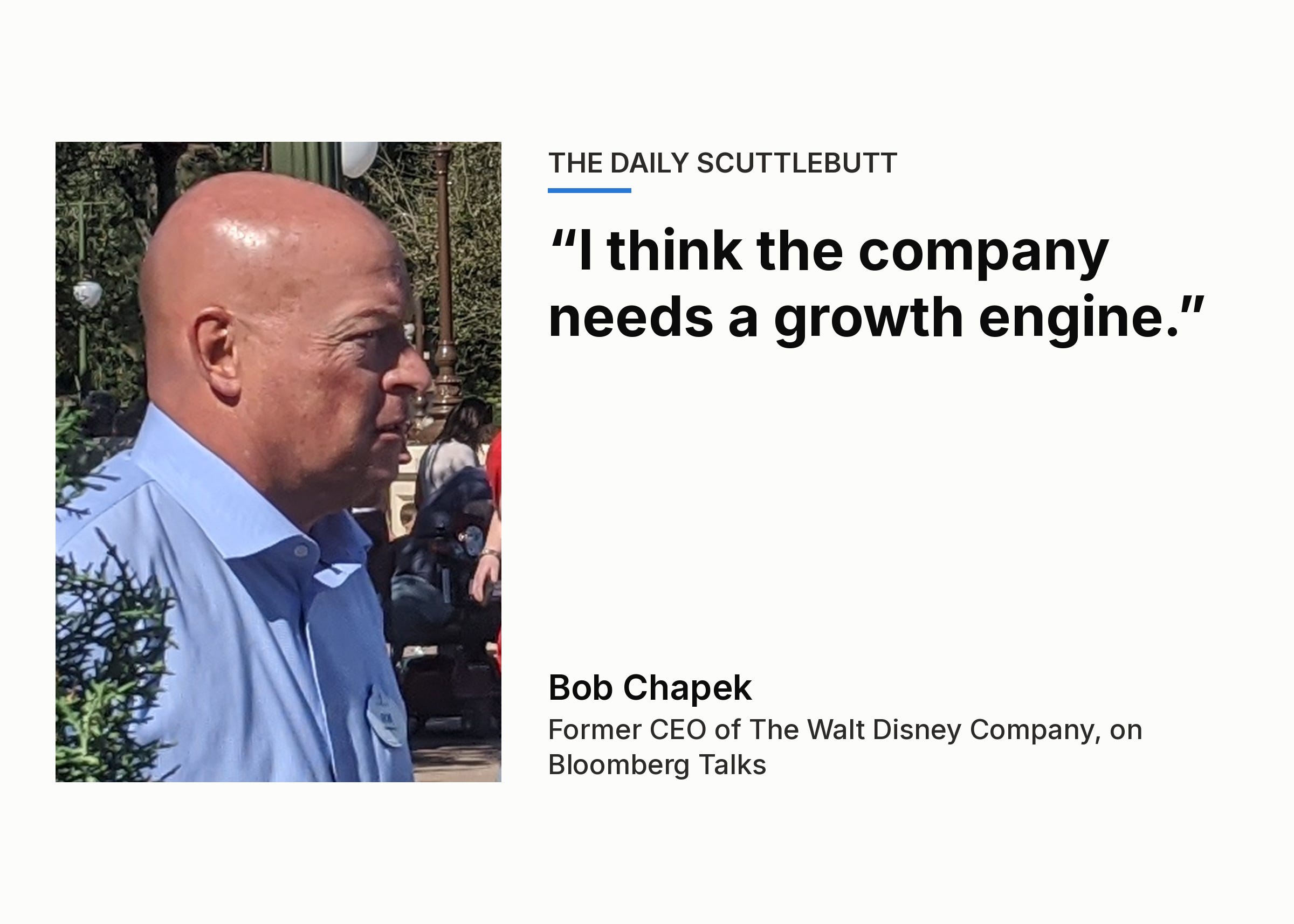
Disney's stock has stalled because the company lacks a growth engine
"But what I think the company needs personally, and again, I'm four years removed, but I think the company needs a growth engine. I think the reason the stock has really largely unchanged versus when I left is that it's missing a growth engine. Too many things are challenged. ESPN's challenged by the cost of content." — Bob Chapek, former CEO of The Walt Disney Company, on Bloomberg Talks
Political campaigns are about 10% of Stagwell's business
"We have a political division. It's active in campaigns. ... And so, the political cycle, you know, is about 10% of our business. It's an important 10%. We think we're entering a political super cycle." — Mark Penn, Chairman and CEO at Stagwell, on Power Players with Brian Sozzi
Other appearances:
Sony's former PlayStation Studios president on why Sony and Nintendo should keep the current consoles on sale as long as possible on The Vergecast
Technology & AI
Atlassian's CEO expects more knowledge workers in 5 to 10 years, not fewer
"They are still going to have a huge number of humans, I would argue more knowledge workers, more developers in five to 10 years time than today because the ability to do tasks to compete will go up. The bar for competition will go up in almost all these industries." — Mike Cannon-Brookes, Co-founder and CEO at Atlassian, on Decoder
Akamai says this year's deals will bring $2.2B a year of revenue once ramped
"But, really, you know, we've signed many deals so far this year with other leading enterprises, and collectively now 14,400,000,000 in long term commits we signed already this year. And when you look at the run rate when it's fully on board and ramped up, that'll be $2,200,000,000 a year of revenue, and very profitable revenue, accretive to our margins." — Tom Leighton, Co-founder and CEO at Akamai, on Bloomberg Podcasts
The risk of an AI bubble sits with venture capitalists, not the clouds
"It works like this. There's the cloud itself doesn't deploy the GPU cluster until they have the contract in hand from the customer. ... And so they go off and they raise money at massive valuations. ... So if you're looking for a bubble, it's held currently by the venture capitalists." — Evan Conrad, Co-founder and CEO at SF Compute, on TBPN
TypeSafe AI's founder thinks software-as-a-service companies will be among AI's biggest winners
"But like I think SaaS is providing the same value it used to. Maybe the markets are just scared. But I think that SaaS will be one of the largest winners of like the whole AI game." — Diogo Almeida, Founder at TypeSafe AI, on The a16z Show
Other appearances:
Gossip Goblin founder on making an AI feature film with a script, a dozen voice actors and a post-production crew on TBPN
Nvidia networking SVP on Nvidia's new chip for keeping AI agents contained inside the data center on SiliconANGLE theCUBE
VC & Startups
40% of Instinct's users hand it a credit card within 3 weeks
"What we find in the data is actually that it takes actually several weeks to build trust. ... And what we find is over several weeks I believe I was looking at the numbers the other day 3 weeks in, there's a 40% chance that the user has shared a personal credit card with Instinct. That's 40% of the user base." — Noah Shinn, Founder at Instinct, on Invest Like the Best
Other appearances:
Andreessen Horowitz general partner on how AI agents could change restaurant bookings and online retail on TBPN
Industrials and Transport
Graco's free cash flow doubled in 5 years, but its stock did not
"We do get I think like 23% net after tax operating profit margins after paying taxes. That's what we get. So, if you look at the free cash flow of the company over the last 5 years, it's actually doubled. Yet, the stock hasn't, and I think it's just a matter of time." — Mark Sheahan, CEO at Graco, on CNBC Television
Data centers are pulling skilled workers away from homebuilding
"But with 300,000 empty jobs in the trades today, plumbers, electricians, painters, HVAC technicians, we're really challenged with building the infrastructure, building the commercial bridges, roads, and homes in this country today. ... We're losing to commercial data center and we have to bring more people into this industry." — Ed Brady, President and CEO at Home Builders Institute, on Fox Business
Materials & Energy
Smead's oil holdings stay profitable at $60 a barrel, and one breaks even at $35
"We very possibly will never again see $55 to $60 oil, but the companies we own organize themselves so they could still be very profitable at $60 a barrel. But just think of how much free cash flow they're going to have the next 10 years at oil anywhere from say 70 to $120. ... and then we bought Diamondback Energy which is the lowcost provider. They're the Costco of the industry. They have the $35 break evens. Just imagine how much money they're making in a quarter when on a $35 break even, they're getting $90 for their oil." — Bill Smead, CIO at Smead Capital Management, on The David Lin Report
Other appearances:
Hilco Global advisor and former congressman on the Iran war, fuel prices and permitting reform on Bloomberg Businessweek
If this was worth your time, send it to someone who has to follow all of this too.
What did you think of today’s edition? Hit ‘reply’ to this email, send us a message, leave a comment, or join the chat!
Get the latest market chatter as it happens: