

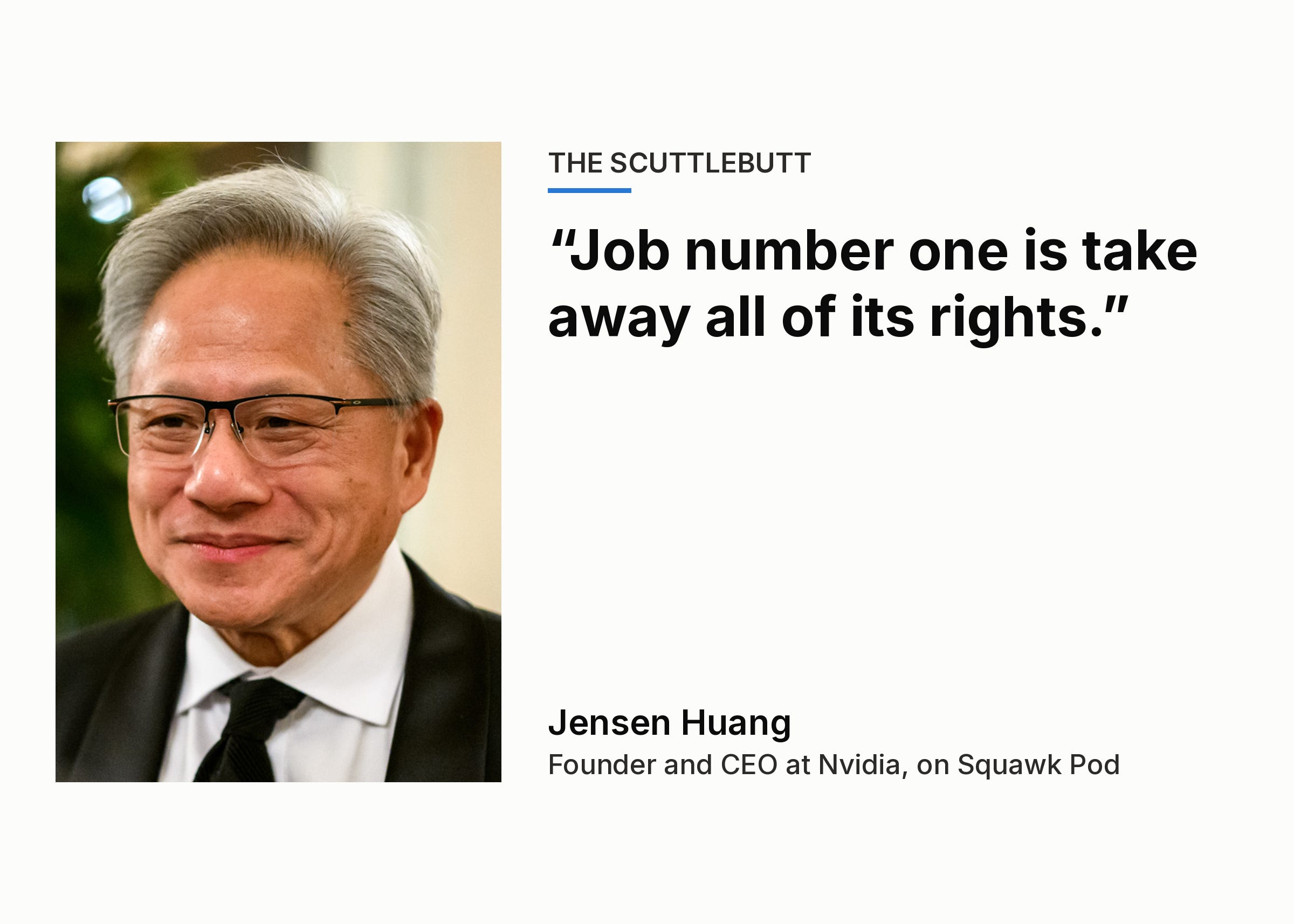
Photo: The White House, Public domain, via Wikimedia Commons
More than 10% of private credit now pays its interest by adding it to the loan, Jeffrey Gundlach said at DoubleLine's September client event, and he expects that share to reach 15% fairly quickly. Counting those loans, he put defaults at probably 22.5% a year from now.
That was one call from one event. Twenty-nine other speakers are quoted below, and one of them disagreed with him directly. Hamilton Lane's co-CEO said private credit defaults are running around 2%. J.P. Morgan Asset Management's bond chief said yields over 5% are a gift unless the Fed can raise rates six times in all. Nvidia's chief executive said the first thing to do with any AI agent is to take away all of its rights.
"And there's more than 10% of private credit that's in pick mode right now. And it's heading to 15 fairly quickly. ... You're 22 and a half% in defaults probably a year from now on this stuff. And it's not being marked that way." — Jeffrey Gundlach, CEO and CIO at DoubleLine Capital, on DoubleLine Capital
We scanned 552 shows and 16 hours of audio, wrote 45 summaries, and pulled 31 quotes into this 17-minute read.
Here is what mattered.
Macro
Bond yields over 5% are a gift unless the Fed hikes 6 times in all
"We've got plenty of buying yet to do. ... One of the things we've talked about is, can the Fed actually do a total of six rate hikes, go from three and five-eighths to five and an eighth, because if they can't, then bond yields of over 5% are pretty much a gift to you, which is where we think we are. We have already seen that the rise in yields, the 110, 130 basis points back up in yields, is starting to slow the economy. We know that businesses are struggling more to finance themselves in the public markets." — Bob Michele, CIO and Head of Global Fixed Income, Currency and Commodities at J.P. Morgan Asset Management, on Bloomberg Surveillance
Mortgage rates are headed for double digits, in Schiff's view
"This is not the top. We're going much higher. And so even if you think 5.2% isn't harmful, what about 6.2? What about 7.2, 8.2? ... Very few Americans can afford to buy if they have to pay an 8% mortgage. And 8% isn't where the mortgage is going to stop. We're going to go higher. It's going to be double digits." — Peter Schiff, Founder at Euro Pacific Asset Management, on WTFinance
20 stocks worth 45% of the S&P 500 are where the money will come from
"The deal is this has pushed us way into the same kind of circumstances that all other capex phases have pushed us which is there's not enough money to go around for everything that people want to do and it's going to have to come out of somewhere and historically the first place it comes out of is the common stock market ... Most of the money in the United States is in 20 companies that make up 45% of the S&P 500." — Bill Smead, CIO at Smead Capital Management, on The David Lin Report
The AI trade is hiding losses in rate-sensitive stocks
"We are already seeing a lot of pain in a lot of interest rate sensitive and consumer facing sectors. I mean, from August 11th to now, consumer discretionary down significantly. ... What's hiding it all is the resilience of the AI trade. And that's what you see the semiconductor sector, the technology sector continuing to do well. ... But underneath the hood, look at the equal weight index, S & P equal weight index down almost three and a half, 4% since that period." — Nimrit Kang, CIO at North Star Asset Management, on Bloomberg Surveillance
53% of S&P 500 stocks sit below their 50-day and 200-day averages
"This is a tale of two cities, Liz. You have the markets at the indices at near all-time highs, a few points below all-time highs, but it's really being held up by five or 10 stocks, these AI stocks that you're referencing. ... 53% of the S&P components are down below their 50-day moving average, below their 200 day moving average as well. So there's a lot of weakness underneath the surface. I liken this to holding a beach ball under the water. You could wake up one day and there's some talks with Iran. Oil prices come down like you referenced in the beginning of this block and all of these stocks, the 95% of the market that has not been participating will start to rip higher as inflation expectations come down, as rate hike expectations come down." — Thomas Hayes, Chairman at Great Hill Capital, on Fox Business
Jobless claims at their lowest since the 1960s point to a healthy economy
"So listen, unemployment's the lowest in quite some time, if not ever. You have jobless claims, the lowest since the 1960s. Nominal humming along at 7 to 8%. That's a pretty healthy economy that transcends just AI spend. ... Listen, I think we are closer to the top of the market and closer to the end of this cycle. But closer could mean three months, could mean six months, it could be 12 months from now. We're not entirely sure." — Michael Contopoulos, Head of Multi-Asset Macro Investing at Janus Henderson Investors, on CNBC Television
Other appearances:
Nomura International Wealth Management North Asia CIO on why 1 or 2 more Fed hikes may not tip the US into recession on Bloomberg Daybreak: Asia Edition
Harris Douglas Asset Management portfolio manager on price-sensitive buyers now setting the 10-year Treasury yield on BNN Bloomberg
International
AI could leave South African media with stories written and read by machines
"But the biggest threats to the local environment is that you get the hollowing out of companies. So as more and more content can get written by AI so you lose journalists. But the end result of that is that you get stuff written by AI, read by AI and there's no human interaction there at all." — Chris Borain, Executive Director at IAB South Africa, on BusinessDayTV
Westpac expects the RBA to hike to head off any sign of complacency
"Yeah, so we are expecting that the RBA will hike tomorrow. ... So we saw in that July print that inflation was not only high, but that inflationary pressures were broadening. ... We saw that the percentage of the CPI basket that's growing beyond the RBA's target band is much higher than it was previously. ... And if they aren't seen as taking inflation seriously, it might show complacency on their part. So this hike is really to ward off any comments or risks around complacency on policy." — Illiana Jain, International Economist at Westpac, on Bloomberg Daybreak: Asia Edition
Other appearances:
British International Investment CEO on reforms to South Africa's power grid, ports and rail on BusinessDayTV
Financials
The 60-40 portfolio is becoming 40-30-30, LPL's CEO says
"Yeah, I think what you see, and it's occurred over the last five years and it's continuing to drive, but is this change in the traditional 60-40 trend portfolio asset allocation into more of a 40-30-30. And so you see increasing exposure into alternatives. There's a lot of burst of product availability and more advisors are bringing that into the portfolio construction." — Rich Steinmeier, CEO at LPL Financial, on Bloomberg Surveillance
Model portfolios now drive 40% to 60% of ETF flows
"And so, ETFs are used extensively inside model portfolios and model portfolios are growing at something like over 20% a year, which is 4 times the rate of the asset management industry. And almost 40 to 60% of ETF flows are coming from model portfolios. So, if you think ETFs are a rocket ship, model portfolios are the jet fuel driving this rocket ship." — Ravi Goutam, Head of US and Canada Institutional iShares at BlackRock, on FTSE Russell Convenes
A bond ETF gives up the safety of holding a bond to maturity
"However, when you are in a rising rate environment, you have to remind, you know, clients that potentially aren't going to hold those bonds for the duration, the safety of a bond, as everyone knows, comes from holding it to maturity. ... And so there's an educational perspective that needs to be delivered of saying, OK, if you're buying these that are fungible on a daily basis at their net present value, then we're not holding these bonds to maturity. ... And in fact, we're not even holding individual bonds anymore. We're holding ETFs." — Rebecca Walser, Founder and CEO at Walser Wealth Management, on Bloomberg Businessweek
Alternatives and PE
A loan that pays its interest with more debt can be booked as a 10% gain
"Paying in kind is the most insidious thing you could possibly imagine. You've got a company, okay? Lend them $100 and it's 10% and they pay you once a year. Make life easy. All right? So, they don't have the $10 at the end of the first year. ... And this is now reported as a performing loan. This is a loan that is on its way to default because if they can't pay 10 percentages on a 100, something really good has to happen for them to be able to pay the 10% on the $110. ... What they do is they mark the value of the position up to 110. They report a 10% profit because a company has admitted that they're in bankruptcy threat. ... This is criminal. I mean that loan is worth best 60 cents on the dollar once it starts picking you on a good day." — Jeffrey Gundlach, CEO and CIO at DoubleLine Capital, on DoubleLine Capital
Hamilton Lane's co-CEO puts private credit defaults around 2%
"I think the honest answer right now is it's too early to tell. ... In fact, the data right now indicates that we're not seeing bankruptcies rising materially. Default rates are basically sitting around 2%. And so that sort of is showing you a pretty healthy book. Also, a lot of the managers, certainly those that are big private credit that are publicly traded, have been very vocal on earnings calls about quality of the portfolio. How much is sitting in cash pay? How much is actually flipped over to pick? Not that much." — Erik Hirsch, Co-CEO at Hamilton Lane, on The Compound and Friends
Consumer
A good ad campaign can outperform a bad one about 8 to 1
"And so there's so many decisions here, but you know what you really have to have, you have to have a good strategy. You have to have a really good creative, then you have to have a good data set, and then you have to have good implementation of it. And if you're on track, a good marketing campaign can outproduce a bad one, probably 8 to 1. Because you probably can go 2 to 1 on every one of those aspects." — Mark Penn, CEO at Stagwell, on Power Players with Brian Sozzi
Disney's stock has stalled because it lacks a growth engine
"And I think, you know, the parks has the opportunity, given the way it's being managed now, to, you know, have high, you know, single-digit returns, low double-digit returns, which on a big asset like that is pretty, you know, significant. But what I think the company needs personally, and again, I'm four years removed, but I think the company needs a growth engine. I think the reason the stock has really largely unchanged versus when I left is that it's missing a growth engine. Too many things are challenged. ESPN's challenged by the cost of content. ... Network television is challenged." — Bob Chapek, Former CEO at The Walt Disney Company, on Bloomberg Talks
Other appearances:
ARK Invest's chief futurist and its director of research on how AI could cut the cost of developing a drug on Milk Road AI
Former head of Sony's PlayStation studios on why Sony and Nintendo should stretch this console generation on The Vergecast
Technology & AI
The first step with any AI agent is to take away all of its rights
"Well, I think the answer is we hope it's an engineering problem. I believe it's an engineering problem. I know it's an engineering problem and we all need to hope that it's an engineering problem. ... But the way you think about that is when you deploy an agent, no matter how smart, the first thing you do is you take away all of its rights. Job number one is take away all of its rights. And then you provision, you give it access to files, data, tools, access to the network or even internet access only if it needs it." — Jensen Huang, Founder and CEO at Nvidia, on Squawk Pod
AMD is buying World Labs to understand AI from chips to models
"And if you think about where AI is today, I've said often, Ed, that we're still in the very early innings of AI, and I truly believe that. And what's becoming more and more clear is that the interaction between the hardware and the software and the systems and the model layer are such that the more you understand end-to-end the better system you're going to build. And so that's why we're acquiring World Labs, really, is to have access to the world-class talent that Fei-Fei has brought together and really bring it together with AMD's complete capabilities around hardware, software, and systems, and build the future of AI." — Lisa Su, Chair and CEO at AMD, on Bloomberg Talks
Akamai's deals this year will bring $2.2B a year once fully running
"So they will become a large customer. I can't think of really a better company to be a large customer. ... And when you look at the run rate when it's fully on board and ramped up, that'll be $2,200,000,000 a year of revenue, and very profitable revenue, accretive to our margins." — Tom Leighton, Co-Founder and CEO at Akamai, on Bloomberg Podcasts
More than 98% of Atlassian's AI-connector users still use its apps
"I say that headless is brainless. ... it is submission in slow motion if you're a software vendor to do such a thing. ... So I think it's 98% was our stat on the earnings call. more than 98% of people using our MCP server also use the user interface and that is not changing" — Mike Cannon-Brookes, Co-founder and CEO at Atlassian, on Decoder with Nilay Patel
90% of white-collar work does not need the most advanced AI
"The future is bright because there will always be a portion of the market that will pay a reasonable amount for high-quality and differentiated intelligence. That being said, for 90% of the white-collar work that we do, which is answering emails, filling out forms, writing emails, it doesn't require PhD-level intelligence, right? ... And in that world, the margin will not exist for 90% of intelligence and for basic tokens, it will exist for this frontier intelligence, which might only be a small sliver of the market." — Daegwon Chae, Partner at Bond Capital, on CNBC International Live
Nvidia at 16 to 17 times earnings faces an earnings bubble, not a valuation one
"Yeah, I think you also need to differentiate amounts of a few probably major companies, because if you're referring to the likes of SpaceX, OpenAI or Anthropic, I would definitely say that they are in a valuation bubble, right? ... Nvidia currently is trading at probably 16, 17 times earnings. I mean, it's the biggest company, $5 trillion. Then you can say that, okay, Nvidia is not exposed to valuation bubble, but it's exposed to earnings bubble." — Stephen Yiu, CIO at Blue Whale Growth Fund, on Merryn Talks Money
Other appearances:
Fidelity Investments assistant portfolio manager on AI bulls leaning too hard on the success of AI coding tools on FidelityConnects
LAUNCH founder on why Apple should buy whole companies instead of its own shares on This Week in Startups
Nvidia networking SVP on a new chip that secures the traffic inside an AI data center on SiliconANGLE theCUBE
Gecko Robotics CEO on keeping AI-driven industrial robots under human control on CNBC Television
TypeSafe AI CEO on why software companies stand to gain from AI rather than lose on The a16z Show
VC & Startups
Higgsfield went from $1M to $1B in annualized revenue in 18 months
"Actually it took us 18 months from 1 million to 1 billion. For cursor it took 24 months. ... But still when I look at the numbers which I have today, NRR at month 12 is over 300%. It just never happens in B2B SaaS." — Alex Mashrabov, Founder and CEO at Higgsfield, on 20VC
Instinct is approaching $1B a year in transactions while still invite-only
"Honestly, we're still running like an invite only program and it's it's quite early for us now, but we're approaching over a billion dollars a year in transaction volume through the platform ... So 40% of the user base 3 weeks in are sharing a credit card." — Noah Shinn, Founder at Instinct, on Invest Like the Best
Only OpenAI and Anthropic raised money in line with how defensible they are
"We mapped 550 companies in the seven power framework, and we mapped them by defensibility of their moat and by how much money they have raised. ... Only OpenAI and Anthropic are on that diagonal and they are at the very top of the diagonal. Raise the ton of money, really defensible. Then there's a cluster of companies that have raised a ton of money, but aren't defensible, because they rely on moats that no longer work in AI, like switching costs, or even cornered resources like a data moat." — SC Moatti, Managing Partner at Mighty Capital, on How I Invest with David Weisburd
Other appearances:
Plexo Capital managing partner on why the best new fund managers are far more technical than a decade ago on TBPN
Andreessen Horowitz general partner on what it costs to run a personal AI agent for one user on TBPN
SF Compute CEO on why venture capitalists hold the AI bubble risk on TBPN
Gossip Goblin founder on the human script, voice actors and crew behind an AI feature film on TBPN
Digital Niche Agency founder on how often an investor visits a deal page before investing on The Raising Capital Show
Industrials and Transport
Graco's free cash flow doubled in 5 years, and its stock did not
"We've been around for 100 years. We have the same playbook. ... We do get I think like 23% net after tax operating profit margins after paying taxes. That's what we get. So, if you look at the free cash flow of the company over the last 5 years, it's actually doubled. Yet, the stock hasn't, and I think it's just a matter of time." — Mark Sheahan, CEO at Graco, on CNBC Television
80% of major US defense programs once went to 5 companies
"One of our early problems was that our investors said Palmer, potential investors. They said, look, we believe that you'll be able to build things that work. We believe you'll be able to build products that are great, but we don't believe the government is capable of actually purchasing them at scale. ... So basically anything that matters, 80% of MDAPs went to five companies, and that's it. ... Anduril has been successful because we use, we're less of a contractor and more of a product company. We use our own money to build products, then we sell them." — Palmer Luckey, Founder at Anduril Industries, on Moonshots with Peter Diamandis
Data centers are pulling skilled workers away from homebuilding
"But with 300,000 empty jobs in the trades today, plumbers, electricians, painters, HVAC technicians, we're really challenged with building the infrastructure, building the commercial bridges, roads, and homes in this country today. ... We need consistency with pricing but we still are losing in the residential industry. We're losing to commercial data center and we have to bring more people into this industry." — Ed Brady, President and CEO at Home Builders Institute, on Fox Business
Geopolitics
No Iran deal is likely for several months, Hilco's geopolitical adviser says
"So I am hopeful that it's before the end of this year. ... But if you're asking my honest opinion, we're still several months away. ... And now it's baked into the balance sheets. ... As you know, electricity prices have raised 18% the last two years." — Patrick Murphy, Executive Director of Geopolitical Advisory at Hilco Global, on Bloomberg Businessweek
Nuggets of Wisdom
A crash is coming, so invest anyway
"So the key thing is I don't know what comes next. Is there a crash? Yeah, there's a crash coming. Of course there is. When? I don't know. How bad's it going to be? I don't know. ... What I do know is the long-term story is that compound wealth creation is phenomenally powerful. We all know the 30-year story, 10 grand or 130 grand over the last 30 years. By the way, during that period, you had the dot-com crash, the GFC, and the COVID crash." — Scott Phillips, CIO at The Motley Fool Australia, on Equity Mates
Other
Higher rates mean property developers now have to build better buildings
"So I think the commercial real estate industry is having a really tough time because for a long time we've been able to make money by financially engineering outcomes. And now the financial conditions are not super great for those financially engineered outcomes. You can't get a cap rate and an interest rate arbitrage and make money. ... So now you actually have to make the product good. ... That's they're like, Oh yeah, we'll totally approve that for you, but it's going to cost a million dollars." — Zach Lasry, Founder at The Western Company, on Odd Lots
If this was worth your time, send it to someone who has to follow all of this too.
What did you think of today’s edition? Hit ‘reply’ to this email, send us a message, leave a comment, or join the chat!
Get the latest market chatter as it happens: