

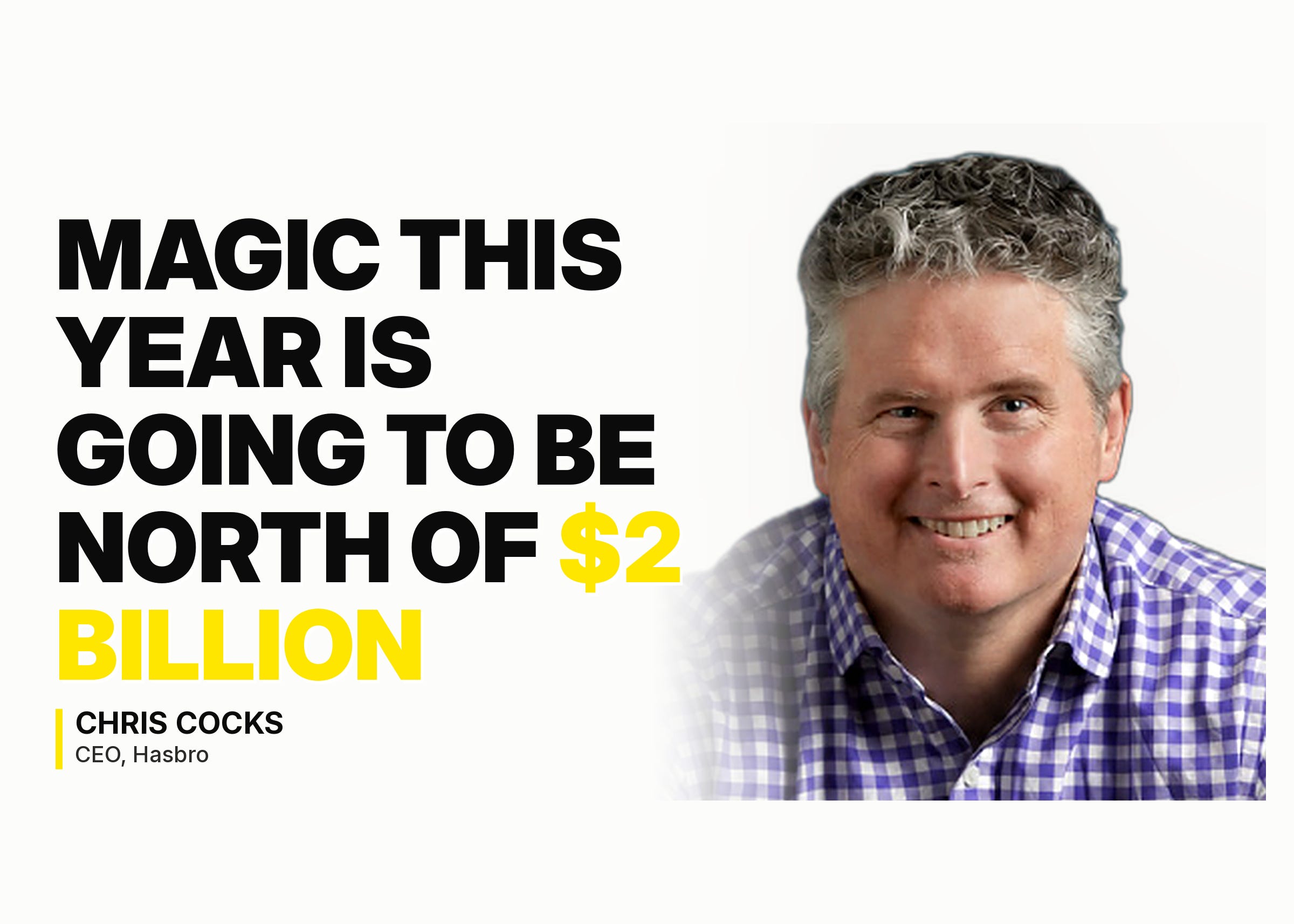
Chris Cocks, Hasbro's CEO, told Semafor he expects Magic: The Gathering to bring in more than $2B this year. He put it at probably $300M when he joined Hasbro in 2016.
Cocks was one of 28 people quoted in this issue. The others ranged from Brett Tejpaul, who said seven of the world's largest banks now use Coinbase's infrastructure, to Erik Bernhardsson, who said Modal's coding sandboxes grew almost 1,000 times into a $300M run-rate business, to Kevin Green, who said Midtown Atlanta drew $21B-$22B of investment in 25 years.
"Magic at that time was probably a $300 million business. I think Magic this year is going to be north of $2 billion." — Chris Cocks, CEO at Hasbro, on Semafor (Read summary)
We scanned 750 shows and 15 hours of audio, wrote 19 summaries, and pulled 57 quotes into this 18-minute read.
Here is what mattered.
Macro
Bessent calls rising energy prices a supply shock and cites the ECB's 2008 hike as a policy error
Scott Bessent spoke to CNBC's Brian Sullivan right after the Fed held rates steady. He said the Fed should keep an open mind about whether the energy shock is temporary.
"I think we are getting an energy supply shock here. And you might remember in 2008... one of the great fails, or policy errors, in central banking history was when the ECB hiked into a similar energy price shock." — Scott Bessent, US Treasury Secretary, on Closing Bell: Overtime
About $8T of US debt is refinanced every year, so interest costs follow short-term rates, Talkington says
"About 8 trillion of U.S. debt gets refinanced on a one-year basis. And so the interest that we pay on our debt is incredibly sensitive to short-term rates." — Bryn Talkington, Managing Partner at Requisite Capital Management, on Halftime Report
Financials
Robinhood now has 14 business lines generating $100M a year each, Tenev says
Vlad Tenev was asked whether prediction markets are taking revenue from crypto trading.
"I don't think there's a cannibalization effect. I think what you're seeing is our business is continuing to diversify. We have 14 business lines now that are generating $100 million in annual revenue." — Vlad Tenev, Co-Founder and CEO at Robinhood, on Squawk on the Street (Read summary)
The SpaceX IPO brought Robinhood a surge of new accounts and deposits
"The SpaceX IPO... was a retail watershed event. You look at our business around the time of the SpaceX IPO — really huge influx of new customer sign-ups, existing customers deposited more funds." — Vlad Tenev, Co-Founder and CEO at Robinhood, on Squawk on the Street (Read summary)
Citi's wealth unit took in a record $38B of net new investments in the quarter
"The business is rocking. We've had ten quarters of revenue growth... these were all-time record flows for us — over 38 billion of net investment flows in the quarter." — Andy Sieg, Head of Wealth at Citi, on Halftime Report (Read summary)
Crypto and Digital Assets
7 of the world's largest banks have signed on to Coinbase's infrastructure, Tejpaul says
Brett Tejpaul pointed to Coinbase's new partnership with Citi, which lets Citi's corporate clients swap cash into the USDC stablecoin and send it across borders.
"Seven of the largest banks in the world have now onboarded and are going to use Coinbase infrastructure." — Brett Tejpaul, Co-CEO at Coinbase Institutional, on The Wolf Of All Streets (Read summary)
Coinbase already moves tokenized JPMorgan deposits on Base, the blockchain Coinbase built
"People still don't believe me sometimes when I say we tokenize JPMorgan deposits and they actually travel on the Base protocol." — Brett Tejpaul, Co-CEO at Coinbase Institutional, on The Wolf Of All Streets (Read summary)
Bitcoin treasury companies faltered once the yield on their Bitcoin fell from 5% to as low as 1%
Tejpaul said he called the model unsustainable when the companies, which buy Bitcoin with money raised from shareholders, first launched.
"Precisely at that moment the market teaches you that hope's not a strategy... Bitcoin yield collapses from 5% to 3%, even 1%." — Brett Tejpaul, Co-CEO at Coinbase Institutional, on The Wolf Of All Streets (Read summary)
Issuers of tokenized stocks pay market makers to supply the shares, Alpaca's Sehgal says
In crypto, a market maker can borrow newly minted tokens at no cost. US securities rules ban the equivalent in stocks, so market makers have to fund that inventory themselves.
"Market makers have to deploy their own balance sheet to prefund the tokenized equities... and in actual fact, it's the tokenized equities issuers that have to pay the market makers to deploy their balance sheet." — Arush Sehgal, Head of Digital Assets at Alpaca, on The Rollup (Read summary)
US stock clearing nets trades down so only 2% of the money moves, which crypto cannot yet do
The NSCC is the clearing arm of the Depository Trust & Clearing Corporation, which settles US stock trades.
"The NSCC clears $4.6 quadrillion dollars of flow... but it's netted down 98%, so only 2% of actual capital moves through the system." — Arush Sehgal, Head of Digital Assets at Alpaca, on The Rollup (Read summary)
All of Orca's value flows to its token holders through a Cayman foundation with no owner, Truitt says
Luke Truitt runs Formation, the company created when the Solana exchange Orca merged with the lender Loopscale.
"Orca token holders are still the only value accruing asset in the entire stack. Orca doesn't have an equity business... all the value in the company is trickling up to an ownerless Cayman foundation." — Luke Truitt, CEO at Formation, on 0xResearch (Read summary)
Alternatives and PE
Demand for data centers will outrun new supply for the next few years, JLL's CEO says
Christian Ulbrich said access to power is still the biggest limit on how fast new data centers open.
"The demand for those data centers is so high that there is more demand than data centers can come to market over the foreseeable next couple of years. So nobody is pulling back." — Christian Ulbrich, CEO at JLL, on Squawk on the Street (Read summary)
Office demand is at a post-COVID peak and little new space is being built, Ulbrich says
"We have a new peak level, post-COVID, in office demand... there's very little new development coming to market, so that drives rents up for the best buildings." — Christian Ulbrich, CEO at JLL, on Squawk on the Street (Read summary)
Midtown Atlanta drew $21B-$22B of investment in 25 years, Midtown Alliance's CEO says
Kevin Green said Midtown was a place people were told to avoid when Atlanta hosted the 1996 Olympics.
"I don't know of a square mile anywhere in the country that's seen this volume of development... 21, 22 billion dollars of investment in 25 years." — Kevin Green, President and CEO at Midtown Alliance, on Sunbelt Developers (Read summary)
Midtown's improvement district paid about 15% of its infrastructure costs, and government paid 85%
Midtown's community improvement district is paid for by the area's commercial property owners.
"Our CID money has been about 15% of those dollars, and we've got in federal, state, and city money to pay the other 85%. So it's all about leverage too." — Kevin Green, President and CEO at Midtown Alliance, on Sunbelt Developers (Read summary)
CEOs want to meet X and Substack writers more than Wall Street analysts, iConnections' CEO says
Ron Biscardi's company arranges meetings between fund managers and the investors who back them. Its new event in Austin, TomorrowX, opens a Wall Street-style CEO conference to individual investors.
"There has been, to be honest, more interest in meeting X contributors and Substack analysts than there has been in meeting the mainstream Wall Street analysts." — Ron Biscardi, Co-Founder and CEO at iConnections, on Marketopolis (Read summary)
Consumer
Health costs would fall sharply if employers ran benefit contracts through AI before signing, Cuban says
Mark Cuban said the contracts employers sign with the largest health insurers and pharmacy-benefit managers (PBMs) hide costs that AI can find in seconds.
"If the employers representing 67%, the 160 million plus Americans, actually did one thing — ran their contracts through AI before they signed them — the entire system for the big BUAs and big PBMs would collapse. The cost of health care in this country would drop like a rock." — Mark Cuban, Co-Founder at Cost Plus Drugs, on a16z (Read summary)
UnitedHealth moves $150B a year among its more than 3,000 subsidiaries, Cuban says
"United Health, 3,000 plus subsidiaries, $150 billion in intercompany transfers annually. That would make them number 14 in GDP in the United States among states." — Mark Cuban, Co-Founder at Cost Plus Drugs, on a16z (Read summary)
Hasbro expects Magic: The Gathering to top $2B this year, up from about $300M
"Magic at that time was probably a $300 million business. I think Magic this year is going to be north of $2 billion." — Chris Cocks, CEO at Hasbro, on Semafor (Read summary)
65% of what Hasbro sells goes to buyers 13 and older, most of them adults
Chris Cocks said Magic, Dungeons & Dragons, board games and Marvel and Star Wars collectibles make up most of those sales.
"65% of anything we sell goes to consumers who are 13 years and older, and most of them are 18 years and older." — Chris Cocks, CEO at Hasbro, on Semafor (Read summary)
Trading-card games are probably now toys' biggest category, ahead of building blocks, Cocks says
"Trading card games back in 2016 were an interesting kind of niche category in toys and games. Today, I think they're bigger than building blocks, the biggest overall category in the industry." — Chris Cocks, CEO at Hasbro, on Semafor (Read summary)
Technology & AI
Modal's coding sandboxes grew almost 1,000 times into a $300M run-rate business
Erik Bernhardsson said Modal launched the product, which runs AI-written code in isolation, in 2023. It took off in 2025, when AI models got good at writing code.
"Sandboxes has grown almost a thousand-x or something like that... standalone, it's a $300 million run-rate business." — Erik Bernhardsson, Co-Founder and CEO at Modal, on Unsupervised Learning (Read summary)
Buyers of GPU capacity pay about 30% upfront and owe the rest every month, Bernhardsson says
"What happens today when you make a GPU commitment is you only have to pay about 30% upfront... in a year you're on the hook for another few hundred million, and every month you have to pay." — Erik Bernhardsson, Co-Founder and CEO at Modal, on Unsupervised Learning (Read summary)
2 founders say the smaller AI clouds are leasing businesses paying up to 20%; Bessent sees no risk
Neoclouds are the smaller companies that rent out GPU computing power in competition with Amazon, Microsoft and Google.
"I think the NeoClouds are fine business models, but people have been confusing it a little bit... these companies, at their core, are financing vehicles — they're doing leasing of hard assets." — Erik Bernhardsson, Co-Founder and CEO at Modal, on Unsupervised Learning (Read summary)
Truitt compared their borrowing costs with those of the largest cloud companies, which borrow close to SOFR, the benchmark overnight lending rate.
"Those NeoCloud guys are paying 14, 16, 20% for the same use of capital" — Luke Truitt, CEO at Formation, on 0xResearch (Read summary)
Bessent, on CNBC, said the smaller AI clouds are too small a part of the market to be a credit risk.
"I don't think it's problematic at all, because we're seeing that the neo clouds are a small component of the overall ecosystem... we're also seeing companies like Meta decide to finance with equity." — Scott Bessent, US Treasury Secretary, on Closing Bell: Overtime
Zeta's clients get back 6 to 7 times their marketing spend, Steinberg says, citing Forrester
"An independent Forrester survey has found that for every dollar a client spends through our platform, we return between 6 and 700% return on marketing spend. Our average competitors are ecstatic at 200%." — David Steinberg, Founder and CEO at Zeta Global, on RiskReversal Pod (Read summary)
Zeta's partners will pay to make and host its custom AI chip, Steinberg says
David Steinberg said Zeta gets exclusive use of the chips on demand without buying them.
"We have a manufacturing partner who's going to make them and they're going to pay for it. We then have a hosting partner who's going to buy them, and then we will exclusively get them on demand." — David Steinberg, Founder and CEO at Zeta Global, on RiskReversal Pod (Read summary)
Shopify built its business to stay on the same side as its merchants, Lütke says
Tobi Lütke said a marketplace that serves both buyers and sellers ends up favoring buyers, because their behavior is easier to measure.
"We fairly intentionally built the business in such a way that up and down the stack we are on the same side of the table as our customers." — Tobi Lütke, Co-Founder and CEO at Shopify, on Sources Podcast (Read summary)
An AI shopping agent paid to pick products would break the buyer's trust, Lütke says
"If it would turn out that your assistant is being paid to choose products for you... that's a breach of trust." — Tobi Lütke, Co-Founder and CEO at Shopify, on Sources Podcast (Read summary)
Gamma uses about 20 AI models and 200 calls to build one presentation
"We've probably used 20 different models, making maybe 200 different calls along the way, to deliver what looks to you like one finished output." — Jon Noronha, Co-Founder and Chief Product Officer at Gamma, on The Startup Ideas Podcast (Read summary)
Extra steps in Gamma's product raised the share of users who paid, Noronha says
Gamma tested a faster version of its product with fewer steps. It lost.
"Those speed bumps we had along the way led to much higher satisfaction ratings. Even though it was slower, people felt more invested in their output, and they converted to paying at a higher rate." — Jon Noronha, Co-Founder and Chief Product Officer at Gamma, on The Startup Ideas Podcast (Read summary)
Customers now buy proof that software will not fail, not the code itself, Choudhary says
Chai Choudhary's company, Workers IO, runs customers' software through simulated production conditions to find failures before their own customers do. He said AI agents now write and test most new code.
"Nobody's buying code. Like, people are buying that if I'm going to implement this database in my bank, it's going to handle all the workloads that we see and you're not going to lose data." — Chai Choudhary, Founder and CEO at Workers IO, on Solo Founders (Read summary)
Memory has grown from 5% of AI capital budgets to about 40%, T. Rowe Price's Rizzo says
"Memory's gone from 5% of the capex budget to roughly 40% of the capex budget, where CPUs, on the other hand, are probably going to go from 5% of the capex budget to 10%." — Dom Rizzo, Portfolio Manager at T. Rowe Price, on Squawk on the Street
Luria says Google now burns cash and raises money; Mahaney says it needs no more capital
"In Microsoft's case, they are still free cash flow positive, unlike Google, Amazon and Meta that are now free cash flow negative, going to the capital markets, raising equity and debt." — Gil Luria, Analyst at D.A. Davidson, on Squawk on the Street (Read summary)
Mark Mahaney of Evercore ISI said Alphabet has enough cash, and pointed to Meta instead.
"I don't think Google needs to raise capital from here... Meta, you can — and the market is correctly dinging them for being a little late to realize how much capital they needed to raise." — Mark Mahaney, Head of Internet Research at Evercore ISI, on Closing Bell: Overtime
Google's ad growth slowed for a second straight quarter while Meta's sped up, Mahaney says
"Advertising for Google across the board decelerated. Now it's the second quarter in a row that it's decelerated... that's a little bit surprising. You had the opposite from Meta, where the two-year stack actually accelerated." — Mark Mahaney, Head of Internet Research at Evercore ISI, on Closing Bell: Overtime
Apple's count of cracked iPhone Duo screens could run to tens of thousands, Gurman says
Mark Gurman reported that a bar in the hinge of Apple's folding iPhone can get stuck under the display and puncture it.
"Apple has come out and said a small number of people have had this issue. But for Apple, you know, a small number could be tens of thousands of units." — Mark Gurman, Chief Correspondent on Apple at Bloomberg News, on TBPN (Read summary)
Apple has earned more from casino-style games than from the Mac, Bloomberg reported
The money comes from Apple's cut of App Store spending.
"We did a story on Bloomberg Businessweek six months ago or so that said Apple makes more money from casino games, that type of game, than they make on the Mac." — Mark Gurman, Chief Correspondent on Apple at Bloomberg News, on TBPN (Read summary)
VC & Startups
Aseon spends about $30K per person a month on AI tools, its CEO says
Aseon Labs, a Y Combinator company, builds robotic pods that service robotaxi fleets.
"We spend about 30 grand per person per month on AI tooling... our founding engineer said we're doing the work of 20 people that would have taken a year and a half, compressed into six months with two people." — George Kalligeros, Co-Founder and CEO at Aseon Labs, on Semafor (Read summary)
Industrials and Transport
Fractional jets work because a company flies a plane 300 hours a year and it can fly 1,200
NetJets pioneered selling shares of private jets. Kenn Ricci built a rival, Flight Options, and now chairs Flexjet.
"Rich Santulli, brilliant, realized that the average company flies an airplane 300 hours a year. A plane wants to fly 1,200 hours a year, so why don't we get four people to share them?" — Kenn Ricci, Chairman at Flexjet, on David Senra (Read summary)
A Flexjet employee earning $80,000 can comp a $300,000 trip, Ricci says
Ricci said no one at Flexjet needs a supervisor's approval to fix a customer's problem.
"This is a person making $80,000 a year that can comp you a $300,000 trip. So that's how we think about customer service." — Kenn Ricci, Chairman at Flexjet, on David Senra (Read summary)
Robotaxis should be serviced 5 minutes at a time, 30 times a day, Aseon's CEO says
George Kalligeros said Aseon's pods charge, clean and inspect cars between rides instead of pulling them into a depot.
"Instead of having the car at the depot for an hour at a time, we in fact have designed a system where we have the car for five minutes, thirty times a day." — George Kalligeros, Co-Founder and CEO at Aseon Labs, on Semafor (Read summary)
93% of US homes still have no standby generator, Generac's CEO says
"Almost 7% of U.S. households now have this product category. But that said, 93% don't. And power outages are crippling." — Aaron Jagdfeld, CEO at Generac, on Squawk on the Street (Read summary)
Storms in the Midwest and Northeast made up for a second quiet hurricane season, Jagdfeld says
Generac's generator sales rise after storms that knock out power.
"This season didn't materialize in the Atlantic — actually last season didn't either. So it's kind of back-to-back years without a lot of activity there. But that was kind of offset by pretty active weather patterns in the Midwest and the Northeast." — Aaron Jagdfeld, CEO at Generac, on Squawk on the Street (Read summary)
How defense contracts are written could itself deter attackers, Stark's CEO says
Uwe Horstmann said contracts could guarantee extra production in a crisis, the way cloud contracts allow surges in computing.
"I'm really interested in solving the next big thing, which for me is kind of like the contractual design... there's a big deterrence possibility in the way we structure those contracts." — Uwe Horstmann, CEO at Stark, on Sequoia Capital (Read summary)
Soldiers asked Stark for wooden boxes instead of plastic ones, because wood burns for warmth
Stark says it designs for the soldiers who use its drones rather than the officials who buy them.
"We show up with this beautiful plastic box that is light to carry, and the soldiers look at it like, 'What do we do with this? Why don't you give us wood, because wood at least we can put in the fire and it keeps us warm in the winter.'" — Johannes Schaback, CTO at Stark, on Sequoia Capital (Read summary)
Policy
Zucman says Zuckerberg will stay and pay California's wealth tax; Rauh says billionaires left
Proposition 40, on California's November 3 ballot, would impose a one-time 5% tax on the state's roughly 250 billionaires.
"The company is not paying for him to stay. He would pay the wealth tax. He would pay more than 10 billion... he would keep his 60% voting rights in Meta, but he would pay the tax." — Gabriel Zucman, Professor at the Paris School of Economics, on Squawk Pod
Joshua Rauh of Stanford said many had already moved before the tax's cutoff date.
"Significant numbers of billionaires left before the end of 2025. And we've documented that." — Joshua Rauh, Professor of Finance at Stanford Graduate School of Business, on Squawk Pod
California's Medicaid spending has more than doubled since 2019, Rauh says
"Total funds for Medicaid for California are up more than double, 123%, since 2019... The idea that we need more revenue is just a flawed idea." — Joshua Rauh, Professor of Finance at Stanford Graduate School of Business, on Squawk Pod
California's billionaires hold wealth equal to 50% of the state's GDP, Zucman says
"The 500 wealthiest people in France... own wealth that's equivalent to 35% of the GDP of France. It's not very different than California, where the 250 billionaires' combined wealth is equivalent to 50% of the GDP of California." — Gabriel Zucman, Professor at the Paris School of Economics, on Squawk Pod
Geopolitics
Iran has no oil exports at sea, perhaps for the first time, Bessent says
"Probably for the first time since Iran started producing oil, they have no barrels of oil on the water — zero, zero." — Scott Bessent, US Treasury Secretary, on Closing Bell: Overtime
Iran's economy may shrink by as much as 25% in one year, Bessent says
He compared it with Russia's 22% contraction over the three years after the Soviet Union fell.
"The economy may contract by as much as 25%... for the three years after the Iron Curtain came down, the Russian economy contracted 22." — Scott Bessent, US Treasury Secretary, on Closing Bell: Overtime
The war in Ukraine shows the advantage lies in an innovation system, not drones, Horstmann says
"The real learning from the Ukraine-Russia war is probably not drones, no drones. It is about an innovation ecosystem. That is the actual wonder weapon." — Uwe Horstmann, CEO at Stark, on Sequoia Capital (Read summary)
Nuggets of Wisdom
Ricci bought his company back three months into the 2008 financial crisis
Raytheon had pushed Ricci out of Flight Options in 2002, then sold it back to him in December 2008. He guaranteed the purchase with his own home.
"Financial crisis happens in September. I buy it in December. So how dumb am I? I'm the dumbest guy in the world. I buy this company back in the nadir of the financial crisis." — Kenn Ricci, Chairman at Flexjet, on David Senra (Read summary)
Founders often decide as if conditions will never get better, Choudhary says
Chai Choudhary sold his first company, a regional-language media business in India, just before internet access there became cheap and made it far more valuable.
"One thing a lot of founders probably do, when they're making important decisions like fundraising or starting a business, is think of everything as, 'This is as good as it ever will be,' instead of being a little more optimistic about where things could go." — Chai Choudhary, Founder and CEO at Workers IO, on Solo Founders (Read summary)
If this was worth your time, send it to someone who has to follow all of this too.
What did you think of today’s edition? Hit ‘reply’ to this email, send us a message, leave a comment, or join the chat!
Get the latest market chatter as it happens: