

In Good Company with Nicolai Tangen · Oct 7, 2026 · 54m · 34m saved
With John Armitage, Co-Founder of Egerton Capital
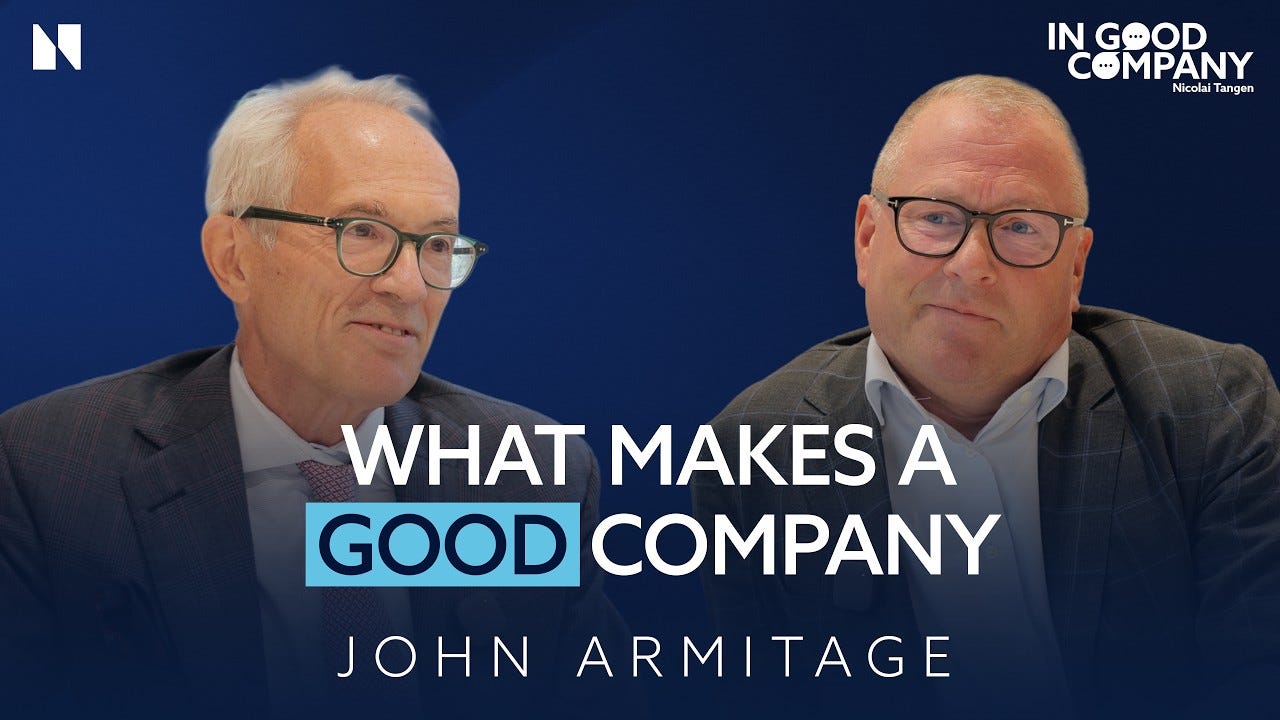
John Armitage started Egerton Capital in 1994 with the equivalent of 1.25 million euros raised on its first evening. Roughly 30 years later he still screens every idea by asking whether it is worth his time.
Most investors now lean on data scientists, channel checks and AI tools. Armitage said he has never wanted to own a company that depended on the latest channel check, and he worries about what AI does to the people who use it.
"If you use AI too much, your brain is going to rot." — John Armitage
John Armitage, co-founder of the London hedge fund firm Egerton Capital, on In Good Company with Nicolai Tangen. Before Egerton he ran a unit trust at Morgan Grenfell for six years that beat its index by 10% a year and ranked first of 85 funds. The host worked for him at Egerton for five years and said nobody taught him more about investing.
The full interview is covered here so you can skip it. 54 minutes of audio, 20 minutes of reading.
Here are the 19 lessons that matter.
Key Takeaways
A moat is worthless without the right management, and he named Boeing, Rolls-Royce and Intel as examples
Pricing power above cost inflation produces structural margin growth, he said
High incremental margins are what turn a small sales beat into a big profit beat
He hates EV/EBITDA valuations, because depreciation and amortization are real costs
Permanent capital is a trap, he said, because it removes the pressure to make hard decisions
AI carries two risks: everyone getting the same answer, and brains that stop working
He cut Altice and Fiserv after small disappointments he could not explain, and both later fell
Sitting in London left Egerton late in 2008, when he thought 7% a year US house-price growth sounded low
Egerton holds about 40 stocks and stays thematically diversified, against the fashion for concentration
KKR's chief executive told him the secret of success was to marry well
1. What Makes a Good Company
The host opened by asking what a good company is.
Moats matter, but management matters as much
Armitage said there is a difference between a good company and a good investment. Many people now talk about moats, the barriers that keep competitors out.
"But at the same time, if you have a moat without the right management, you get destroyed." — John Armitage
He cited Boeing under its previous chief executive, and Rolls-Royce before its current chief executive, who described the company as a burning platform even though it had a moat.
Capital allocation and culture decide what a company becomes
A company's value is its future cash flows, so how those cash flows are reinvested matters. Berkshire Hathaway began as a New England textile mill that was closed, he said, and became what it is through capital allocation and culture. Intel lost its way for a long period because it did not dare to innovate or enter new fields, and its large market shares eroded.
"So I think culture, capital allocation and moats are all very important." — John Armitage
