

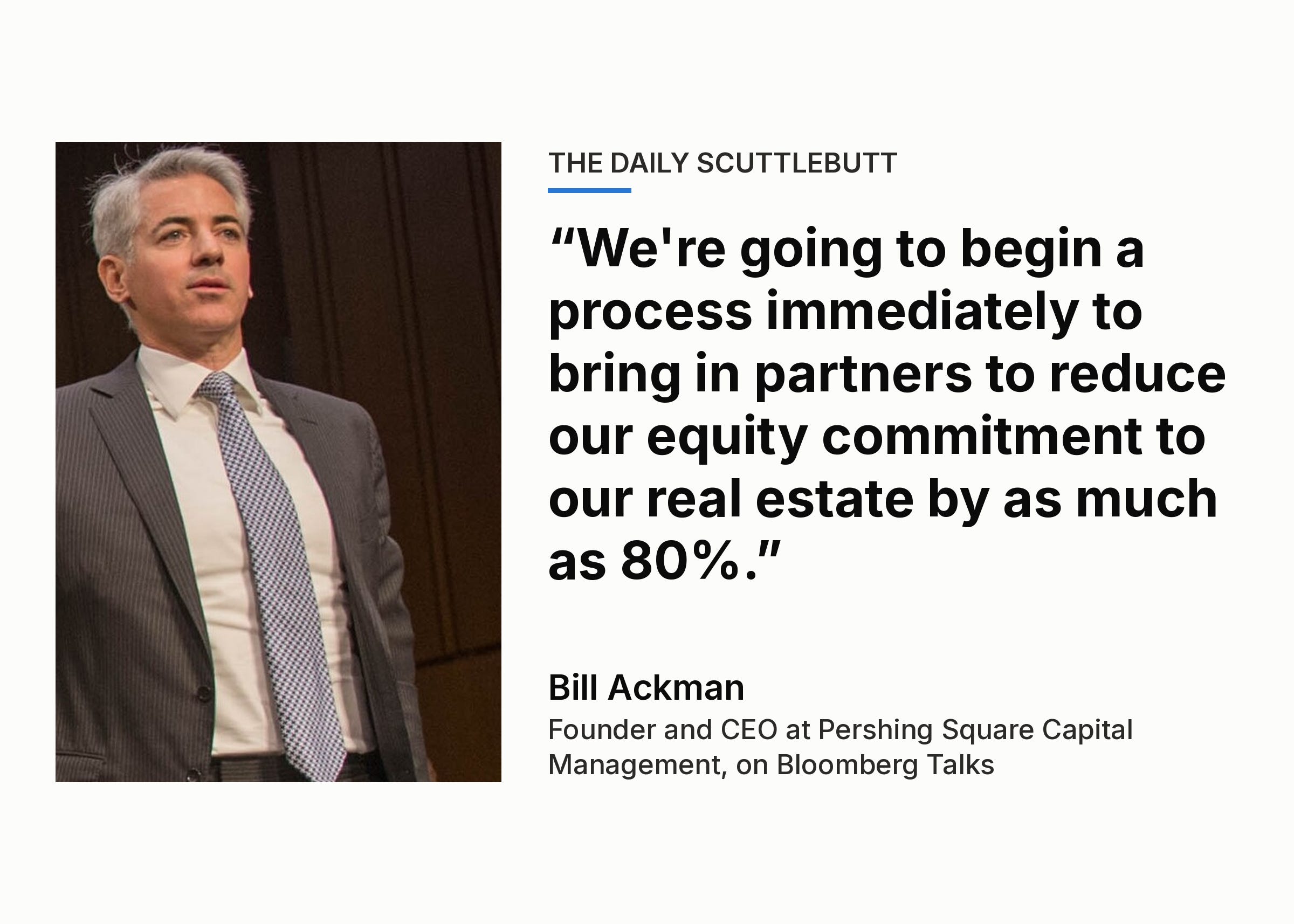
Photo: Senate Democrats, CC BY 2.0, via Wikimedia Commons
Howard Hughes will bring in outside investors to cut its own stake in its real estate by as much as 80%, Bill Ackman said on Bloomberg Talks. The company has financed that business entirely with its own equity for 15 years.
That was one plan at one company. The other 38 quotes below come from 33 speakers. John Hancock's co-chief investment strategist said bonds now pay about 6%, a 20-year high, and "no one wants them." CoreWeave's chief executive said graphics chips of a 2020 design are rented out through 2029. An SK Ventures managing partner said 2 customers account for about 25% of Anthropic's revenue.
"It's a business we financed entirely with our own equity for the last 15 years. ... Today we have 100% of the equity. We're going to begin a process immediately to bring in partners to reduce our equity commitment to our real estate by as much as 80%. And then turn Howard Hughes into more of a real estate asset management business with a lot of skin in the game, but one that can earn a much higher return." — Bill Ackman, Founder and CEO at Pershing Square Capital Management, on Bloomberg Talks
We scanned 484 shows and 16 hours of audio, wrote 37 summaries, and pulled 39 quotes into this 21-minute read.
Here is what mattered.
Macro
Bonds pay about 6%, a 20-year high, and investors are avoiding them
"And right now I think we've gone from about three hikes priced in to two — that's a nice little reduction for the markets. But I think it's a lot built in. And right now you can get about a six percent yield in the intermediate part of the curve. That's really attractive. We're at 20-year high yields and no one wants them. So there's a ton of value in the bond market." — Matthew Miskin, Co-Chief Investment Strategist at John Hancock Investment Management, on Bloomberg Surveillance
The main US bond index just had its worst 10-year real return since 1976
"So the Agg goes back to 1976. ... Investment grade since 1976 — this is one of the worst five-year returns ever. It's negative. It's never been negative before, until this part of the cycle. ... If you add inflation on top of it, this is the worst 10-year real return ever for the Agg right now since the inception back in 1976. And the reason was, even though inflation was higher and rates were rising even more rapidly in the 80s, yields were a lot higher. So, this was literally the perfect storm for a bad bond market — low starting yields, rapidly rising rates, high inflation." — Michael Batnick, Managing Partner at Ritholtz Wealth Management, on Animal Spirits
Stocks have returned 19% a year while rates rose from 0.5% to 5.2%
"Since Treasury yields bottomed in March of 2020 — they bottomed before the stock market did, I think the Treasury rate bottomed like March 9th or something, below 50 basis points — since that date, the S&P 500 is up 19% annualized since rates went from 0.5% to 5.2%." — Ben Carlson, Director of Institutional Asset Management at Ritholtz Wealth Management, on Animal Spirits
Oil and technical selling, not the economy, pushed rates above 5%
"I think the market wanted the Fed to be hiking, partially because oil prices spiked — and in the survey of clients we did yesterday, that seems to be the primary reason rates have backed up most recently, taking rates notably above 5%. It's a combination of technical factors and oil, so it's not really economic in nature, nor do Fed hikes really solve that — but the market wanted them to hike, and therefore they went ahead and did it." — Stephanie Roth, Chief Economist at Wolfe Research, on Bloomberg Surveillance
A 7.34% mortgage rate has frozen the housing market, Cramer says
"You want a 30-year the national average is 7.34%. Exactly 5 years ago it was 3%. That is outrageous. ... Maybe they bought a home 5 years ago with a 3% mortgage. Now they have a child with another one on the way. The typical starter home may be too small for that. Normally, they'd be searching for a larger home. But now that mortgage rates have surged, they literally can't afford to move. ... The nearly 7.5% mortgage has made housing the least affordable it's been in 40 years." — Jim Cramer, Host of Mad Money at CNBC, on Mad Money
International
China's car-chip market has narrowed to 3 suppliers, including Horizon Robotics
"And if you look at China, pretty much the three top players for the automotive computing, I think, really consolidated to Nvidia, Huawei, and Horizon Robotics. Not very crowded. ... So normally, if we initiate a new project, a new generation of product, it will take three to four years to get the product, the chip and the solution ready for car makers. ... So, in some sense, this is a terrible business — heavy investment, very slow return. But in my view, sometimes terrible business means a great business, because that's the entry barrier for all the other newcomers is extremely high." — Kai Yu, Founder and CEO at Horizon Robotics, on In Good Company with Nicolai Tangen
Europe's €2T autonomy plan is meant to fund companies, not governments
"We are talking about €2 trillion of investment, so it's quite huge. ... The aim is not to fund states. There is enough public funding available for states, and we wanted to focus on what is important for Europe, and to be sure that what is important for European investors is funded properly. ... Europeans are quite rich, and the capital in Europe is quite high – we have big pension funds, we have a lot of money retained in the banks. We have asset managers in Europe that can help compensating the indebtedness of states" — Fadi Berbari, Senior Fixed Income Portfolio Manager at BNP Paribas Asset Management, on Talking Heads
3 chipmakers make up about 28% of the emerging-markets index
"There are two markets that worry me a bit passively right now. The first, and the glaring one, is emerging markets — Taiwan Semiconductor, Samsung and SK Hynix are the three largest companies in the index and represent about 28% of it. Those are all AI-related trades, and those are some of the names where we're seeing these significant single-day moves, like what happened in the South Korean market, given the levered exposure in the direct market. ... That 28% as of this morning peaked at around 35% — we've seen three names come down 7% in about a month in the emerging markets." — Andrew Clee, Vice President of Product and Managed Accounts at Fidelity Investments Canada, on FidelityConnects
Financials
150,000 Robinhood customers have connected outside AI agents to trade
"Agentic trading is a little bit different than what you're talking about, which is almost like a one time, hey, move my money over to where it earns higher interest. You don't need super intelligence for that. ... That was a very popular product. It has over 150,000 users who have actually connected external agents to it. ... And so Robinhood Agents brings that within Robinhood with all the benefits like trade approvals, separate account, brings it into the Robinhood experience where we have over 28,000,000 accounts." — Vlad Tenev, Co-founder and CEO at Robinhood, on TBPN
Visa and Mastercard take only 15 to 16 basis points of a card purchase, Imprint's CEO says
"So the rails take 15 or 16 basis points. ... then the name on the card, Imprint, Chase, whomever, we get interchange of about a buck 80, 2%. ... And then we give almost all of that back to the brands to give the consumer better rewards. ... Everybody hates paying Visa and Mastercard. ... This is actually the first time I think interchange is in danger. ... And it's 2% of American commerce that goes across these rails." — Daragh Murphy, Co-founder and CEO at Imprint, on TBPN
Public lists no sports contracts, only events that can move a portfolio
"We focus on events that move the markets — things that have an impact on people's portfolios. We don't do sports, we don't do general entertainment — you're not going to find who's going to win Dancing with the Stars — you're going to find only events that have a real impact, or could have an impact, on your portfolio. ... If the probability of another rate hike goes to 70%, sell my Treasuries, for example — making those connections is what we find super interesting. It becomes another data point agents can act on." — Leif Abraham, Co-Founder and Co-CEO at Public.com, on Prediction Market Movers
Crypto and Digital Assets
Bitcoin's 3-year correlation with stocks is about 20%, and about zero with bonds
"What we've seen over the last month or so is, with the US announcing more bond repurchases and financial looseness coming back into the market, it's actually acting as a decent hedge. When you see days where bonds are negative, or the yield curve's up, and equities are down, we've seen Bitcoin rally. That's short-term — I'm not saying it's the longer term, but I do go back to the longer-term correlations, which is the M2 money supply. ... Even when you look at the one- and three-year correlations, we are seeing diversification benefits. Over three years, you're probably seeing 20% correlation to equity markets, about zero correlation to the bond markets. Over one year, it's more like 30%." — Andrew Clee, Vice President of Product and Managed Accounts at Fidelity Investments Canada, on FidelityConnects
Alternatives and PE
Pershing Square's new listed fund bought S&P Global at 21 times earnings
"So I think NAV is down about 3% from the IPO. About 240 basis points of that is actually the cost of the IPO. ... But we own a portfolio of some of the best stocks. ... businesses like an S&P Global that you couldn't touch at something less than 30 times earnings, they were able to buy at 21 times earnings. A business like the Intercontinental Exchange, an amazing business with an incredible track record, you couldn't own it 24 times earnings today, you buy it at 17 times." — Bill Ackman, Founder and CEO at Pershing Square Capital Management, on Bloomberg Talks
Other appearances:
Builders Vision Head of Strategic Relationships & Active Ownership on why meeting counts tell an asset owner little about a fund manager on The Future of Finance Podcast
Consumer
Shake Shack went back to frozen fries after a year of cutting fresh potatoes
"And I learned a really important lesson. Well, first of all, we retrofitted 35 shacks so that we could cut fresh potatoes. We stuck with this thing for at least a year despite the fact that all of the public was clamoring to get the crinkle cuts back. And we learned two important lessons. Number one is while fresh generally is better than frozen when it comes to potatoes. It's not. It's just not. ... And we should have been listening to our guests much more loudly than to one voice who wrote in the New York Times." — Danny Meyer, Founder and Executive Chairman at Union Square Hospitality Group, on Mad Money
Doctors using OpenEvidence will treat 300M Americans this year
"There are 1 million physicians in the United States. Yesterday, we powered 1.5 million medical license verified queries on OpenEvidence just in the United States. So, this year, there are going to be 300 million Americans who were treated by a physician who used OpenEvidence to make the treatment decision. It's nation-scale use already. It's become the default operating system of medical knowledge in the United States." — Daniel Nadler, Co-Founder and CEO at OpenEvidence, on Talks at GS
Donor lungs now travel nearly 80% farther, which favors a national air network
"The plan is to move to what's called continuous distribution, a national allocation methodology that focuses primarily on the sickness of the patient and just gives points for geographic proximity. When we saw lungs move from acuity circles to continuous distribution, we saw a nearly 80% increase in the distance between donors and recipients. That makes the logistics much more challenging. But that's also an area where Strata is uniquely positioned to help because of that network that we showed you of airplanes all across the country. We're much better situated than small regional incumbents to be able to provide that cross-country transportation service." — Will Heyburn, Co-CEO and CFO at Strata Critical Medical, on MicroCapClub
A tip prompt on card machines raised pooled staff tips about 10% at Camino
"But also, we're actually able to pay our staff more now, because we never had the tipping option on PDQs. That's probably one of the most undersold things in hospitality — that tipping option. There'll be people who moan about it, but that added about 10% to the tronc pots for every one of our sites." — Tyrone Delaney, Finance Director at Camino, on Tech on Toast
A Fidelity manager bet against Sweetgreen's plan for 1,000 stores, and the stock fell 80%
"And that's what Sweet Green is — a restaurant chain that sells salad bowls. When we shorted them, they had about 200 locations. They were very confident they were on their way to a thousand locations, and the investors were also very confident, pricing a lot of that destination without necessarily looking at the journey that's required to get there. And that happens a lot in the US — when there's a good story, investors like to price the destination. ... And I go to our cafeteria at work — when they sell burgers, the day they sell burgers there's about 50 people in line for everyone who's at the salad bar. So maybe the answer was simply that people don't love salad that much. But whatever the reason behind it, the numbers didn't support management's plan. ... They started missing numbers, the growth got priced out, and the stock got cut by 80%" — Nic Bellemare, Portfolio Manager at Fidelity Investments Canada, on FidelityConnects
Sports
The UFC pays fighters about 15% of revenue, against 50% in other leagues
"So, first and foremost is they don't put fighters first. So, they pay their fighters roughly 15% of their total revenue, which in other professional sports leagues it's 50% ... They're not willing to pay for the big fights, and people don't want to risk it." — Jake Paul, Founder at Most Valuable Promotions, on All-In
Other appearances:
Inside Prediction Markets Hosts on Novig trading $100M in a single NFL Sunday on Inside Prediction Markets
Technology & AI
Switching AI models cut SAP's costs 10-fold, more than token limits did
"But for developers, product managers, designers, people in finance and HR, we did introduce limits, because we can't have people experimenting with tokens when we're not seeing the productivity outcome. ... What was even more important than the token limits is model switching — when you switch from one model to another, that can cut your cost by a factor of 10, which is even more effective than the token limits." — Christian Klein, CEO at SAP, on Big Technology Podcast
HPE's orders for traditional servers rose 70% as AI inference spread
"In fact, the demand has been so strong. Our orders in the last earnings were up 70% on a year-on-year basis. And what we're starting to see, which I'm super excited about, is the move into inferencing. And it's really starting to be a tailwind for our traditional server business. In fact, I spoke about a very large deal that was about $3.5 billion, where that enterprise customer was really focused on using traditional compute for inference. ... So, clearly inference is going to become an increasingly important tailwind in our traditional compute business." — Marie Myers, CFO at Hewlett Packard Enterprise, on Bloomberg Talks
CoreWeave has rented out its 2020-era A100 chips through 2029
"And what we have seen repeatedly over the years is that every time a GPU is no longer capable of driving the frontier for it, it has a slew of other uses that will absorb it. And I talked about this in my last earnings report, the A100s. ... That's 2020 architecture. ... Getting that contracted out through 2029." — Mike Intrator, Co-founder and CEO at CoreWeave, on TBPN
69% of S&P 500 companies have AI in use, but only 2% track its results over time
"One is if you think about live deployments at S&P 500 companies, that's at 69%. ... But then if you move toward quantifiable impact, which is probably a good metric of how far along they are in their deployment, that's 30%. Now if you go to the ultimate barometer, which is a metric tracked over time, that's actually only at 2%. So we believe that AI is delivering results but there is a huge amount of room to actually deepen its use inside the organization and track those results over time." — Sarah Wang, General Partner at Andreessen Horowitz, on The a16z Show
Big Tech's data-center spending is now revenue for chip, power and construction suppliers
"And as we talk about this capex for the hyperscalers we should think of it as someone else's order books. So these big platforms with historically the largest profits are pouring their cash back into AI infrastructure. That's putting pressure on their free cash flow shortterm as we just talked about. But it's been a boon for chip orders, for power, for construction and that's why this broader technology boom has become an industrial boom" — Santiago Rodriguez, Partner at Andreessen Horowitz, on The a16z Show
Kedrosky says 2 customers make up about 25% of Anthropic's revenue
"You expect a small company to have really high levels of customer concentration, meaning that a small number of customers is a material fraction of revenues. But to see a company at this size where two customers are on the order of 25% of revenues, and there's been some other leaks, or whatever you want to call it, that's something like six customers or 60% of revenues — these are absolutely, to use the technical term, bananas numbers. And why they matter is because it shows how unusual their earliest customers are." — Paul Kedrosky, Managing Partner at SK Ventures, on Prof G Markets
Model-training costs are an ordinary operating expense for AI labs, not one to exclude
"It's this old joke — we used to call it, when I was in my analyst days, earnings before bad things. If you let me get away with characterizing my earnings before bad things, my earnings look really good. So, you have to decide: are these bad things, and they're not so bad because they're fundamental to the business? Are they things that they should be allowed to characterize as something other than operating costs — something you capitalize, for example, like you might with R&D — or are they actually just the day-to-day parts of running the business? I would argue the latter. The training costs are just the day-to-day running of the business — whenever you're training new models every six to 18 months, that's not something that you're capitalizing out four or five years like a building." — Paul Kedrosky, Managing Partner at SK Ventures, on Prof G Markets
Other appearances:
TBPN Hosts on what AI company chiefs signed in the White House safety accord on TBPN
Nvidia Senior Director of AI Software on why AI agents lack the security layer that encrypted connections gave the web on TBPN
VC & Startups
Airbnb once offered 10% of itself for $150,000, and most investors never replied
"Now at the time Jason we were trying to raise $150,000 at a $1.5 million post money valuation. So, for $150,000, you could have owned 10% of Airbnb. And the majority of them didn't even reply to the email." — Brian Chesky, Co-founder and CEO at Airbnb, on This Week in Startups
EliseAI passed $200M in annual recurring revenue and raised $350M
"We did. We raised 350,000,000. ... We passed 200,000,000 ARR earlier this year. It's really coming from serving more customers in the housing industry and the health care industry. So we've developed a lot of new products for our customers and we just keep building as quickly as possible because there's a lot of problems in the industries we serve." — Minna Song, Co-founder and CEO at EliseAI, on TBPN
96% of Flow Engineering's customers find it on their own
"We raised 50,000,000 on a $750,000,000 valuation. ... Today, 96% of our customers come to us inbound. ... And they're able to get up and running within thirty days. ... The legacy players are looking for a nine to twelve month period, us about thirty days. And AI is absolutely driving that adoption in itself." — Pari Singh, Founder and CEO at Flow Engineering, on TBPN
A beauty brand found 10% of its buyers were doctors and nurses
"For example, one massive beauty brand found out that 10% of their customers were very distinctly nurses and doctors and practitioners of medicine. ... And they weren't speaking to them at all. ... It turns out that they were buying one very specific SKU in their set dramatically more than the rest of the customers." — Noah Friedman, Co-founder at OuterSignal, on TBPN
Selling half of one stake returned about 35% of 645 Ventures' first fund
"Chips off the table. And that can actually have a huge impact on your returns. Like, huge. In our first fund, for example, we sold a position that we were debating about selling — won't name the company, but long story short, we returned about 35% of our first fund selling half of our position in this company, which is a good company. Right? But it was valued way in excess of what it should have been valued at based on our performance. Right? The company ended up getting acquired by a good company, but at a fraction of the price we sold at." — Nnamdi Okike, Co-Founder and Managing Partner at 645 Ventures, on How I Invest with David Weisburd
Most companies that pause an IPO never go public
"Well, historically the majority of companies that have paused their IPOs have never gone public. Some, like Soul Cycle, get acquired — sometimes at a good price, sometimes at more of a fire sale price or conservative valuation. ... You know, what's difficult for companies is to execute the business model. Stuff happens. A company can be firing on all cylinders, but competition comes along, or the demand evaporates, sometimes for things outside of its control" — Jay Ritter, Director of The IPO Initiative at the University of Florida, on Prof G Markets
Other appearances:
Mantis VC General Partners on paying off the mortgage before investing in venture funds on All-In
Industrials and Transport
A neglected German gas-turbine maker rose 10-fold on AI power demand
"I can give you the example of a German gas turbine company we bought a few years ago. ... It was a very cheap stock relative to the revenue they generate, and there were good reasons for it. The gas turbine cycle was depressed. There was a real secular question about whether it would be replaced by renewables. The margins had been crushed by the cost inflation and some questions on the balance sheet. ... And that's where I was looking a lot at the early developments in AI and realizing this whole capital cycle is very power hungry, right? Simple fact: back then a request on ChatGPT would take 10 to 15 times the power of a search on Google. So it was still small back then, but there was a chance that after 20 years of stagnant power demand in the US, you could finally see some growth, and that neglected industrial could turn into an exciting story. And that's kind of what happened, right? So this stock, during the time we owned it, didn't double or triple, it went up 10-fold. And that was more than any of the Mag 7 stocks, the more obvious AI plays during that period." — Nic Bellemare, Portfolio Manager at Fidelity Investments Canada, on FidelityConnects
Materials & Energy
A US ban on diesel exports could cause shortages at home and raise gasoline prices
"One of the issues with the ban is that you might end up creating shortages in parts of the U.S. that are importing diesel. So if you were to do this ban, you would need to do it in conjunction with ample shipping capacity within the U.S. — and shipping is complicated, we have record shipping costs right now. ... Number two, you have to be careful about the impact on gasoline markets, because you could trigger a reduction in crude runs in the U.S., which right now are the highest in the world, I may add. The U.S. has been making a lot of money exporting energy, and it's had a massive increase in market share across all major thermal fuel products. But under a ban, you have less incentive to run those refineries — you'd likely see some of them go into maintenance, and that might also push up the price of gasoline." — Francisco Blanch, Head of Global Commodities and Derivatives Research at Bank of America, on Bloomberg Surveillance
Geopolitics
The Hormuz blockade works, but it costs $20-plus a barrel in shipping
"Well, the numbers clearly show the blockade is working. The question is whether it can continue to work. And the other point you made — not only do you have to face shipping costs of $20-plus a barrel, we're also looking at two aircraft carrier groups from the U.S. having to maintain the system here, which, frankly, is also a very expensive process. And I think the question is whether a different arrangement might just be a lot more convenient. If we were spending $40 a barrel to try to get oil moving through the Strait of Hormuz, could we find consensus around some other arrangement that brings those costs down dramatically — maybe not to zero, like it was before, but to just a few dollars." — Francisco Blanch, Head of Global Commodities and Derivatives Research at Bank of America, on Bloomberg Surveillance
Nuggets of Wisdom
Switching funds after good or bad returns is investors' biggest cost, Welton says
"Somebody once asked me what's the biggest input to compounding, and I said, well, it's actually how much your hand shakes. Steady handedness compounds well. The return gap, the negative investor alpha that occurs from people switching on performance, is usually the biggest cost that they face in putting their portfolios together." — Patrick Welton, Founder and CIO at Welton Investment Partners, on Top Traders Unplugged
Other
Colossal expects to birth a mammal fully outside the womb within 24 months
"I think within 24 months, Colossal will birth animal mammals fully ex utero ... Hopefully sooner, but 24 months is highly likely." — Ben Lamm, Co-Founder and CEO at Colossal Biosciences, on Moonshots with Peter Diamandis
Griffin expects a Carnegie Mellon campus to bring Miami hundreds of tech companies
"I'd like to think that I have decades ahead of me to explore that question more fully, but this gift, the magnitude of this gift, represents the magnitude of the aspiration. I truly believe that just as Carnegie Mellon University is transforming Pittsburgh, a renaissance for the 21st century, that CMU Miami will transform Miami, bringing to Miami hundreds of technology companies, startups, career opportunities and futures that impact both the people of Miami and the greater prosperity of our nation." — Ken Griffin, Founder and CEO at Citadel, on Bloomberg Talks
If this was worth your time, send it to someone who has to follow all of this too.
What did you think of today’s edition? Hit ‘reply’ to this email, send us a message, leave a comment, or join the chat!
Get the latest market chatter as it happens: