

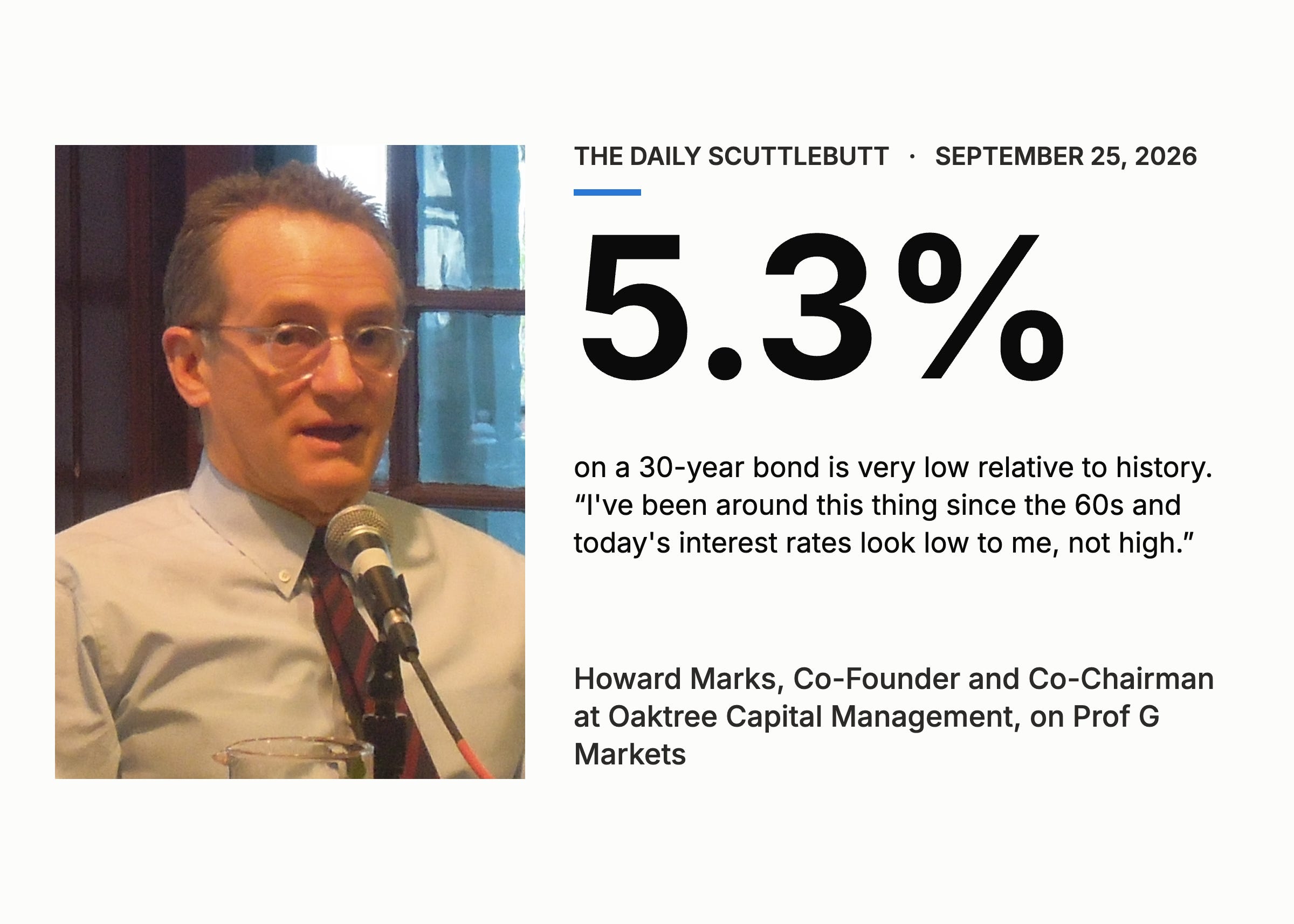
Photo: kellywritershouse, CC BY 2.0, via Wikimedia Commons
Howard Marks, co-founder and co-chairman of Oaktree Capital Management, said a 30-year Treasury bond yielding 5.3% or 5.4% is very low relative to history. The fed funds rate sat at zero most of the time from 2009 to the end of 2021, he told Prof G Markets, and he called that stretch the aberration.
That was one interview. The night produced 49 other summaries, and many of them carried a claim worth weighing. Citi Wealth's chief investment officer said real yields, not inflation, drove almost all of the 10-year yield's rise since February. A Columbia Threadneedle bond manager expects consecutive Fed hikes through December. A Magnetar portfolio manager said stressed debt grew to about $600 billion in a year while the pool of buyers shrank.
"We actually have been underweight fixed income in general and the ... fixed income we own has been shorter duration and that's done very well for us. ... I've taken some of the money that would otherwise be in long duration bonds and actually allocated that to gold and gold has outperformed significantly fixed income." — Kate Moore, CIO at Citi Wealth, on CNBC Television
We scanned 526 shows and 21 hours of audio, wrote 50 summaries, and pulled 53 quotes into this 24-minute read.
Here is what mattered.
Macro
A 5.3% 30-year bond is very low relative to history
"It's very important ... that everybody recognize that today's interest rates are not high. ... a 5.3 or 4% ... 30-year bond is very low relative to history. ... it's only high relative to recent history. And I argue strenuously that the recent history of interest rates is the aberration. ... That Fed funds rate was zero most of the time from the beginning of '09 to the end of 21. ... I've been around this thing since the 60s and today's interest rates look low to me, not high." — Howard Marks, Co-Founder and Co-Chairman at Oaktree Capital Management, on Prof G Markets
A failed Treasury auction is unlikely, and rates probably will not fall much
"I said in the memo that acute results like a failed auction or something like that are unlikely and so I think your scenario of continuous rising rates is probably the more likely one ... I think the most important thing is that people have been counting on declining interest rates for a long time and people look at declining interest rates as a real booster for the markets and I think ... the thing we can say with more confidence than almost anything else but I don't believe in confidence in opinions is that interest rates probably will not be going down much if at all ... in the coming year or two let's say" — Howard Marks, Co-Founder and Co-Chairman at Oaktree Capital Management, on Prof G Markets
Real yields, not inflation, drove 110bps of the 10-year's 119bps rise
"I think the most important thing ... is that the majority of the move in the bond market has been about real yields right this is not necessarily pricing in higher inflation which we actually believe is a situation we have that bears monitoring but you know since the lows on February 27th 10-year yield almost has been exclusively 109 I think ... or 110 of the 119 basis point rise has come from higher real yields higher structural growth and I think also an acknowledgement, you know, of what's happening on the fiscal deficit side." — Kate Moore, CIO at Citi Wealth, on CNBC Television
The Fed, not the deficit, drove most of this year's bond repricing
"I would say my read of the repricing so far this year is the large vast majority has been driven by the Fed. There's been very little term premium. There's been very little in terms of the fiscal story that has changed. Now, the fiscal story isn't great, but it hasn't changed this year. Expected deficits are right in that 6% area." — Ed Al-Hussainy, Fixed Income Portfolio Manager at Columbia Threadneedle Investments, on Bloomberg Surveillance
3 to 4 rate hikes are the floor, with consecutive hikes through December
"I would kind of ballpark three to four as the floor. That's roughly where we are priced for right now. I think it will take some sort of accident for us to not get to that level in terms of a growth accident, labor market accident. These things happen. ... My baseline is consecutive hikes through December." — Ed Al-Hussainy, Fixed Income Portfolio Manager at Columbia Threadneedle Investments, on Bloomberg Surveillance
Bonds now compete with stocks, and AI borrowers have less easy funding
"I ... do think it's a headwind and I think because we don't see this ending anytime soon. ... There's a lot of competition there right now. we've also seen that a lot of the stock market and the AI space using the debt market to fund some of this capex spending. They don't have that source of funding as easy as it was once before. So, I think that you're going to get some more volatility in the equity market." — Megan Horneman, CIO at Verdence Capital Advisors, on CNBC Television
Fed tightening cycles have rarely ended bull markets
"I think history shows these types of moves in the bond market that are associated with Fed tightening cycles, they really don't break the back of the equity market when new tightening cycles have taken place. We've had expansions on average that have lasted another five and a half years. What we could be setting up for, however, is a period in which the Federal Reserve goes aggressive, in a time where we have powerful investment growth driving the economy, and then it stops and policy is out of line. So I think that's the scenario I would be a little worried about." — Steven Wieting, Chief Investment Strategist at CIO Group, on The Exchange
Stocks rose about 30% while yields rose 15% to 20%
"So you go back to when President Trump was elected, or that voting in November of 2024 — we have seen yields go from about 434, 440, up to 515, about a 15 or 20% rise in yields. But what has the S&P 500 done, Kelly? It was about 5800 at the time. Now it's at 7700. So about a 30% move higher in equities. So I don't want to tell you that cats and dogs can live together, but we can see equities go higher in a rising rate environment. I think the big offset is this robust earnings season — we have Q3 projections for another 25% year-over-year earnings growth." — Jeff Kilburg, Founder and Portfolio Manager at KKM Financial, on The Exchange
The US economy can probably sustain a 6% 10-year yield
"My history goes back to periods when five or six percent would have been considered perhaps a little bit under the normalized level, so it doesn't give me great pause. ... But I think that the structure of the US economy will certainly sustain a 5% level and probably even a 6% level." — Gordon Reid, President and CIO at Goodreid Investment Counsel, on In the Money with Amber Kanwar
A $1T-a-year AI debt load meets rising rates
"So all bubbles are always burst by the credit market. ... so when you have $1.6 trillion in private credit, you have $1.4 trillion in collateralized loan obligations. $1.5 trillion in junk bonds, $1.5 trillion in margin debt, and a $40 trillion national debt. And when AI is raising a trillion dollars a year in debt, you've got a big problem when interest rates spike." — Michael Pento, Founder and President at Pento Portfolio Strategies, on The Julia La Roche Show
Oxbow's best years came out of bear markets, buying 15% dividend yields
"That's all our very best years, you know, coming out of '87, '88, '03, '09. Because not that we're not that smart, but we have a chance to buy things so cheap. We were buying things in '09 early, the first quarter, they were paying 15% on the dividend. I mean, you know, you don't even have to be very smart." — Ted Oakley, Founder and Managing Partner at Oxbow Advisors, on Thoughtful Money
ReSolve's CIO expects a negative return on stocks over the next decade
"If it were up to me, I would own nothing but trend following. ... I personally think that the expected return on stocks here over the next decade or so is negative, maybe deeply negative. So, I don't personally want to own any stocks, and I have so much equity beta in my portfolio via the companies that I am an owner in that like I'm full up, right?" — Adam Butler, CIO at ReSolve Asset Management, on The Derivative
Today's bond yields are a strong predictor of future returns
"There are losses right now, but if you look back to 2022, ... 2022, fixed income had a real inflation problem. We were looking at negative real yields that were substantial. Right now, I think fixed income has an income opportunity. So starting yields matter. ... So getting in at today's yields is a very strong predictor of what your future return stream would be." — Kelley Gerrity, Fixed Income Client Portfolio Manager at Morgan Stanley Investment Management, on Bloomberg Surveillance
Oil would have to move toward $150 for inflation to accelerate
"Scott, I ... just think the probabilities are really high it's going to drop. ... And then we know that the tariff effects start to fade and the ... flash memory effects start to fade. ... So for inflation to really accelerate from here, housing has to become higher price but higher rates is going to contain that and oil would have to make a move towards 150 and then flash memory would have to actually jump again but again it's being adjusted out of the methodology. So ... I think the odds favor a much lower inflation year in 6 months." — Tom Lee, Co-Founder and Head of Research at Fundstrat Global Advisors, on CNBC Television
International
It took 26 months to get a first UK credit card after moving
"It took me 26 months to get my first credit card in the UK, right — so these are the experiences. ... Yeah, I think it's by design — the financial infrastructure design that exists today is national by design, right." — Ibrahim Oladele, Founder and CEO at Maxim, on Fintech Insider Podcast by 11:FS
Boralex traded near 5-year lows before Brookfield's offer
"And not every company is as well placed to fund that, especially in the public markets where you have to maintain a dividend, there may be restrictions around the ability to pursue capital recycling, as we've done in select portfolio companies. And so, under that construct, where the share price for Boralex was trading towards its 5-year lows before we announced the transaction, it really enables us to step in, provide a premium to the existing shareholders, and ultimately unlock value by removing capital constraints on the business." — Esper Nemi, Managing Director of Investments at Brookfield, on Brookfield Perspectives
Australian listed funds offer private-credit yields at $500 minimums
"And look, for our retail clients that don't have their wholesale certificate, we absolutely do use these instruments. And I think it's amazing, like I said before, that these are available because you are getting yields that once were only available to those with 5, 10, $15 million to invest at minimums of $500." — Daniel Kelly, CIO at Viola Private Wealth, on Buy or Sell
Other appearances:
The Canadian Investor co-hosts on Canadians' record $31B sale of US stocks in July on The Canadian Investor
Financials
Commercial loans at a Sequence-backed bank now take 11 days, not 30
"So the average consumer underwriting today has decreased by 94% since we got started in March. Another good example of what we've done — we've started to roll out commercial loan underwriting over the last few months, and we functionally have taken the average loan at the bank, which used to take 30 days to go end to end, to 11 days." — Michael Lee, Co-Founder and CEO at Sequence Holdings, on No Priors
Public lists prediction markets only on events that move portfolios
"So today, we've launched AI agents for prediction markets. ... Our take on that is no sports, no entertainment, but essentially events that could impact your portfolio. Right? Events that moves the market. ... Like, the one example I right now always make all day long here is, you know, if you see that the market or the where the probability of a rate hike goes above 70%, sell my Treasuries, for example." — Leif Abraham, Co-Founder and Co-CEO at Public.com, on TBPN
Stressed debt grew to about $600B in a year as buyers thinned
"On one side, we see stress debt growing. So in total, we had probably a $400 billion or so stress debt opportunity set, which I'm defining as everything that's 10% or above in terms of yield, increasing to something like $600 billion over the last year. ... And then the other side of it, what we see is a thinning buyer base, which is driven by a few factors, which we can get into simultaneously. But the upshot is supply up, demand down." — Austin Camporin, Senior Portfolio Manager and Head of Special Situations at Magnetar Capital, on The Credit Edge by Bloomberg Intelligence
About $1T of high-yield debt comes due through 2029
"And if you look out over the next number of years, say through 2029, there's roughly a trillion dollars of high yield debt that's coming due. ... Roughly half of that is rated B3 or lower." — Austin Camporin, Senior Portfolio Manager and Head of Special Situations at Magnetar Capital, on The Credit Edge by Bloomberg Intelligence
Other appearances:
Finavator CEO on why AI agents may need prepaid cards until card tokens are ready on Fintech One-On-One
Crypto and Digital Assets
Backpack licensed market by market as the CLARITY Act stalled
"Backpack is kind of a weird company in crypto in the sense that we're probably the only exchange that got spun up post FTX that didn't just open our product to the entire world on day one, right? We've taken this very long, very slow, but very intentional path of focusing on licensing and doing things by the book ... so that we can actually build a durable business over a long period of time irrespective of the political winds. Right? I woke up this morning and the clarity act appears to be dead or at least that's the conversation on Twitter." — Armani Ferrante, Founder at Backpack, on Raoul Pal The Journey Man
Banks fear deposits will leave for interest-paying stablecoins
"So now there's these factions of the banks saying, wait a minute, if stablecoins can pay all of this interest and we're only paying a fraction of that, all the money is going to leave the banks and that's a banking risk. So you've got a lot of very powerful lobby groups that are having a hard time finding a middle ground on what the rules should be related to stablecoins. So that is also part of the hang-up." — Brett Rentmeester, Founder and Managing Director at WindRock Wealth Management, on Wealthion
Alternatives and PE
Portfolio-company founders keep at least 20%, and managers own over 30%
"Our model is very much we want the founders to stay to remain in the company be involved retain a meaningful ownership in the business which to us is at least 20% and on average our management teams own north of 30% of the company." — Ward McNally, Founder, Co-CEO and Managing Partner at McNally Capital, on Private Capital
A $4M Patriot missile to stop a $100,000 drone cannot be sustained
"We're shooting down drones with $4 million Patriot missiles. These are $100,000 drones we're shooting down. And that economically cannot be sustained here in the United States. We need to change that." — Ward McNally, Founder, Co-CEO and Managing Partner at McNally Capital, on Private Capital
Consumer
More mortgages are now above 6% than below 3%
"However, what we are seeing is that for the first time in the last several years, you have more mortgages that are above 6% than are below 3%. And what that indicates is that people are willing to let go of those COVID era, really low mortgage rates, either because they have to move or they found their dream house that creates movement in the market through purchases. And it also creates potential movement through homes coming on the market and increased inventory. And ultimately, inventory is the problem right now." — Kamini Rangappan Lane, CEO at Coldwell Banker Realty, on Squawk on the Street
60- to 90-day vendor terms funded FarmboxRx's operations
"So we were very smart in our terms of our negotiation with our vendors, right? So our customer would pay us and we probably had maybe 60, 90-day terms with FedEx and different vendors. So, we had cash to kind of float the operations of the business every month for our cash flow. And then we would put everything on the Amex." — Ashley Tyrner-Dolce, Founder at FarmboxRx, on Build Mode
Sports
Fans of men's and women's teams overlapped by no more than 10%
"When I first got to Angel City and was thinking, how are we going to fill this venue, one of the main questions I had was, what is the actual crossover between the men's and women's teams that are sharing venues, whether that's fandom or ownership? And what I found through a very exclusive study, which was me calling people, there was really no more than 10% crossover. So that was an immediate lightbulb — you should be building for the 90 and then inviting the 10 to be a part of that." — Jess Smith, President at Golden State Valkyries, on Masters of Scale
Only 1% of a successful sports brand's fans ever attend a game
"But the most important thing to keep in mind is the ticketed product is just a small part of our business, and when you look at the most successful sports brands around the world, they often see 1% of their fans ever go to a game — so how are we building everything else? We launched a bar network this year, we have 40 bars across Northern California committed to playing every single Valkyries game" — Jess Smith, President at Golden State Valkyries, on Masters of Scale
ShotTracker sells subscriptions on 3- to 5-year contracts
"What we try to do is not necessarily an install fee — we just try to make it a SaaS platform so people don't have to come up with that large capex. ... ARR contracts, and traditionally we do multi-year — most of our deals are three to five years." — Davyeon Ross, Co-Founder and CEO at ShotTracker, on Forbes: The Enterprise Zone
Technology & AI
One client's AI agent resolves over 90% of cases on its own
"I think every company's AI agent will become their digital front door. And I love one example of their agent, you know, resolves over 90% of cases autonomously. And you know, if you look at a company growing that quickly, you've decoupled your costs from your growth, which is just, you know, remarkable leverage." — Bret Taylor, Co-Founder and CEO at Sierra, on The McKinsey Podcast
AI models can make money at scale, but the risk is extremely high
"I think just like the cloud infrastructure market, it probably wouldn't be profitable if there was a hundred companies in the space, but there's basically like four. I think at scale, I think these models can monetize at scale and you can make it work. There's a lot of risk though. ... So I remain optimistic but ... I don't mean to dismiss the risk at all. It's extremely high risk." — Bret Taylor, Co-Founder and CEO at Sierra, on The McKinsey Podcast
Big AI customers went from tens of exabytes to triple digits
"I think the demand is there today. I'm not sure it gives me comfort and sometimes it scares me as to how much demand is there and the acceleration in demand because every quarter our customers are coming back to us and telling us they need a lot more than they thought they did. ... we're seeing that across the board both in the smaller and medium-sized environments as well as in the big environments where they thought they would need tens of exabytes and now they're talking in triple digits." — Renen Hallak, Founder and CEO at VAST Data, on The MAD Podcast with Matt Turck
Nation states are storing encrypted data to decrypt later
"So you're already seeing people starting to hoard data saying this is you know long-term useful data I'll hoard it and I'll crack the code thereafter. Now we're less careful about securing encrypted data because what are you going to do with it if you get it? So it's a lot easier to tap encrypted data and get a handle on it. So that's kind of a fear that from a nation state perspective there's a reasonable probability they will harvest it today and decrypt it later." — Nikesh Arora, Chairman and CEO at Palo Alto Networks, on The Tech Download
AI can be right 95% of the time and badly wrong the other 5%
"So this is another problem with AI. It might be able to be Einstein 95% of the time, but mister bean the other 5% of the time." — Diogo Almeida, Founder and CEO at TypeSafe AI, on TBPN
AI infrastructure is being built faster than it can be secured
"You're having this massive AI infra build out and it's just going so fast that security can't keep up. And we're deploying these massively important models which are approaching, you know, AGI or ASI on these systems that have limited security. ... And then the third is theft. So this is an external actor, you know, let's say a very sophisticated intelligence service that is breaking in to steal these weights which compress billions and billions of dollars of investment into a few terabytes." — Shalev Lifshitz, Co-Founder at Enclosure, on TBPN
Data center operators should subsidize local power rates
"Well, permitting and other delays are clearly slowing us down. But I do think it doesn't hurt the rate of model development. It does hurt the rate of deployment of models for inferencing. ... I do think the data center providers should subsidize rates where they are. So that's very easy to do because they have room in the economics to do that." — Vinod Khosla, Founder at Khosla Ventures, on Bloomberg Talks
Khosla Ventures made its first quantum investment after 10 years
"So I've looked at every quantum computing effort in this country for the last 10 years, turned down every single one. ... And so we made our first quantum computing investment after looking at a dozen of them. And I do think there's a radical breakthrough. Previously, the question was, which is the best quantum computing company? I've always looked at what's a good enough quantum computing company. to solve what's technically called the Shor's algorithm, which is very disruptive. I think that happens before 2030, which is very disruptive, and it's an area we can also beat China in." — Vinod Khosla, Founder at Khosla Ventures, on Bloomberg Talks
The US could double its power generation
"Can we double the power generation in the United States? Yeah, there's no physical reason we can't do that — we just spent 20 years not doing it. We spent 20 years with flat electricity demand in the US and so people are freaking out over a 5% growth. I spent a lot of years doubling things every year at Meta and it was just — it's hard, takes a lot of work, takes a lot of capital, but it's doable." — Mike Schroepfer, Founding Partner at Gigascale Capital and former CTO at Meta, on Power Players with Brian Sozzi
AI may split like smartphones, where Apple takes 80% of the profit
"It looks like they're both proliferating at the moment. ... this view could be subject to change given how rapidly evolving this space is, but we're just seeing it kind of evolving a bit like the smartphone market maybe. So, if we look at the smartphone market, Apple is at the what we could call the frontier from a pricing perspective. ... So, Apple only capture about 20% of volumes and then Android and China capture about 80% of volumes. But then if we look at ... economic profit, Apple capture about 80% of the economic profit whereas Android and China only capture about 20%. So that kind of proportional ratio completely flips." — Ewan Bowerbank, Active Equities Portfolio Manager at L&G, on L&G Talks Asset Management
Other appearances:
MRKT Call hosts at RiskReversal Media on Oracle's credit default swaps reaching a new high on MRKT Call
User Mag founder on data center opposition as a 2026 election issue on Odd Lots
VC & Startups
The AI era will have many winners, not only OpenAI and Anthropic
"You know, when we look at the ... original version of the internet, there are so many winners. Google, Amazon, you know, Facebook, Meta, you know, Twitter, I mean, so many things got very, very large. When we look at the mobile economy, Uber and Instacart and DoorDash and again so many companies grew. So I look at this not as OpenAI and Anthropic's game to lose or win." — Josh Elman, Partner at Andreessen Horowitz, on Newcomer
A great idea cannot rescue a weak founding team
"I think my biggest successes, by far, all correlate most highly with the quality of founding teams I've backed. No matter how great an idea is, if the founding team isn't stellar, the outcome is not going to be great. I've had to relearn this lesson many times, many times in my career, but thankfully, I've also been bailed out many times by investing in incredible founders who always seem to find a way to make lemonade, even if they get dealt lemons." — Glenn Solomon, Managing Partner at Notable Capital, on The Full Ratchet
Passing on startups over deal terms was a costly mistake
"I think, like many investors, in my specific case, passing on companies because of the deal spec has been one of the bigger mistakes. This runs counter to a lot of what Fika cares about — making sure that incentives are aligned, that things are reasonable on all sides from a valuation and ownership perspective — but the outlier outcomes oftentimes look different or outrageous in certain ways, and so ... maybe the lesson is actually not allowing the deal spec at all to creep into the conversation until you've actually done the real work of understanding the opportunity, the founder quality, etc." — John Chen, General Partner at Fika Ventures, on The Full Ratchet
Other appearances:
20VC hosts on Meta's free Muse chatbot and the leverage in data center bets on The Twenty Minute VC (20VC)
Pioneer Labs CEO on why her Mars biotech lab is a nonprofit on TBPN
Industrials and Transport
Moving through water takes about 1,000 times the energy of air
"And on the propulsion side, the really high level metric that's of interest is that seawater or water in general is about a thousand times more dense than air. So for us to move a vehicle one nautical mile takes about a thousand times more energy than it does in the air domain, just because you're fighting much more physical resistance from the ocean environment you have." — Andrew Nuss, Head of Growth and Strategy for the Maritime Division at Anduril, on Catalyst with Shayle Kann
Slow battery certification means missing 2 or 3 commercial cycles
"I have lit a lot of batteries on fire in my last 10 or 15 years to go through this testing process. It can take up to a year or two, never mind the cost and the time to invest in that testing regime. You're then losing the ability to keep pace with the commercial market as battery technology changes. So if it takes two to three years to certify a battery system for use, then you've now missed out on two or three cycles of commercial investment in this space." — Andrew Nuss, Head of Growth and Strategy for the Maritime Division at Anduril, on Catalyst with Shayle Kann
Materials & Energy
China's labor costs 10 times less and its power a third
"Their cost of labor is 10 times less. Their cost of power is a third. So we really just could not compete with China if we were just copying that same technology stack again. It was impossible. The economics don't close." — Hooman Reza Nezhad, Co-Founder and CEO at Solcoa Industries, on TBPN
A US grid connection takes 5.2 years, and most energy is lost as heat
"Well, one of the problems to get before the solution is there's a queue, right? I mean, they've got 5.2 years on average. You have to wait for a grid connection in the U.S., roughly the same five years in Europe. So the first thing is, what do you do with the queue? The second thing is, when you get the energy to the data center, how much has been wasted on the way? ... So most of it's lost as heat. ... So that's the biggest loss in the world, which is heat loss." — Jonathan Maxwell, Founder and CEO at Sustainable Development Capital, on Bloomberg Surveillance
Policy
Without federal action, 50 states could write 50 different AI laws
"If we don't do something soon, I think we're going to run the risk of 50 states doing 50 different laws, which are going to be really difficult ... Just self-regulation I don't think is going to be sufficient. ... I think it's going to be an issue along with affordability in the 28 election." — Steve Case, Chairman and CEO at Revolution, on Squawk Pod
A Commerce Department office already reviews every frontier model
"Remember the course that we are on is both safe and fast. The idea that we don't have any regulation is a little bit crazy. The Center for AI Standards and Innovation, which is in the Commerce Department, it reviews and looks at every single frontier model before it's released. Remember, and I think we're the only government on the planet to pull a model off the shelf when Mythos was suspended earlier this year in order to make it more cyber safe to be released. That was directed by the president and the White House. And so there is a cop on the beat. We are taking safety and these precautions seriously, but we're not doing it in a way that's slowing us down." — Brad Gerstner, Founder and CEO at Altimeter Capital, on CNBC Television
Nuggets of Wisdom
Investors' main mistake is thinking they have to predict
"Well, the principal mistake is they think they can predict things or they think they have to try to predict things in order to be successful. They have to figure out which stocks to buy, when to get in the market, when to get out. And the evidence is none of that kind of makes sense. ... Your AI algorithm has to be better and faster than everybody else's AI algorithm, which that seems a bit unlikely." — David Booth, Founder and Chairman at Dimensional Fund Advisors, on The David Rubenstein Show
Only 4% of stocks have created meaningful shareholder value
"So I guess we fall back on the empirical evidence, and the Bessembinder study is a good example, where you've got basically 4% of all the stocks in the history of the stock market that have created meaningful shareholder value, and the other 96% essentially have matched the return of T-bills or lost money." — John Crawford IV, CIO at Crawford Investment Counsel, on Standard Deviations
Delegating fails unless people know why
"You have to delegate and provide context, and no amount of context is too much. What I do now is I go out of my way to tell people why I'm asking you to do X, Y, and Z. Why am I asking you to do that?" — Vivek Vaidya, Founding General Partner at super{set}, on The Full Ratchet
If this was worth your time, send it to someone who has to follow all of this too.
What did you think of today’s edition? Hit ‘reply’ to this email, send us a message, leave a comment, or join the chat!
Get the latest market chatter as it happens: