

Compound Interest · Nov 3, 2026 · 49m · 40m saved
With Dylan Taylor, CEO of Voyager Technologies
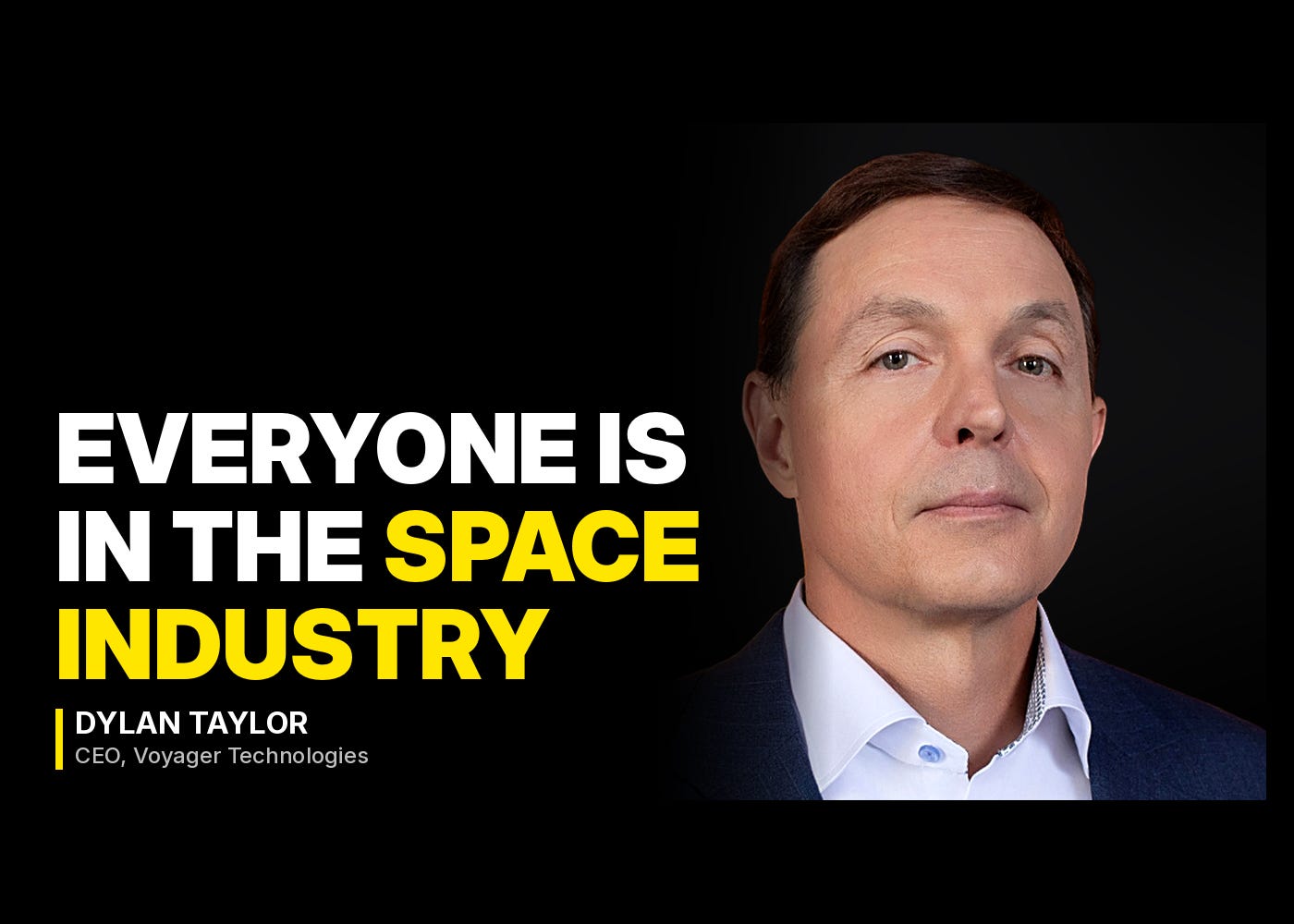
Photo via voyagertechnologies.com
SpaceX has put about $10 billion to work since its founding, less than Blue Origin is trying to raise after $40 billion of Jeff Bezos's money. Dylan Taylor, CEO of Voyager Technologies, told Semafor's Liz Hoffman and Rohan Goswami on Compound Interest that the gap has split the space industry into companies investors will fund and companies they are leaving behind.
Space is often dismissed as a hobby for the very rich. Dylan says only four or five of roughly 3,000 billionaires are seriously involved, and that every other industry already depends on what sits in orbit.
"Everyone is in the space industry. They just don't know it yet." — Dylan Taylor
Dylan runs a public company that sold a convertible bond in 48 hours against $2 billion of investor demand, and he has been to space himself as what he calls a commercial astronaut.
The full interview is covered here so you can skip it. 49 minutes of audio, 9 minutes of reading.
Here are the 11 takeaways that matter.
Key Takeaways
Whether the first human birth or the first combat death in space comes first will decide humanity's future there, Dylan says
Income is a derivative of assets, so the race in space is to own the orbital asset base
SpaceX raised about $10 billion against Blue Origin's $40 billion of Bezos money, and that split the industry
Well-run public companies get funded; weaker private rivals are "being cast aside"
Data centers in orbit are a real business, with no permitting and unlimited power
The technology for Golden Dome is mature; its fate depends on political spending decisions and the midterms
The moon is no backup for Earth, which is why Dylan still argues for Mars
1. Voyager's Three L's
Voyager runs two businesses. One is space infrastructure: lunar missions, a commercial space station and the equipment and services behind satellite constellations. The other is an advanced technology platform that works at the highest levels of defense and national security, including on Golden Dome.
Dylan frames the company's growth along three L's:
LEO, low Earth orbit, where the space station and Starlink sit
Lunar, where Voyager wants to build power, habitation and a regular lander service to the moon
Lagrange, stable orbits about a million miles out, home to assets like the James Webb telescope, which never need reboosting and can watch Earth continuously
Power comes first on the moon, Dylan said, because a base has to survive the lunar night.
Dylan expects people to be living and working on the moon around 2040
"I think people will be living and working on the moon in our lifetime... maybe it's 2040 and you'll look at the moon and there'll be lights on the moon." — Dylan Taylor
