

Arvind Krishna, chairman and CEO of IBM, said he would put the share of all AI token use that eventually goes to open-weight models, which companies can download and run on their own servers, at 75% to 90%. He added that he does not know whether it will land in that range.
Krishna was among 30 people quoted in this issue. The others ranged from Sheikh Nawaf Al-Sabah, who said safer passage through the Strait of Hormuz is what stands between Kuwait and its prewar output of 2.7 million barrels a day, to Tarek Mansour on a goat herder who paid $50,000 on Kalshi for a $500,000 payout, and Eric Schmidt on Anthropic breaking the revenue-growth record Google set while he ran it.
"I don't know whether it will be 75 to 90 percent, but that's the range I would put of all token users that will go to open weight models." — Arvind Krishna, Chairman and CEO at IBM, on All-In (Read summary)
We scanned 735 shows and 10 hours of audio, wrote 20 summaries, and pulled 59 quotes into this 22-minute read.
Here is what mattered.
Macro
60% of Chase's small-business owners are optimistic about their own firms, 30% about the economy
Stevie Baron said the split comes from Chase's monthly survey of its small-business customers. Owners cite inflation, tariffs and the wars in the Middle East and Ukraine as reasons for worry, he said, even as payrolls and consumer spending rise.
"About 60% of them are excited about where their businesses are heading and they're very optimistic. Only about 30% of those same folks feel the same way about the economy." — Stevie Baron, CEO at Chase for Business, on Bloomberg Businessweek (Read summary)
Randstad's CEO sees no sign yet that AI is cutting jobs at scale
Sander van 't Noordende, whose staffing company just reported almost 4% organic growth, said AI's effect so far is limited to pockets such as clerical, marketing, design and call-center work.
"There is no evidence whatsoever that AI is impacting the labor market at scale. Unemployment levels are at historically low levels in most developed markets." — Sander van 't Noordende, CEO at Randstad, on WSJ What's News (Read summary)
AI coding tools have raised demand for software developers, Randstad's CEO says
He said the tools have opened up more automation projects than they have replaced engineers.
"Claude can indeed do everything, but that has resulted in a higher demand for software developers because there's a lot of automation still to do in the world." — Sander van 't Noordende, CEO at Randstad, on WSJ What's News (Read summary)
Electricians and HVAC engineers for data centers can earn above $100K
He named skilled trades, along with healthcare, hospitality and logistics, as the areas where hiring is growing.
"Skilled trades is very important, especially these days in the data centers, your electricians, your maintenance engineers, your HVAC engineers... those are in extremely high demand and they can make very good money, above 100K." — Sander van 't Noordende, CEO at Randstad, on WSJ What's News (Read summary)
International
Europe regulates AI before it innovates, the former Google CEO says
Eric Schmidt, who ran Google from 2001 to 2011 and was an early investor in France's Mistral, suggested Europe adopt a French-style rule under which companies with fewer than 20 employees answer only to health-and-safety law.
"The regulators regulate before they innovate... the US one said, 'Run as fast as you can, align it with human values, and if bad things happen, fix them immediately.' The Europeans wrote, 'You can't do this, you can't do this, you can't do this.'" — Eric Schmidt, former CEO at Google, on In Good Company with Nicolai Tangen (Read summary)
Financials
A goat herder paid $50,000 on Kalshi for a $500,000 payout when a wage law changed
Tarek Mansour said the California herder could not buy ordinary insurance against a change in wage law, so Kalshi listed a market on the change.
"He has 3,000 goats... within two hours there was price discovery and it said 10% chance of that event happening. And he bought $50,000 that would pay $500,000 if the bad thing happened, which it did." — Tarek Mansour, Co-Founder and CEO at Kalshi, on Reuters Econ World (Read summary)
A multimillion-dollar push on a Kalshi election market reversed within 9 seconds
Mansour said someone spent millions of dollars trying to push Spencer Pratt's odds in the Los Angeles mayoral race from 10% to 25%, and other traders sold the price straight back down.
"Within nine seconds, the price reverted back to 10% immediately... that million, two million dollars would be much better used spending on ads." — Tarek Mansour, Co-Founder and CEO at Kalshi, on Reuters Econ World (Read summary)
Kalshi's median user is 31, and 18- to 20-year-olds are 1% to 2% of volume
Mansour was answering critics who say prediction markets prey on young men. He said sportsbooks aim their marketing at losing customers, while Kalshi welcomes the informed traders a casino would ban.
"Our median age is 31 years old... the percentage of volume that we have from the 18 to 20 bucket is like 1 to 2 percent." — Tarek Mansour, Co-Founder and CEO at Kalshi, on Reuters Econ World (Read summary)
Crypto and Digital Assets
Robinhood says stablecoins can undercut the 6% average cost of a foreign wire
Nicola White said cross-border payments are a bigger opportunity for stablecoins than domestic use, now that the OCC has finalized the first federal rule under the Genius Act. Robinhood uses USDG, a stablecoin backed by a consortium of companies.
"The average cost to wire money internationally costs about 6%. We can do that for a fraction of the cost with stablecoins." — Nicola White, VP of Institutional Crypto at Robinhood and General Manager of Bitstamp, on The Wolf Of All Streets (Read summary)
Buying Bitstamp gave Robinhood about 50 licenses around the world
White runs Robinhood's institutional crypto business and Bitstamp, the exchange it bought. She said those licenses would otherwise have taken years to obtain.
"Bitstamp's one of the largest, longest crypto exchanges. It's been around since 2011... with it came about 50 different licenses globally, which we were able to leverage and build upon." — Nicola White, VP of Institutional Crypto at Robinhood and General Manager of Bitstamp, on The Wolf Of All Streets (Read summary)
Elliptic-curve cryptography is the most tested because breaking it would pay out in Bitcoin
Alex Pruden said elliptic curves, the math blockchains use to prove who owns an address, have held up for decades in part because anyone who broke them could take real coins. Coinbase's chief cryptographer, Yehuda Lindell, has said there is no logical basis for the view that AI's progress in math puts them in danger.
"They are the only cryptographic schemes that have a trillion-dollar asset honeypot. If you break them, you get the prize. You steal the Bitcoin." — Alex Pruden, Co-Founder and CEO at Project Eleven, on Unchained (Read summary)
AI has already broken 2 post-quantum schemes that were not in production use
Conor Deegan said no scheme in production today has been broken, including the elliptic curves blockchains rely on. The schemes that fell were candidates designed to resist quantum computers.
"We've seen two schemes, one called Hawk... another called McEliece... both of these schemes have fallen to an AI attack. One was broken for about $100,000 by Anthropic... a post-quantum scheme that was not being used in production." — Conor Deegan, CTO at Project Eleven, on Unchained (Read summary)
Hash-based signatures protect against quantum computers and AI at once, Deegan says
Hash-based schemes rely on randomness rather than on a mathematical structure an attacker could find, he said, which is why Ethereum researcher Justin Drake has called for a migration to them.
"The post-quantum migration and the post-AI migration are the same. If you use hash-based schemes, you kill two birds with one stone — you're now post-quantum secure, and... post-AI secure as well." — Conor Deegan, CTO at Project Eleven, on Unchained (Read summary)
Alternatives and PE
Get Access charges $5,000 a year and 10% carry, with no management fee
Michael Goodbody, Robinhood's former global head of marketing, runs the members-only platform. It offers a late-stage private deal every week, set up as a separate investment vehicle and priced alongside the venture firm leading the round.
"It's $5,000. So it's a decent whack. But once you get past that, it's 10% carry and no other costs to you." — Michael Goodbody, CEO at Get Access, on Smart Humans with Slava Rubin (Read summary)
Get Access earns its money by keeping members, not by how much they invest
Goodbody said that is what separates Get Access from the rest of the private-markets industry.
"We don't make more money based on the amount of money that you put into the funds or into the companies. We make money based on retaining our users." — Michael Goodbody, CEO at Get Access, on Smart Humans with Slava Rubin (Read summary)
Technology due diligence now starts before a buyout firm signs a letter of intent
Dan Bender's firm reviews software companies for private equity buyers. He said the review used to be a 3-week exercise to confirm a deal before signing, and now opens with a test of whether a target's claimed AI advantage is real.
"Tech DD was a bit of a confirmatory exercise... now our work has been ripped apart and shifted left." — Dan Bender, Founding Partner at Code & Co., on Private Equity FunCast (Read summary)
Some AI products shown to buyers in diligence were built the night before
Kirby Montgomery said targets increasingly share live demos that turn out to run on a chief technology officer's laptop rather than in production.
"The amount of things that were vibe coded the night before for the diligence... none of this is real." — Kirby Montgomery, Head of North America at Code & Co., on Private Equity FunCast (Read summary)
Consumer
Kroger will pay for lower prices by buying better and cutting its own costs
Greg Foran, who became Kroger's CEO in February after stints at Walmart and Air New Zealand, said the price cuts unveiled at the company's investor day will be paid for by better buying, some direct importing and a smaller headquarters staff.
"We can buy better... take those savings, invest them into lower prices overall for our customers." — Greg Foran, CEO at Kroger, on Squawk on the Street (Read summary)
Weight-loss drugs are moving Kroger shoppers toward protein
Foran estimated that GLP-1 drugs affect roughly 1 in 10 Kroger customers today, and said the share could rise to 15 in 100.
"There is no doubt that GLP-1s are having an impact." — Greg Foran, CEO at Kroger, on Squawk on the Street (Read summary)
Bose is buying Skullcandy to grow, not to cut costs
Lila Snyder said Skullcandy will keep its brand and its Park City, Utah, team. Bose, which already licensed audio technology to Skullcandy, would not disclose the price.
"This is really a growth acquisition for us. It's not about cost." — Lila Snyder, CEO at Bose, on Bloomberg Talks (Read summary)
New cars now average $50,000, and 18% of car payments top $1,000 a month
Leslie Wims Morris said buyers are responding by buying more used cars and by buying out their leases, while demand for new vehicles has held steady.
"The average vehicle prices are now $50,000 for a new vehicle... you now have 18% of car payments are now over $1,000 a month." — Leslie Wims Morris, CEO at Chase Auto, on Bloomberg Businessweek
An Atlanta restaurateur now carries a P&L line for non-alcoholic drinks
Reggie Washington, who runs Southern National in Atlanta's Summerhill neighborhood, said GLP-1 drugs have cut volume at his restaurants as diners eat less and eat lighter.
"Never did we think we'd have a line item on our P&L for non-alcoholic beverages." — Reggie Washington, Restaurateur at SONAT Hospitality Group, on Bloomberg Businessweek
YouTube now has 2x Netflix's viewer engagement, CNBC's founder says
Tom Rogers said Netflix's advantage of outspending rivals on programming is fading as cheaper creator content and AI-made shows draw viewers.
"YouTube now has twice the amount of viewer engagement as Netflix does, and not long ago they were neck and neck." — Tom Rogers, Executive Chairman at Fountain 0 and Claigrid, on Squawk Pod
Denied Medicare claims are overturned in 80% of appeals, Reducto's CEO says
Adit Abraham, whose company sells software that reads documents for AI systems, said the figure shows how error-prone the original decisions are.
"In 80% of appeals, the original decision was overturned, which should be shocking, because clearly there's some inefficiency in how the decision was originated." — Adit Abraham, Co-Founder and CEO at Reducto, on a16z (Read summary)
Technology & AI
Self-hosted open-weight models cost $1 to $2 per million tokens, IBM's CEO says
Arvind Krishna said a company that runs an open-weight model on its own servers also keeps its data and the model's reasoning away from an outside provider. He expects Western open-weight models to match the Chinese ones within 6 to 12 months.
"We could take one of the Chinese open-weight models... and drop the cost to about a dollar to two dollars for a million tokens. Which enterprise in the world will not accept a ten times cheaper answer for effectively what can do 95% of the work?" — Arvind Krishna, Chairman and CEO at IBM, on All-In (Read summary)
Palo Alto Networks moves proven AI tasks onto smaller, cheaper models
Nikesh Arora said employees experiment on frontier models, and once a use is proven, the work moves to a smaller model trained for that task.
"What we're doing is we're trying to figure out what tasks requires what level of intelligence and what is the cost of that intelligence for that particular task, and you'll suddenly discover you don't need a Ferrari for every task." — Nikesh Arora, Chairman and CEO at Palo Alto Networks, on All-In (Read summary)
During a breach, customers want the most capable model whatever it costs
Arora said responding to an active attack is the exception to Palo Alto's cost discipline.
"If you're undergoing a breach, every customer in the room says, don't worry, use whichever model you need to stop the breach, because they know the business impact of that breach in the billions of dollars." — Nikesh Arora, Chairman and CEO at Palo Alto Networks, on All-In (Read summary)
Frontier models now get only 28% of the AI tokens being used, Code & Co. says
Bender said engineering teams are learning to send each request to the cheapest model that does the job well enough.
"Less than 30%, 28% of tokens consumed are being consumed by frontier models now. The rest is open weight models." — Dan Bender, Founding Partner at Code & Co., on Private Equity FunCast (Read summary)
A model built only to read documents can far undercut frontier-model prices
Abraham said the big AI labs are racing toward general intelligence, while Reducto's models only have to be good at reading documents.
"We are able to be orders of magnitude more aggressive on price than a frontier model at a comparable accuracy profile." — Adit Abraham, Co-Founder and CEO at Reducto, on a16z (Read summary)
Reducto's agents now beat people at pulling data from documents on many tasks
He said Reducto has agents review and correct their own output, and that people reading long documents tend to drop rows.
"It's the first time where I find that agents can be better at structured extraction than humans on many tasks." — Adit Abraham, Co-Founder and CEO at Reducto, on a16z (Read summary)
Gemini 4 Argon processed almost 25T tokens in its first 72 hours, 3x Gemini 3.0
Sundar Pichai said the demand has left Google short of computing capacity, so access to Argon is limited to paid tiers while Google builds smaller, more efficient versions.
"In the first 72 hours since Argon launched, we've had about almost 25 trillion tokens, which is about 3x what 3.0 had in the first 72 hours." — Sundar Pichai, CEO at Google and Alphabet, on Sources Podcast (Read summary)
Google never shipped Gemini 3.5 Pro because Argon would have overtaken it fast
Pichai said the lessons from 3.5 Pro went into training Argon instead.
"3.5 Pro would have had a very short shelf life. So we decided to take all the learnings and apply it in Argon post-training." — Sundar Pichai, CEO at Google and Alphabet, on Sources Podcast (Read summary)
Google says signed long-term contracts back its spending
Pichai was defending capital spending that turned Google's free cash flow negative over the summer for the first time since its IPO. He said Google is already planning computing capacity, land and power for 2028 and 2029.
"We also have durable long-term contracts with committed revenue which we are signing. So it's not just hope." — Sundar Pichai, CEO at Google and Alphabet, on Sources Podcast (Read summary)
Anthropic broke Google's revenue-growth record at more than 2x the speed, Schmidt says
Schmidt cited the record as evidence that AI is not a bubble, because customers are paying for real value.
"If you look at Anthropic's revenue growth, when I was CEO at Google, we set the revenue growth record. They smashed it, more than twice the speed as we did." — Eric Schmidt, former CEO at Google, on In Good Company with Nicolai Tangen (Read summary)
IBM's CEO dates quantum code-breaking to about 2030; Project Eleven's CEO leans to 2033-2035
Krishna said companies should switch to quantum-safe encryption now, because data stolen today can be stored and decrypted later. Alex Pruden, whose company builds quantum-resistant custody for crypto, puts the earliest realistic date near 2030 but called 2033 to 2035 more likely than not.
"If you pick the middle point, let's call it 2030, it will break this cryptography. That's not a supposition, that's just a reality." — Arvind Krishna, Chairman and CEO at IBM, on All-In (Read summary)
"My earliest date where I think a quantum attack is realistic is probably around 2030. And a chance where it's more likely than not is the early to mid 2030s, so 2033 to 2035." — Alex Pruden, Co-Founder and CEO at Project Eleven, on Unchained (Read summary)
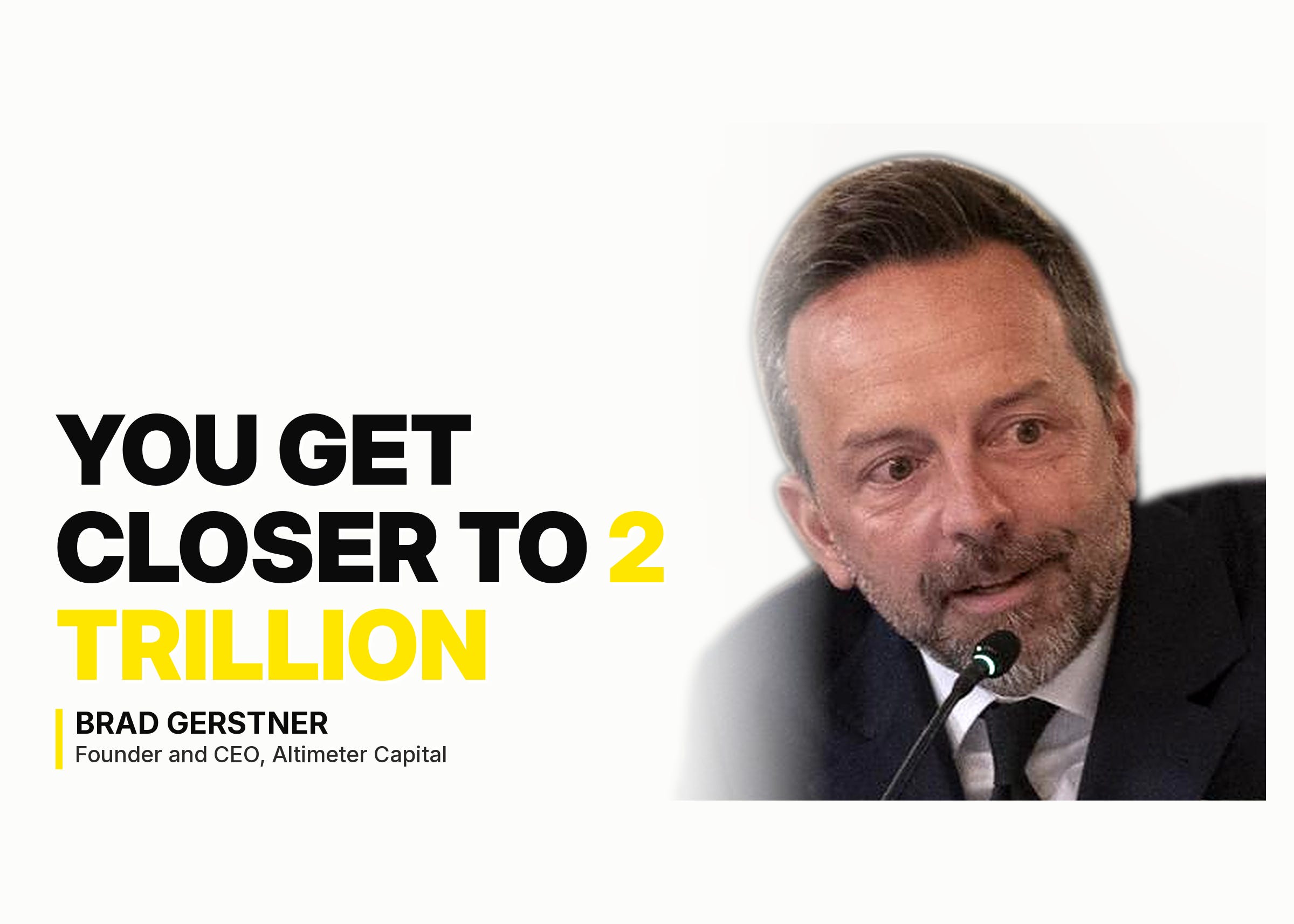
Altimeter's math puts Anthropic at $1.5T on 10x revenue and near $2T on 12x
Brad Gerstner said Altimeter forecasts $140 billion to $150 billion of revenue for Anthropic next year, ahead of an IPO expected around next month.
"If you apply a ten-times multiple to that, you get to 1.5 trillion. If you apply a 12-times multiple, you get closer to 2 trillion." — Brad Gerstner, Founder and CEO at Altimeter Capital, on Squawk Pod (Read summary)
SpaceX alone will add 25% of the US computing capacity coming online, Gerstner says
Gerstner, who owns shares of both SpaceX and Tesla and sits on Tesla's special committee considering a merger, said SpaceX will have to raise the money for the buildout.
"SpaceX alone is going to put up 25% of the total gigawatts going up in the United States." — Brad Gerstner, Founder and CEO at Altimeter Capital, on Squawk Pod (Read summary)
Oppenheimer's analyst puts SpaceX's total capital need at about $500B
Tim Horan estimated SpaceX's actual cash burn at closer to $100 billion to $200 billion if graphics chips pay for themselves in about 6 months.
"I think they need to raise about 500 billion in total capital." — Tim Horan, Senior Digital Infrastructure Analyst at Oppenheimer, on Squawk on the Street
Other appearances:
XPRIZE founder on why SpaceX is no longer just a rocket company on Squawk on the Street
VC & Startups
Datarails went from 90% outbound sales to 90% inbound in 5 years
Aviv Canaani joined the finance-software company as its first marketing leader, when inbound leads were rare enough to be emailed to the sales team once a week.
"Back then, the company was really at the very beginning — it was 90% outbound. Five years later, the company is now 90% inbound." — Aviv Canaani, CRO and CMO at Datarails, on GTMnow (Read summary)
Datarails backed inbound marketing in 2022 because those leads closed more often
He said Datarails judges each channel by its cost per closed deal, not per meeting.
"What we noticed is that the outbound team was still generating as many leads and opportunities as they used to, but they weren't converting to deals as much as inbound. So we decided to double down on inbound." — Aviv Canaani, CRO and CMO at Datarails, on GTMnow (Read summary)
Industrials and Transport
United has passed about 72% of its higher fuel costs through to fares
Scott Kirby said fares lag fuel prices by about 3 months. If fuel stops rising, he said, he thinks United has a good shot at full pass-through in the first quarter.
"We've passed about 72% of the increase in fuel price." — Scott Kirby, CEO at United Airlines, on Bloomberg Talks (Read summary)
United says Starlink on its planes is pulling customers from other airlines
Kirby said applications to match elite status from other airlines have run at about 4x the normal rate since the installations began.
"We're going to cross the 50% threshold this week with 50% of flights on Starlink... we already see customers moving from other airlines." — Scott Kirby, CEO at United Airlines, on Squawk Pod
US hypersonic programs have yet to field a weapon, Hermeus's CEO says
Zach Shore's company flies an unmanned test aircraft the size of an F-16 that has already gone faster than sound.
"We've spent huge amounts of money, tens of billions of dollars, and really haven't fielded anything yet." — Zach Shore, CEO at Hermeus, on Core Memory (Read summary)
Hermeus reached supersonic flight in 7.5 years without $100M to start
A.J. Piplica said flying without a pilot lets Hermeus take more risk in testing, the way SpaceX accepts losing rockets to learn faster.
"Elon was 6 and a half years to orbit. We were 7 and a half years to supersonic flight. And we didn't have the $100 million to start with." — A.J. Piplica, Co-Founder and Executive Chairman at Hermeus, on Core Memory (Read summary)
Hermeus says a defense business has to come before a hypersonic airliner
Piplica said a hypersonic passenger plane, crossing an ocean in a fraction of today's time, remains a later goal.
"The reality is if you really want to go after sustainable commercial flight operations... you need to create a stable cash flowing defense business first. Period." — A.J. Piplica, Co-Founder and Executive Chairman at Hermeus, on Core Memory (Read summary)
Tesla's self-driving miles rose about 190% from a year earlier
Gene Munster said the growth in miles driven on Full Self-Driving, up from 125% in March, matters more than Elon Musk's long-range targets.
"The FSD miles driven increase by about 190% year over year in the September quarter." — Gene Munster, Managing Partner at Deepwater Asset Management, on CNBC's Fast Money
RAV4 sales are down 30% because Toyota cannot build enough of them
Chris Otts said Toyota kept building the popular 2025 model and put off retooling its plants for the hybrid-only 2026 version. Some buyers have moved to Honda's CR-V.
"RAV sales are down 30% this year, which is not at all to do with demand, it's to do with the fact that they simply cannot make enough to keep up." — Chris Otts, Autos Reporter at The Wall Street Journal, on WSJ What's News
Materials & Energy
Kuwait needs safer passage through Hormuz to get back to 2.7M barrels a day
Sheikh Nawaf Al-Sabah said Kuwait Petroleum Corporation has brought production back to over 2 million barrels a day, from almost nothing at the height of the conflict, using its own trading arm and ship-to-ship transfers outside the Strait.
"What is missing right now is additional security for ships to transit through the Strait so that we can raise our production to what it was before this crisis began at 2.7 million barrels a day." — Sheikh Nawaf Al-Sabah, CEO at Kuwait Petroleum Corporation, on Bloomberg Talks (Read summary)
A shortage of product tankers is holding Kuwait's jet fuel and diesel in the Gulf
He said the tanker shortage explains why prices for refined products have spiked while crude prices have stayed comparatively calm.
"One of the biggest refineries in the world that produces jet and diesel is actually in Kuwait. We need more product carriers to come into the Gulf to carry that product out." — Sheikh Nawaf Al-Sabah, CEO at Kuwait Petroleum Corporation, on Bloomberg Talks (Read summary)
KPC signed a $16B pipeline deal with infrastructure funds during the attacks
He said KPC is still aiming for 4 million barrels a day of capacity by 2035, built on its first offshore wells.
"We signed with three infrastructure funds a major $16 billion joint venture for pipeline lease and leaseback in Kuwait in the midst of Iranian attacks and missiles." — Sheikh Nawaf Al-Sabah, CEO at Kuwait Petroleum Corporation, on Bloomberg Talks (Read summary)
Policy
IBM's CEO sees no chance all 50 states ban data centers, but 30 could
Krishna said the states that allow data centers would gain the investment the others turn away. He called AI and data-center regulation in Washington a product of populism.
"I think there's no chance all 50 will ban. Is it possible 30 will ban? Yes." — Arvind Krishna, Chairman and CEO at IBM, on All-In (Read summary)
Geopolitics
Free Chinese AI models can win users while trailing by 6 months, Schmidt says
Schmidt estimated that Chinese models trail the US frontier by about 6 months, and said poorer countries in particular will use them because they cost nothing.
"It looks like they are six months behind... if we're six months behind, then we're already losing, because their strategy is that the products are free." — Eric Schmidt, former CEO at Google, on In Good Company with Nicolai Tangen (Read summary)
A Starlink speed cap cuts the video link to Ukrainian drones flying over 100 mph
Marcus Walker said the cap Elon Musk placed on a military version of Starlink has hurt Ukraine's interceptor drones and its strikes on Russian supply lines. Kyiv is negotiating with Secretary of State Marco Rubio to restore full service.
"Ukrainian forces can only fly their drones up to a certain speed. If they fly faster than a hundred miles an hour, they lose the video connection via Starlink." — Marcus Walker, Ukraine Bureau Chief at The Wall Street Journal, on WSJ What's News
Nuggets of Wisdom
After 2 failed IPO attempts, a buyer paid more than a listing would have, Grossman says
Mike Grossman said his most recent company spent about 9 months preparing to list in Australia before COVID ended the plan, and a later attempt also fell through.
"A big company came along, swooped in, and paid more money, meaningfully more money, to buy us than we would have received had we gone public in the first place." — Mike Grossman, author of Failure Is an Option and former CEO of 6 venture-funded companies, on What's Your Deal? (Read summary)
Grossman's results improved once he stopped trying to control outcomes
Grossman once built a company to a $30 million revenue run rate just as Congress passed a law that ended its business model.
"I ended up coming to the realization that it wasn't worth worrying about the outcome because it really couldn't be controlled. The irony is that the more I focused on the input and tried not to worry about the outcome, the outcome tends to be better." — Mike Grossman, author of Failure Is an Option and former CEO of 6 venture-funded companies, on What's Your Deal? (Read summary)
Nearly every company Grossman ran turned profitable by holding down spending
Grossman said a billboard he once put up beside a Bay Area highway, with no measurable payoff, taught him how fast investors' money goes.
"Almost all the companies that I've run did become profitable by being very disciplined about spending, but it certainly doesn't happen immediately." — Mike Grossman, author of Failure Is an Option and former CEO of 6 venture-funded companies, on What's Your Deal? (Read summary)
Schmidt says Google led social media for a moment and he failed to press it
Schmidt said founders can make large bets that professional CEOs like him cannot, citing Mark Zuckerberg's costly push into virtual reality before Meta's turn to AI.
"There was a moment when Google was ahead of everybody else in social media... I take responsibility for not getting ahead of that. That was a big error." — Eric Schmidt, former CEO at Google, on In Good Company with Nicolai Tangen (Read summary)
If this was worth your time, send it to someone who has to follow all of this too.
What did you think of today’s edition? Hit ‘reply’ to this email, send us a message, leave a comment, or join the chat!
Get the latest market chatter as it happens: