

The Cognitive Revolution · Oct 3, 2026 · 1h 32m · 72m saved
With Keerthana Gopalakrishnan, Staff Research Scientist and Research Lead for Gemini Robotics at Google DeepMind
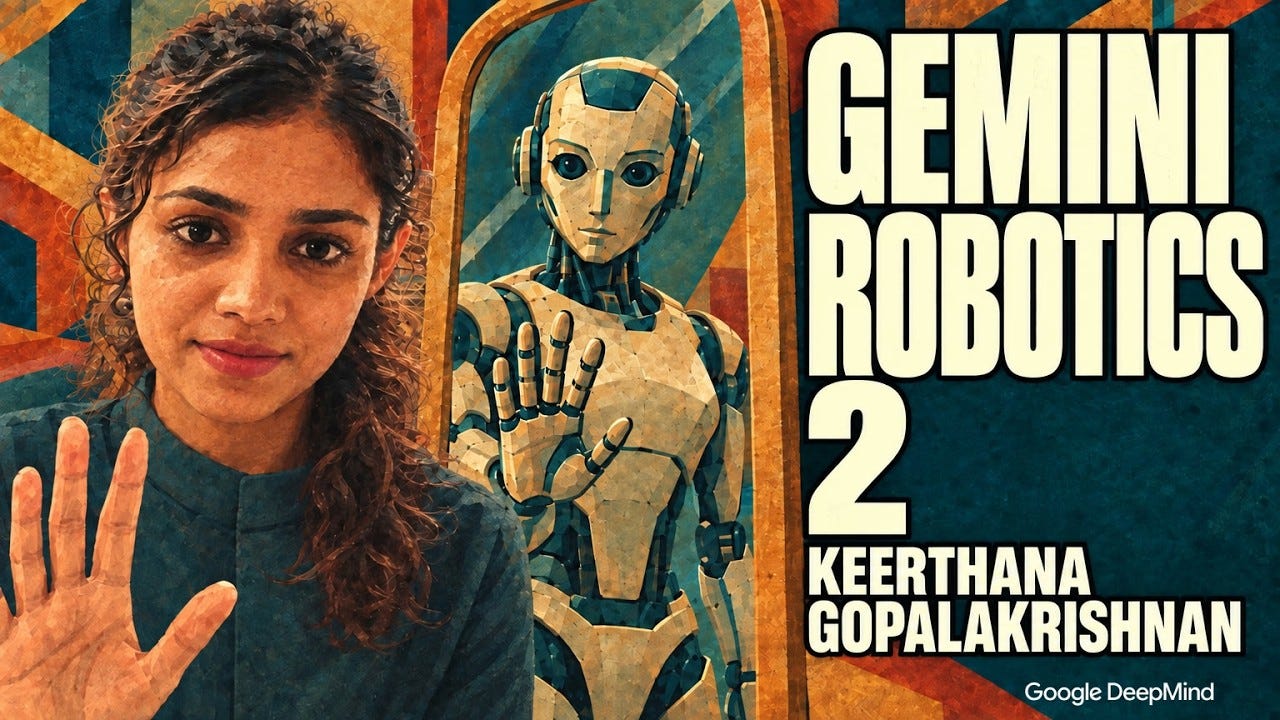
Google DeepMind's Gemini Robotics 2 now controls a humanoid robot from its fingertips to its feet, and the researcher who leads the work still rates robotics at the GPT-2 stage.
Humanoid robots in China now run faster than the fastest humans, and the clips went around the world. Keerthana Gopalakrishnan said running is relatively easy to train in simulation, and that the harder problem is a single model that works on any robot body.
"If it just works on your robot with your specific setup, is it really a generic brain?" — Keerthana Gopalakrishnan
Keerthana Gopalakrishnan, Research Lead for Gemini Robotics at Google DeepMind, on The Cognitive Revolution, was making her fourth annual appearance on the show. Her team started on humanoids two years ago, when getting one to grab an apple was hard, and now prompts one to squat and pick up a watering can.
The full interview is covered here so you can skip it. 1 hour 32 minutes of audio, 21 minutes of reading.
Here are the 15 insights that matter.
Key Takeaways
Robotics is still at the GPT-2 stage, Gopalakrishnan said, because few-shot learning is not yet reliable and models still depend on the robot body they were trained on
Generalization and mastery are separate goals, and a general model makes every new task cheaper to master
Gemini Robotics 2 is three models: a reasoning model available in Google's API, an action model that moves the robot, and a smaller version that runs on the robot itself
About 3 minutes of memory fits in the reasoning model's 128,000-token context window, she estimated
A new robot body can learn many tasks from 200 examples on the on-device model
Multi-finger hands now do everything grippers can and more, and the hardware improved faster than she expected
Safety is a capability, not a trade-off against one, in her view, because people will not use an unsafe robot
No single data source wins: robot teleoperation is precise but does not scale, while video of people scales but is noisy
1. Running Is the Easy Part
Nathan Labenz opened with the humanoid robot games held in China this summer, where robots outran Usain Bolt. Gopalakrishnan heard about them from her father and from friends in India who had entered politics, who marveled that China was building robots that run faster than the fastest humans.
Fast bipedal robots are not a research surprise
She said the games captured public imagination and work as a benchmark, and compared them with robots in the DARPA challenge years earlier that could walk, open a door and then fall down. But she said locomotion, unlike manipulation, is a field where simulation makes a large difference.
"And because of that, locomotion has advanced quite far." — Keerthana Gopalakrishnan
Speed is not what makes a robot useful
She said running fast may matter for some defense applications, but her team is focused on robots that do useful physical work.
"A lot of my friends are also very productively employed, but we don't run faster than Usain Bolt." — Keerthana Gopalakrishnan
Contact is what simulation gets wrong
Labenz noted that robots smashed to pieces after sprinting into a wall, so they could not have been trained that way in the real world, or the teams would have run out of robots. Gopalakrishnan said a flat floor is easy to model, while manipulation depends on contact with objects, which current simulators handle poorly. Folding cloth is hard because of friction; picking up and placing rigid objects is easier because their contact is predictable.
"So where the physics is easier to model, simulation gets in." — Keerthana Gopalakrishnan
The racers were probably trained with standard methods
"I didn't work on these demos, so I'm only speculating." — Keerthana Gopalakrishnan
She guessed the racers used controllers trained by imitating motion and then refined with reinforcement learning for that one task, which is a widely published approach.
