

Excess Returns · Oct 17, 2026 · 1h 3m · 53m saved
With Colin McQueen, Portfolio Manager in T. Rowe Price's Global Equity Division
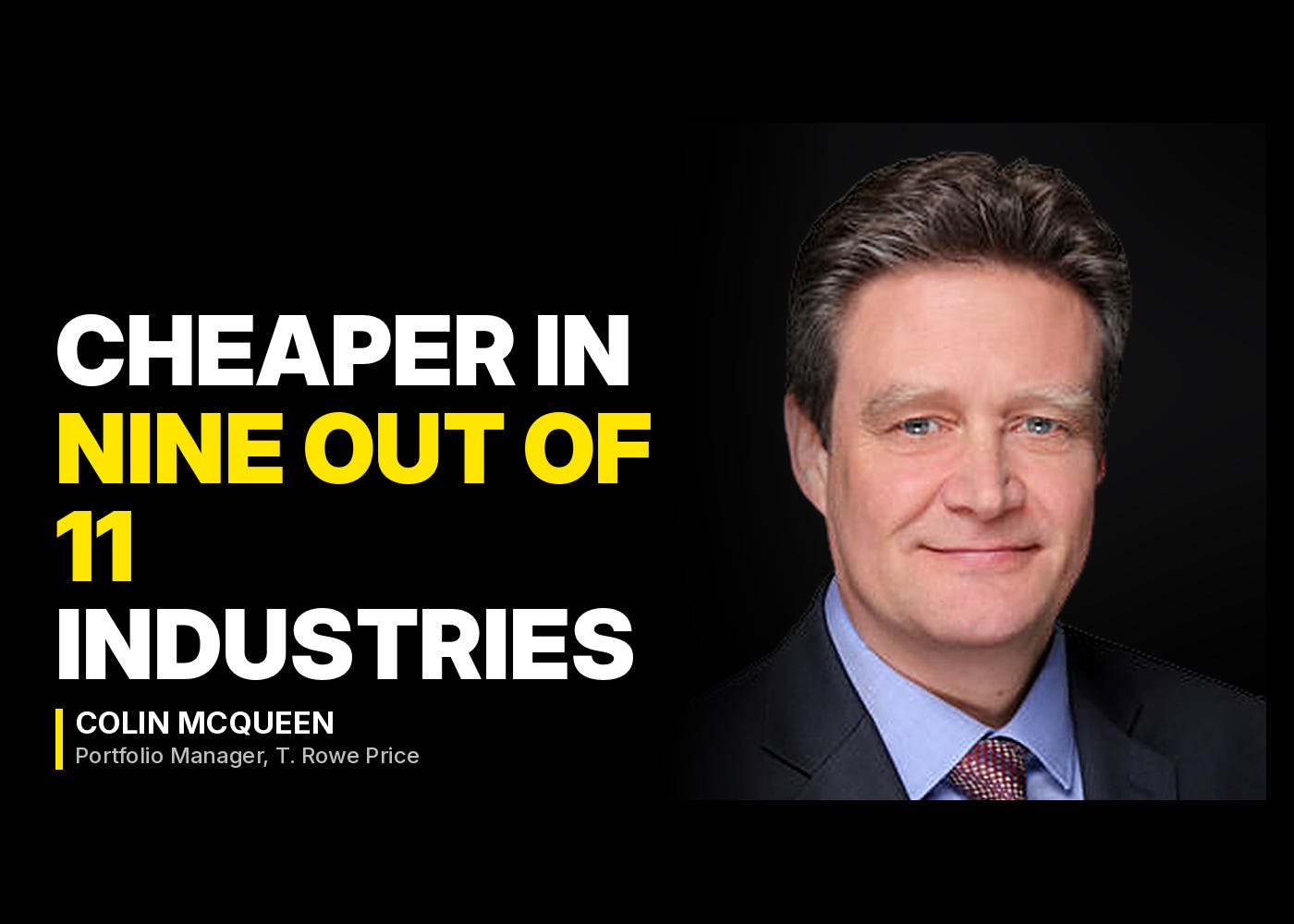
Photo via troweprice.com
International stocks are cheaper than US stocks in 9 of 11 industries, and in all 11 once emerging markets are added. Colin McQueen, a portfolio manager in T. Rowe Price's Global Equity Division who runs an international value strategy, laid out the gap for Justin Carbonneau and Jack Forehand on Excess Returns.
Through the 2010s that discount looked deserved, because international earnings grew about 1% a year against 8% for the S&P 500. Colin's argument is that the earnings gap has since narrowed, while the valuation gap is still wide.
"We have a long laundry list of things that we need to spend kind of tangible capital on. And the companies that supply that are therefore having a much better time." — Colin McQueen
Colin has invested in value stocks since 1989. He launched a value fund at the start of what he calls the worst decade for value since the Great Depression, and he still runs the style today.
The full interview is covered here so you can skip it. 1 hour 3 minutes of audio, 10 minutes of reading.
Here are the 13 insights that matter.
Key Takeaways
International stocks are cheaper than the US in 9 of 11 industries, and in all 11 with emerging markets
International earnings growth has risen to about 4.5% a year since 2019, from about 1% in the 2010s
About 14–15% of international stocks are tied to the AI supply chain, often industrials and memory makers
Samsung Electronics went from 1x book value to just under 3x in 18 months
About 60% of Colin's new buys have a restructuring angle, with Rolls-Royce his biggest win
70% of Korea's Kospi still trades below book value, and Korea is the fund's largest country exposure
Colin uses AI as an "alternate voice" to check the stubbornness that comes with value investing
The market overweights quarterly earnings against his holding period of a bit over four years
1. Fishing in Garbage Cans
Colin started in 1989 at Phillips & Drew Fund Management, later absorbed into UBS Asset Management. It was a deep-value shop with an unofficial motto.
Phillips & Drew taught Colin McQueen to buy what other investors had discarded
"We fish in the garbage cans for the things that other people have thrown out." — Colin McQueen
The approach built emotional resilience. It also worked best in the first half of his career, when value simply outperformed, a lesson he says he learned later.
"I probably spent the next half of my career kind of getting the answer to that the difficult way." — Colin McQueen
