

Sunbelt Developers · Nov 12, 2026 · 1h 7m · 59m saved
With Dr. Eloisa Klementich, President & CEO, Invest Atlanta
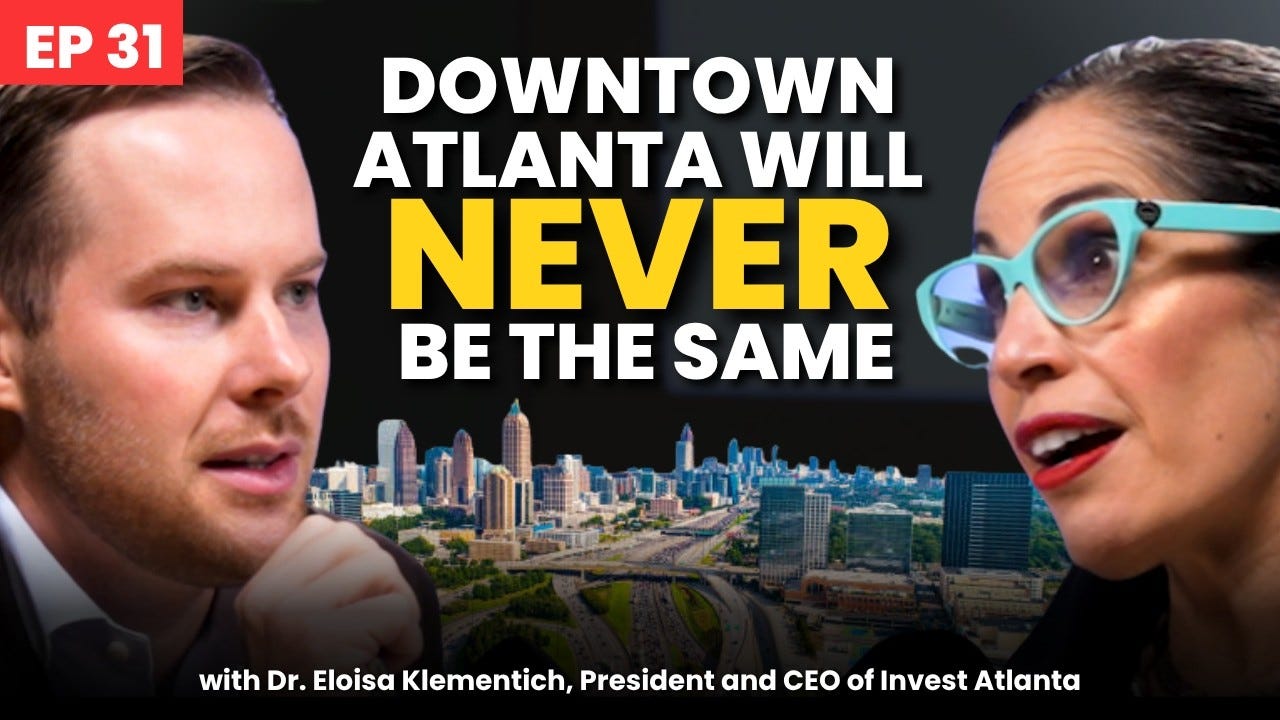
A roughly 500-foot hole at the Centennial Yards site in downtown Atlanta needed an estimated $500 million in infrastructure before anything visible could be built, and more than 15 earlier attempts at redeveloping the site had stalled. Dr. Eloisa Klementich, President and CEO of Invest Atlanta, told broker Tim Wright on Sunbelt Developers that her team had to invent a new financing structure to get it done. The city council would not let Invest Atlanta bond for the work, because the agency would still need general-fund money to cover the debt.
"I think the downtown you see today will not be the downtown of the future." — Dr. Eloisa Klementich
Eloisa built Invest Atlanta's business-development team from the ground up after earlier stints in the Schwarzenegger and Obama administrations, and now runs the agency that negotiated that financing and built a senior tax-freeze program funded in part by a Tyler Perry donation.
The full interview is covered here so you can skip it. 67 minutes of audio, 8 minutes of reading.
Here are the 7 takeaways that matter.
Key Takeaways
Invest Atlanta is a legal "authority," not city government or a nonprofit, built to bridge government and developers toward cheaper capital
A "TAD within a TAD" financed the $500M Centennial Yards infrastructure gap, by only reimbursing a developer after they spend their own capital first
Negotiating the structure took roughly a year
Georgia's only C-PACE tool lets building owners finance energy retrofits against the building, not their own credit
A Tyler Perry donation and Centennial Yards money fund a 20-year tax freeze for more than 500 seniors
COVID relief required $10,000 of mandatory technical assistance on top of a $40,000 grant, over business owners' objections, and recipients now credit it
Invest Atlanta's loan book runs a 3-5% default rate because it deliberately takes on borrowers banks reject
"Affordable housing" at 80% of area median income usually means a Starbucks worker or a teacher, not someone homeless — and Midtown developers have built almost none of it
1. An Authority, Not a Rival
Eloisa said she fell into economic development by accident. She started as a staffer for then-city-council candidate Alex Padilla, now a US Senator, in the San Fernando Valley, walking storefronts to ask merchants what they needed and cold-calling the Yellow Pages to land a Blockbuster as a client. She later worked in Governor Arnold Schwarzenegger's administration and the Obama administration before landing at Invest Atlanta, where she built the business-development team and eventually became CEO.
Invest Atlanta is a legal "authority," neither city government nor a private business
Eloisa said that structure is what lets the agency act as a bridge between government and developers, helping projects reach lower-cost capital that neither side could access alone.
"The city doesn't have the ability to do it on their own. We need the muscle of the state." — Dr. Eloisa Klementich
