

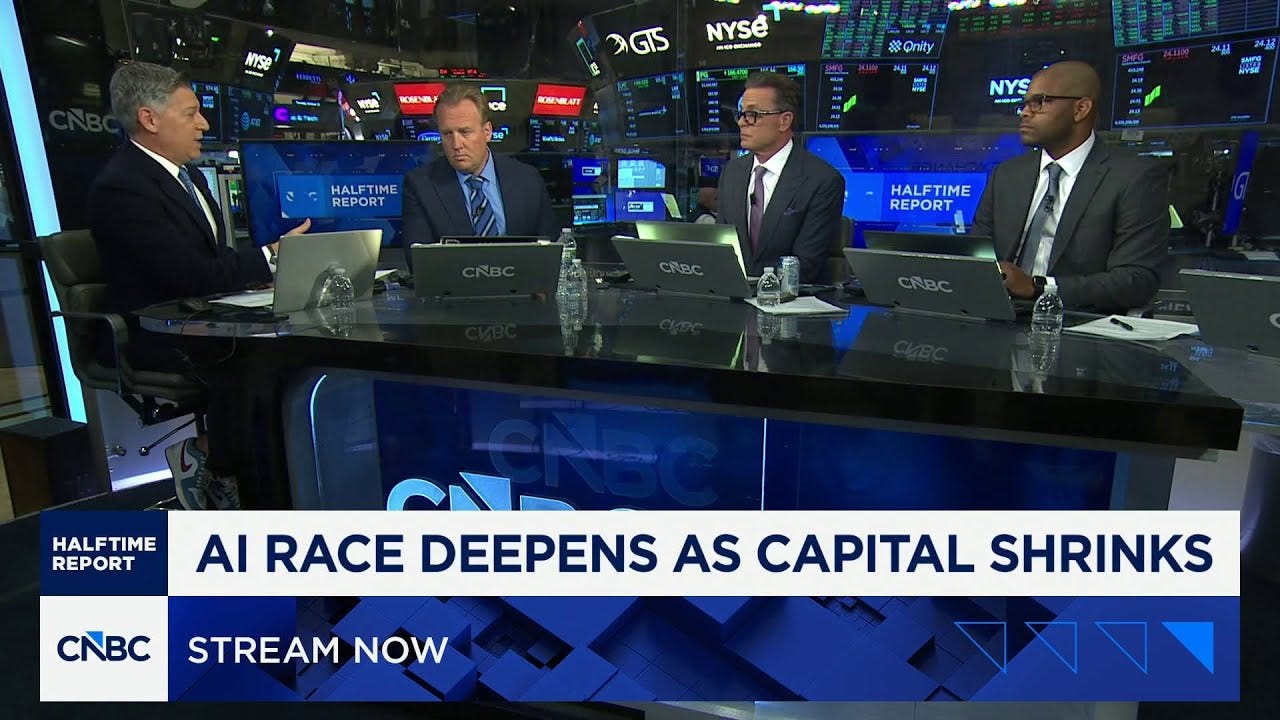
The Nasdaq fell more than 500 points the day CNBC's Investment Committee turned to whether capital for the AI trade is actually running scarce. Most of the day's reaction to Meta's post-earnings slide was about the stock price; Josh Brown, CEO of Ritholtz Wealth Management, and Malcolm Ethridge, Managing Partner at Capital Area Planning Group, argued instead about who actually eats the risk if the spending doesn't pay off.
"What happens when we've got to walk back some of those commitments? Who gets left holding the bag?" — Malcolm Ethridge
Josh has flagged Meta on Halftime's own "Best Stocks in the Market" segment. Malcolm, who manages client portfolios directly as Capital Area Planning Group's managing partner, was the one who connected Microsoft's own retreat from a European data-center project to what he called a new "zero tolerance policy" on hyperscaler cash burn.
The full segment is covered here so you can skip it.
Here are the 3 calls that matter.
Halftime Report · Oct 22, 2026
With Josh Brown, CEO of Ritholtz Wealth Management · Malcolm Ethridge, Managing Partner at Capital Area Planning Group
This Scuttlebutt Summary is available in full to premium subscribers. If you're not one already, please consider subscribing to keep reading.
Key Takeaways
Hyperscalers now face a "zero tolerance" policy on cash burn, Malcolm says — exactly what rattled Meta's stock after earnings
He points to Microsoft's retreat from a European data-center project, which left its neocloud partner holding the asset, as proof it's already happening
Josh counters that even under real capital scarcity, "There will be scarcity of capital, but not for Meta"
His reasoning: enterprise demand for AI doesn't care which data center the workload runs in
SpaceX earns roughly $20 billion per gigawatt in contracted revenue — and just pledged 10 more gigawatts
Josh frames this as the real fight: who wins "the right to the economics," not whether AI demand is real
Meta has "this trick up their sleeve" — declaring itself a cloud-compute provider outright, which Josh predicts would send the stock "up 75 points"
Malcolm's worry is the opposite of Josh's: rising expenses compressing margins even while the cost of capital climbs
Both agree the open question is who breaks a promise first if capital gets scarcer — "Facebook... Anthropic... on and on and on," Malcolm says
1. Meta's Capital Problem
Scott Wapner opened Halftime Report against a Nasdaq down more than 500 points, noting staples, healthcare and utilities were the day's best performers. He framed Meta's selloff as the real question: the company raised the midpoint of its spending range but gave little color on 2027, guided to negative free cash flow with no return expected until 2029, and is seeing expense growth outpace sales growth.
Josh says the selloff is really about being forced into heavier capital spending
"I think it's indicative of the need to be a more capital-intensive company. That's it's almost as simple as that." — Josh Brown
He said he isn't worried about it in the short run, since the core ad business is "firing on all cylinders" with proven AI monetization already showing up in the numbers.
Josh ties Meta's wobble to the entire AI trade, not just one company's capex
"This AI or superintelligence trade, for better or for worse, underlies the whole economy. And anything that's going to be a threat to that is going to cause a wobble." — Josh Brown
He pointed to Meta's new non-voting share class — created to preserve Mark Zuckerberg's control while financing growth — as exactly the kind of threat the market punished. His closing logic: "They wouldn't be spending this if they did not think they could monetize it on the other side."
