

With Philip Maymin & Allan Maymin, Co-Heads of Global Asset Allocation, Janus Henderson
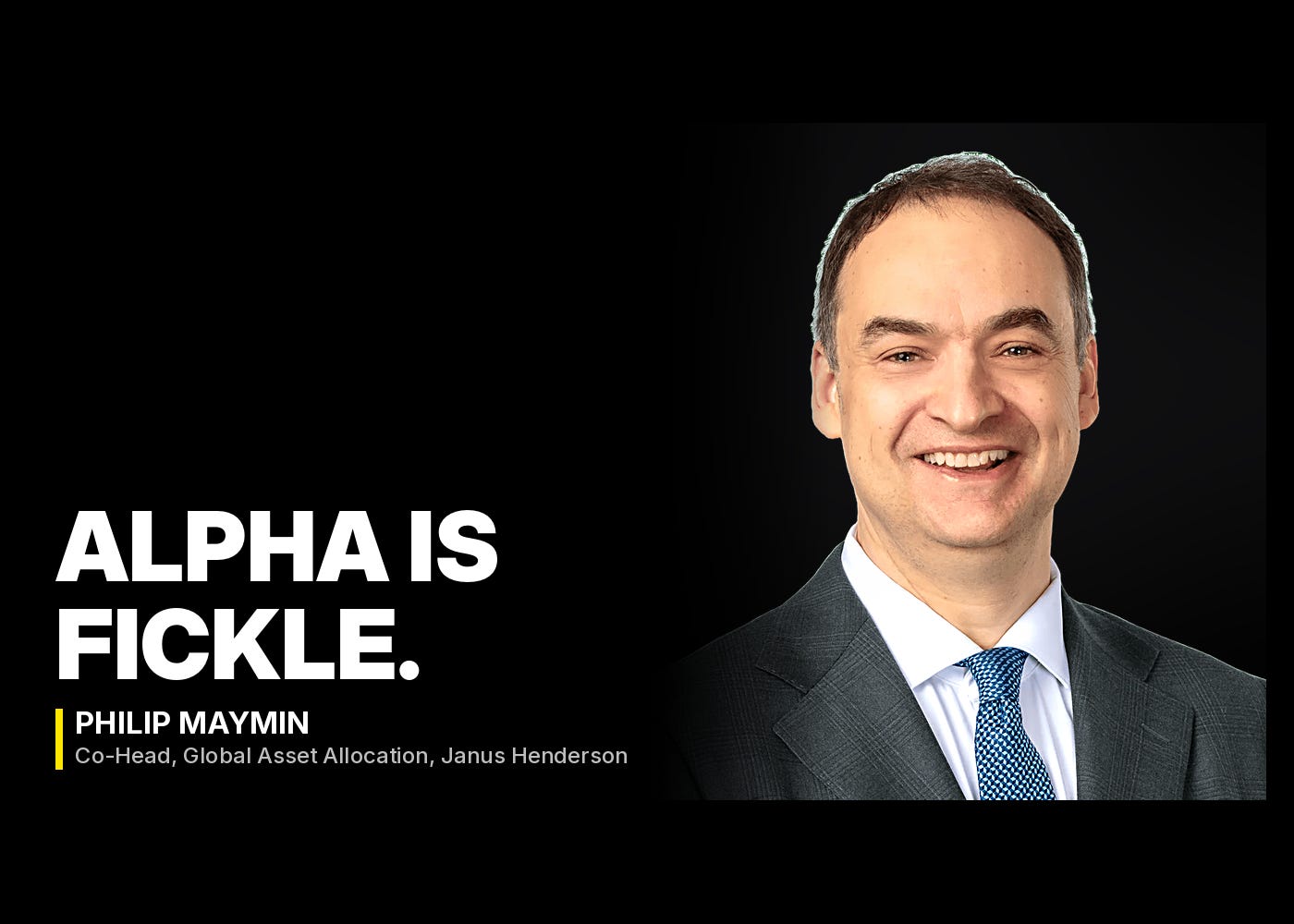
Photo via janushenderson.com
Janus Henderson's Global Asset Allocation group, a team Myron Scholes founded more than a decade ago, runs its risk models across more than 4,000 assets.
Most managers still chase higher expected returns. Philip and Allan Maymin, who co-head the group, build portfolios around managing risk instead, because drawdowns do more damage to long-run compounding than a shortfall in average return ever could.
"People live in an average return world, and they ought not. What matters to investors is compound growth." — Philip Maymin
Philip and Allan Maymin, co-heads of Global Asset Allocation at Janus Henderson, told Corey Hoffstein on Flirting with Models that risk, not return, is the lever that actually compounds wealth. Philip cut his teeth on LTCM's equity derivatives desk in the 1990s and still talks to his old boss, Myron Scholes, almost every day; Allan traded through the 2010 Flash Crash and has run quantitative execution, sell-side derivatives and an internal hedge fund since.
The full interview is covered here so you can skip it.
Here are the 7 principles that matter.
Key Takeaways
Compound return equals average return minus risk, so a good average "alpha" can still erode to nothing
"Alpha is fickle," in Philip's words, while risk is easier to measure and more persistent
Risk means the chance of falling short of the client's objective, not plain volatility
Volatility treats gains and losses the same way; clients don't
Options prices are the richest forward-looking signal because a trade requires real money, not just an opinion
They read tail risk off roughly 2-3 month, 90th-percentile ("10-delta") options
The whole framework is built on the idea that middles don't matter, only the tails
A paper of theirs shows discarding the middle 80% of a distribution keeps roughly 80-90% of the risk and correlation structure
A 60/40 portfolio is really just a proxy for a 30% drawdown tolerance, not a law of nature
The negative stock-bond correlation it assumes broke in 2022 and has often been positive over a 100-150 year lookback
In the tails, correlations collapse toward plus or minus one, which makes them easier to estimate than the messy middle
Myron Scholes says the opportunity disappears only once institutional benchmarks themselves become dynamic and risk-managed
1. Two Paths to One Desk
Philip's road ran through LTCM in the 1990s, a few hedge funds, a PhD, academia and behavioral analytics before Janus Henderson. Allan's ran through early high-frequency trading, Platinum Grove, Société Générale and an internal hedge fund at AllianceBernstein.
Myron Scholes was Philip's first boss out of college, and remains his boss today
"He was my first boss. He's my current boss and hopefully he'll be my last boss." — Philip Maymin
On LTCM itself, Philip says he traded convertibles and warrants on the equity derivatives desk, somewhat removed from the fixed-income trades that blew up the firm. His takeaway was that correlations go to one in the tails, and that arbitrage carries self-imposed limits: spreads widened not because LTCM held certain positions, but because the market believed it might have to unwind them.
Speed buys explainability, not necessarily edge, Allan argues
Allan points to the May 2010 Flash Crash, when short-horizon strategies worked better because they exploited mechanical, uninformed flow. Pressed by host Corey Hoffstein on a provocative pre-call line, Allan reframes it around how much economic rationale a strategy needs to survive a drawdown.
"As you get faster, you get dumber, and as you get slower, you get smarter." — Allan Maymin
At longer horizons, where realized Sharpe ratios fall and noise dominates, you need a story you can anchor to in order to hold a position through pain; at very short horizons, you can tolerate not fully understanding why a strategy works.
