

The average US bond yields about 5.5% today, against 2% in 2020, so a one-point rise in yields now costs a bondholder about 5.5% of their money instead of 7%, Jim Bianco, president and macro strategist at Bianco Research, said on The Master Investor Podcast with Wilfred Frost. He has called bonds too expensive for six years. He has now started buying them.
That was one bond investor on why the price finally works for him. Below are 20 more quotes from 18 speakers, Bianco among them. Vercel's COO said an AI agent now resolves 91% of the company's support volume, and Mastercard's chief economist said she expects holiday spending to grow 5.5%, the most in four years.
"I see the bond market as being maybe fairly valued now, where it was too expensive for the last 6 years. ... So, in 2020, the average yield was 2% and the duration was seven. So, that meant if you went from 2% to 3%, you lost 7% of your money, but you were only getting a 2% coupon to cushion you. Today, that is five and a half on the yield, the average yield all in the bond market in the US, and five and a half on the duration. ... I'm getting off of my bearish position and going long bonds." — Jim Bianco, President and Macro Strategist at Bianco Research, on The Master Investor Podcast with Wilfred Frost (Read summary)
We scanned 495 shows and 4 hours of audio, wrote 5 summaries, and pulled 21 quotes into this 10-minute read.
Here is what mattered.
Macro
About 50 AI-related stocks are 45% to 48% of the S&P 500 and now move apart from the other 450, Bianco says
"I would argue that the equity market is effectively two stock markets. ... There is about 50 stocks that you could identify as AI-related. ... Right now, those 50 stocks are about 45-ish, 48% of the size of the S&P. The other 450 stocks, the non-AI stocks are 52 to 55% of the S&P. ... they're starting to diverge. Their correlation is going down." — Jim Bianco, President and Macro Strategist at Bianco Research, on The Master Investor Podcast with Wilfred Frost (Read summary)
Rising interest rates tend to burst speculative bubbles, and Felder sees real assets as the alternative to bonds
"There's really nothing like rising interest rates to burst a speculative bubble. Everything is now dependent on the AI bubble. If I don't want to own Treasuries, I don't want to own corporate bonds, you're really only other choice outside of these kind of financial assets is real assets." — Jesse Felder, Founder of The Felder Report, on Wealthion
Small-cap stocks will keep lagging, and the 10-year yield will likely be lower in 12 to 18 months, Manley says
"I think the small cap trade's in a lot of trouble right now. I mean, we're seeing a flight to quality with rates moving higher. ... So yeah, small caps keep on underperforming, large caps keep on doing pretty well, and market leadership within that large cap space is more or less maintained. ... if I had to guess where, say, the 10-year goes over the next 12 to 18 months, it's lower rather than higher." — Jack Manley, Global Market Strategist at J.P. Morgan Asset Management, on Bloomberg Surveillance
A 6% 10-year yield would not make the yield curve unusually steep, though Alden's base case stops short of it
"I would point out that even 6% yields on the 10-year wouldn't be a particularly steep yield curve. it would only be, you know, moderately higher than it is now. ... Now from what I'm seeing on social media, what I'm seeing on financial media, bond yields are getting a ton of attention. ... my current base case wouldn't necessarily call for 6%." — Lyn Alden, Founder of Lyn Alden Investment Strategy, on The David Lin Report
Counting supply-chain spending, US gross output rose 5% in the second quarter while real GDP rose 2.2%, Skousen says
"It's almost 2:1 business spending versus consumer spending. ... So gross output in real terms jumped 5% in the second quarter. ... real GDP increased 2.2%." — Mark Skousen, Editor of The Skousen Report, on The David Lin Report
With PCE inflation at 3.4%, the Fed's next rate hike can wait until the end of the year, Rosengren says
"The PCE inflation rate is 3.4%. So we're well above target, and that target has been missed for the last five and a half years. So I think there is a reason to try to bring inflation down more quickly. I don't think it's so urgent that you have to do it at every meeting. ... I think there'll be enough disruptions around the midterm election that waiting till the end of the year is completely appropriate." — Eric Rosengren, former President of the Federal Reserve Bank of Boston, on Bloomberg Talks
International
The MSCI emerging-markets index is now 50% a bet on semiconductors once Samsung and TSMC are counted, Mitchell says
"So the lazy index exposure has never been more focused on a single bet than it has done right now. ... The MSCI emerging markets is 50% a bet on semiconductors right now once you take into account you know Samsung electronics ... and TSMC plus a bunch of others you know that is not your mother's emerging market portfolio." — Rupert Mitchell, author of The Blind Squirrel, on Wealthion
Canada's working-age population will grow 3% by 2035 while most rich-country peers shrink, Sinha says
"And so, by our estimates, we think that potential growth in Canada could feasibly rise from about 1.5 percent to closer to 1.75 percent. ... And what we see is that Canadian working age population is going to rise by about 3 percent by 2035, by 5 percent by 2040, and 6 percent by 2045. Meanwhile, most of the developed economy peers are going to see shrinkage in their working age populations." — Arunima Sinha, Global Economist at Morgan Stanley, on Thoughts on the Market
Consumer
Mastercard expects 5.5% growth in holiday spending, the most in 4 years, about half of it from inflation, Meyer says
"We released our forecast ... last week, and we're looking for 5.5% year-over-year growth in holiday spend this year. That's the strongest in four years. ... So, we estimate about half of the gain in retail spend is due to inflation, but that means the other half is due to real volumes." — Michelle Meyer, Chief Economist at Mastercard, on RiskReversal Pod
Mastercard data show shoppers who pay for AI tools spread spending across more merchants and start holiday buying earlier
"But the first observation is that AI power users go to a wider number of merchants to spend. So there's greater dispersion of purchasing power across multiple merchants. And that really shows up in a handful of categories. The number one is beauty services. ... We see evidence that there's an earlier engagement in the holiday season for AI users" — Michelle Meyer, Chief Economist at Mastercard, on RiskReversal Pod
Technology & AI
An AI agent resolves 91% of Vercel's support volume, and sales quotas have gone up every 6 months, Grosser says
"[Vercel] gets a lot of support volume as you'd expect and 91% of it we resolve with an agent. A lot of outbound we do with an agent. All the inbound qualification is done with an agent. ... Even sales, we've raised quotas every 6 months." — Jeanne Grosser, COO at Vercel and former Chief Business Officer at Stripe, on Grit with Joubin Mirzadegan
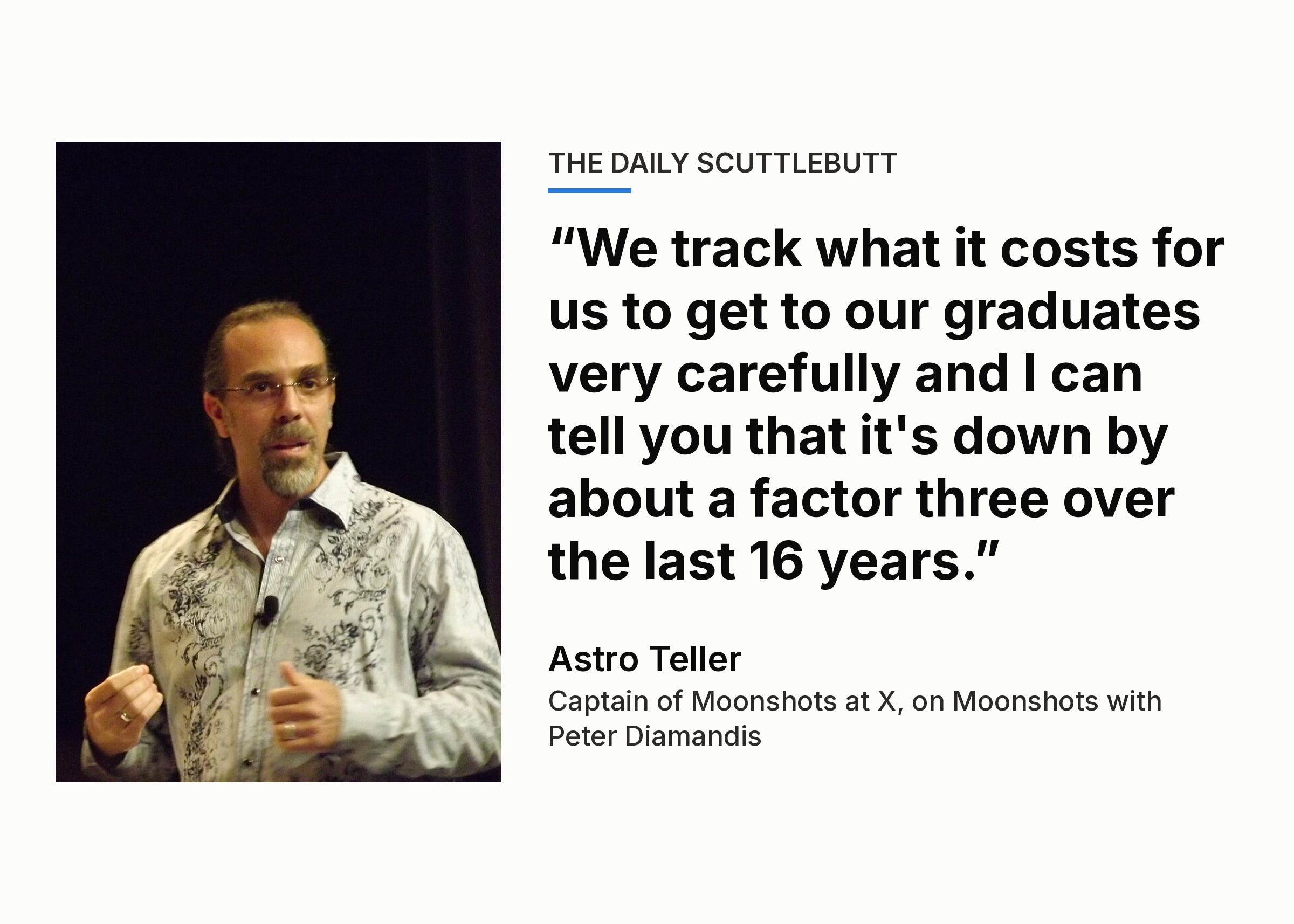
X's cost to take a moonshot project through to graduation is down about 3x in 16 years, Teller says
"We track what it costs for us to get to our graduates very carefully and I can tell you that it's down by about a factor three over the last 16 years. ... that is getting cheaper at I don't know, 10 20% year-over-year, something like that. ... A lot of it is because of artificial intelligence." — Astro Teller, Captain of Moonshots at X, Alphabet's moonshot factory, on Moonshots with Peter Diamandis (Read summary)
One growth-stage startup's AI spend went from $200K to a $4M run rate in a year, Man says
"I've had many CEOs tell me that ... if you're not AI native in the next 6 months there is not a job for you here ... that sort of top down pressure I think is what you're seeing a lot in the consumption numbers these days ... I was speaking to the COO of a growth stage ventureback company who told me last week that their AI spend went from $200,000 last year to a run rate of 4 million. Think about that as the order of magnitude difference with no end in sight." — Emily Man, Partner at Primary Venture Partners, on Run the Numbers (Read summary)
The biggest tech companies have put $1.7T into AI and plan $1T a year more, which Garran says would eat 98% of their non-AI income by 2034
"The problem is they've invested 1.7 trillion already and they're planning to invest another trillion a year over the next six years and they've got to come up with something that pays that back. Now, on a very generous depreciation schedule, I estimate that blows out or destroys 98% of their underlying nonAI income by 2034." — Julien Garran, Macro Strategist at MacroStrategy Partnership, on The Noble Update Podcast
VC & Startups
Leland's AI sales agents, overseen part-time by one entry-level employee, bring in over $1M a year, Koelliker says
"There's a pricing agent, there's an SDR agent, there's like a closing agent, there's a few other agents that all talk to each other and coordinate and they work across different products and different categories. ... And that team of agents is now managed by an entry- level employee at about 15 20% of his time and it drives over a million dollars in sales every year and is growing and does it all night, all day, all weekend." — John Koelliker, Co-founder and CEO at Leland, on Everything Marketplaces (Read summary)
Industrials and Transport
RobCo prices its robots against the monthly cost of a human shift, so customers see a return from day one, Hölzl says
"So basically, Robco's pricing is pegged to the cost per shift per month for human labor. So as soon as you run a full shift or second shift, third shift, you have a very clear ROI from day one." — Roman Hölzl, Co-founder and CEO at RobCo, on Bloomberg Talks
Sellers of private companies almost never get all cash, and many cannot get their price, Dreamliner's Thomson says
"Most people would love 100% cash, right? But that almost never happens. People typically have to roll over equity and or leave a big seller note in there for some form of financing. ... I think the world today seems to be in a place where a lot of people would probably like to sell their company. They can't sell it for what they want to get for it or what they think it should be worth." — Rich Thomson, Founder and CEO at Dreamliner Luxury Coaches, on Founder's Story (Read summary)
Materials & Energy
Pento sold his gold miners and cut gold to about 5% of his portfolio because rising real rates hurt it
"I sold the miners a while back about a week or two ago maybe a little longer. ... I took the gold down to my minimum position of around 5%. ... the rising nominal rates and rising real interest rates are not good for gold. ... they're going to surge to record highs ... after the recession becomes manifest." — Michael Pento, President of Pento Portfolio Strategies, on WTFinance
Nuggets of Wisdom
Executives pick a 1-in-100 shot at $1B over a sure $1M, until asked whether their boss would back it, Teller says
"So, A, million guaranteed, B, billion, one chance in a hundred. Who's choosing choice A? All right, almost nobody here, almost nobody in the world raises their hand. ... I've done this with CXOs the world over. And I've said, “Okay, now keep your hand up if on their best days, in your wildest dreams, your manager, your CEO, your board of directors actually supports you doing choice B.” ... And every hand in the room goes down. ... And I say, “You don't need a lecture on innovation, you need a new manager.”" — Astro Teller, Captain of Moonshots at X, Alphabet's moonshot factory, on Moonshots with Peter Diamandis (Read summary)
Every bubble rests on a true story, and the stronger the story, the bigger the bubble, Forager's Johnson says
"Every single bubble has a true and strong narrative behind it. And the stronger the narrative, the bigger the bubble." — Steve Johnson, Founder and CIO of Forager Funds Management, on Equity Mates
If this was worth your time, send it to someone who has to follow all of this too.
What did you think of today’s edition? Hit ‘reply’ to this email, send us a message, leave a comment, or join the chat!
Get the latest market chatter as it happens: