

Reuters Econ World · Oct 21, 2026 · 1h 5m · 57m saved
With Tarek Mansour, Co-Founder and CEO of Kalshi
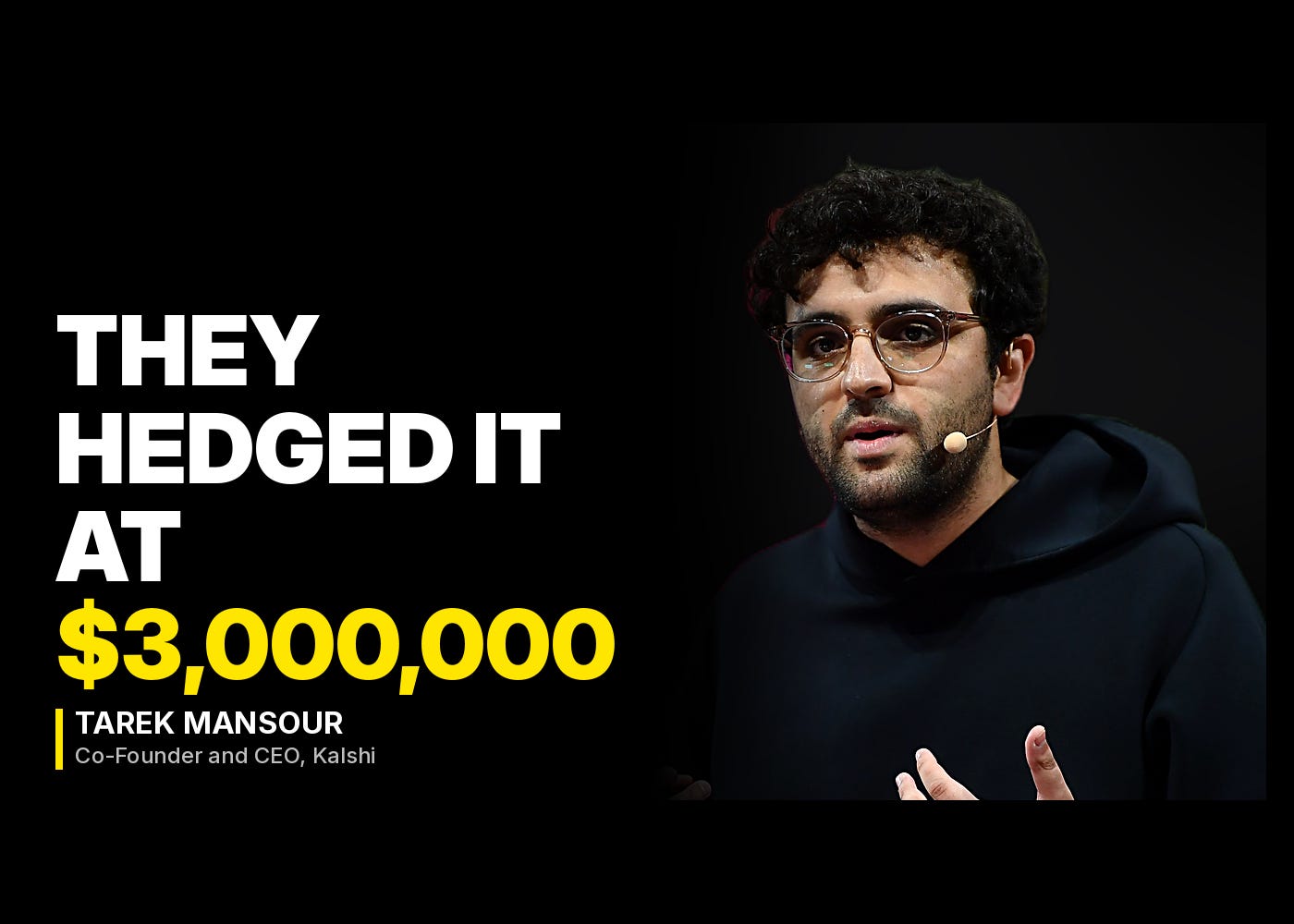
Photo via Wikipedia
LSU faced a $3 million playoff bonus owed to coach Lane Kiffin. An insurer wanted close to $1 million to cover it; a Kalshi event contract did it for roughly $600,000. Tarek Mansour, co-founder and CEO of Kalshi, told Carmel Crimmins on Reuters Econ World that examples like this are why prediction markets are a public good and not gambling.
Critics see markets on pop stars and dance shows. Tarek argues the line between a market and a casino is how it is built, not what it trades: a casino bans the informed player, and an open market pays them.
"I don't think if something looks like gambling, it means it's gambling." — Tarek Mansour
Tarek spent Kalshi's first four years getting it approved by regulators before launching anything, and now runs it through a state-by-state legal fight over who gets to regulate it.
The full interview is covered here so you can skip it. 1 hour 5 minutes of audio, 8 minutes of reading.
Here are the 10 takeaways that matter.
Key Takeaways
LSU hedged a $3 million coaching bonus on Kalshi for far less than an insurer quoted
A California goat herder's $50,000 contract paid $500,000 when a wage-law change hit
Kalshi's median user is 31, and 18-to-20-year-olds are 1 to 2 percent of volume
A multi-million-dollar push on a mayoral race reversed within nine seconds
Kalshi's approval came under the Biden administration, not the current White House
The legal fight with the states echoes 19th-century lawsuits against the Chicago Board of Trade
Sports has fallen to about 65% of revenue, from 95 to 96% nine months ago
1. A Bad Proxy at Goldman
Tarek was born in California and raised in Lebanon by a single mother. The chaos there pushed him toward the predictability of math, and on to MIT and a 2016 internship at Goldman Sachs.
At Goldman he watched clients try to bet on yes-or-no events, such as Brexit or a Trump win, through other instruments. One shorted the S&P as a bet against Trump. Trump won, the view was right, and the trade still lost money because the S&P rose anyway.
A proxy trade can be right about the event and still lose
"You're trading on something that should coordinate with your view, but sometimes it doesn't." — Tarek Mansour
He calls that toolkit opaque, indirect and closed to anyone outside Wall Street. He traces the case for prediction markets to the economist Friedrich Hayek's "knowledge problem," the idea that no central authority can gather information spread across many people the way a market can price it. Carmel put it in one line.
Carmel Crimmins frames prediction markets as a way to pool what crowds know
"Prediction markets use this so-called wisdom of crowds to aggregate expectations around future events." — Carmel Crimmins
