

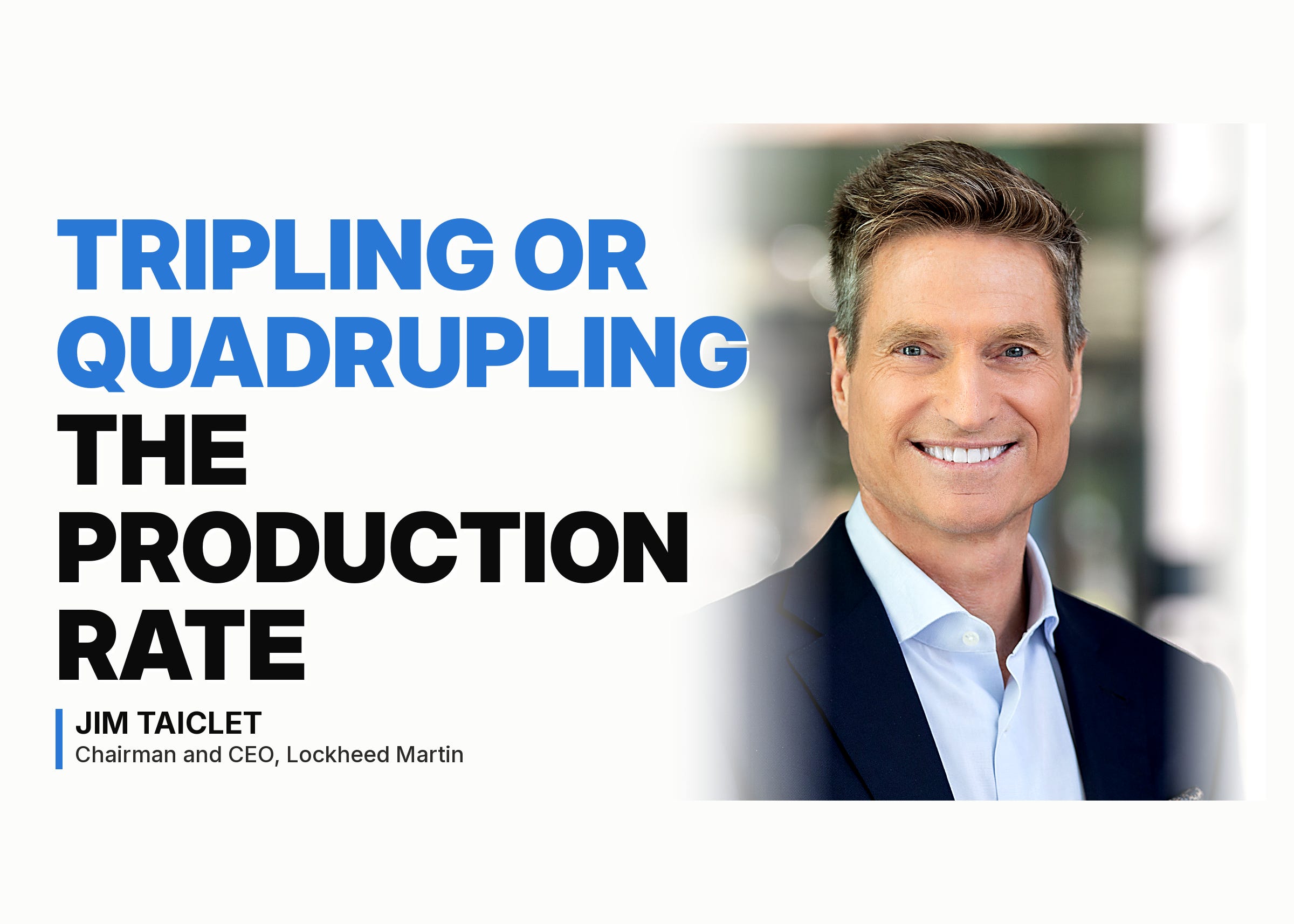
Lockheed Martin is tripling or quadrupling its production rate for defensive and strike missiles, Jim Taiclet, its chairman and CEO, said from a new missile plant in Texas. He was asked why defense stocks have fallen even so.
That was one of 17 episodes in this issue. The others ranged from Arthur Hayes, the BitMEX co-founder, putting 75% odds on AI labs needing a government bailout to pay for compute, to Goldman Sachs CEO David Solomon on why the IPO market is wide open for AI giants at the right price, and Nick Gerli, a housing analyst, on buyer demand at its lowest in 40 years.
"What investors need to know and understand [is] that this demand is not fleeting. It's permanent." — Jim Taiclet, Chairman and CEO at Lockheed Martin, on Halftime Report (Read summary)
We scanned 789 shows and 10 hours of audio, wrote 16 summaries, and pulled 31 quotes into this 12-minute read.
Here is what mattered.
Macro
Nick Gerli puts US housing demand at a 40-year low once the size of the housing stock is counted
Nick Gerli, founder of the housing-data firm Reventure, said prices are now falling in Florida, Texas, Tennessee, Arizona and Colorado, while parts of the Northeast and Midwest are still rising 5% to 8% a year.
"Housing is now in a multi-year recession... when adjusting for the size of the housing stock, demand today is the lowest it's been in 40 years." — Nick Gerli, Founder at Reventure, on Wealthion (Read summary)
A rebound in home buying would take 5% mortgage rates and a 20% fall in prices, Nick Gerli says
He put the typical US mortgage payment, with taxes and insurance, at about $2,850 a month, close to 40% of gross household income. Nick Gerli said he bought a house this year for $330,000 that had sold for $490,000 in 2023.
"We really would need to see mortgage rates go to five and prices drop 20%. If those two things happened, I think there would be a big rebound in demand." — Nick Gerli, Founder at Reventure, on Wealthion (Read summary)
DoubleLine sees bond-market stress spreading to the financing of Oracle and CoreWeave
Jeffrey Sherman, DoubleLine's deputy chief investment officer, spoke after the hotter-than-expected September consumer price report pushed Treasury yields up before buyers seeking safety pulled them back down.
"Bond market concerns are leaking over to parts of the financing markets ... the stressed operators, the Oracles, the CoreWeaves of the world." — Jeffrey Sherman, Deputy CIO at DoubleLine, on Closing Bell (Read summary)
DoubleLine is staying out of long-dated Oracle bonds
Jeffrey Sherman said DoubleLine prefers shorter-dated credit it can analyze, and pointed anyone trading interest rates to bonds maturing in 5 to 7 years.
"We don't like these 30-year kind of space or Oracle-type bonds where you're out there really speculating on this magnificent technology working for 30 years." — Jeffrey Sherman, Deputy CIO at DoubleLine, on Closing Bell (Read summary)
Financials
BlackRock wants rated debt backed by AI chips so startups can pay for compute
Larry Fink said BlackRock is working with hyperscalers and chipmakers, including AMD, Broadcom and Nvidia, to gather data on how long a chip stays useful, so that credit-rating agencies can rate debt backed by the chips' remaining value. He compared it to the mortgage-backed securities BlackRock helped build from 1976, and put meaningful progress about a year away.
"We have to unlock this compute, because yes, the big hyperscalers can afford this, but the foundation of the U.S. economy is young startup companies." — Larry Fink, Chairman and CEO at BlackRock, on Squawk on the Street (Read summary)
Bank of America raised its growth guidance to 8% or more despite a $1.2B Treasury fine
Brian Moynihan said the bank's businesses earned $8B in the quarter, more than 40% of it from consumer banking. The fine, over anti-money-laundering failures, brought more than $200M of extra remediation cost this quarter, which he said savings elsewhere are paying for.
"We increased our guidance from 5 to 7% to 8% plus. That is the core engine of the company kicking in." — Brian Moynihan, Chairman and CEO at Bank of America, on Squawk on the Street (Read summary)
$100M of Bank of America's AI budget this year goes to defending against frontier models
Brian Moynihan said an AI agent using a customer's credentials can make mistakes the customer will blame on the bank, so Bank of America wants a person to approve any payment an agent makes.
"We're going to spend roughly $250, $300 million this year... on AI initiatives... we're spending $100 million trying to remediate against the frontier model's impact." — Brian Moynihan, Chairman and CEO at Bank of America, on Bloomberg Businessweek (Read summary)
Morgan Stanley's CEO says the direction of AI spending matters more than next year's total
Ted Pick put the eventual AI build at $10T to $15T, against an S&P 500 worth $70T to $80T, and said it is adding about 50 basis points to real US GDP growth.
"Whether the hyperscaler capex is a trillion next year or a trillion two or 900 billion, it's less important than where we're going." — Ted Pick, Chairman and CEO at Morgan Stanley, on Squawk on the Street (Read summary)
Morgan Stanley's CEO sees nothing troubling in the leverage behind a 41% rise in equities revenue
The rise came mostly from prime brokerage and derivatives. Ted Pick said equities investing outside the US, in Japan, India, Korea and parts of Europe, is still at an early stage.
"We're not seeing it in any kind of troubling way inside of the equities business." — Ted Pick, Chairman and CEO at Morgan Stanley, on Squawk on the Street (Read summary)
Goldman's CEO says a delayed IPO reflects price, not a closed market
David Solomon was asked about Anthropic and OpenAI possibly going public at valuations in the trillions. He said deals get delayed when sellers hold to expectations set months earlier, in a hotter market.
"The IPO market is wide open. It's just a question of price." — David Solomon, Chairman and CEO at Goldman Sachs, on The Exchange (Read summary)
AI and government borrowing are competing for capital, but David Solomon says it is still there
He was answering Broadcom CEO Hock Tan's warning that access to capital, not demand, is AI's biggest constraint. David Solomon said competition for capital raises its cost a little at the margin.
"There's a lot of capital in the world... that doesn't mean that everybody that has an idea, everybody that has a data center, everybody that has a chip can have unlimited capital at a very, very low cost." — David Solomon, Chairman and CEO at Goldman Sachs, on The Exchange (Read summary)
Crypto and Digital Assets
BitMEX invented the perpetual swap in 2016 because clients found dated futures confusing
Arthur Hayes, who co-founded BitMEX in 2014, said the perpetual swap, a futures contract with no expiry date, is now standard across crypto trading. BitMEX shut down a few weeks before the recording with no customer funds ever lost, by his account.
"We invented the perpetual swap in May 2016 to solve a problem, which was our clients didn't understand the products." — Arthur Hayes, Co-Founder at BitMEX, on 1000x (Read summary)
Consumer
Match Group's CEO says the company had been squeezing its users for short-term revenue
Spencer Rascoff took over in February 2025. He said he started with a listening tour and a new product plan, and only then turned to making more money from users.
"The company had sort of lost its way. It had not been innovative, it had been run too much by Wall Street for Wall Street essentially, which to me means very short-term focused, very focused on squeezing every nickel out of our users." — Spencer Rascoff, CEO at Match Group, on In Good Company with Nicolai Tangen (Read summary)
Hinge loses paying users when they find a partner, and gains more from their word of mouth
Hinge markets itself as the app designed to be deleted, Spencer Rascoff said.
"The word of mouth that they have spread of having told hundreds of their friends that they met their person on Hinge has undoubtedly created much more revenue for Hinge than the revenue that we lost from them." — Spencer Rascoff, CEO at Match Group, on In Good Company with Nicolai Tangen (Read summary)
Sports
Fanatics' CEO expects betting companies' US marketing spend to more than double next year
Michael Rubin said Fanatics plans to raise its own betting and gaming marketing from $350M this year to as much as $1B in 2027. Its market share is about 10%, up from 7%, and he called Fanatics a distant third.
"There were probably $3 billion spent in U.S. betting and gaming last year. I bet you there'll be $7 billion spent in marketing next year." — Michael Rubin, Founder and CEO at Fanatics, on Squawk Pod
Fanatics limits prediction markets to customers 21 and older, though most rivals allow 18
Michael Rubin said Fanatics keeps the policy even though it costs the company customers.
"I don't think people should be in prediction markets until they're 21. It's just my fundamental belief." — Michael Rubin, Founder and CEO at Fanatics, on Squawk Pod
Technology & AI
Jensen Huang calls OpenAI and Anthropic the fastest-growing tech companies in history
Nvidia is a major investor in both. Jensen Huang said they have real revenue and profit.
"These are the two fastest growing technology companies in history." — Jensen Huang, CEO at Nvidia, on Bloomberg Podcasts (Read summary)
Nvidia's CEO says the cost of an AI token is falling 30x to 40x a year
Jensen Huang said demand for computing keeps rising even as the price falls.
"The cost of a token is reducing by 30 to 40 times per year." — Jensen Huang, CEO at Nvidia, on Bloomberg Podcasts (Read summary)
Arthur Hayes puts the odds at 75% that AI labs need a government bailout to pay for compute
His view is the opposite of Jensen Huang's. Arthur Hayes said frontier labs are not profitable and their customers do not pay the true cost of the computing they use, and that governments will step in because the global economy is tied to the AI build.
"I'd say that it's probably 75% that these companies will not be able to afford the compute commitments without a government bailout." — Arthur Hayes, Co-Founder at BitMEX, on 1000x (Read summary)
Workday counts Google, Anthropic and OpenAI as customers, its CEO says
Aneel Bhusri was answering February's sell-off in software stocks on fears that AI coding tools would replace them. He said he has not met a customer planning to replace Workday with software written by an AI model.
"All three major AI companies run Workday. So Google runs Workday, Anthropic runs Workday, and so does OpenAI." — Aneel Bhusri, Co-Founder and CEO at Workday, on Fortune Magazine (Read summary)
Workday's own AI agents will replace work done by junior auditors and lawyers, Aneel Bhusri says
He expects significant job losses from AI within 5 years, and said Workday is cutting management layers because agents can do much of the low-level management work.
"I look at what we're doing with some of our agent technology, say like a financial audit agent. It's going to replace the work of junior auditors... our contract intelligence agent... does replace the work of lawyers." — Aneel Bhusri, Co-Founder and CEO at Workday, on Fortune Magazine (Read summary)
Sunil Bharti Mittal says his satellite venture is ahead of Starlink in India's approval queue
The chairman of Bharti Enterprises was answering Elon Musk's accusation that Indian telecom billionaires are blocking Starlink's access to spectrum.
"I think I am significantly ahead in the queue from him. I applied five years back, my satellites have been hovering over India for the last five years." — Sunil Bharti Mittal, Chairman at Bharti Enterprises, on Bloomberg Television (Read summary)
Cummins mapped its tariff exposure across the company in 3 weeks using graph software
Jim Jacob, who runs AI and advanced analytics at the engine maker, said a knowledge graph linked raw-material, supplier, invoice, customer, assembly and shipping data, so Cummins could see which products and customers a new tariff on one country's components would hit.
"For us, it was a... three-week exercise to get enterprise-wide tariff visibility for decision making and decision support. I would contend it would have taken months, if not six to seven months... if we didn't use graph." — Jim Jacob, AI and Advanced Analytics Executive at Cummins, on SiliconANGLE theCUBE (Read summary)
Cummins staff spent 70% to 80% of their time wrangling data, its CFO told Jim Jacob
"I said... in my previous company, people would spend 40, 50% of the time on wrangling data to do their day job. And he said, you're wrong. That doesn't happen in Cummins... it's about 70 to 80%." — Jim Jacob, AI and Advanced Analytics Executive at Cummins, on SiliconANGLE theCUBE (Read summary)
Industrials and Transport
Lockheed Martin is using automated production cells to multiply its missile output
Jim Taiclet spoke from a new Lockheed missile plant in Texas with Michael Duffey, the Pentagon's under secretary for acquisition and sustainment. The plant uses production cells from robotics company Hadrian and manufacturing help from General Motors' defense business. Lockheed and the Pentagon have found about 20 key suppliers per munitions program that need outside financing to triple their output.
"We are tripling or quadrupling the production rate of these kinds of defensive and sometimes strike missiles." — Jim Taiclet, Chairman and CEO at Lockheed Martin, on Halftime Report (Read summary)
Lockheed Martin's CEO wants Pentagon contracts to work like commercial deals
Jim Taiclet said the defense budget will not double or triple, so long-term agreements that build backlog and let margins expand are how the industry pays for more output.
"We have to change the relationship between government and industry writ large ... to make the Pentagon's relationship with industry more like a commercial business relationship and less like a cost-based contract relationship." — Jim Taiclet, Chairman and CEO at Lockheed Martin, on Halftime Report (Read summary)
Geopolitics
Oil prices understate the cost of shipping through the Strait of Hormuz, Amos Hochstein says
The former White House senior energy adviser said tankers in the strait come under fire daily and that shipping costs have reportedly risen to about $1.4M a day from about $100,000, even though oil is still moving.
"The price on the screen is a futures contract that is detached from reality almost." — Amos Hochstein, Managing Partner at TWG Global, on Squawk Pod
Nuggets of Wisdom
Emma Grede learned that earning money and managing it are different skills
The Good American co-founder said she billed well for years but could not explain where her business's profits went, and did not think of herself as an investor until her late 30s.
"Just because you're good at making money doesn't make you good at managing money. And I learned that the hard way." — Emma Grede, Co-Founder and CEO at Good American, on The Important Part (Read summary)
Emma Grede started her first business at 24 because she was underpaid
"The genesis of my first business was not because I had some entrepreneurial mindset. It was just because I was underpaid and undervalued where I was." — Emma Grede, Co-Founder and CEO at Good American, on The Important Part (Read summary)
Evan LePatner's foundation trains leaders on the model his late wife set at Blackstone
Wesley LePatner ran Blackstone's real estate income trust, a business of about $70B, and later oversaw more than $120B before she was killed in a shooting at her New York office building in July 2025. The foundation named for her has announced its first eight fellows, professionals in their 30s and 40s.
"Wesley was about furiously climbing the ladder and furiously pulling people up at the same time." — Evan LePatner, Board Chair at the Wesley Mittman LePatner Foundation, on Fortune Daily (Read summary)
If this was worth your time, send it to someone who has to follow all of this too.
What did you think of today’s edition? Hit ‘reply’ to this email, send us a message, leave a comment, or join the chat!
Get the latest market chatter as it happens: